
LUXURY PACKAGING SYSTEMS
Luxury Packaging Sets: How to Coordinate Every Layer
Coordinate the shopping bag, rigid box, tissue and ribbon as one practical brand system—without forcing every component to look identical.
A successful luxury packaging set gives every layer a clear job. The paper shopping bag creates recognition at a distance and carries the complete purchase. The rigid box protects and presents the product. Tissue paper manages surface contact and the reveal. Ribbon adds closure, colour or ceremony only where it earns its place.
The set should feel related, but “related” does not mean using the same paper, colour and finish everywhere. Different substrates reproduce colour differently, different components face different loads, and unnecessary layers add cost, material and packing time. This guide shows buyers how to build a coherent, quote-ready system around premium paper bags, boxes, tissue and ribbon.
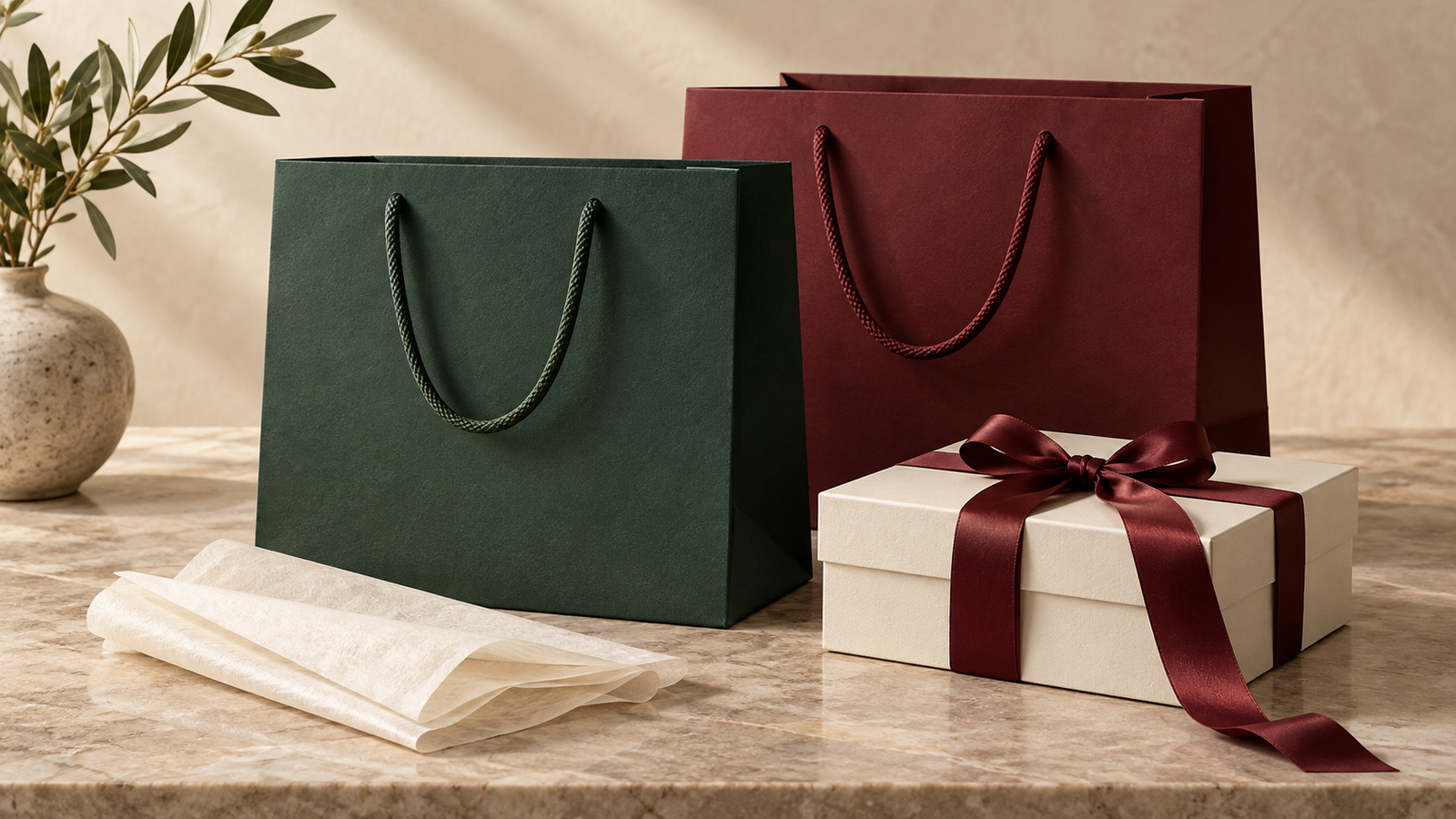
What is a luxury packaging set?
A luxury packaging set is a coordinated group of components that protects, presents and carries a product through the intended customer journey. For a boutique or gift-led brand, it may include a premium paper shopping bag, a rigid gift box, an insert, tissue paper, ribbon, a label and a product card. For e-commerce, protective transit packaging may sit outside that presentation set.
The word “set” should describe a functional system, not a pile of matching accessories. Begin with the product and the handoff: what must be protected, what the customer sees first, where the pack is assembled, how it is carried and how each component is separated after use.
Which component should lead the design?
For in-store retail, the paper bag is usually the most visible public component, so it often leads the exterior brand language. Its scale, handle, colour and logo need to work from across a room and in the customer’s hand. The box is seen closer and can carry finer texture, structural detail and a more intimate reveal. Tissue and ribbon bridge those two moments.
Function can change that order. If the product requires a fitted rigid box, design the protective box and insert first, then size the shopping bag around the finished pack. Our luxury paper bag size guide explains how to translate the complete packed product into width, gusset and height. Avoid choosing the bag from an abstract “small, medium or large” label.
| Component | Primary role | Decision to lock first |
|---|---|---|
| Luxury paper bag | Carry, public visibility and final handoff | Finished pack fit, maximum load, handle and exterior identity |
| Rigid gift box | Protection, structure and close-up presentation | Product fit, insert, opening style and outer dimensions |
| Tissue paper | Surface separation, concealment and reveal | Sheet size, fold method, colour and print coverage |
| Ribbon | Closure, accent or gift ritual | Purpose, width, length, material and application time |
| Card or label | Information, care or authentication | Content, placement and whether it remains with the product |
Should every component use the same colour?
Usually not. Exact visual matching across coated paper, uncoated paper, dyed ribbon and tissue can be difficult because surface, absorbency, opacity and light reflection change colour appearance. Pantone’s official guidance explains that the same colour can look different on coated and uncoated paper because the ink interacts differently with each surface.
Choose one of three relationships and name it in the brief:
- Controlled match: the bag and box aim for the same approved visual target, with separate production references for each substrate.
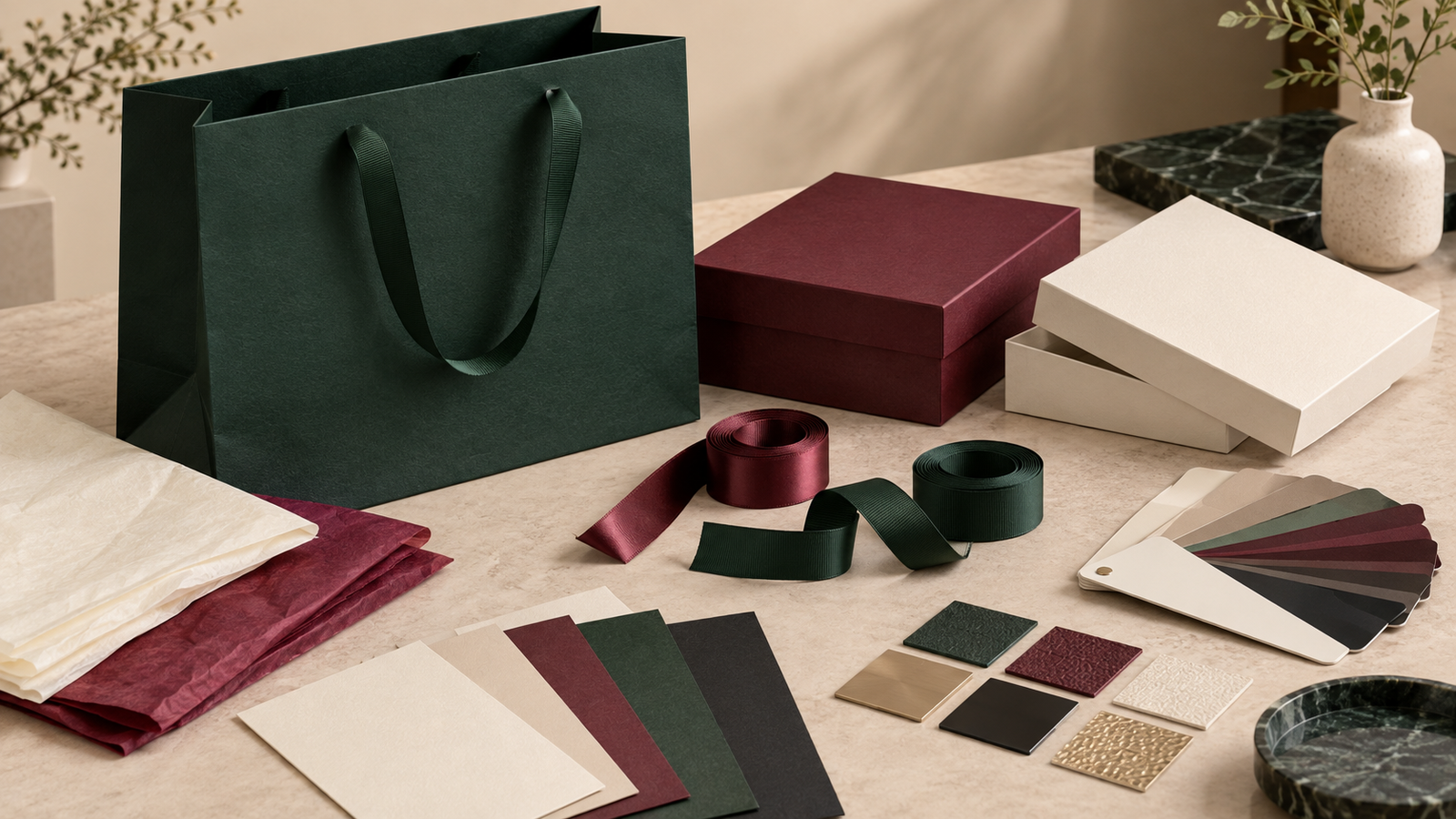
- Tonal family: forest green may move darker on the bag, softer on uncoated tissue and richer on ribbon while still reading as one family.
- Coordinated contrast: a green bag, ivory box and burgundy ribbon repeat a disciplined palette without pretending the materials are identical.
Approve physical samples together under consistent lighting. A screen value or digital mock-up is useful for layout but cannot define paper texture, ribbon sheen, foil reflection or the way a translucent tissue colour changes when folded.
How many brand cues should the set repeat?
Repeat a small number of recognizable cues and let the materials create variety. A useful system might repeat one main colour, one accent colour and one logo treatment. The bag can carry the full wordmark, the box a small foil mark, the tissue a light repeating motif and the ribbon only the accent colour.
- Choose one dominant component rather than making every layer visually loud.
- Keep logo scale appropriate to each surface; do not shrink one master layout onto every item.
- Use finish repetition selectively. Foil on both the bag and box may be enough; it does not automatically belong on tissue and ribbon.
- Reserve high-detail artwork for surfaces and print methods that can reproduce it cleanly.
- Check the sequence from closed bag to opened box so the customer does not see all effects at once.
For the paper bag, map artwork around gussets, seams, handle holes and folds using the supplier dieline. The paper bag artwork checklist gives a practical file-handoff method, while our finishes guide compares foil, embossing, spot UV and lamination.
How do you right-size a complete packaging set?
Right-sizing starts at the product and moves outward. Fit the product in its insert, confirm the closed box, add only the tissue or card that performs a real function, then size the paper bag for practical loading and carrying. Test the full pack rather than adding nominal allowances to separate drawings.
- Build the heaviest and largest real product combination.
- Confirm the protective box and insert hold the product without avoidable movement.
- Decide how tissue is folded and whether ribbon wraps the box or is tied elsewhere.
- Measure the finished presentation pack at its widest, deepest and tallest points.
- Choose the smallest practical bag that accepts the pack without crushing tissue or rubbing finished surfaces.
- Lift, carry, set down and reopen the completed set using the final handle and packing sequence.
This discipline also supports material reduction. Regulation (EU) 2025/40, the EU Packaging and Packaging Waste Regulation, began applying on a phased basis from 12 August 2026. Its packaging-minimisation rules require weight and volume to be reduced to the minimum necessary for functionality, with detailed requirements phased toward 2030. Brands selling into the EU should review the current obligations for their role, market and launch date rather than treating “luxury” as a reason for unused volume or superfluous layers.
How should materials and finishes be distributed?
Put performance where it is needed. The shopping bag needs an appropriate carrying structure, handle reinforcement and resistance to normal handling. The rigid box needs board, wrap and insert choices suited to protection and presentation. Tissue needs the right sheet size, opacity and surface behaviour. Ribbon needs the width, hand-feel and fray resistance appropriate to its application.
A premium result does not depend on maximizing paper weight or decorative coverage. A tactile uncoated bag with a small foil mark can feel more resolved than a heavily laminated bag covered in effects. Review the complete construction—including inks, varnishes, laminates, adhesives, metallic decoration, handles and reinforcements—when considering recovery. The 4evergreen Circularity by Design Guideline, Version 4 provides current industry guidance on how constituents and integrated components can affect conventional paper recycling; it also notes that actual testing takes precedence over general design recommendations.
Can the whole set carry an FSC claim?
Do not assume that buying one certified paper makes the entire packaging set claim-ready. FSC chain-of-custody certification controls how certified forest-based material is sourced, processed, identified, labelled and sold through the supply chain. If an FSC on-product label or sales claim is required, define which components are in scope, the claim type, the certified organizations involved and the artwork approval process before production.
Ask the supplier to state the claim on the quotation and approval documents, and verify certificate information through the appropriate FSC channels. Keep evidence with the final specification. Vague wording such as “FSC paper available” is not the same as an approved claim on a finished bag, box or tissue sheet.
Should one supplier make every component?
One coordinated supplier can simplify colour review, fit checks, sample scheduling, packing and delivery, but one-source convenience is not automatically the best technical answer. A specialist may be stronger in a particular ribbon, insert or print process. The key is clear ownership of interfaces: who confirms the box fits the bag, who holds the colour references, who assembles the approval set and who records changes across components.
| Sourcing model | Potential advantage | Control to establish |
|---|---|---|
| One coordinated supplier | Fewer handoffs and one combined sample schedule | Confirm capabilities, subcontracted processes and component-level specifications |
| Several specialist suppliers | Wider process choice and specialist materials | Name one owner for fit, colour references, deadlines and final set approval |
| Stock components plus custom hero item | Lower commitment for early launches | Accept the limits on colour, size and finish coordination before artwork is approved |
Which samples should be reviewed together?
Component samples answer component questions; an assembled set answers system questions. Review material swatches first, then structural samples, then printed and finished samples. Before mass production, assemble at least one representative set using the approved bag, box, insert, tissue, ribbon and cards.
- Fit: does the closed box enter and leave the bag without abrasion or awkward tilting?
- Carrying: does the handle and reinforced top support the approved packed load?
- Colour: do the materials form the intended match, tonal family or contrast under agreed lighting?
- Sequence: can staff assemble the set consistently without excessive steps or wasted ribbon and tissue?
- Finish durability: do foil, print, coatings and dark surfaces remain acceptable after packing and handling?
- Documentation: can every approved material, colour, dimension and process be traced to a named reference?
Keep a controlled master set and photograph the packing sequence, but do not treat photos as the sole colour or texture reference. Our custom paper bag sample guide explains what swatches, prototypes, proofs, strike-offs and pre-production samples can each prove.
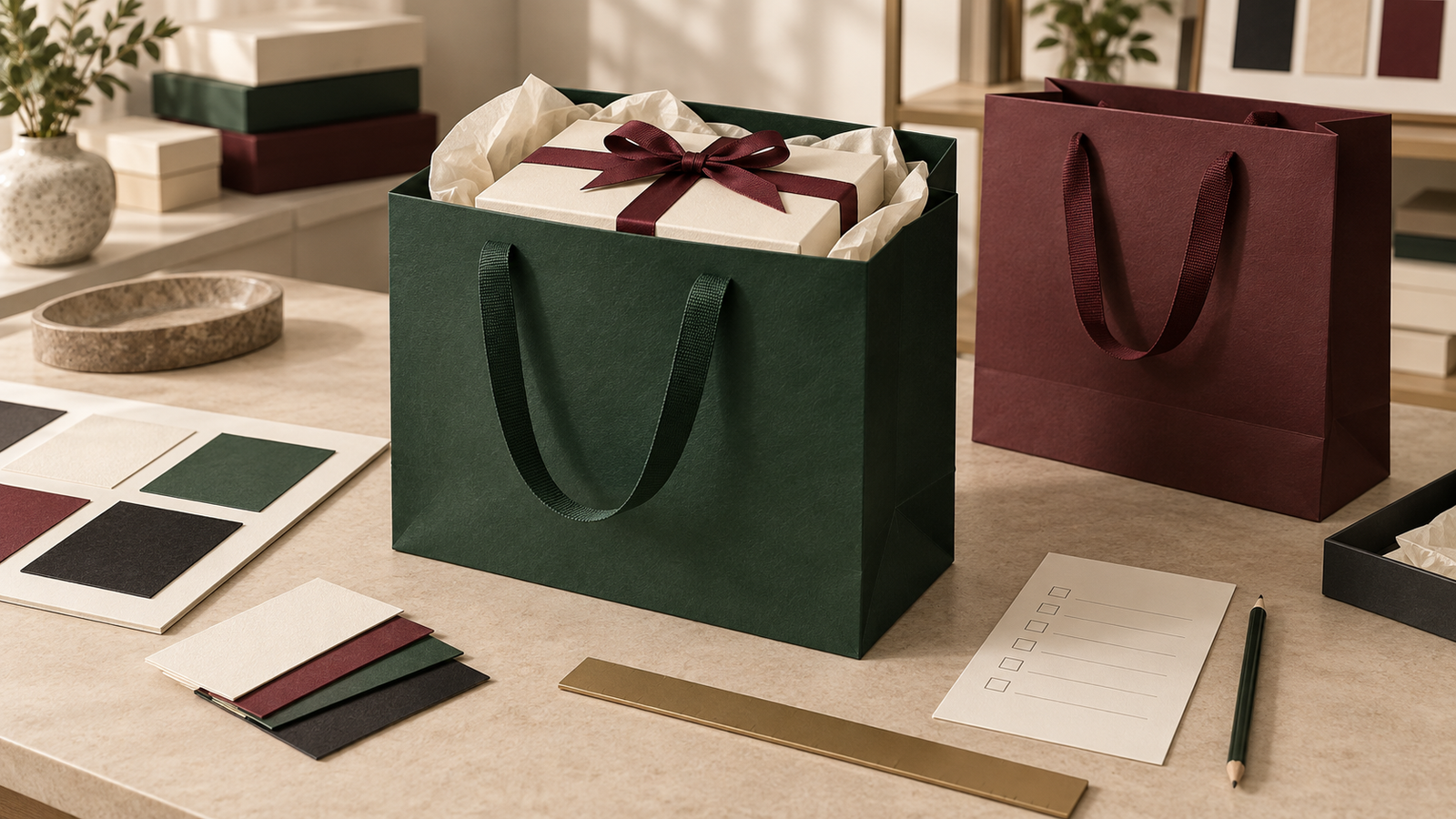
What belongs in a quote-ready packaging set brief?
- List every component and state its role: carry, protect, present, separate, close or inform.
- Provide finished product dimensions, weight and the proposed packing sequence.
- State finished dimensions and quantities by bag, box, tissue, ribbon and card SKU.
- Define the colour relationship across substrates and supply physical or named references.
- Specify materials, construction, print, finish, handle and insert requirements component by component.
- Provide dieline-based artwork with separate finish layers and revision numbers.
- State any sourcing claim, label or destination-market requirement and the evidence needed.
- Define sample stages, approval owners and the final controlled master set.
- Describe flat or assembled packing, units per carton, destination and target delivery date.
- Ask suppliers to separate tooling, samples, unit prices, packing and delivery terms so quotations can be compared consistently.
Share the same brief with every bidder. If one quotation includes an assembled rigid box, printed tissue and pre-tied ribbon while another excludes them, the unit prices are not comparable. The custom paper bag cost guide provides a method for aligning assumptions and comparing complete landed usable cost.
Frequently asked questions about luxury packaging sets
Does a luxury packaging set need both a box and a bag?
No. Use the box when the product needs protection or a structured reveal, and use the bag when the retail handoff and carrying experience justify it. A set should contain the fewest components that perform the required functions well.
Should the paper bag be larger than the gift box?
It needs enough practical clearance for the finished box, tissue and packing method, but unnecessary loose volume can reduce stability and presentation. Test the complete pack in a structural bag sample instead of applying a universal allowance.
Can tissue paper and ribbon use the same brand colour?
They can aim for the same colour family, but the translucent paper and reflective textile surface may not look identical. Approve physical samples together and define whether the goal is a close visual match or an intentional tonal variation.
How many finishes should a premium packaging set use?
There is no fixed number. One or two repeated cues are often clearer than placing foil, embossing, varnish and lamination on every component. Choose finishes for hierarchy, material compatibility, handling and recovery—not as a checklist.
What should be approved before placing the production order?
Approve the written specifications, dimensions, dielines, artwork revisions, colour references, physical materials, functional samples, finish trials where needed, assembled-set fit, packing method, quality criteria, quantities, carton packing and delivery basis.
Build one system, not four separate products
The strongest luxury packaging sets are coherent because the decisions connect. The product defines the box; the finished box defines the paper bag fit; the bag leads the public brand impression; tissue and ribbon control the transition between them. Colour, structure, materials, claims and samples are then approved as one system.
Bespoke Packaging develops custom luxury paper bags together with rigid gift boxes, tissue paper and ribbon. Send us your product dimensions, component quantities, artwork, destination and target experience, and we can help turn them into a coordinated sampling and production brief.
Does every layer in your packaging set perform a clear job—or is it only matching the colour?