
LUXURY PAPER BAG PRINTING GUIDE
Luxury Paper Bag Printing: Offset, Screen or Digital?
Compare offset, screen and digital printing by artwork, paper, quantity, colour control and sampling—then brief a supplier for a paper bag that looks intentional in the customer’s hand.
The best printing method for a luxury paper bag is the one that matches the artwork, paper, quantity and converting route. Offset lithography is often the strongest starting point for detailed multicolour graphics on flat sheets. Screen printing is useful for bold, opaque spot-colour marks and selected finished-bag applications. Digital printing removes conventional plates and is valuable for short runs, samples, versioned designs and variable content. None is automatically “more premium” in every project.
A print method cannot be chosen from a logo alone. The same artwork behaves differently on smooth coated paper, absorbent kraft, coloured-through stock and a textured specialty sheet. Bag size, ink coverage, handle and fold positions, colour tolerance, finishing, delivery date and the number of designs also change the sensible production route. This guide explains the trade-offs in buyer-friendly terms so you can ask for a comparable quote and approve the right sample.
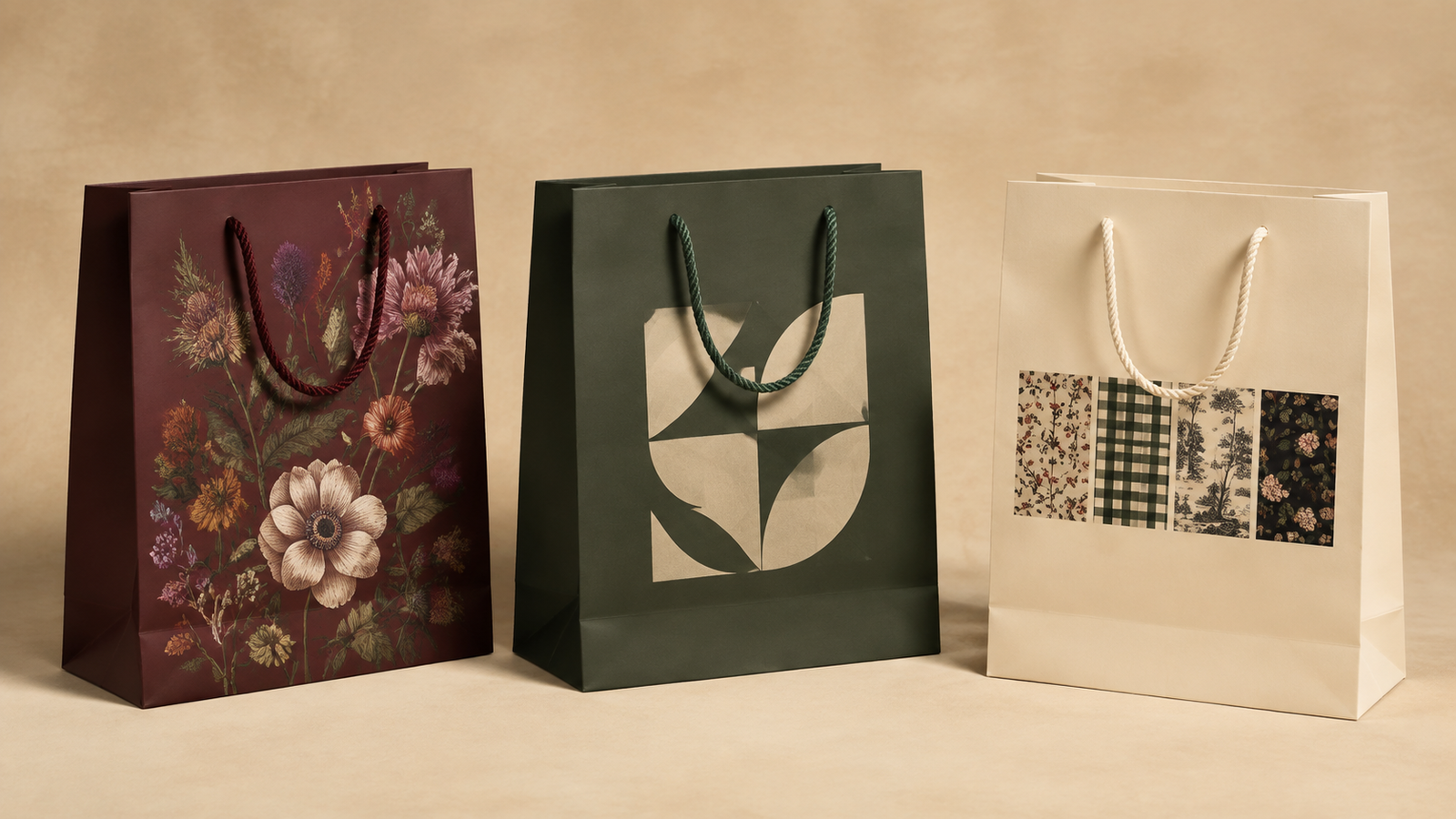
Which printing method is best for a luxury paper bag?
Use the artwork and production scenario as the first filter:
- Choose offset printing when the bag needs fine typography, photographs, smooth gradients, detailed illustration or controlled CMYK and spot-colour work across a repeat production run.
- Choose screen printing when a simple mark needs a heavier, opaque ink deposit, particularly on a dark or tactile surface, or when the print must be applied to a suitable finished bag.
- Choose digital printing when avoiding conventional plates, testing a concept, producing several design versions or changing content between sheets matters more than the lowest unit cost at scale.
- Ask about flexography for high-volume, machine-made paper bags, especially simpler work printed from a reel. It is a major paper-bag process, but it serves a different production route from many premium sheet-fed bags.
These are decision patterns, not universal price rules. Press format, supplier equipment, paper availability, number of colours, total ink coverage, drying, finishing and converting can move a project from one route to another. Request a recommendation against the complete specification rather than asking for a method in isolation.
How do offset, screen and digital printing compare?
| Decision factor | Offset lithography | Screen printing | Digital printing |
|---|---|---|---|
| Typical artwork strength | Fine detail, images, gradients and controlled process colour | Bold spot colours, simple graphics and opaque marks | Full-colour short runs, versions and variable content |
| Image carrier | Printing plates and a rubber blanket | A stencil on mesh, normally one screen per colour | Digital file drives the imaging system without conventional plates |
| Setup pattern | Plates, make-ready and colour control before the run | Screens, ink setup and registration for each colour | File preparation, press profiling and substrate qualification |
| Paper fit | Commonly selected for suitable coated and uncoated flat sheets | Can work well with selected tactile or dark papers after testing | Depends strongly on the press-qualified sheet, coating and format |
| Versioning | Changing artwork normally changes plates or setup | Changing artwork normally requires a new screen | Designed for versioned or variable files |
| Buyer priority | Repeatable detail and colour across a production specification | Ink character, opacity and a direct graphic statement | Agility, variants and reduced analogue setup |
The comparison assumes that the printer has approved the paper and that the printed sheet or bag can move through the remaining production steps. A digital press that accepts one stock may reject another because of thickness, surface treatment or size. A screen ink that looks opaque on a swatch may flex differently near a gusset. An offset image can be accurate on a flat sheet yet still need protection and careful scoring before conversion.
What is offset printing for paper bags?
Offset lithography is an indirect process. The image moves from a plate to a rubber blanket and then to the paper. Heidelberg’s description of sheet-fed offset printing explains that each printing unit transfers a colour from the plate through the blanket to the substrate, with measurement and operator control used to bring the print to its approved condition.
For a premium shopping bag, the paper is usually printed as a flat sheet before it is cut, creased, folded, reinforced and fitted with handles. That flat-sheet route gives the printer access to the full panel and supports detailed artwork. It also means the designer must work from the bag dieline: important text cannot drift into a side gusset, disappear beneath the turn-top or collide with a handle hole.
When does offset printing make sense?
- the design uses photographs, detailed illustrations, fine type or controlled gradients;
- the bag needs process colour together with one or more specified spot colours;
- the paper and sheet size suit the selected press and later converting equipment;
- the order justifies plate and make-ready work;
- the brand needs a repeatable reference for future production.
Offset is not a promise that every colour will match a screen or every Pantone reference exactly. Ink is partly transparent, the paper contributes its own shade and texture, and a protective coating or laminate can change the final appearance. Use the intended production paper and finishing stack during approval. If the bag uses a large dark solid, ask the printer how it will control mottling, set-off, scuffing, drying and edge wear.
When is screen printing useful on a premium paper bag?
Screen printing pushes ink through open areas of a stencilled mesh. Each colour normally needs its own screen and pass. The method is especially useful when a bold logo or graphic needs more opacity or physical ink presence than a thin process-ink film would provide. It can produce a deliberate, crafted look on an appropriate uncoated or coloured paper.
It is usually strongest with a limited number of solid colours, clear shapes and sensible registration tolerances. Photographic detail, very fine reversed type, subtle gradients and many tightly registered colours may point toward another process. Ink can bridge or fill small details, and paper texture changes the edge. Ask for the minimum line width, minimum type size and trapping rules from the actual printer rather than applying generic artwork limits.
Screen printing can sometimes be applied after a stock bag has been made, which may be useful for selected small projects or positions. Finished-bag printing also creates constraints: seams, gussets, handles and panel flatness limit the printable area. A supplier should confirm whether the proposed bag can sit securely on the press and whether the ink will cure without marking adjacent bags.
When should a brand consider digital printing?
Digital printing images each sheet from digital data instead of using a fixed conventional plate set. That makes it valuable when the artwork changes frequently or the quantity is too low to make analogue setup attractive. A launch sample, a regional variation, an event edition or a set of test designs can all be sensible digital applications—provided the paper, format and later bag-making route are qualified.
Current production digital presses can also change text, images or codes between impressions. HP’s documentation for the Indigo 7K+, for example, describes personalised text, images, barcodes and conditional templates. This is useful evidence for the general capability of variable-data digital printing, but it does not mean that every paper-bag supplier owns that press or can convert every digitally printed sheet into the requested bag.
Digital does not remove colour management, proofing or substrate tests. It removes conventional plates; it does not remove the need to profile a press, prepare files, control colour, allow ink or toner to bond correctly and test the printed sheet through lamination, creasing, folding and rubbing. Ask whether the production sample and final order will use the same press, paper, coating and colour settings.
Where does flexographic printing fit?
Flexography uses flexible relief plates on rotating cylinders and is closely associated with reel-fed and inline packaging production. It is often considered for high-volume machine-made kraft carriers and other repeat work where printing and bag production are engineered as a continuous system. The decision depends on the bag machine, web material, repeat length, colour count and artwork.
Modern flexography can produce accomplished packaging graphics, so it should not be dismissed as “low quality.” The practical question is whether its production strengths match the bag. A detailed sheet-fed luxury carrier with ribbon handles may lead to offset; a large run of machine-made kraft bags with a controlled graphic may lead to flexo. Compare real samples from the proposed line.
How does paper change the printed result?
Paper is part of the colour and image, not a neutral platform beneath it. A bright coated white sheet can support crisp process colour. A natural kraft sheet warms and darkens transparent inks. A rough uncoated paper softens fine detail and may make solid coverage appear more varied. A coloured-through stock can create strong contrast with an opaque light ink, but it needs a real drawdown or printed test.
- Shade: changes the starting white point and the perceived colour of transparent ink.
- Smoothness: affects dot shape, fine detail, solid coverage and the edge of a screen-printed mark.
- Absorbency: changes ink holdout, density, drying and rub behaviour.
- Coating: can improve detail but changes touch, folding and the material construction.
- Texture: creates character while making delicate artwork less predictable.
- Caliper and grain direction: affect press handling, scoring, folding and the final bag panel.
Choose the substrate and print process together. Our luxury paper bag materials guide explains how coated, uncoated, kraft, specialty and recycled papers influence touch and construction. Ask for both an unprinted paper swatch and a printed sample; one cannot substitute for the other.
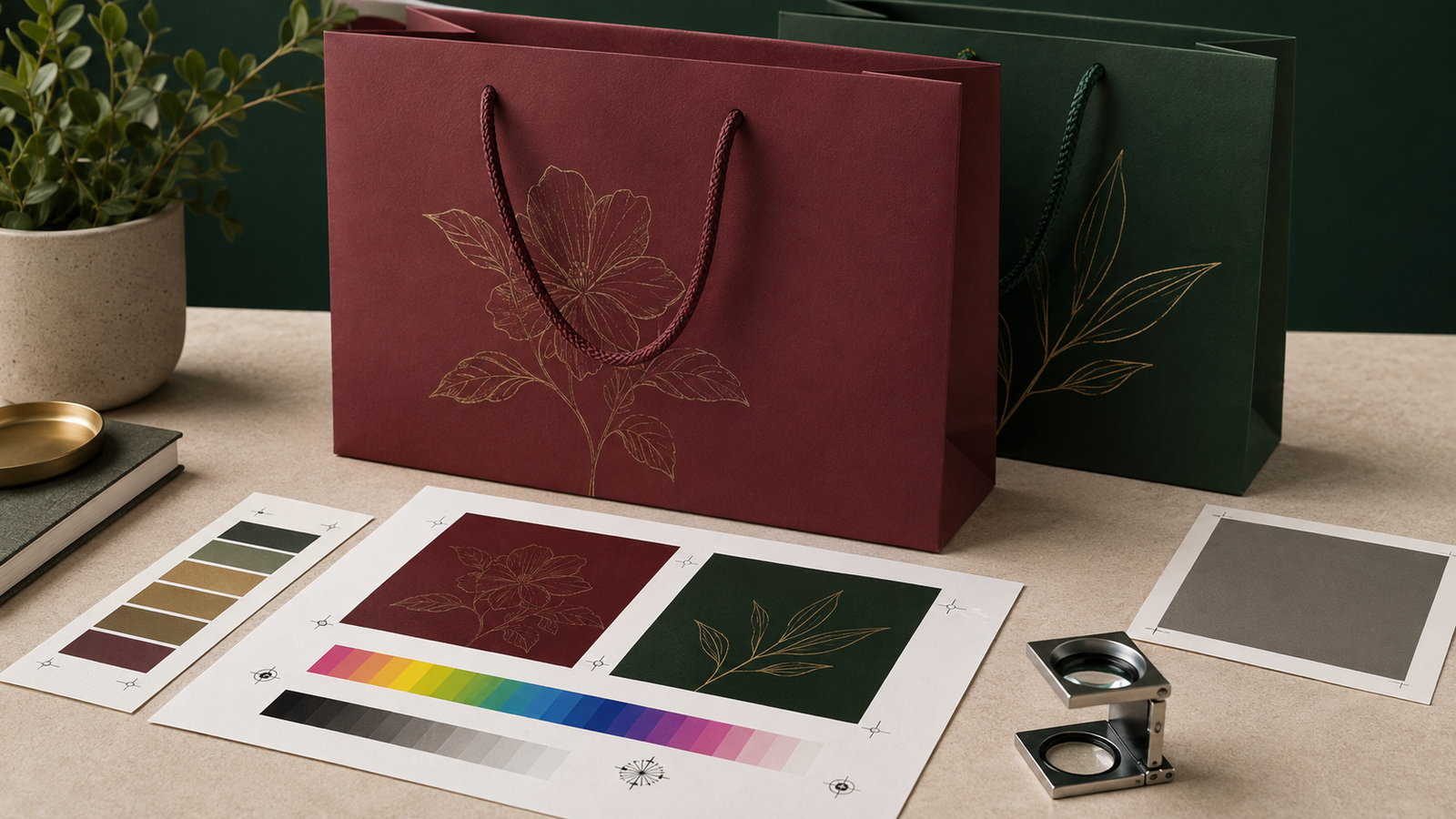
How should you approve colour and print quality?
Separate three approval questions. First, is the artwork correct? Second, does the proof simulate the agreed printing condition? Third, does the converted bag meet the approved production reference? A PDF can answer the first question but cannot reliably answer the second or third on its own.
ISO 12647-7:2016 specifies requirements for hard-copy digital proofing systems intended to simulate a defined printing condition. The standard remains current after confirmation in 2022. For offset production, ISO 12647-2:2013 covers process parameters for colour separation, proofing and four-colour sheet-fed and web-fed offset, including packaging board applications; ISO lists that edition as due for revision. These standards provide a useful framework, but your purchase order still needs a project-specific paper, colour target, tolerances and approval route.
A practical print approval sequence
- Approve the dieline and content. Check panel orientation, safe areas, gussets, seams, handle holes and turn-top zones.
- Define colour targets. Identify process images, spot colours, opaque whites and any areas that use the paper as a colour.
- Confirm the printing condition. Record the process, press or line, paper, coating, ink system and finishing stack.
- Review a suitable proof. Understand whether it predicts layout only, colour appearance or the actual production process.
- Inspect a printed sheet. Check solids, gradients, fine type, trapping, registration, banding, mottling and rub resistance.
- Approve a converted sample. Fold, carry, pack and unpack it; inspect scores, gussets, seams and handle areas.
- Keep a signed reference. Link the physical sample to dated files, specifications and agreed tolerances for production control.
For colour terminology, process artwork and spot-colour expectations, see our RGB, CMYK and Pantone packaging colour guide. If a metallic or relief effect is also planned, treat it as a separate production layer and review the luxury paper bag finishes guide.
What artwork should you send to a paper bag printer?
- the supplier-approved dieline at the correct size, with panels and folds clearly identified;
- editable vector artwork for logos, line graphics and type where appropriate;
- high-resolution linked images suitable for the final printed dimensions;
- outlined fonts or the required licensed font files, according to the printer’s workflow;
- clearly named process, spot-colour, white-ink, varnish, foil and relief layers;
- bleed, safe areas and image extensions that follow the supplier’s template;
- a reference PDF showing the intended appearance and orientation;
- the chosen colour profile or agreed printing condition;
- version names that make language, market, size and revision unmistakable.
Do not build the final file on a generic shopping-bag outline from the internet. Bag factories use different turn-tops, base folds, gussets and gluing areas. Artwork that looks centred on a flat diagram can appear off-centre after folding. Ask the producer to return a marked production proof and verify every panel before approving plates, screens or a digital run.
Does one printing method make a bag more recyclable?
Do not judge recyclability from the process name alone. The ink or toner chemistry, printed coverage, varnish, laminate, adhesives, handles and other components all belong to the final construction, while collection, sorting and mill routes differ by market.
The February 2026 4evergreen Circularity by Design Guideline for Paper-based Packaging distinguishes oil-based, solvent-based, water-based and UV-curing inks as well as liquid and dry toners. It explains that recycling routes may include flotation deinking or conventional processing, and notes that large design areas with high shares of carbon-black-based or metallic inks can create sorting concerns that require testing. The responsible buyer action is to document the complete printed construction and verify it against the destination system rather than advertise an unsupported universal claim.
Ask the supplier which ink, coating and adhesive systems are proposed, whether the paper is certified or contains recycled fibre where required, and what evidence supports any end-of-life statement. Reducing unnecessary full coverage or decorative layers can simplify a design, but environmental performance should be assessed across material use, production, durability, transport and realistic recovery—not inferred from a single adjective such as “water-based” or “digital.”
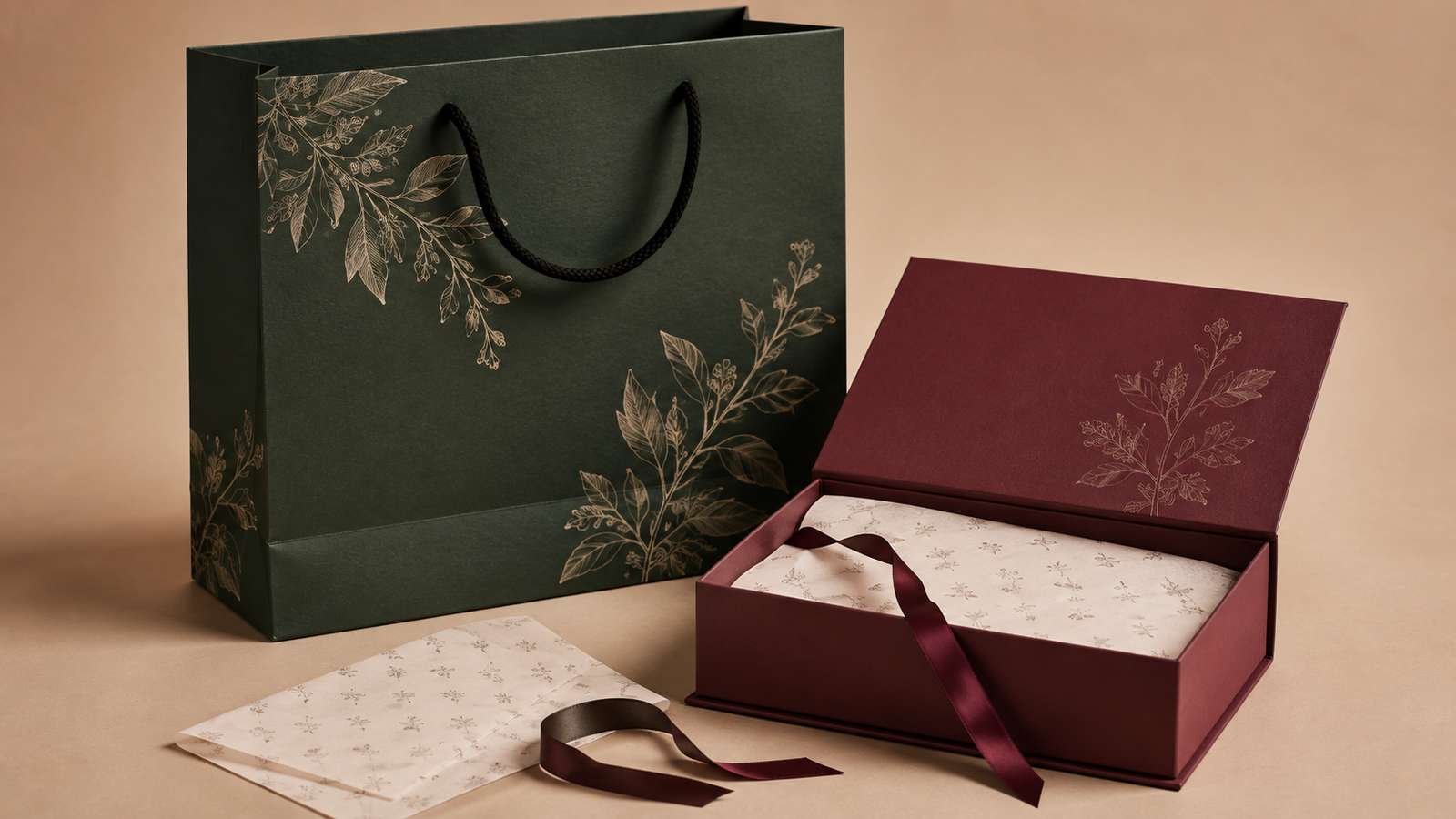
How should print connect the bag, box, ribbon and tissue?
A coordinated packaging suite does not need the same printing process on every component. The luxury paper bag may use offset for a detailed hero illustration, while a rigid gift box repeats one line element, the ribbon carries a woven or printed colour cue, and tissue paper uses a lighter repeating pattern. The design feels related because scale, colour and motif are controlled—not because every surface is covered.
Plan the unboxing sequence. The bag must read at a distance and survive carrying. The box is viewed closer and can support quieter detail. Ribbon introduces movement and touch. Tissue controls the reveal and should not transfer ink or obscure the product. Create one master brand specification, then set a process-appropriate version for each substrate.
What belongs in a luxury paper bag printing brief?
- finished bag width, height and gusset, plus handle and turn-top construction;
- product dimensions, packed weight and packing method;
- quantity per size, design, language and delivery batch;
- destination market, required date and shipping plan;
- paper family, shade, texture, certification and any acceptable alternatives;
- artwork files, dieline revision, colour references and ink coverage;
- requested comparison between offset, screen, digital or flexographic routes;
- coating, lamination, foil, embossing or other post-print finishing;
- proof, printed sheet and converted sample stages;
- visual tolerances, rub or handling tests and production reference;
- matching box, ribbon and tissue-paper requirements;
- substantiation required for material or end-of-life claims.
Ask suppliers to state what changes between their options. One quote may use offset on flat sheets with manual conversion; another may use a digitally printed short run; a third may print a stock bag after conversion. Prices are not comparable until paper, size, handles, print coverage, finishing, sampling, packing and delivery scope are aligned.
Frequently asked questions about paper bag printing
Is offset printing always best for luxury paper bags?
No. Offset is a strong choice for detailed sheet-fed graphics and repeatable production, but a simple opaque mark on textured paper may suit screen printing, while a short versioned run may suit digital. The complete bag specification determines the route.
Can digital printing match a Pantone colour?
Some digital presses and ink configurations can simulate or use extended-gamut and spot-colour capabilities, but not every device can reproduce every reference on every paper. Ask the printer to identify the press, ink set, substrate and measurable target, then approve a physical sample.
Can you screen print a finished paper bag?
Sometimes. The panel must sit flat enough for the equipment, and seams, gussets, handles and reinforcements restrict the printable area. The ink also needs suitable adhesion, curing and rub performance. Confirm the exact bag and artwork with the printer.
Should the same proof be used for offset and digital printing?
A layout PDF may support both, but a colour contract proof needs to simulate a defined printing condition. If the production process, press, ink or paper changes, ask what the proof represents and whether a new printed or converted sample is required.
What is the cheapest way to print a custom paper bag?
There is no method that is cheapest for every job. A one-colour design, short digital run, high-volume flexographic bag and detailed offset carrier have different cost structures. Compare total delivered cost against the same dimensions, paper, handles, quantity, artwork, finishing, sampling and packing specification.
Choose a print route you can specify and approve
Luxury paper bag printing succeeds when the image, substrate and conversion process are designed as one system. Offset offers detailed sheet-fed reproduction, screen printing gives selected bold and opaque marks, digital enables short and variable work, and flexography supports repeat reel-fed production. The best route is the one your supplier can explain, sample, measure and repeat for the real bag.
Bespoke Packaging develops custom luxury paper shopping bags together with rigid gift boxes, ribbon and tissue paper. Share your artwork, bag size, quantity, delivery market and target appearance, and we can help compare print routes, plan samples and coordinate the complete packaging set.
Does your next bag need intricate image detail, a bold opaque mark or the freedom to change from one version to the next?