
LUXURY PAPER BAG MATERIAL GUIDE
Luxury Paper Bag Materials: How to Choose the Right Paper
Kraft, coated, uncoated, specialty and recycled papers can all look premium. The right choice is the one that balances print, touch, structure and the real journey of the filled bag.
The best material for a luxury paper bag is not simply the heaviest or smoothest sheet. Choose coated paper when precise colour and a polished print surface lead the brief; choose uncoated or specialty paper when touch and understated character matter; choose kraft when strength, natural texture and a paper-led appearance are priorities. Recycled paper can work across these categories, provided its shade, surface and performance are approved on a physical sample.
Material choice also needs to account for bag size, filled weight, handles, reinforcement, folds, finishing and the recovery system in the destination market. This buyer’s guide explains how to compare papers for custom luxury paper bags without reducing the decision to a GSM number or a swatch viewed on screen.
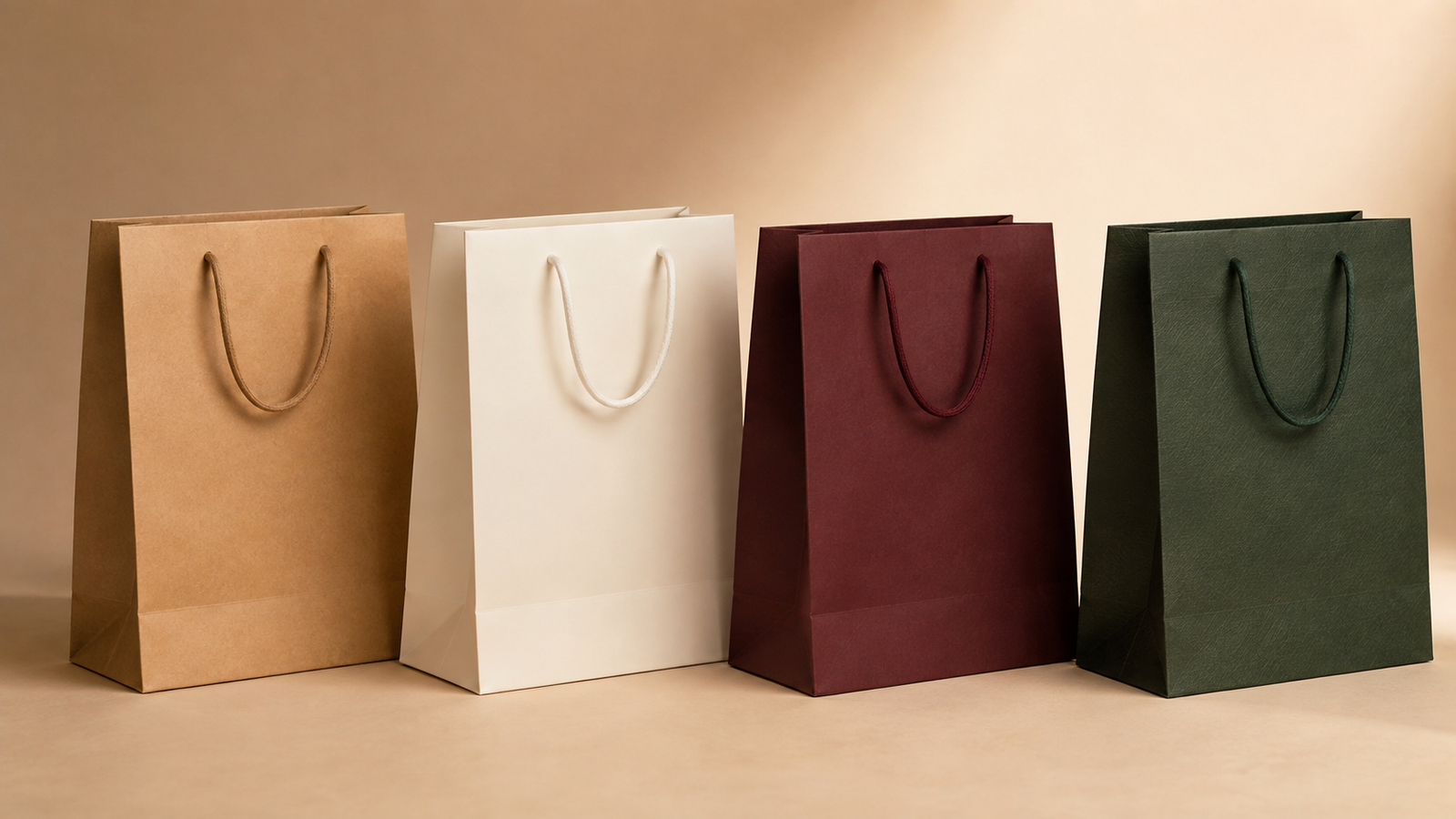
Which paper is best for a luxury shopping bag?
There is no universal best paper. A useful shortlist starts with the experience the bag must create and the work it must perform:
- For crisp graphics and controlled brand colour: begin with a smooth coated or high-quality smooth uncoated sheet.
- For a quiet, tactile luxury feel: compare premium uncoated and subtly textured specialty papers.
- For a natural, robust expression: compare brown and white kraft grades that are suitable for converting into carrier bags.
- For a dark, material-led design: consider coloured-through specialty paper, then test opacity, scuffing and the selected print or foil process.
- For a recycled-content brief: define the required claim and consistency, then approve the actual recycled grade rather than relying on the word “recycled” alone.
A supplier should narrow the options after seeing the product dimensions, maximum packed weight, bag size, artwork, handle design, finish, quantity and delivery market. The final decision should be made with production-intent samples.
What are the main luxury paper bag materials?
Natural and white kraft paper
Kraft paper has a direct, fibre-led character. Natural brown kraft gives colour and photography a warmer, more muted base, while white kraft provides a cleaner background without losing the straightforward material feel. Suitable kraft grades can offer useful tear performance for shopping bags, but “kraft” is a family of papers, not a guaranteed load rating.
Natural kraft works well for restrained one- or two-colour artwork, bold typography, simple foil details and brands that want the substrate to remain visible. White kraft can support brighter artwork and a more contemporary retail look. Always proof light colours and fine details on the chosen sheet because the paper shade and absorbency affect the printed result.
Best starting point when: a natural appearance, honest texture and practical carrier-bag performance lead the brief.
Coated paper
Coated paper has a smoother printing surface, making it a common choice for detailed artwork, photography, fine type and controlled colour reproduction. It can be finished with matte or gloss effects, foil, embossing and other decorative processes to create a familiar polished luxury-shopping-bag appearance.
The coating does not make every sheet equally suitable for a bag. Folding behaviour, crack resistance, stiffness, tear performance and the compatibility of the coating with inks, adhesives and finishing all need to be considered. Dark solid areas can also show rub marks, fingerprints or edge wear differently from a lighter design, so test the real artwork rather than a generic sample.
Best starting point when: precise print, smoothness and a refined graphic surface are central to the brand expression.
Premium uncoated paper
Premium uncoated paper feels warmer and more tactile than a highly smooth coated sheet. Its surface can make a restrained logo, blind emboss or carefully chosen ink colour feel more considered. It suits beauty, jewellery, fashion, hospitality and gifting projects that want subtlety rather than shine.
Because uncoated fibres interact with ink differently, printed colours may look softer and fine detail may not behave exactly as it does on a coated proof. That difference can be a design advantage, but it must be intentional. Ask for a drawdown, wet proof or production-equivalent proof when colour is critical.
Best starting point when: touch, restraint and a soft premium appearance matter more than gloss or photographic sharpness.
Textured and coloured specialty paper
Specialty papers can introduce a felted, linen-like, embossed, pearlescent or coloured-through surface before any artwork is printed. They are useful when the substrate itself should carry much of the design. A deep green paper with a small burgundy foil mark, for example, can feel more distinctive than a fully printed imitation of the same texture.
Texture can reduce contact between the paper and a printing or foil plate, while a dark sheet may require opaque ink, foil or another process to create contrast. Strong texture can also affect scoring, adhesive contact and the cleanliness of folded edges. Confirm that the selected grade is available in the required quantity and remains suitable for the proposed bag construction.
Best starting point when: the paper itself is a primary visual and tactile feature.
Recycled paper
Recycled content can appear in kraft, coated, uncoated and specialty grades, so it should not be treated as one visual category. Some papers show visible fibre flecks and shade variation; others are engineered for a cleaner, more consistent surface. Neither appearance proves a particular percentage or certification.
Specify the recycled-content requirement, acceptable shade range, print expectations and performance criteria. Request documentary support for any claim that will appear on the bag. A recycled grade still has to fold, glue, print and carry the approved product reliably.
Best starting point when: a verified recycled-content objective is part of the procurement brief and the actual grade has been sampled.
Does a higher GSM make a stronger paper bag?
Not necessarily. GSM describes grammage—the mass of paper per unit area. ISO 536:2019 specifies a method for determining paper and board grammage, but grammage is not a complete measure of bag strength, stiffness or thickness.
Two papers with the same GSM can have different caliper, fibre composition, tensile properties, tear behaviour, surface treatment and response to moisture. The converting process also changes the outcome. Grain direction, scores, side seams, turn-top reinforcement, base board, handle holes and adhesives all contribute to the finished carrier.
The practical question is therefore not “What GSM feels luxurious?” but “Which paper and construction pass the agreed test with this filled product?” ISO publishes separate methods for properties such as tensile strength, illustrating why grammage and strength should not be treated as synonyms.
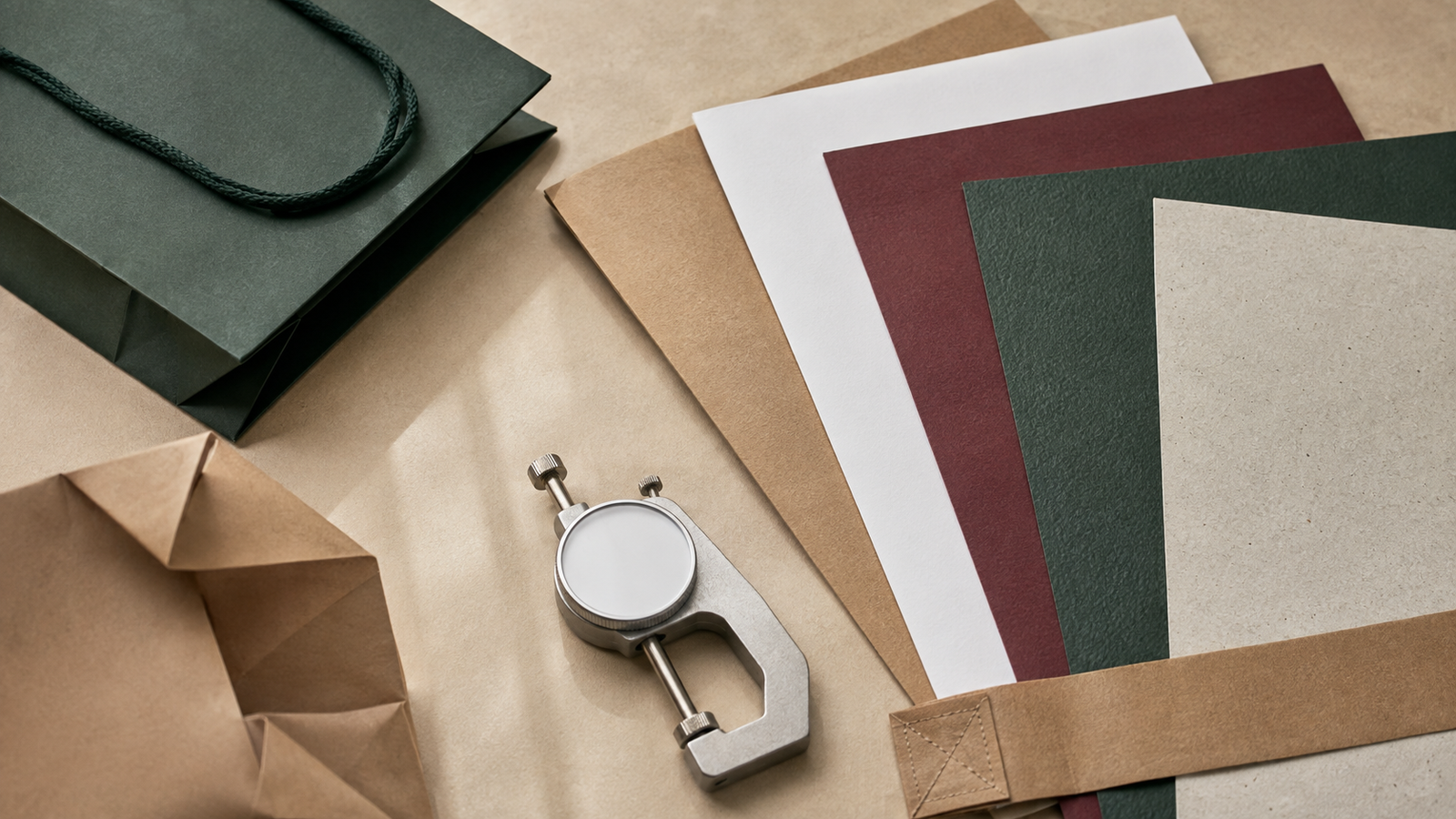
How do paper, printing and finishing affect one another?
Paper is the foundation of the print result. Its shade changes perceived colour; its texture changes edge sharpness; its absorbency changes ink behaviour; and its surface energy can affect adhesion. Review the paper, artwork and finish as one system.
- Fine photography and gradients: usually benefit from a smooth, predictable surface and a production-relevant colour proof.
- Large dark areas: require scuff, rub and fold checks, especially around corners and gussets.
- Hot foil: needs the foil, paper texture, coverage and stamping conditions tested together.
- Embossing or debossing: needs enough definition without weakening a fold or crowded structural area.
- Blind embossing: can be especially effective on tactile uncoated or coloured papers, but depth and detail must suit the sheet.
- Lamination and protective coatings: can change feel and resistance to handling, but they also add constituents that should be considered in the end-of-life assessment.
For colour-critical work, provide reference swatches and compare proofs under controlled lighting. Our packaging colour guide explains how RGB artwork, CMYK printing, Pantone references, paper shade and finishes interact.
How does the product change the paper specification?
Start with the complete packed unit. A small jewellery item may sit inside a dense rigid box; a fashion bag may be large but carry a relatively light garment; a candle or bottle may create a concentrated load. Product corners, movement and weight distribution matter as much as the nominal weight.
- Define the maximum filled configuration. Include the product, gift box, insert, tissue paper, ribbon and accessories.
- Choose the bag dimensions. Allow practical clearance without creating unnecessary volume.
- Select candidate papers. Compare print surface, touch, stiffness and expected converting behaviour.
- Engineer the carrying system. Match the paper with the base, gussets, folded top, reinforcement and handle specification.
- Test the finished sample. Use the real or representative product and realistic carrying conditions.
A paper that feels substantial as a flat swatch may crease poorly at the gusset. A beautiful soft sheet may need a different reinforcement strategy. A smooth coated stock may reproduce artwork precisely but reveal abrasion during packing. Only the converted, filled sample brings these interactions together.
How should sustainability claims influence paper choice?
Begin with a specific objective: responsibly sourced fibre, verified recycled content, lower material complexity, reduced weight, reuse potential or compatibility with a named collection and recycling route. These are related goals, but they are not interchangeable.
If FSC certification is required, confirm the chain of custody and the exact claim available for the finished product. The Forest Stewardship Council’s chain-of-custody standard is the system used to track eligible forest-based materials through the supply chain. Buying an FSC-labelled paper stock does not, by itself, authorise every converter or brand to place any FSC mark on a finished bag.
Also assess the complete bag, not only the base sheet. The 2026 4evergreen Circularity by Design Guideline considers how constituents and components affect collection, sorting and different paper-recycling processes. Its framework is a useful reminder that inks, varnishes, laminates, adhesives, windows, eyelets, handles and other additions can influence the route.
For packaging placed on the EU market, Regulation (EU) 2025/40 introduces phased recyclability and packaging-minimisation requirements. The official PPWR text requires packaging design to consider all components and the ability to collect, sort and recycle the packaging in relevant streams. Requirements and assessment methods are phased, so confirm current obligations and destination-market guidance for a live project rather than making a blanket “recyclable” claim.
What should you approve on a paper bag material sample?
A small blank swatch is useful for narrowing options, but it cannot approve a finished bag. Use a staged sampling process:
- Paper identity: grade, colour, finish, grammage, caliper where relevant, recycled content and certification documentation.
- Appearance: shade, formation, fibre flecks, texture and consistency within the acceptable range.
- Artwork: colour, opacity, fine detail, solids, registration and contrast on the actual paper.
- Finishing: foil coverage, emboss definition, coating or lamination adhesion and resistance to visible handling marks.
- Conversion: clean scores, folded edges, gusset memory, seam adhesion and base construction.
- Carrying performance: handle comfort, reinforcement, hole or slot behaviour and stability with the maximum approved load.
- Packing and transit: scuffing, blocking, moisture exposure relevant to the route, carton fit and recovery after shipment.
Record the approved sample and specification together. A photo alone cannot reliably communicate paper shade, texture, stiffness or hand-feel. Sampling should be planned early in the custom packaging order process, before the material and finish are locked for production.
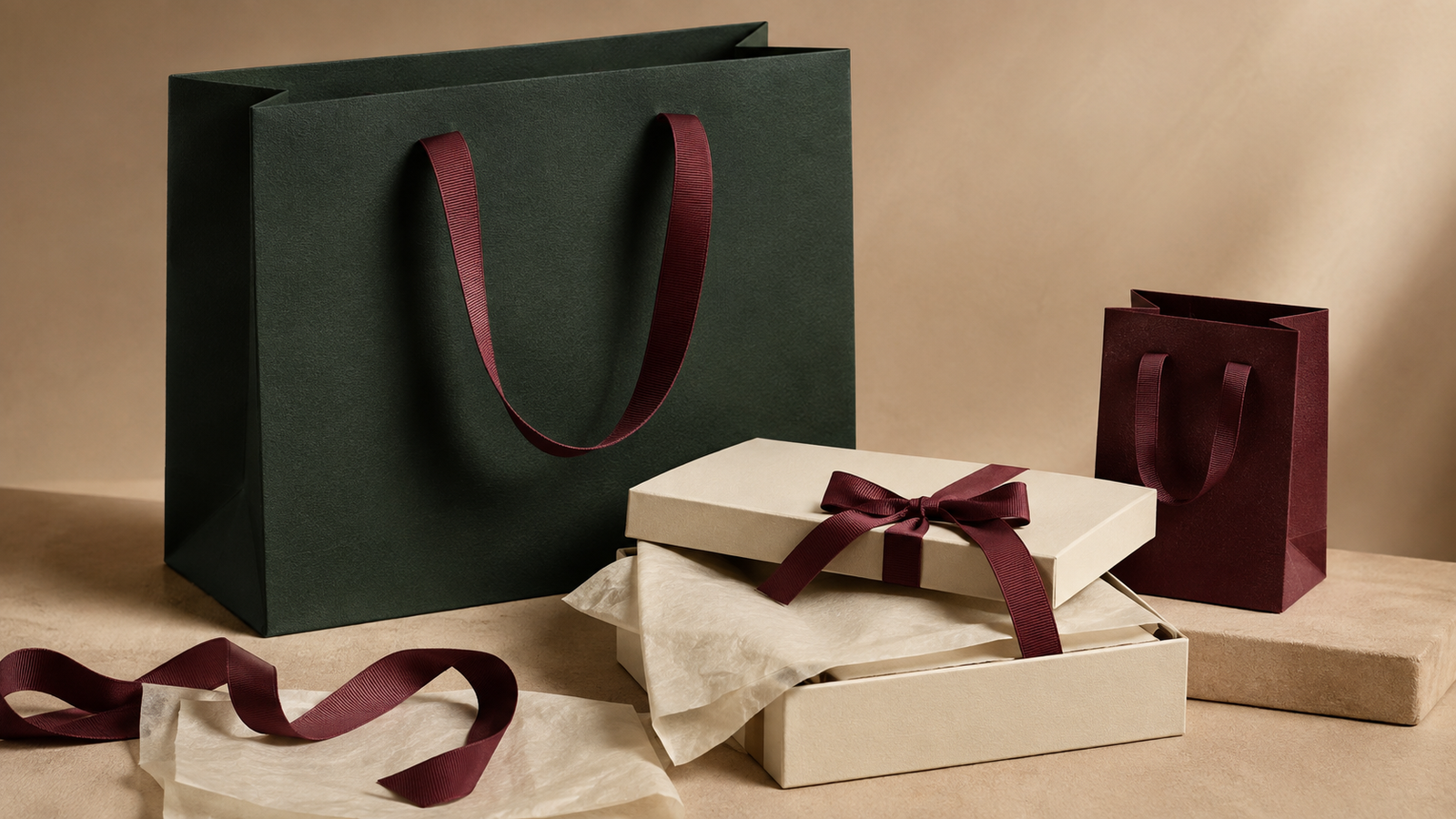
How can one paper choice connect a full packaging set?
A luxury shopping bag should feel related to the unboxing packaging without forcing every component to use the same substrate. Repeat a small number of cues—paper shade, texture, foil colour, ribbon weave or print treatment—and let each format use the construction it needs.
For example, a deep green textured bag can share burgundy grosgrain handles with the ribbon around a cream rigid box. A lighter cream tissue paper can soften the interior without trying to match the board exactly. A smaller burgundy bag can use the same foil colour as the larger carrier. The result feels coordinated because the materials have a clear hierarchy.
What belongs in a luxury paper bag material brief?
Include the following when requesting options or a quotation:
- product dimensions, shape and maximum packed weight;
- bag width, height and gusset, if already known;
- quantity, delivery country and target date;
- brand position and desired visual or tactile direction;
- candidate paper family, colour and texture;
- required recycled-content or fibre-sourcing claims;
- artwork, print colours, ink coverage and fine details;
- foil, embossing, varnish, lamination or other finishes;
- handle type, attachment and carrying method;
- base and top-reinforcement requirements;
- coordinating gift box, ribbon and tissue paper;
- sample stages, performance checks and approval responsibilities.
If the paper is not yet known, send the product, artwork and performance requirements rather than guessing a GSM. A packaging supplier can propose comparable options and explain the trade-offs before sampling.
Frequently asked questions about paper bag materials
Is kraft paper suitable for luxury shopping bags?
Yes. Natural or white kraft can look premium when the paper grade, proportions, print, handles and construction are considered together. Kraft gives a more direct and tactile expression than a highly coated bag, which may suit understated or material-led brands.
Is coated paper better than uncoated paper?
It is better for some briefs, not all. Coated paper generally offers a smoother, more controlled print surface. Uncoated paper provides a softer, more tactile appearance. Choose according to the artwork, finish, handling conditions and brand experience, then test the converted bag.
What GSM should a luxury paper bag use?
There is no single correct GSM. Bag size, paper grade, caliper, strength properties, product weight, handles, reinforcement and converting method all affect performance. Ask for a specification and filled-sample test instead of approving by grammage alone.
Can recycled paper look luxurious?
Yes. Recycled papers range from visibly flecked kraft-like sheets to smooth premium grades. Approve the exact paper for shade, consistency, print and converting performance, and verify any recycled-content claim with supplier documentation.
Do textured papers print well?
They can, but the texture changes ink and foil contact. Fine lines, small type, large solids and foil coverage should be tested on the actual sheet. Sometimes a simpler artwork or a different process produces a more convincing premium result.
Choose the paper with the whole bag in mind
Luxury paper bag materials should be compared as part of a complete packaging system. Kraft, coated, uncoated, specialty and recycled papers each offer useful possibilities, but the right answer only emerges when print, touch, structure, handles, finishing, transit and end of life are considered together.
Bespoke Packaging develops custom paper shopping bags alongside rigid gift boxes, ribbon and tissue paper. Share your product, artwork, quantity, delivery market and preferred material direction, and we can help shortlist papers, plan samples and coordinate the complete packaging set.
Should your bag feel smooth and precise, naturally tactile or quietly distinctive before a customer even opens it?