
LUXURY PAPER BAG BUYER GUIDE
Luxury Paper Bag Handles: Choosing Rope, Ribbon or Paper
The handle is the point where appearance, comfort and carrying performance meet. Choose it with the product, bag structure and end-of-life plan in mind.
For most luxury paper bags, the practical starting point is simple: cotton rope feels substantial, ribbon looks refined, and paper handles support a more material-efficient, paper-led design. None is automatically best. The right choice depends on what the bag will carry, how long it will be held, how the handle is attached, the visual language of the brand and the recycling route in the sales market.
A beautiful handle can still fail if the turn-top, reinforcement board or attachment method is wrong. Equally, an over-engineered handle can add cost and material without improving the customer experience. This guide explains the main handle types for custom luxury paper bags and gives buyers a clear way to specify, sample and approve them.
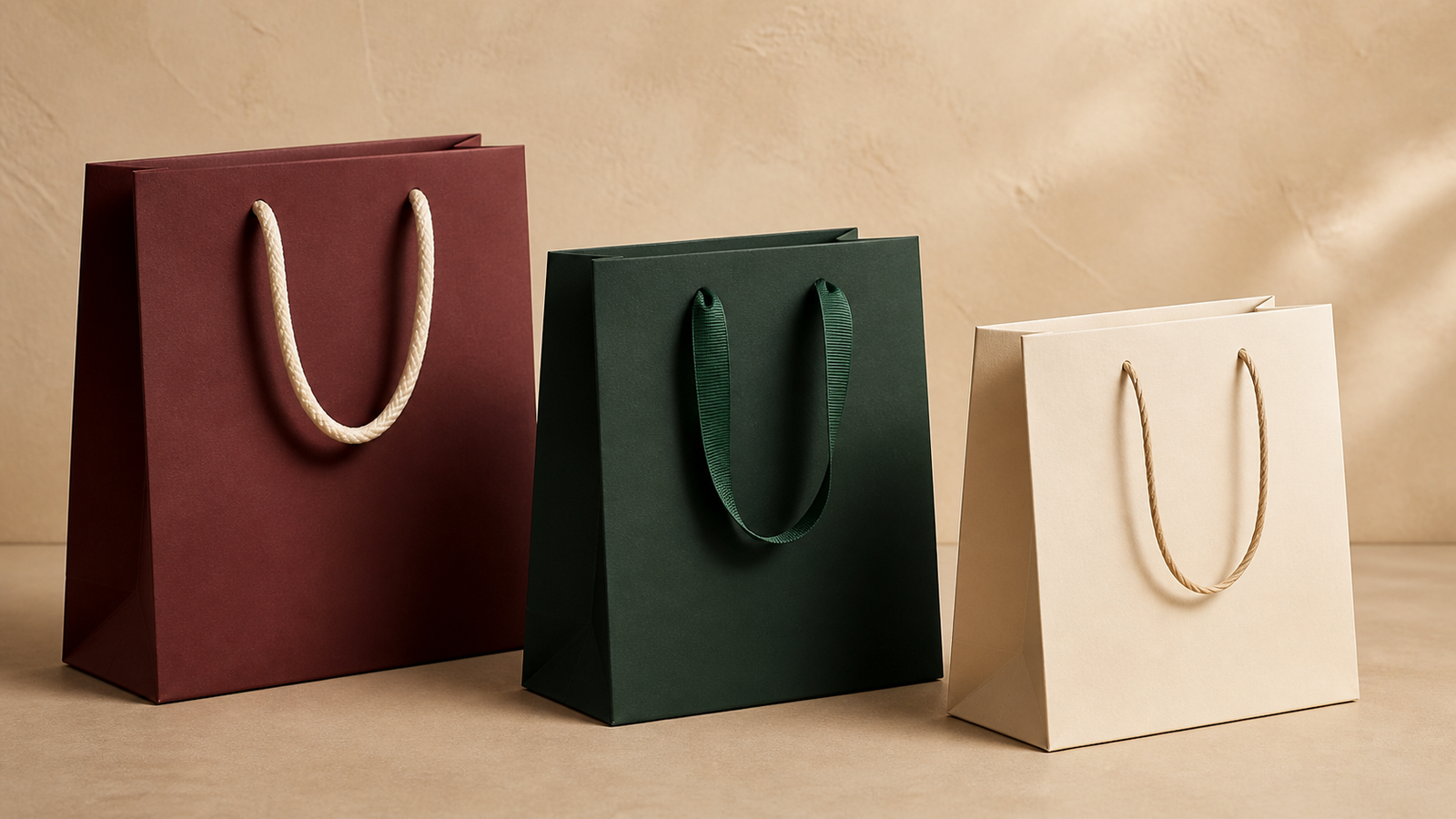
How do you choose a handle for a luxury paper bag?
Start with the complete use case rather than the handle catalogue. Ask five questions in this order:
- What will the filled bag weigh? Include the product, gift box, inserts, tissue paper and any accessories.
- How will it be carried? A short walk from a boutique counter is different from an exhibition day or a journey across a shopping centre.
- What should the bag communicate? Soft cotton cord, ribbed grosgrain and twisted paper each create a different brand signal.
- How should the handle relate to the bag? Colour, width, length, knot style and attachment should work with the bag size, artwork and finish.
- What happens after use? Consider whether components are compatible with local collection, sorting and recycling systems, or can be separated easily.
These questions are more useful than choosing from photographs alone. A supplier can then match the handle to the paper weight, gusset, base board, folded top and reinforcement specification.
What are the main luxury paper bag handle types?
Cotton rope handles
Cotton rope is a familiar premium choice because it feels soft, rounded and substantial in the hand. It works well for fashion, beauty, jewellery, gifting and other retail bags that need a polished appearance without looking overly decorative.
The cord can be matched or contrasted with the bag colour. Diameter, weave and firmness all affect the result: a slim cord can look delicate on a small jewellery bag, while a thicker cord gives a larger boutique bag better visual proportion. Cotton is often chosen for its natural hand-feel, but buyers should still confirm fibre composition, dye colour, colourfastness and the exact attachment method.
Best considered when: comfort, tactile quality and a classic luxury look are priorities.
Grosgrain or satin ribbon handles
Ribbon gives a paper bag a more fashion-led or gift-led character. Grosgrain has visible ribs and a structured feel; satin has a smoother surface and more sheen. Either can echo a ribbon closure on a gift box or a loose ribbon used elsewhere in the packaging set.
Ribbon width matters. A wider ribbon can feel comfortable and visually confident, but it needs enough space at the top of the bag and an attachment that keeps it flat. Very soft ribbon may twist during packing or carrying. Very narrow ribbon can concentrate pressure in the hand when the filled bag is heavy.
Best considered when: the bag is part of a premium gifting experience and the handle is an intentional design feature.
Twisted paper handles
Twisted paper handles are made from paper formed into a cord. They create a simpler, more craft-led expression and can suit natural kraft, uncoated or restrained premium bag designs. When the bag body, handle and reinforcement are all paper-based, the material story can also be easier for customers to understand.
The appearance depends on the paper colour, twist, cord thickness and attachment. A carefully specified paper cord can look considered and premium; a generic handle chosen only to reduce cost may not. Ask to see the actual handle colour beside the printed bag because natural fibres and uncoated materials can vary.
Best considered when: a paper-led construction and understated visual language are central to the brief.
Flat paper handles
Flat paper handles are folded paper strips attached inside the top of the bag. They sit neatly for storage and are common on everyday retail and food-service bags. With the right paper, proportions and print treatment, they can also support a clean contemporary look, although they usually communicate practicality more strongly than traditional luxury.
Best considered when: efficient packing, a simple paper construction and everyday use are more important than a decorative handle.
Die-cut handles
A die-cut handle is an opening cut into the bag itself, sometimes with a folded or reinforced top. It creates a minimal silhouette and removes a separate loop from the design. The comfort and carrying performance depend heavily on the handle shape, edge, paper construction and load, so the exact filled sample should be tested rather than judged from the dieline alone.
Best considered when: a compact, architectural look suits the product and the filled weight is appropriate for the structure.
What makes a paper bag handle reliable?
The handle material is only one part of the carrying system. Reliability comes from how several elements work together:
- the strength and grain direction of the bag paper;
- the folded turn-top at the opening;
- the reinforcement board or patch behind the handle area;
- the size and position of punched holes or slots;
- the knot, tab, glued end or concealed attachment;
- the bag width, gusset and base construction;
- the shape, weight and movement of the packed product.
Paper grammage is useful specification information, but it is not a complete strength rating. Two bags with the same grammage can behave differently because the paper grade, fibre direction, coating, lamination, reinforcement and construction are different. Moisture, sharp box corners and repeated movement can also change performance.
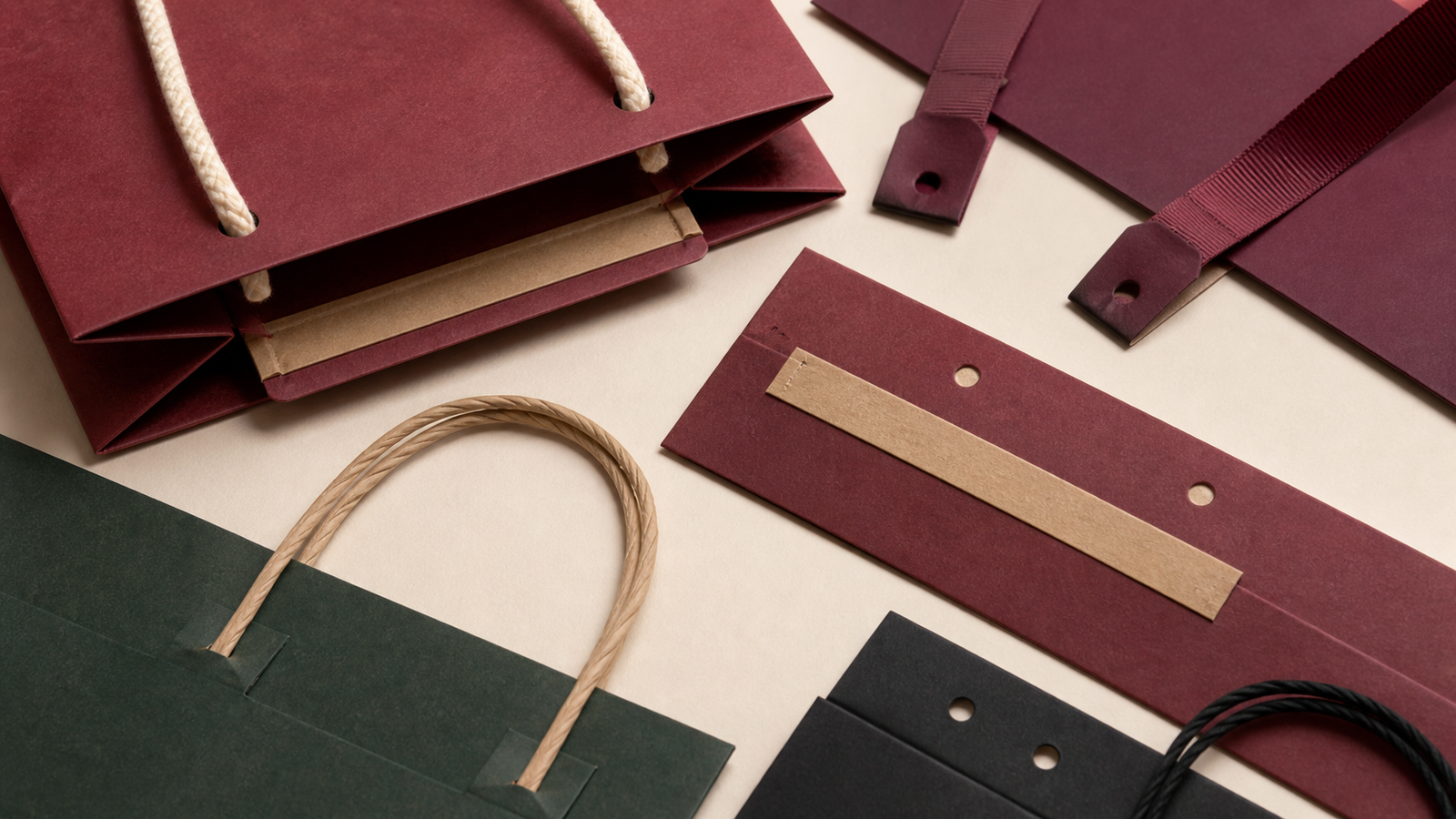
Which attachment details should a buyer approve?
Visible knots give a handcrafted signal and make the construction easy to understand. Concealed ends create a cleaner interior and exterior, but the hidden fixing still needs to be checked. Ribbon may pass through slots, be knotted through holes or be secured inside the folded top. Rope often passes through round holes and is held by knots or internal fittings.
Eyelets can become a visual detail, but they introduce another material and change the look around the handle hole. They are not automatically necessary. Ask what functional problem the eyelet solves, whether the same result can be achieved with reinforcement, and how it affects the intended recovery route.
Also approve the handle drop: the vertical distance from the top of the bag to the inside of the handle at its highest point. It determines whether the bag is carried by hand, on the forearm or over a shoulder. A useful length on a large fashion bag can look out of proportion on a small cosmetics bag.
How should handle colour and finish match the bag?
A precise colour match is not always the best design. Paper, ink, cotton and polyester ribbon reflect light differently, so the same digital colour value will not look identical across materials. Decide whether the goal is a close tonal family or a deliberate contrast.
- Tonal matching creates a quiet, integrated result.
- High contrast makes the handle a graphic element and can frame the logo.
- Neutral handles in cream, black or natural kraft can simplify a complex printed design.
- Coordinated ribbon can connect the bag to a rigid box, tissue wrap or gift bow.
Review handle samples under the same lighting as the printed bag and approved proof. Our packaging colour guide explains why screen values, spot colours, paper and finishing can produce different physical results.
Are paper handles always the most recyclable choice?
A paper handle can support a simpler material story, but no handle should be described as universally recyclable without checking the complete bag and the local system. Inks, coatings, laminations, adhesives, eyelets, reinforcement and non-paper handles can all affect collection, sorting or processing. A component that customers can easily separate may be treated differently from one permanently integrated into the bag.
For brands selling in the European Union, the Packaging and Packaging Waste Regulation (EU) 2025/40 generally applies from 12 August 2026 and introduces phased recyclability requirements. Its design-for-recycling framework considers the compatibility of packaging components with collection, sorting and recycling processes. That makes it sensible to document the complete bag construction instead of making a claim based only on the outer paper.
If responsibly sourced fibre is part of the brief, ask which organisation in the supply chain holds certification and which claim can legally appear on the finished bag. The Forest Stewardship Council explains that chain-of-custody certification is the route used to communicate FSC-certified or controlled forest-based materials through the supply chain. A supplier offering FSC paper is not the same as every finished bag automatically qualifying for an on-product label.
Our guide to EU packaging rules for small brands provides a broader introduction. For a live project, confirm current obligations with a qualified compliance adviser in each market.
How should you test paper bag handles before production?
There is no useful universal load promise based on a handle name alone. Test the production-intent bag with the real product or a representative load. Agree the test method and acceptance criteria with the supplier before the order is approved.
- Pack the full set. Include boxes, inserts, tissue paper and accessories, not just the main product.
- Check the first lift. Watch the handle holes, attachment, folded top, base and gussets as the load transfers.
- Hold the bag. Confirm that the grip is comfortable and the handle does not cut into the hand.
- Simulate movement. Carry the bag for a realistic distance and repeat normal lifting and setting down.
- Inspect after testing. Look for hole elongation, tearing, delamination, loose knots, detached tabs, stretched ribbon or base distortion.
- Test the worst credible case. Use the heaviest approved product configuration and consider humidity or transit conditions relevant to the market.
- Record the approved sample. Keep the handle material, dimensions, attachment and reinforcement specification with the signed-off sample.
A visual mock-up can approve proportion and colour, but only a physical sample can demonstrate hand-feel and carrying behaviour. This is one reason sampling belongs early in the custom packaging order process.
Which handle suits different premium products?
Fashion and boutique retail
Cotton rope offers comfort and familiar premium cues for medium and large bags. Grosgrain ribbon can create a more editorial statement when the product is light enough and the proportions are carefully tested.
Jewellery, watches and beauty
Small bags often benefit from slim cotton cord or narrow grosgrain ribbon. Because the product may already sit inside a rigid box, include that box in the weight and size calculation rather than specifying the bag in isolation.
Wine, candles and heavier gifts
Structure and reinforcement take priority. A comfortable rope handle may suit the visual brief, but the base, gussets, top reinforcement and product restraint all need to manage the load. A divider or fitted box can stop a dense product moving against the bag walls.
Natural and paper-led brand systems
Twisted or flat paper handles can reinforce a restrained material story. Keep the design intentional with suitable paper colour, controlled printing and a handle scale that fits the bag rather than treating the handle as a generic replacement.
How can the bag handle connect a full packaging set?
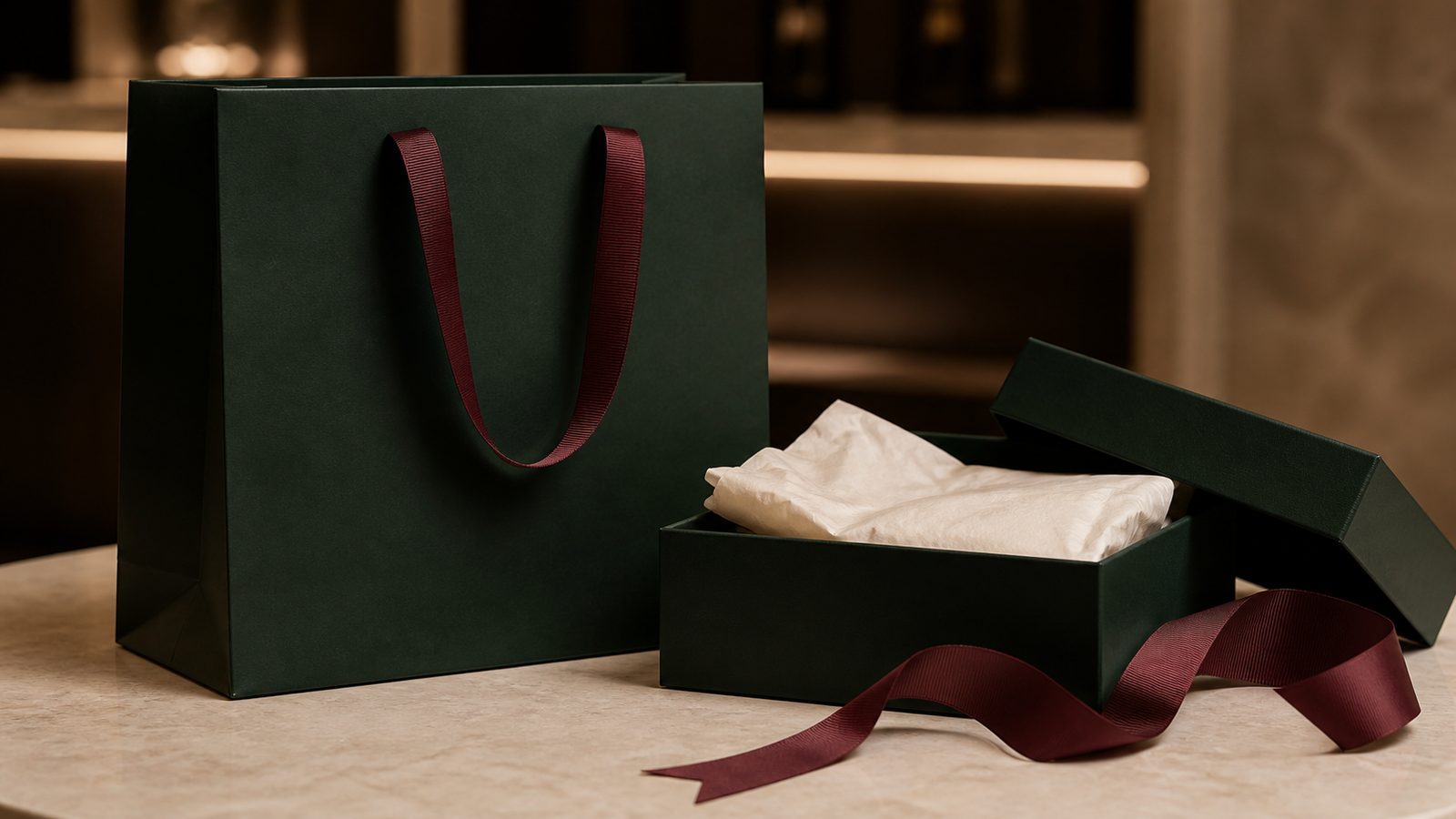
The shopping bag is often the most visible part of the packaging after purchase. Its handle can connect that public-facing moment to the private unboxing experience. A burgundy grosgrain handle might repeat the ribbon around a cream rigid gift box; a natural cotton cord might work with uncoated paper, blind embossing and neutral tissue; a deep green handle might pick up one colour from a printed tissue pattern.
Coordination does not require every component to be identical. Repeat one or two cues—colour, texture, finish or material—and let the paper bag remain practical. This creates a recognisable packaging family while keeping each item suited to its job.
What should be included in a paper bag handle brief?
Send the following information when requesting a quotation:
- finished bag width, height and gusset;
- product dimensions and maximum filled weight;
- order quantity and delivery country;
- preferred paper and finish;
- handle type, material, colour, width or diameter;
- required handle drop and intended carrying method;
- visible knot, concealed end, slot or other attachment preference;
- reinforcement and base-board requirements;
- logo, artwork and physical colour references;
- coordinating box, ribbon or tissue paper specifications;
- sampling and test expectations;
- target delivery date.
If some details are unknown, send the product and brand requirements first. A packaging partner can propose practical options and explain which decisions affect price, sampling or lead time.
Frequently asked questions about paper bag handles
Are rope handles stronger than ribbon handles?
Not automatically. Handle material, thickness, attachment, reinforcement, bag paper and packed load all matter. Compare physical samples built to the proposed production specification.
What is the most luxurious paper bag handle?
Grosgrain or satin ribbon often creates the most decorative luxury signal, while cotton rope creates a softer and more classic premium feel. The most convincing choice is the one that fits the product, bag proportions and wider brand system.
Can the handle match a Pantone colour?
A supplier may dye or source a close colour, but paper, ink, cotton and ribbon do not reproduce colour identically. Approve a physical handle sample beside the printed bag rather than relying only on a Pantone reference or screen image.
Do luxury paper bags need eyelets?
No. Eyelets can be decorative or support a particular construction, but many premium bags use reinforced holes or concealed attachments without them. Ask what they contribute to the approved design and recovery route.
How long should paper bag handles be?
There is no single correct length. Specify the intended carrying method, bag dimensions and product weight, then approve the handle drop on a physical sample. The handle should look proportional, keep the bag stable and feel comfortable in use.
Choose the handle as part of the bag, not after it
A luxury paper bag handle is not a decorative extra. It is part of the structure, the brand experience and the material specification. Cotton rope, ribbon and paper handles can all work beautifully when they are selected for the real product and tested with the complete bag.
Bespoke Packaging develops custom paper bags alongside rigid boxes, packaging ribbon and tissue paper. Share your product size, filled weight, quantity, delivery market and visual references, and we can recommend handle, reinforcement and sampling options for a coordinated packaging set.
Which handle should your customer notice first: soft cotton rope, tactile grosgrain ribbon or a considered paper construction?