
MAGNETIC GIFT BOXES
Magnetic Gift Boxes: A Buyer’s Guide to Custom Rigid Boxes
Specify the structure, closure, insert and sample as one system—then coordinate the finished box with the luxury paper bag, tissue and ribbon.
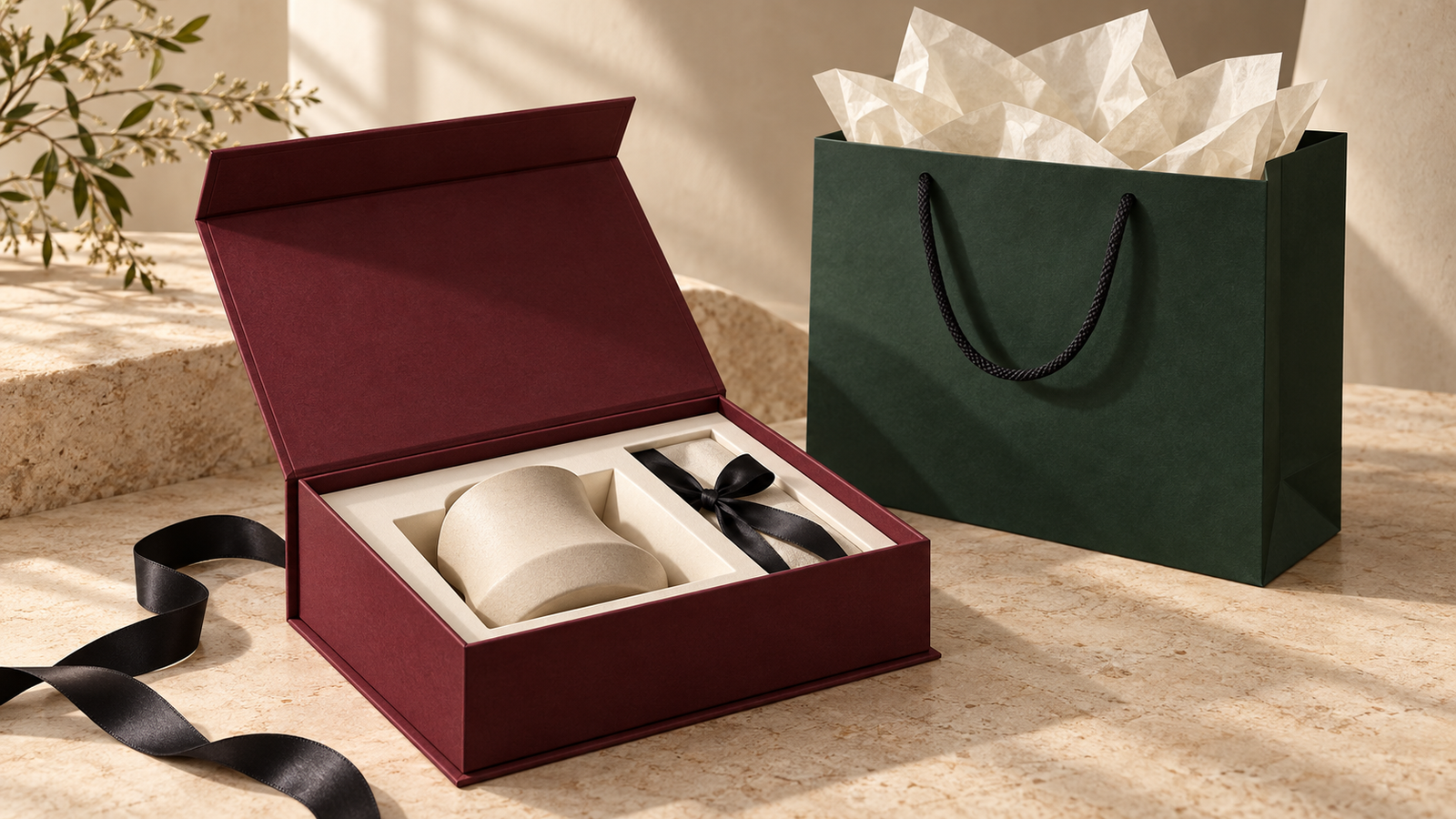
Magnetic gift boxes are rigid or rigid-feel presentation boxes that use concealed magnetic components to hold an attached lid or flap closed. The best custom magnetic box is not the one with the strongest possible snap. It is the one whose board, hinge, closure, insert and dimensions work together for the product, packing process, customer reveal and delivery route.
This guide explains how to choose between assembled and collapsible magnetic boxes, what a production sample should prove, and how to write a useful quotation brief. It also shows how the box can coordinate with luxury paper shopping bags, printed tissue and ribbon without adding components that have no clear job.
What is a magnetic gift box?
A magnetic gift box normally has an attached cover that opens like a book and a front flap that meets the box wall. Magnets and matching metal or magnetic components are hidden below the wrap paper so the closure looks clean. The shell may arrive fully assembled or use collapsible corners that allow the box to ship and store flatter before packing.
“Magnetic” describes the closing method, not the complete quality specification. Two boxes with the same outer appearance can differ in board rigidity, wrap paper, hinge movement, magnet alignment, insert fit, corner construction and finishing. Those details must be shown on drawings and confirmed on a physical sample.
When is a magnetic closure the right choice?
Choose it for a controlled reveal
An attached lid keeps the opening sequence simple and provides a broad inside-lid surface. The closure can suit beauty sets, jewellery, fragrance, confectionery, stationery, corporate gifts and other products where the presentation box remains part of the experience.
Avoid choosing it by appearance alone
A lift-off lid, drawer box or folding carton may use less material, pack faster or suit the product better. Compare alternatives in our rigid box styles guide. A magnetic box is justified when the attached-lid experience and operating requirements earn their place in the brief.
The magnetic closure is not a shipping lock. If the box will travel through parcel, pallet or international distribution, specify the outer transit packaging and test the complete packed-product system for that route.
Should you choose an assembled or collapsible magnetic box?
| Decision point | Assembled rigid magnetic box | Collapsible magnetic box |
|---|---|---|
| Arrival format | Delivered as a finished three-dimensional box | Delivered flat or partly flat for erection before use |
| Opening feel | Direct, stable and ready to pack | Can feel similarly premium after correct assembly |
| Storage and inbound freight | Consumes the full box volume | Reduces empty-packaging volume before assembly |
| Operations | Less store or fulfilment assembly | Requires a repeatable erection and corner-locking method |
| Key sample check | Squareness, hinge, closure and wrapped corners | Assembly time, corner security, squareness and closure after erection |
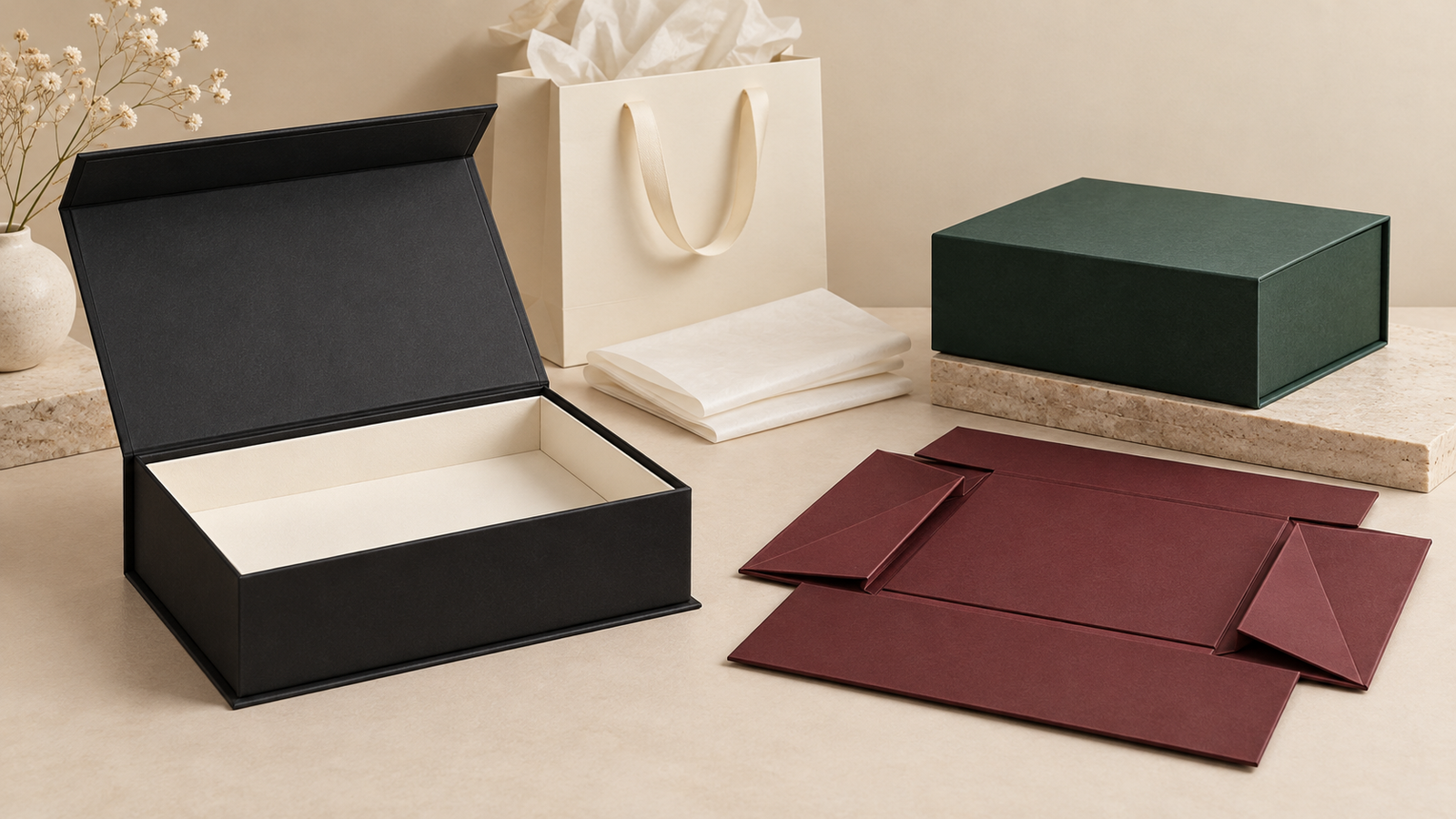
A collapsible box can be valuable when storage or freight volume matters, but the assembly step becomes part of quality control. Ask who will erect it, how corners lock, whether adhesive liners must be removed, and how many boxes can be prepared accurately during a normal shift. An assembled box removes that step but may need more carton and warehouse space.
What creates a reliable magnetic close?
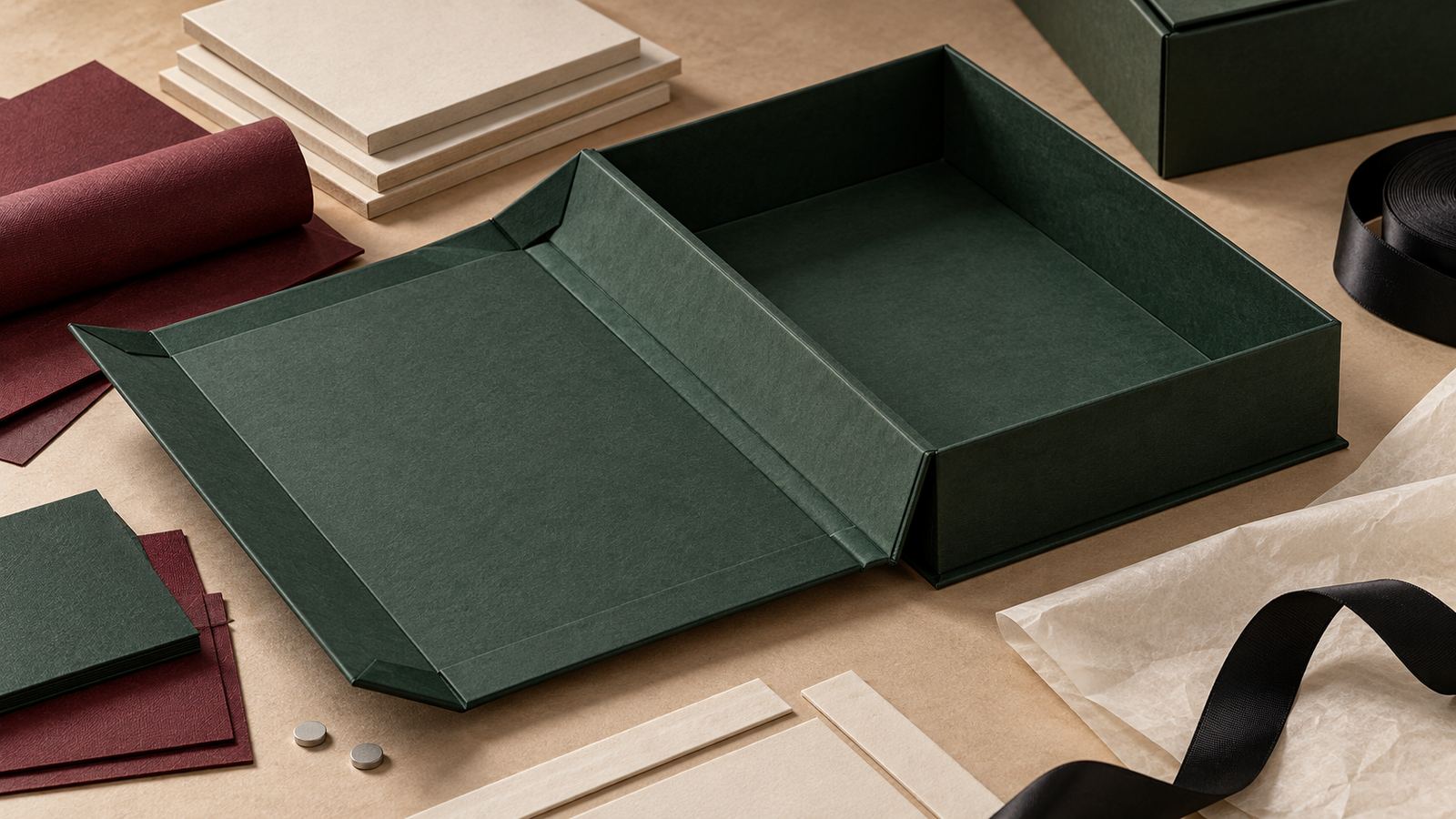
The closing action comes from a chain of details. Magnet type and placement matter, but so do board flatness, wrap build-up, hinge geometry, flap length and the position of the receiving component. A supplier should develop these parts together rather than add magnets after the rest of the box is fixed.
Board and wrap
The board provides the shell; the wrap controls the visible surface. Confirm the proposed grade, thickness or caliper, grain and finished construction on the sample. Dark papers and large solid prints should be checked for scuffing, corner cracking and exposed edges.
Hinge and opening angle
The hinge must flex repeatedly without whitening, tearing or pulling the wrap. Approve where the lid rests when open and whether it remains stable while the product is removed.
Closure alignment
The flap should meet the wall evenly, close without twisting and reopen without excessive force. Define the desired feel with an approved sample; a numerical magnet specification alone does not describe the finished action.
How should you size the box and insert?
Measure the final saleable product, including any primary pack, accessories, literature and protective sleeves. Record the orientation in which it should be presented, the acceptable movement and how a customer will remove it. The GS1 Package and Product Measurement Standard is useful for consistent communication of package dimensions, although it does not replace a supplier’s structural drawing or product-specific fit test.
- Approve the actual product set. Do not size from a concept rendering or bare product when the packed item will be larger.
- Define the presentation orientation. State which face is seen first and whether products must stay upright.
- Choose the insert by function. It may locate, separate, raise or cushion the contents; our custom box inserts guide compares paperboard, pulp and foam directions.
- Provide removal access. Finger notches, ribbon lifts or exposed edges should let the customer remove the product without shaking the box.
- Check lid clearance. Literature, tissue and ribbon must not interfere with the hinge or magnetic close.
How should materials, printing and finishes be specified?
Separate the structural board from the visible wrap. The wrap may be printed paper, coloured-through paper or another approved covering material. State whether colour is created by the paper itself or by print, which faces are decorated, and whether the inside lid or tray carries artwork. Then define foil, embossing, varnish or lamination only where each effect supports the design.
Keep the approval hierarchy clear
Approve artwork position on the supplier’s dieline, colour on the intended wrap, special finishes on a representative surface, and the complete result on a converted sample. A screen mock-up cannot prove hinge movement, corner wrapping, magnetic alignment or surface durability.
Can a magnetic gift box be described as recyclable or sustainable?
Do not base a claim on the paper wrap alone. Review the board, wrap, magnets or receiving pieces, adhesives, finishes, insert and any ribbon as one construction, then check the collection and recycling route in the destination market. The 4evergreen Circularity by Design Guideline, Version 4 provides current design guidance for paper-based packaging and emphasises evaluating the complete pack.
For packaging placed on the EU market, the European Commission states that Regulation (EU) 2025/40 on packaging and packaging waste has applied since 12 August 2026. The regulation covers packaging of all materials and includes requirements concerning waste prevention, design and recyclability. Buyers should confirm the obligations that apply to their role, market and launch date rather than treating a supplier description as legal evidence.
If an FSC on-product label is requested, the label is not a decorative asset that a brand can place freely. FSC’s official on-product labelling guidance explains that the supplying company must be certified and the label use must follow the applicable approval process. Put the certification and label requirement into the brief before artwork approval.
How should the box coordinate with a luxury paper bag?
The magnetic box presents and locates the product; the luxury paper bag carries the completed retail pack. Size the bag around the closed box, not the unboxed product. Allow practical clearance for counter packing and tissue without letting the box rotate excessively. Confirm the final packed weight, base support, handles and reinforcement on the bag sample.
Coordinate, do not duplicate
- Use one colour hierarchy across box and bag.
- Repeat a motif at a different scale.
- Let ribbon or tissue carry the secondary accent.
- Keep the bag artwork legible when filled.
Approve the pack as a sequence
- Product seats in the insert.
- Box closes without tissue obstruction.
- Ribbon supports the reveal.
- Closed box enters and leaves the bag comfortably.
Our luxury packaging sets guide explains how boxes, paper bags, tissue and ribbon can share a visual language while keeping distinct functions.
What should a production sample prove?
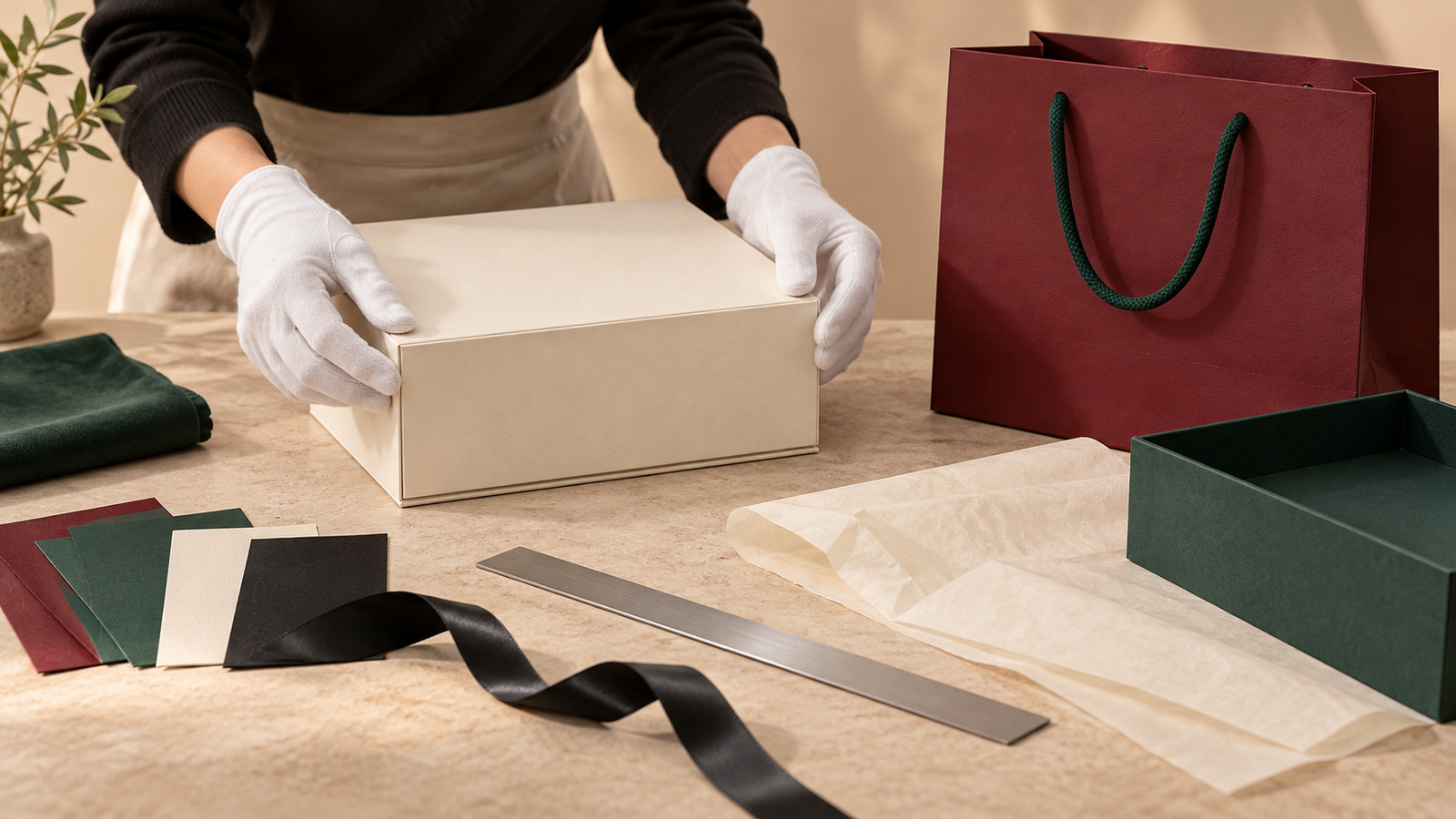
- Finished dimensions and squareness: measure the closed box and check that panels, lid and flap sit evenly.
- Product and insert fit: pack every approved component and check movement, presentation and removal.
- Closure feel: open and close the box repeatedly; inspect alignment, noise, pull and unintended reopening.
- Hinge performance: check the opening angle and look for wrap stress, whitening, lifting or delamination.
- Surface quality: review colour, print, foil, embossing, scuffs, bubbles, glue marks, edges and wrapped corners under agreed lighting.
- Packing workflow: time realistic assembly and packing, especially for a collapsible structure.
- Complete packaging fit: place the finished box, tissue and ribbon into the approved paper bag and repeat the intended handoff.
Keep one signed or otherwise controlled approval sample and record any agreed tolerances or appearance references. A beautiful prototype has limited value if purchasing, production and inspection teams cannot identify the same approved details.
How should transport testing be planned?
Test the product, insert, magnetic box and transit pack as a complete system. The International Safe Transit Association distinguishes screening tests from general simulation procedures intended to represent defined distribution hazards. Select a procedure around the actual route and objective with a qualified packaging professional or laboratory; do not claim that the magnetic presentation box alone is “shipping safe.”
Also test how finished boxes are protected before filling. Wrap surfaces can scuff, corners can crush and flaps can shift inside master cartons even when the retail product is not yet present. State the inner wrapping, dividers, carton orientation, pallet pattern and receiving checks in the supply agreement.
What belongs in a magnetic gift box RFQ?
- Product and complete pack dimensions, weights, photographs and samples
- Required presentation orientation and removal method
- Assembled or collapsible box direction and expected packing workflow
- Finished internal and external dimensions, plus drawing approval
- Board, wrap, print, colour and finish requirements
- Magnetic closure feel, lid opening angle and hinge expectations
- Insert material, cavity layout and acceptable product movement
- Quantity by size or artwork, destination markets and need-on-site date
- Sustainability, certification, labelling and regulatory evidence required
- Sample stages, approval owners, inspection criteria and delivery route
- Coordinated paper bag, tissue and custom ribbon requirements
Frequently asked questions
Are magnetic gift boxes always rigid boxes?
Many are traditional set-up rigid boxes or collapsible rigid boxes, but suppliers may also use “magnetic box” for other paperboard constructions. Ask for a structural drawing, material specification and physical sample instead of relying on the product name.
Are collapsible magnetic boxes less premium?
Not automatically. A well-designed collapsible box can look and feel refined after assembly. Its success depends on corner construction, erection accuracy, board and wrap quality, hinge geometry and closure alignment. Approve both the flat format and the correctly erected result.
How strong should the magnets be?
There is no universal value for every box. Size, flap geometry, wrap build-up, magnet spacing and the desired opening feel all affect the result. Define the experience and performance on an approved physical sample, then make the production construction match that reference.
Can a magnetic gift box be mailed without an outer carton?
Do not assume so. A presentation box may not protect its wrap, corners or contents through a parcel network. Develop and test an appropriate transit pack around the actual product and distribution route.
Build the box and bag as one customer handoff
Share your product dimensions, quantity, artwork, destination markets and timing. Bespoke Packaging can develop custom magnetic gift boxes with coordinated luxury paper bags, tissue paper and ribbon.