
RIGID BOX STRUCTURE GUIDE
Rigid Box Styles: How to Choose the Right Structure
Compare lift-off lid, drawer, book-style, shoulder-and-neck and collapsible rigid boxes by product fit, opening experience, packing, freight and sampling.
The right rigid box style is the simplest structure that fits the complete product, creates the intended reveal and works through packing, storage and delivery. A two-piece lift-off lid is versatile, a drawer box creates a controlled slide-out reveal, a book-style box keeps the lid attached, a shoulder-and-neck box adds a visible stepped detail, and a collapsible rigid box reduces empty-packaging volume before use.
Structure should be chosen before decorative finishes. A visually impressive box can still be slow to pack, expensive to ship or awkward inside its matching luxury paper shopping bag. This buyer’s guide compares the main rigid box styles and turns the decision into a practical specification for product fit, inserts, samples and quotations.
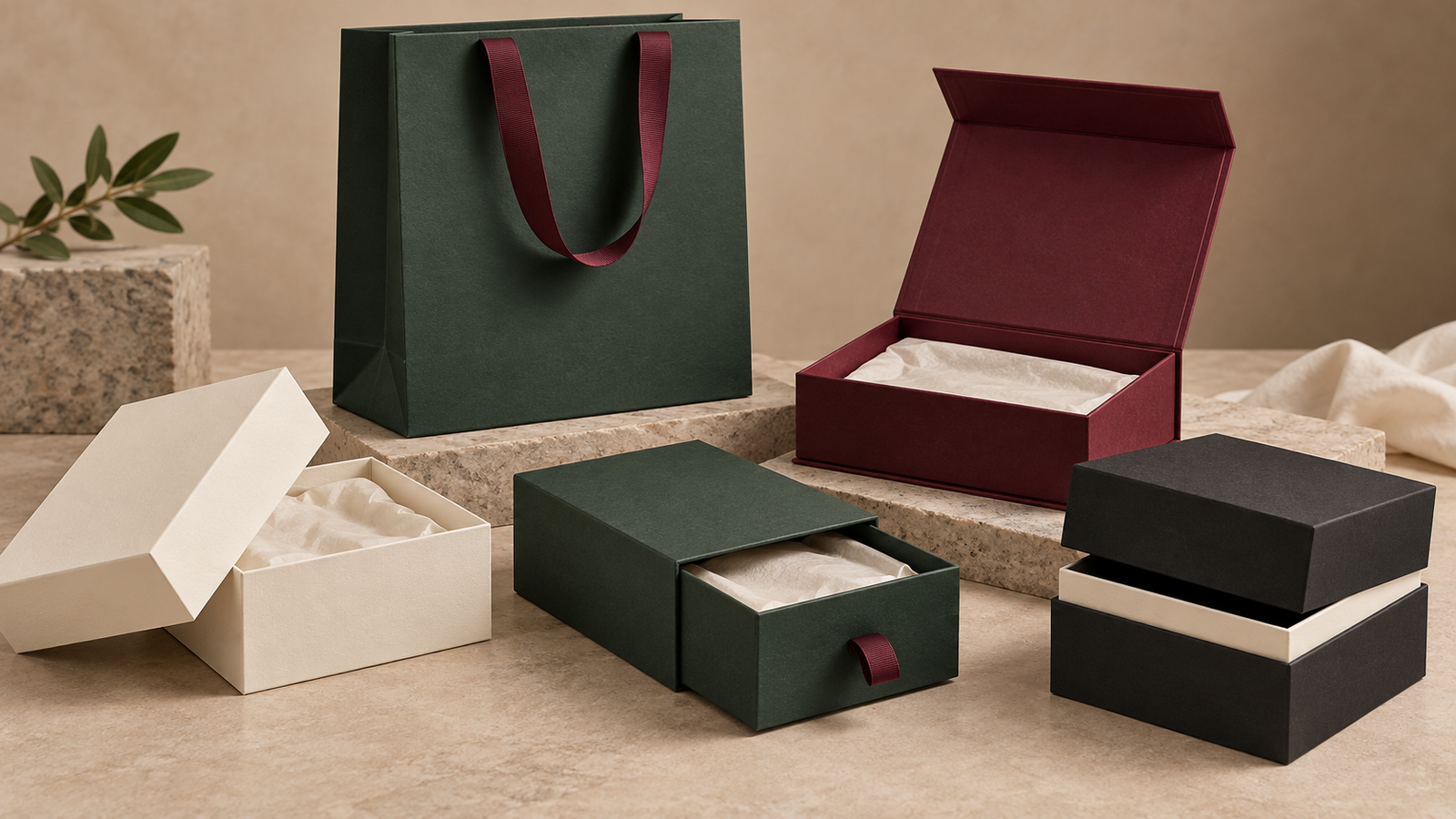
What is a rigid box?
A rigid box, also called a set-up box, uses a dense paperboard shell covered with a separate paper wrap. The board is cut and assembled into a stable three-dimensional form, while the wrap provides the colour, print surface and tactile finish. Most traditional rigid boxes arrive already formed rather than being erected from a single folded carton blank.
That construction gives a rigid box crisp walls, substantial hand-feel and a controlled opening action. It also means the buyer must consider the assembled volume, wrapped-corner quality, lid fit, insert height and protection during transport. A rigid box is premium because its construction and proportions feel resolved—not simply because it uses thick board or metallic foil.
Which rigid box style should you choose?
| Rigid box style | Best reason to choose it | Detail to prove in a sample |
|---|---|---|
| Two-piece lift-off lid | Familiar premium presentation and flexible sizing | Lid fit, lift speed and corner alignment |
| Drawer or slide box | Controlled reveal for compact products | Tray travel, pull-tab strength and product restraint |
| Book-style hinged box | Attached lid and broad interior presentation area | Hinge movement, closure alignment and opening angle |
| Shoulder-and-neck box | Distinctive stepped profile and colour contrast | Neck height, reveal line and lid engagement |
| Collapsible rigid box | Lower inbound storage and shipping volume | Assembly time, corner locking and repeatable squareness |
These names describe useful structural families, not one universal engineering specification. Suppliers may use different terms or build similar-looking boxes in different ways. Compare drawings, dimensions, assembly videos and physical samples rather than assuming that a style name guarantees the same result.
Two-piece lift-off lid rigid boxes
A separate lid fits over a base. This is often the most adaptable starting point for apparel, beauty sets, confectionery, accessories and corporate gifts. The opening experience depends on the fit between lid and base: too loose can feel uncontrolled, while too tight can create suction, scuff wrapped surfaces or make the product difficult to present.
Decide whether the lid is shallow, full-depth or telescoping, and whether the box should open quickly at a counter or slowly for a deliberate reveal. If boxes will be nested for transport, confirm how the wrap, corners and dimensions support nesting without surface damage.
Drawer rigid boxes
A drawer box combines an outer sleeve with an inner tray. The structure suits jewellery, small cosmetics, fragrance, stationery and compact gifts because the product appears gradually as the tray slides out. A ribbon pull can support the gesture, but it must be attached securely and placed where it does not twist the tray.
Approve the clearance between tray and sleeve, the stop or retention method if one is required, and how the product remains seated when the box is opened horizontally. Very tight tolerances can become unreliable when wrap paper, adhesive and humidity change the finished dimensions.
Book-style hinged rigid boxes
A book-style box has an attached cover that opens like a hardback book. It provides a large inside-lid area for restrained storytelling and keeps the lid with the base during retail use. Closures may rely on construction, ribbon or concealed magnets, depending on the project.
Test the hinge through repeated opening, confirm that the cover sits square when closed and check that any closure is necessary and appropriate for the destination market. A magnet can create a satisfying closure, but it adds a non-paper component and should not be treated as the default route for every luxury box.
Shoulder-and-neck rigid boxes
This construction places an inner neck or shoulder between the base and lid. Part of the neck can remain visible when the box is closed, creating a fine reveal line and an opportunity for a controlled colour contrast. It works well when the stepped silhouette is part of the brand language rather than an added layer without purpose.
The neck must be positioned consistently and engage the lid without leaning or binding. Specify the visible height, wrap colours and acceptable alignment. Also confirm whether the added components and volume are justified by protection, function or a genuine presentation need.
Collapsible rigid boxes
A collapsible rigid box uses wrapped panels and engineered joints so the empty box can travel or be stored flat, then be erected before filling. This can reduce inbound volume compared with a traditional set-up box, especially for larger formats. The trade-off moves into fulfilment: staff need space, time and a repeatable method to form every box correctly.
Ask for the flat dimensions, assembled dimensions, setup sequence, closure method, units per master carton and expected assembly time. Check that corners close cleanly, walls stay square and the structure does not relax after repeated opening. “Collapsible” describes a logistics feature; it does not guarantee equal strength or appearance across designs.
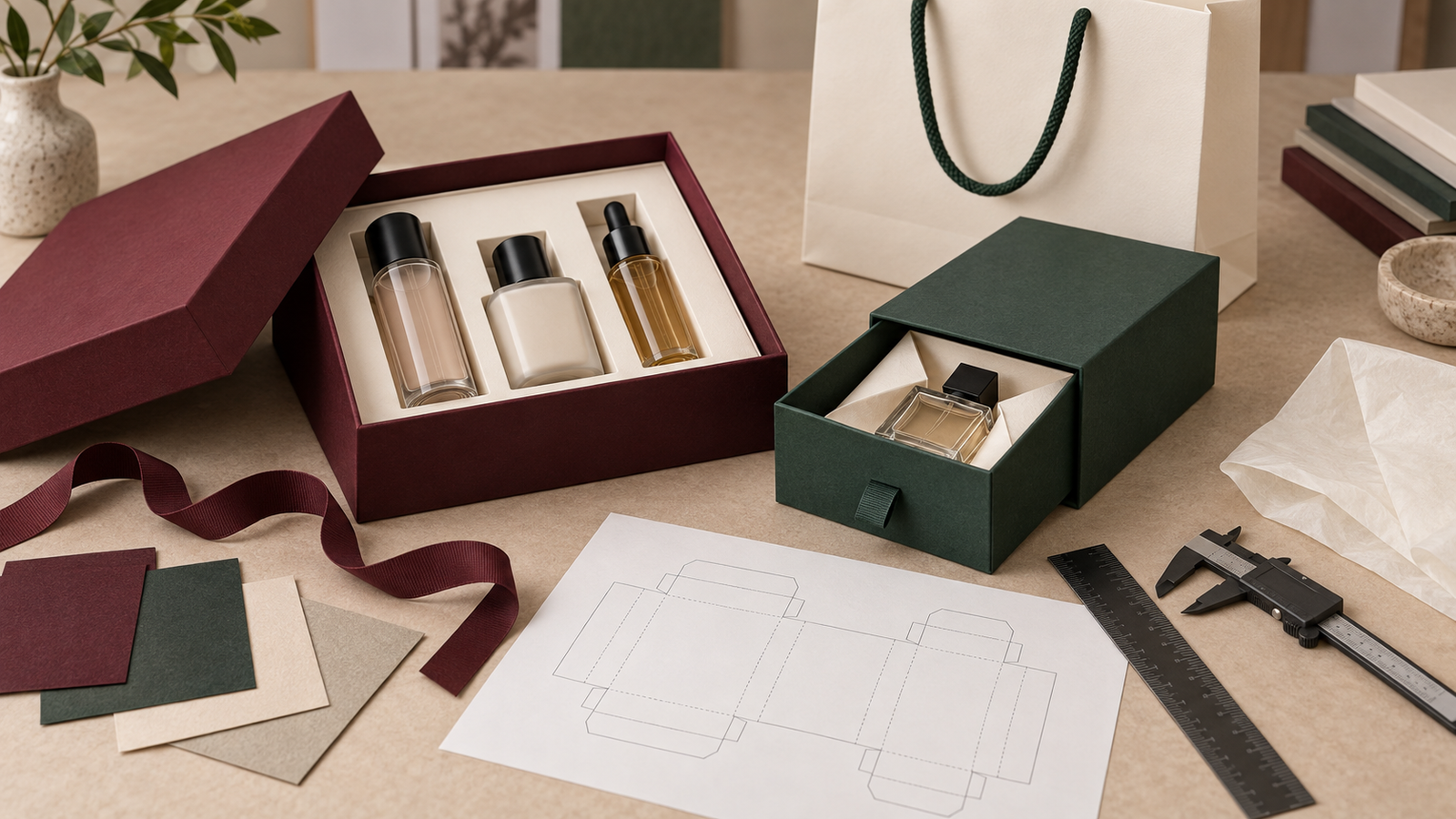
How should the product determine the box structure?
Begin with the complete packed product, not a catalogue dimension or an empty box style. Include caps, closures, cables, instruction cards, dust bags, tissue, ribbon and anything else that will be present at the moment of opening. Define the intended orientation and identify surfaces that can scratch, leak, settle or move.
- Measure the maximum product dimensions in its intended orientation.
- Record the packed weight and centre of gravity.
- Decide how the customer should see and remove the product.
- Choose an insert concept that restrains the product without making removal frustrating.
- Allow manufacturing tolerance, wrap thickness and realistic packing clearance.
- Build and handle a plain structural sample before committing to decorative finishes.
- Place the finished box inside the proposed shopping bag and transport packaging.
The GS1 Package and Product Measurement Standard provides a repeatable method for communicating height, width and depth and says measurements should include maximum projections. That is useful for shared data, but the internal fit still needs a drawing and physical sample because inserts, lids, necks and wrapped walls consume space.
How do inserts change the best rigid box style?
The insert is part of the structure and reveal. A folded paperboard insert can create compartments and printed surfaces; moulded pulp can support rounded products; other materials may be considered when the product demands them. The correct choice depends on weight, fragility, removal, recovery route and the number of product variants sharing the box.
- Top presentation: control the finished insert height so the product sits visibly without touching the lid.
- Removal: provide finger access, ribbon lifts or another intentional removal route.
- Restraint: prevent a bottle, jar or accessory from moving into the lid or wrapped walls.
- Variant control: use a common outer box only when interchangeable inserts do not create misleading empty space or weak support.
- Material clarity: identify each insert material and how it separates from the box after use.
- Production tolerance: prove fit with production-intent products, not only ideal CAD geometry.
A drawer box often needs especially good restraint because the product moves horizontally during opening. A lift-off lid can accommodate a removable tray more easily. A book-style box may use the inside cover as part of the presentation, but the product should not strike it during transport. Choose the structure and insert together.
Which rigid box style is most efficient to ship and store?
There is no single winner. Traditional set-up boxes arrive ready to fill but occupy their finished volume. Some lift-off lids and bases can nest, although nesting must not scuff the wrap or make unpacking difficult. Collapsible boxes reduce empty-packaging volume but add assembly labour and quality checks at the packing site.
Compare the complete landed and operational picture: units per master carton, carton dimensions and gross weight, total shipment volume, pallet plan, warehouse footprint, assembly time, protective packing and expected damage rate. Our guide to packaging size and shipping cost explains why an economical unit price can still produce a costly pack-out.
Retail presentation packaging should also be protected by suitable transport packaging. Do not assume that a premium rigid box is itself a parcel shipper. The route from factory to warehouse and from fulfilment centre to customer can expose the complete pack to compression, shock, vibration and changes in temperature or humidity.
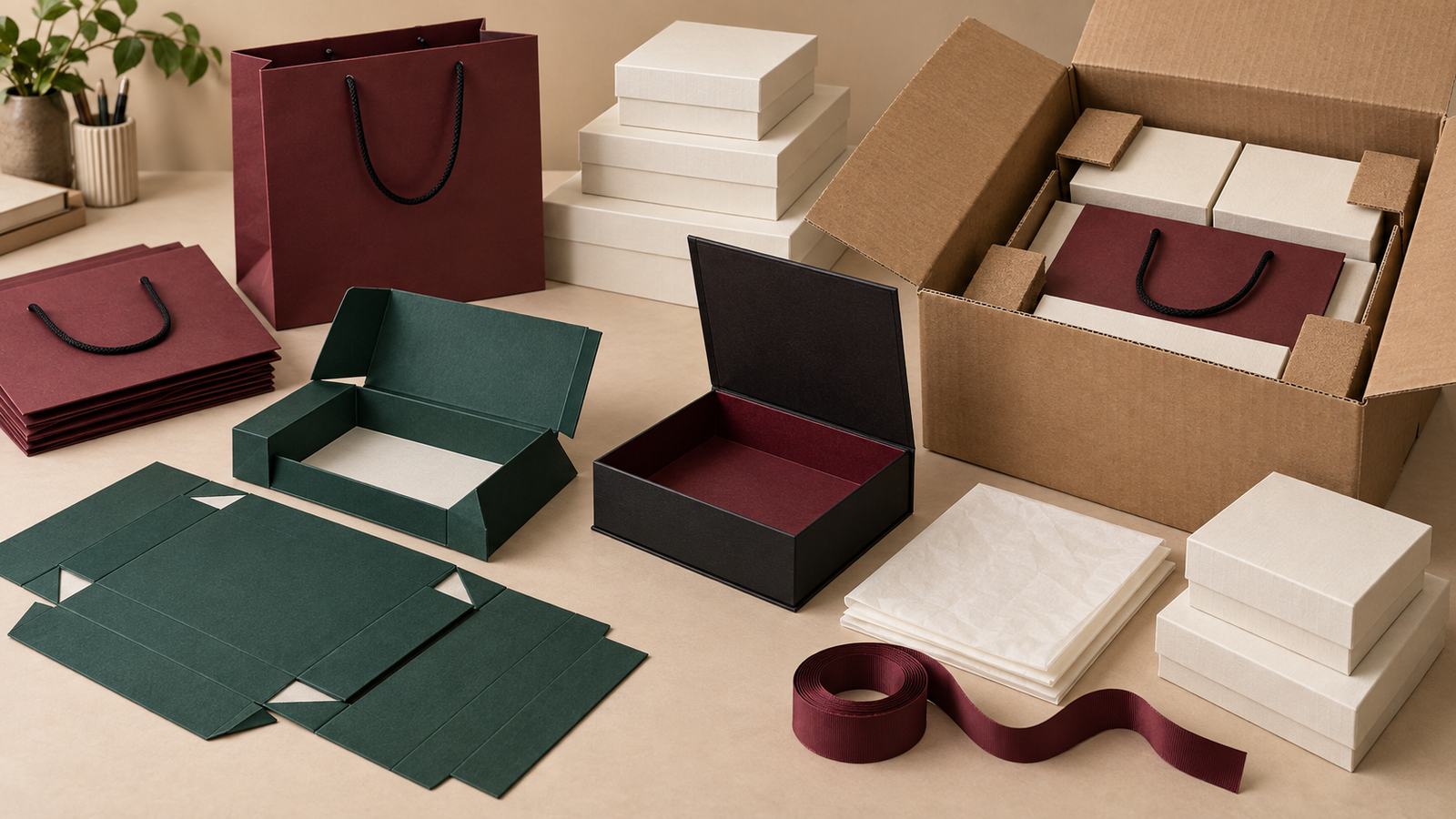
How does rigid box style affect cost and MOQ?
Cost follows the exact design rather than the style name alone. Finished size, board and wrap specifications, number of components, insert complexity, printing, finishing, assembly, packing and order quantity all matter. A simple two-piece box can become expensive if it is oversized or uses difficult wraps; a more complex structure may be efficient when it is compact and designed for repeatable production.
- Compare internal and external finished dimensions.
- Confirm whether tooling, samples and assembly are included.
- List each board, wrap, insert, ribbon, closure and decorative finish.
- Ask how many finished boxes fit in each master carton.
- Separate unit price from freight, import costs, storage and fulfilment labour.
- Compare quantity breaks using the same specification and delivery term.
There is no honest universal minimum order for every rigid box. Minimums depend on material purchasing, tooling, printing, construction and factory scheduling. If a quotation changes the structure, wrap or packing method to reach a lower minimum, treat it as a different option rather than an equivalent price.
Can a rigid box be designed for better recycling?
Start by identifying every component: greyboard, paper wrap, ink, coating, adhesive, insert, ribbon, magnet, textile or plastic part. A box that looks paper-based may still contain integrated elements that affect sorting or fibre recovery. Avoid broad claims based only on the outer wrap.
The 4evergreen Circularity by Design Guideline, Version 4, published in February 2026, gives current industry guidance on inks, coatings, adhesives, integrated components and sorting disruptors in paper-based packaging. Use it as a design reference, then confirm the actual construction and destination-market collection route rather than declaring every rigid box recyclable everywhere.
For packaging placed on the EU market, Regulation (EU) 2025/40 phases in recyclability and packaging-minimisation requirements. It also requires sales-packaging empty space to be reduced to the minimum necessary for functionality from 12 February 2028. A fitted, right-sized box can preserve a premium reveal without relying on false bottoms or unused volume.
How should the rigid box and luxury paper bag work together?
The rigid box creates the private unboxing moment; the paper bag carries the purchase through a public retail environment. Design them as a sequence. The bag must accept the finished box naturally, keep it in the intended orientation and provide enough clearance for tissue or a receipt without letting the box move excessively.
- Size the bag around the finished external box, including any sleeve or ribbon.
- Keep box corners from scraping the bag panels during loading and removal.
- Match the handle, top reinforcement and base board to the complete packed weight.
- Repeat one or two cues—such as wrap texture, ribbon colour or foil tone—rather than making every component identical.
- Test the filled bag at the retail counter and through a realistic carry cycle.
- Coordinate tissue paper so it protects and frames the box without preventing easy loading.
Use our luxury paper bag size guide to define practical clearance and our luxury packaging sets guide to coordinate the box, bag, tissue and ribbon as one system.
What should a rigid box sample prove?
Approve structure before appearance wherever possible. A plain prototype can prove dimensions, opening action and product removal. A wrapped or printed sample can then prove colour, texture, corners, registration, finishing and the complete brand presentation.
- Internal and external dimensions against the approved drawing.
- Product and insert fit using representative production items.
- Lid, drawer, hinge, neck or collapsible-corner movement.
- Wrapped-edge alignment, corner quality and surface resistance.
- Opening force, removal access and safe repacking.
- Complete box fit inside the shopping bag and shipping carton.
- Pack-out sequence and staff assembly time where relevant.
- Acceptance criteria for visual and functional variation.
For transport validation, select tests around the real distribution route and the complete packaged product. ISTA’s design and testing guidance recommends understanding how packages are shipped, handled and stored, using representative samples and choosing the current test procedure for the intended decision. A decorative empty-box check is not a substitute for testing the filled packaging system.
What belongs in a rigid box quotation brief?
- Product dimensions, weight, orientation and fragility.
- Required internal space and proposed external box dimensions.
- Preferred structure and opening experience.
- Insert material, compartments and removal method.
- Board, paper wrap, print, colour and surface finish.
- Closure, hinge, ribbon pull or other functional components.
- Order quantity, variant count and expected repeat orders.
- Sample stages and approval criteria.
- Flat, nested or assembled packing method and units per carton.
- Delivery country, route, deadline and applicable requirements.
- Matching paper bag, tissue paper and ribbon specifications.
If the structure is not decided, send the product, desired reveal, quantity, delivery plan and reference direction first. Ask the supplier to compare two practical routes with the same product and commercial assumptions. That produces a more useful decision than requesting several style names without a common brief.
Frequently asked questions about rigid box styles
What is the most luxurious rigid box style?
No single structure is automatically the most luxurious. A precisely fitted two-piece box can feel more premium than a complicated magnetic box with poor alignment. Product fit, opening control, wrap quality, proportions and consistency create the result.
Are magnetic closure boxes always rigid boxes?
No. Magnetic closure describes a feature, not one construction. It can appear on a traditional book-style rigid box or a fold-flat design. Confirm the board construction, assembly method, magnet placement and finished packing format.
Can rigid boxes ship flat?
Traditional set-up boxes normally keep their three-dimensional form, while collapsible rigid boxes are engineered to ship or store flat. Compare assembly labour, corner quality and total landed cost before choosing the fold-flat route.
Is a rigid box stronger than a folding carton?
A rigid box generally has thicker, more stable walls, but strength is not one universal rating. Board, dimensions, joints, insert, product weight and distribution conditions all affect performance. Test the complete filled package for its real route.
Should the rigid box or paper bag be designed first?
Define the product and protective box first, then size the paper bag around that finished pack. Develop both within the same packaging system so colour, handles, carrying weight and retail packing remain coordinated.
Choose the structure before the decoration
Rigid box styles create different opening gestures and operational demands. Select the structure by product fit, reveal, packing method, storage and shipping; prove it with an appropriate sample; then add the wrap, printing and finishes that support the brand. The result will feel more luxurious because every layer has a clear job.
Bespoke Packaging develops custom rigid gift boxes alongside luxury paper bags, tissue paper and ribbon. Share your product dimensions, quantity, delivery market, preferred opening style and visual direction, and we can help compare structures and plan a coordinated sample.