
CUSTOM DRAWER BOX BUYER GUIDE
Custom Drawer Boxes: A Buyer’s Guide to Luxury Packaging
Specify the sleeve, tray, opening detail, insert and retail carrier as one packaging system—then approve how the finished box opens, protects and ships.
Custom drawer boxes are sleeve-and-tray packages in which an inner tray slides from an outer sleeve to reveal the product. They can create a controlled premium opening, but the result depends on more than the box style. Product fit, tray-to-sleeve movement, pull detail, board and wrap, insert, packing method and distribution route must work together.
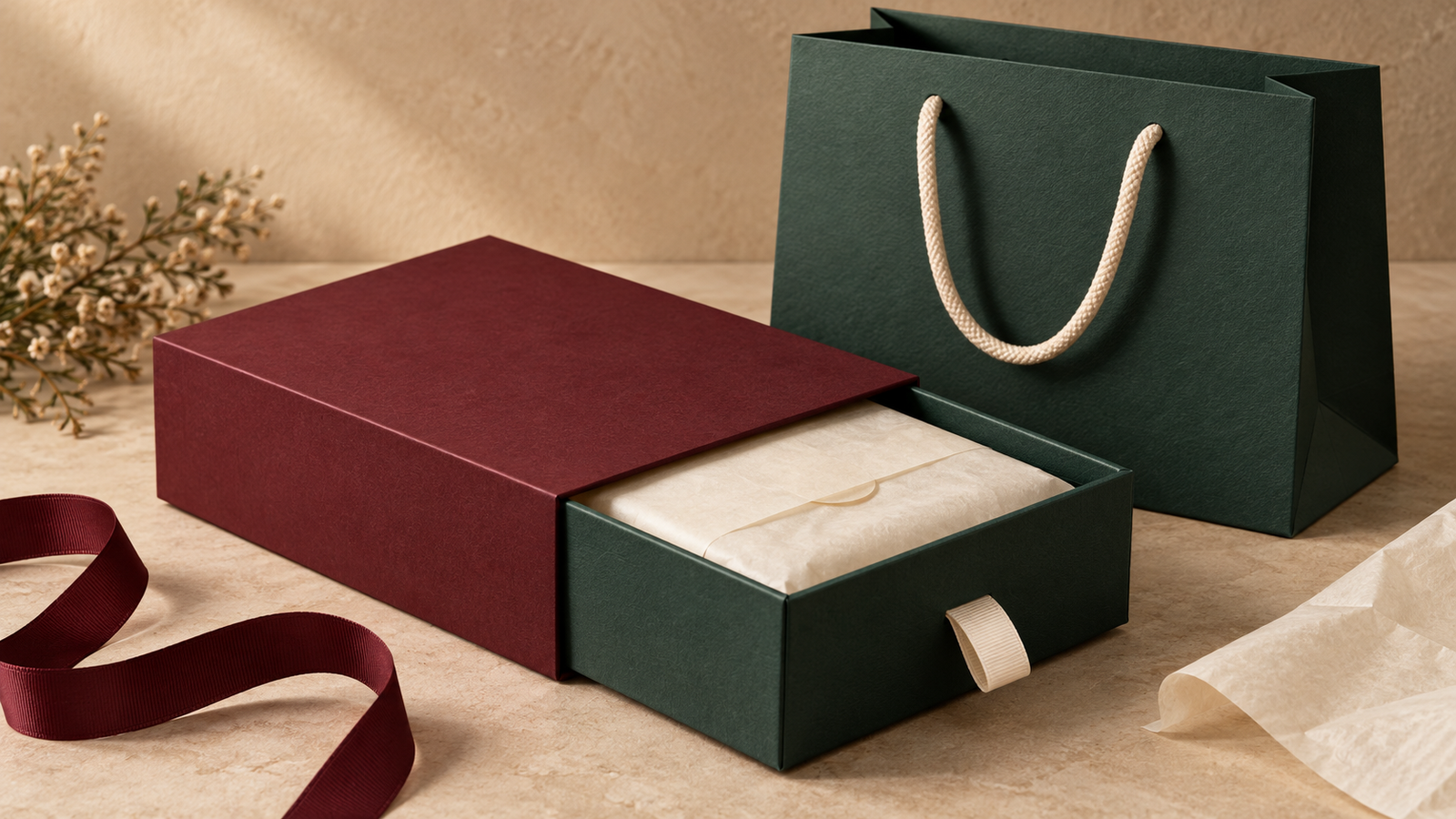
The sleeve
The outer sleeve controls the visual reveal and guides the tray. Its inside wrap, squareness and opening dimensions affect friction as much as the visible exterior.
The tray
The inner tray carries the product and insert. Its loaded weight, wall height, pull point and fit determine whether opening feels deliberate, loose or frustrating.
What is a custom drawer box?
A drawer box—also called a sliding box, sleeve-and-tray box or matchbox-style box—uses a separate inner tray and outer sleeve. A rigid version is commonly built from wrapped board components that remain set up. Lighter folding-paperboard versions can use the same sliding idea but have a different hand-feel, protection level, assembly method and freight profile.
The useful buying question is not simply “Do we want a drawer box?” It is “What must the complete package do?” A compact jewellery item, a skincare set and a dense electronic accessory create different needs for insert retention, tray depth, opening force and transport protection. Start with the packed product and customer journey, then choose the structure.
The short buyer answer
Choose a rigid drawer box when a controlled slide-to-reveal opening, repeated storage and a compact rectangular form support the product experience. Approve a loaded physical sample, because the same nominal size can feel very different after wrap paper, lining, adhesives, inserts and production variation are introduced.
When does a drawer box suit the product?
| Packaging format | Opening experience | Best starting point | Main question to test |
|---|---|---|---|
| Rigid drawer box | Tray slides from a sleeve | Premium sets, accessories and products where a staged reveal matters | Does the loaded tray move smoothly without drifting open? |
| Lift-off lid rigid box | Lid lifts away from a base | Classic gifting and products viewed from above | Is lid fit consistent and easy to remove? |
| Magnetic hinged box | Lid pivots open and closes at a defined point | Presentation sets and repeated access | Do hinge, closure and insert work together? |
| Folding carton | Flaps open from a flat-made structure | Lighter products, efficient flat shipping and faster packing lines | Does the board and closure protect the product through the route? |
Format choice should reflect product value, protection, store or fulfilment workflow, packer time, storage and distribution—not an assumption that one style is universally more luxurious. The rigid box styles guide compares the broader family, while this guide focuses on getting the drawer format right.
How should the tray slide?
The tray should open with an intentional, repeatable action. It should not fall from the sleeve when the box is handled in its expected orientation, and it should not require a sharp pull that bends the tray wall or strains the ribbon. There is no responsible universal clearance to copy: board caliper, wrap thickness, lining, humidity response, adhesive build, box size and loaded weight all affect movement.
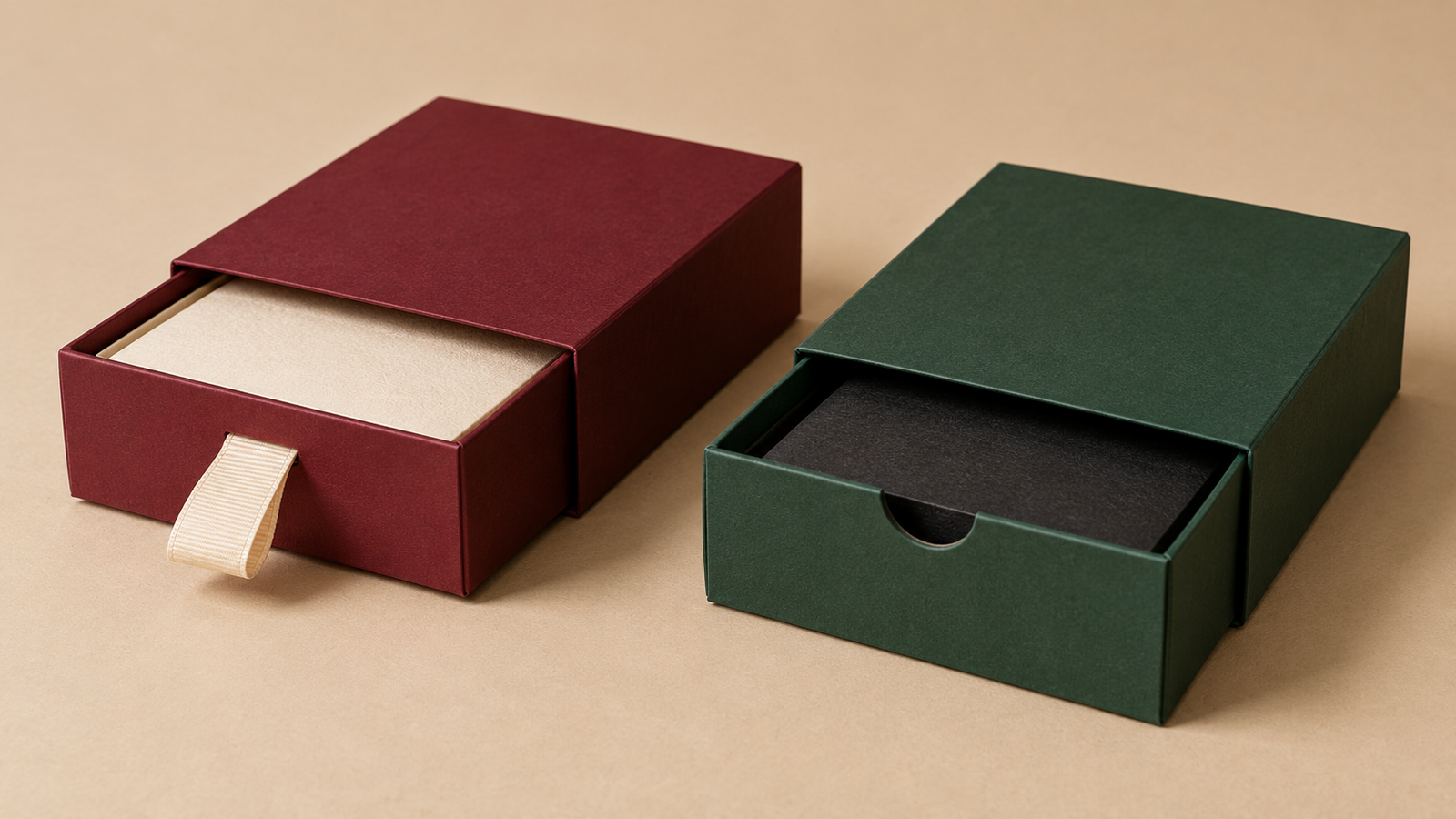
Ribbon pull
A ribbon loop gives the customer a clear place to pull and can coordinate with the wider packaging set. Specify fibre, weave, width, colour, loop length, cut-edge treatment and anchoring. The pull must remain secure under the real loaded tray—not only on an empty display sample.
Thumb notch
A die-cut notch can create a quieter, all-paper visual direction and avoid a loose pull component. Check finger access, cut quality, wrap edges and whether the customer can start the tray without marking the front panel. A notch may suit a lighter tray better than a deep, heavily loaded one.
Evaluate the motion after the box has been conditioned, packed, transported and opened repeatedly. A pristine empty sample can hide the forces created by the actual product and insert.
How do you size a sleeve-and-tray box?
Size the cavity around the complete product presentation: product, primary pack, protective wrap, insert, instructions and any accessories. Record the intended orientation and removal path. The insert needs enough retention to prevent movement but should not force the customer to pry out the product or crush a delicate surface.
- Measure the real product system. Use production-representative units, not a nominal website dimension.
- Choose the presentation direction. Decide what the customer sees first and where fingers need access.
- Develop the insert and tray together. Include wall thickness, finger cut-outs, accessory wells and required cushioning.
- Fit the tray to the sleeve. Approve sliding movement on the final wrap and lining materials.
- Measure the finished closed box. Use that external size for the retail bag, shipper and storage plan.
The current GS1 Package and Product Measurement Standard provides a repeatable method for recording package dimensions and says measurements should be retaken when a product or package change could affect size or weight. Keep internal cavity dimensions, finished external dimensions and shipping-case dimensions as separate fields.
Which materials and finishes belong in the specification?
A rigid drawer box specification should identify the board or structural substrate, exterior wrap, interior lining, printed areas, adhesives, insert material and opening component. Colour and finish names alone are not enough. A dark uncoated wrap, matte printed wrap and film-laminated surface can show edge wear, fingerprints and folds differently.
Structure and fit
- Board type and thickness direction
- Tray and sleeve construction
- Wrap and lining papers
- Corner, seam and edge requirements
- Insert material and retention points
- Ribbon pull or thumb-notch detail
Appearance and evidence
- Print process and colour references
- Foil, embossing or coating locations
- Inside-versus-outside colour relationship
- Rub, fold and edge acceptance criteria
- Required fibre-sourcing claim
- Recovery or recyclability evidence by market
If an FSC on-product label is required, plan it before artwork approval. FSC’s on-product labelling guidance explains that the company supplying the finished labelled product must be certified and that label graphics and approval are controlled through the certified supplier. A statement about one paper component should not be presented as certification of the complete box without the correct chain-of-custody route.
What should a drawer-box sample prove?
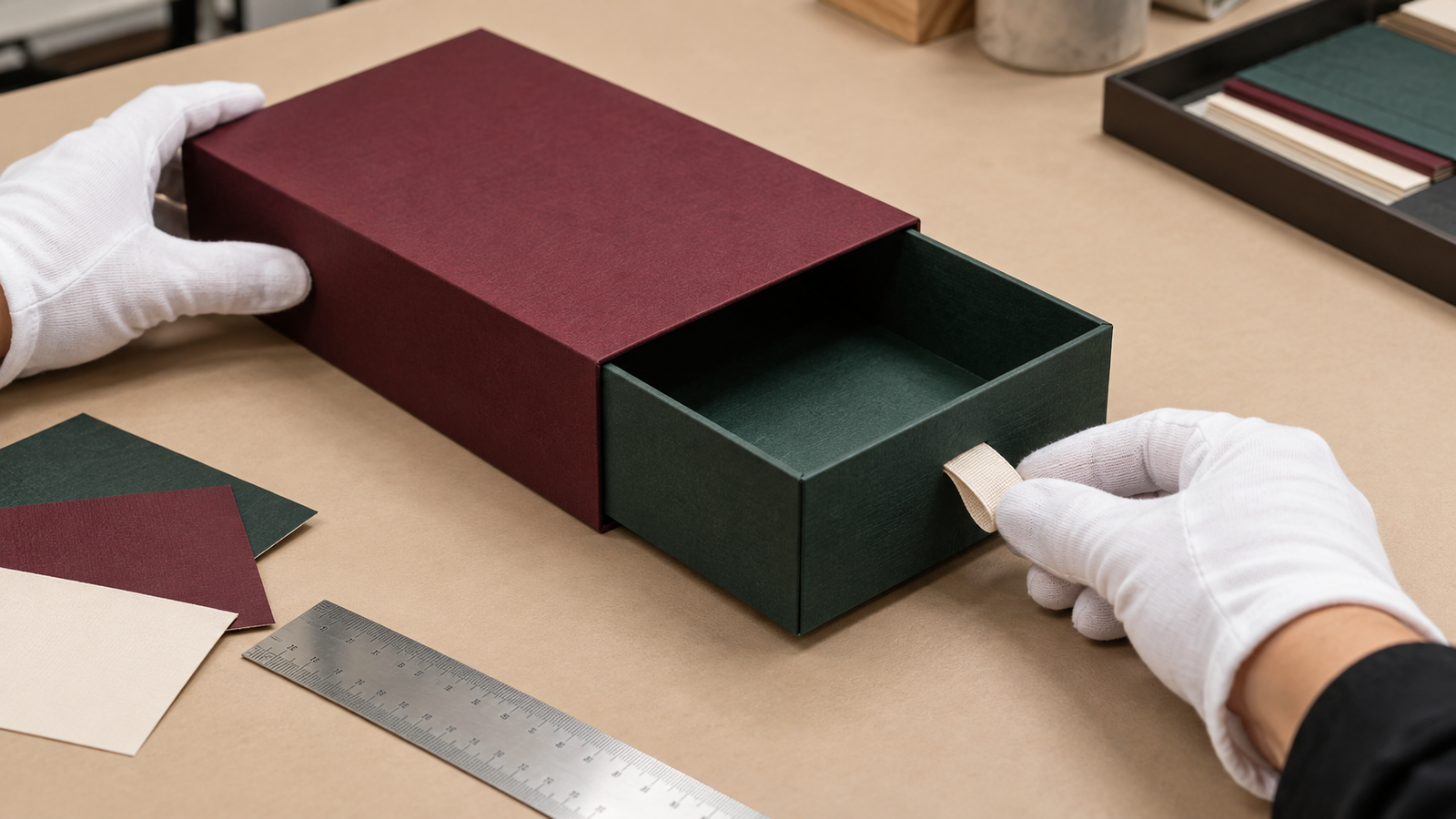
- Product fit: every item sits in the intended orientation and can be removed without damage.
- Sliding action: the loaded tray moves smoothly, stays aligned and does not drift open during normal handling.
- Squareness: sleeve and tray sit level without rocking, bowing or visibly uneven gaps.
- Pull detail: ribbon anchoring, notch access and front-wall strength survive repeated realistic opening.
- Surface quality: wrap joins, corners, edges, print and finishes meet the written appearance reference.
- Packing routine: staff can insert the product, close the box and prepare the retail presentation consistently.
- Master reference: the approved sample is signed, dated and linked to the final dieline, artwork and bill of materials.
Use the sample to define acceptance, not merely to admire the concept. Record any temporary material or hand-made difference so it is not mistaken for the mass-production standard. For detailed insert choices, see the custom box inserts guide.
How should the finished box be tested for shipping?
A presentation box is not automatically a transport package. Decide whether the drawer box travels inside a protective corrugated shipper, a master export carton or another distribution system. Test the packed product and all packaging layers together against the actual route.
ISTA’s current test-procedure overview separates basic integrity screening from partial, general and enhanced simulation and stresses selecting a procedure for the intended outcome and distribution environment. A successful screening test is not a universal promise for every route. Define the hazards, sample count, conditioning, pass criteria and retest triggers with a qualified packaging partner or laboratory.
Protect the box surface and pull detail inside the shipper, then inspect for sleeve crushing, corner damage, scuffing, tray movement, insert release and product damage. Changes to board, wrap, insert, product weight, pack-out or route can justify retesting.
How does a drawer box work with a luxury paper bag?
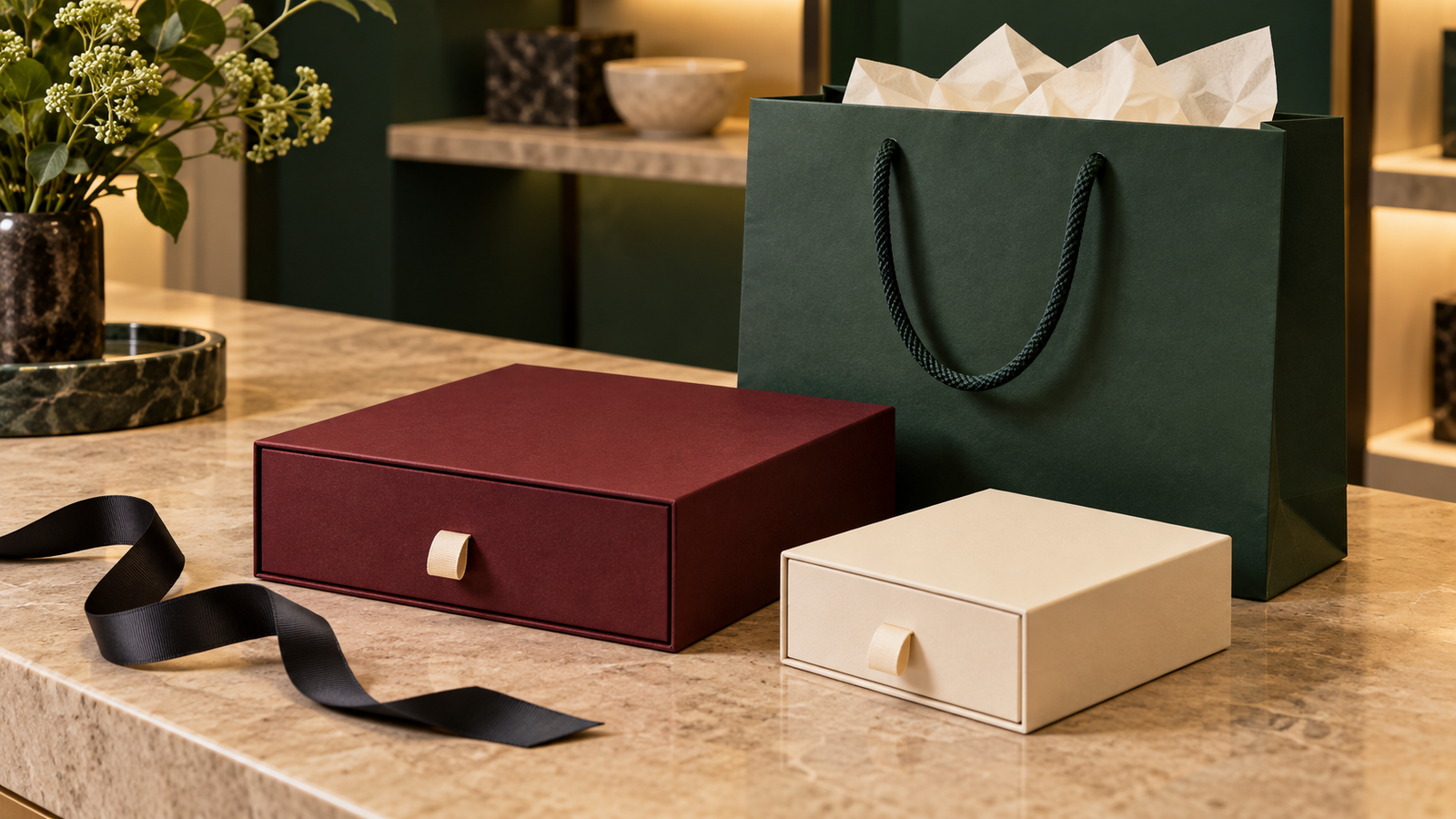
The rigid box protects and stages the product; the luxury paper shopping bag supports the store handoff, carrying experience and public-facing brand cue. Size the bag around the closed box, tissue and any receipt or message card. Check loading clearance, carried orientation, handle comfort and maximum packed weight using the real set.
Coordination does not require identical materials on every component. One colour, texture or ribbon cue can link the drawer box to the bag while allowing each structure to perform its own job. Printed tissue paper can control the reveal inside the bag, and a shared packaging ribbon can connect the box pull with gift wrapping or handles.
How should material efficiency and recycling be assessed?
Rigid construction can support protection, presentation and continued storage, but those functions do not remove the need to optimize material. ISO 18602:2013, confirmed current in 2024, sets out assessment of packaging weight or volume while maintaining packaging functions. Use that principle across the complete system, including the insert, retail bag and transport pack.
The 2026 4evergreen Circularity by Design Guideline, Version 4 assesses paper-based packaging as complete constructions and distinguishes recycling pathways. Ask how wrap papers, films, foils, adhesives, magnets, ribbons and insert materials affect the intended recovery route. Do not claim that a box is recyclable merely because its main structural board is paper-based.
For EU destinations, the European Commission states that Regulation (EU) 2025/40 began applying on a phased basis from 12 August 2026, with additional measures and secondary rules following on later dates. Confirm the destination market and current obligations before approving claims, labels or material choices.
What belongs in a custom drawer-box RFQ?
- Product dimensions, weight, orientation and removal needs
- Finished box internal and external dimensions
- Rigid or folding sleeve-and-tray construction
- Board, wrap, lining, insert and adhesive direction
- Ribbon pull, thumb notch or other opening detail
- Artwork, colour references, print and finishing layers
- Quantity by size, artwork and destination
- Sample stages and signed approval reference
- Sliding, appearance and functional acceptance criteria
- Retail bag, tissue and ribbon coordination
- Master-carton packing and distribution route
- Required sourcing, recovery and regulatory evidence
Frequently asked questions
Are custom drawer boxes always rigid boxes?
No. The sleeve-and-tray concept can be made as a rigid set-up box or a lighter folding-paperboard structure. Ask the supplier to identify the construction, materials, assembly and shipping state rather than relying on the style name.
Is a ribbon pull better than a thumb notch?
Neither is universally better. Ribbon can add a tactile brand detail and help with a deeper tray; a notch can create a simpler material direction. Test accessibility, anchoring, appearance and repeat opening with the real product loaded.
How tight should a drawer box be?
There is no single correct numerical gap for every construction. The tray should move smoothly, remain controlled in expected handling and continue to work after materials, loading, conditioning and production variation are represented.
Can a drawer box ship without an outer carton?
Do not assume so. A premium retail box may need a protective shipper or export carton to prevent crushing, scuffing and unintended opening. Base the decision on product risk, route and tested pack performance.
Should the paper bag match the drawer box exactly?
No. Match the brand system rather than forcing identical substrates. Repeat a controlled colour, texture or ribbon cue, and approve the box, tissue and bag together under the same lighting and packing conditions.
Build the reveal around the real product
Share your product, box dimensions, opening direction, insert needs, quantity and delivery market. Bespoke Packaging can develop custom drawer boxes and coordinate the finished set with luxury paper bags, tissue paper and ribbon.