
COLLAPSIBLE RIGID BOX BUYER GUIDE
Custom Collapsible Rigid Boxes: A Buyer’s Guide
Plan the flat pack, assembly method, product fit, luxury finish and retail paper bag as one controlled packaging system.
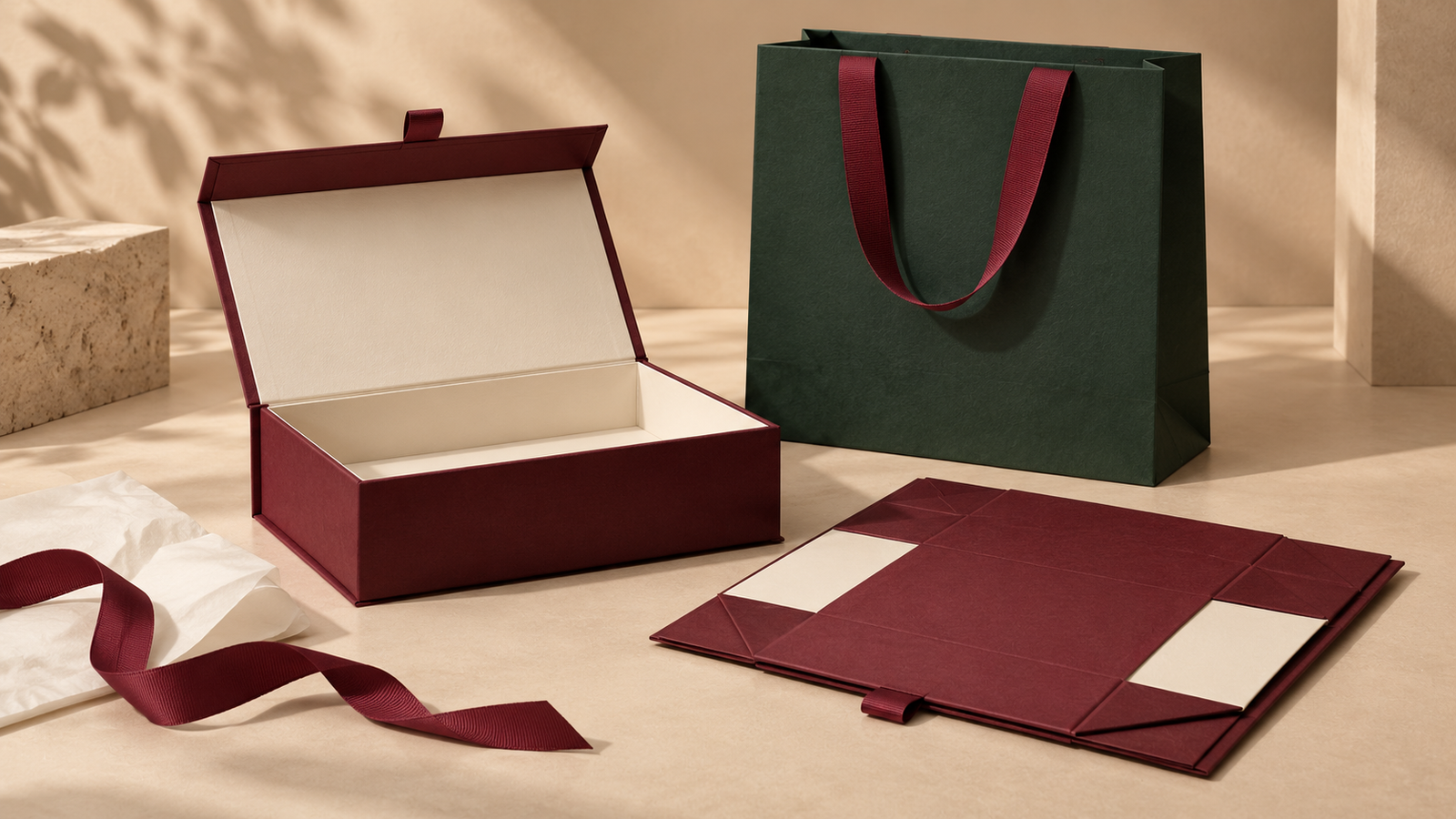
Custom collapsible rigid boxes are wrapped-board presentation boxes that travel and store flat, then lock into a shape-holding form for pack-out. They can reduce the unused volume associated with shipping fully assembled setup boxes, but only when the folding joints, corner locks, closure, insert and store assembly routine are engineered together.
The short buyer answer
Choose a collapsible rigid box when premium presentation is important but assembled-box freight or storage volume is a genuine operational constraint. Approve both states: the flat pack must arrive protected and stack efficiently; the assembled box must square up consistently, retain its corners, close cleanly and fit the real product. A rendering or an empty display sample cannot prove the whole system.
What is a collapsible rigid box?
A collapsible rigid box uses rigid or semi-rigid wrapped panels connected by flexible hinge areas. Side walls fold inward for transport and rise during assembly. Corners may be held by concealed magnets, adhesive strips, locking tabs or another supplier-specific method. Many versions use an attached book-style lid; others adapt lift-off or gate-fold presentations.
The word collapsible describes how the structure ships and stores, not a universal construction. Ask for the flat layout, assembled drawing and closure detail. “Foldable gift box,” “flat-pack rigid box” and “collapsible setup box” may refer to related formats with different joints, board builds and assembly steps.
| Format | Delivered state | Operational advantage | Main approval focus |
|---|---|---|---|
| Collapsible rigid box | Flat or partly folded | Reduces storage volume before pack-out while retaining a wrapped-board presentation | Assembly repeatability, corner retention, hinge life, closure and squareness |
| Conventional setup box | Fully assembled | Ready to fill with no store assembly | Dimensional consistency, wrap quality, lid fit and transport protection |
| Folding carton | Flat | Efficient material and storage route for many products | Board grade, crease behaviour, locking features and required protection |
How does the flat box become a rigid presentation box?
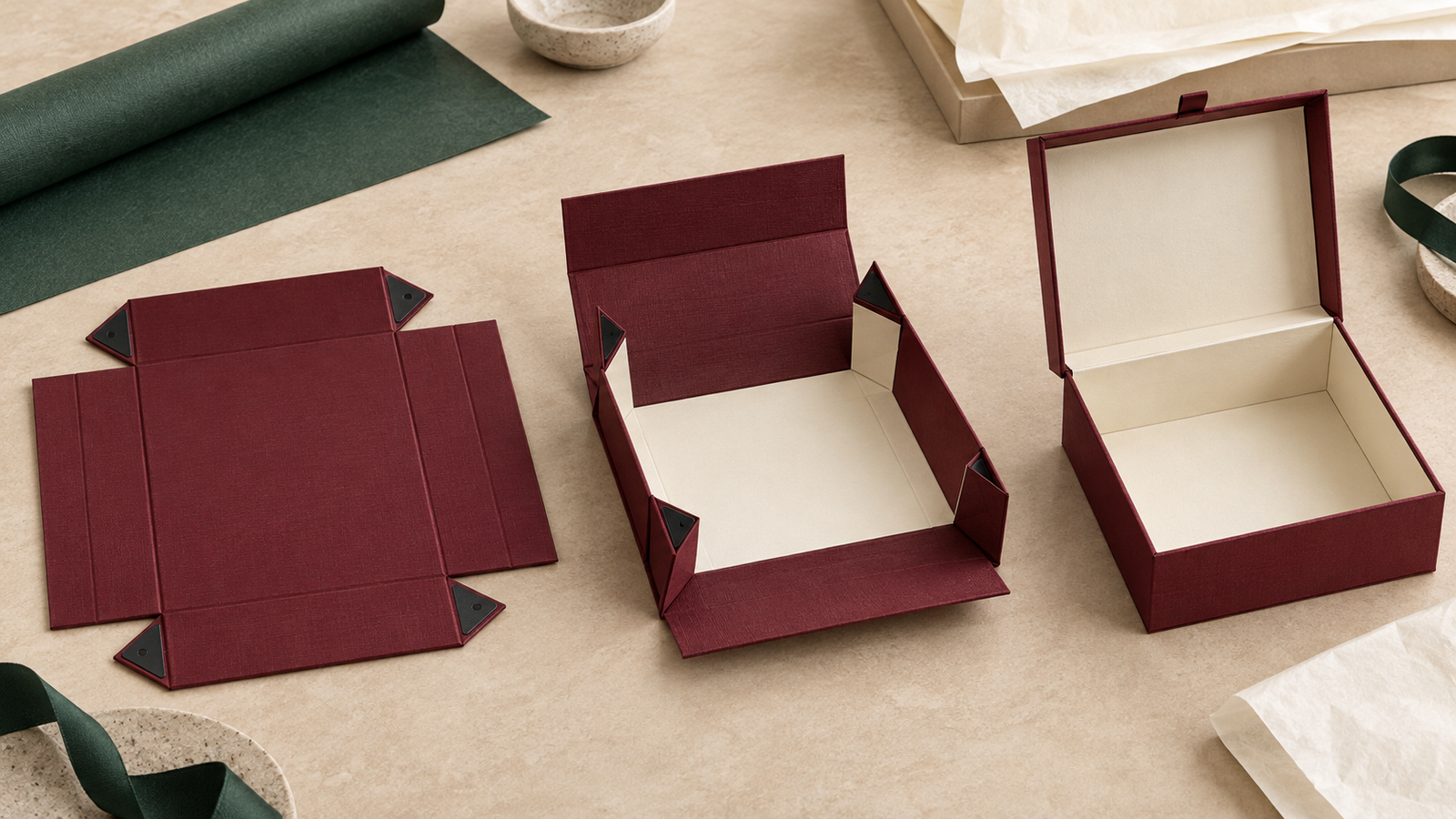
Watch the collapsible box structure in motion
The video shows how a collapsible rigid box changes from a flat pack into a shape-holding presentation box. Watch the side panels rise, the corners engage and the lid align with the assembled base. The mechanism is a useful visual reference, but corner locks, closures and hinge construction vary by supplier, so the production sample and approved assembly sequence remain authoritative.
A typical assembly sequence raises the side walls, brings the corner flaps into position, engages the locks and checks that the base and lid sit square. The exact sequence matters because a rushed operator can trap a lining, leave a magnet partly engaged or force a panel against its intended fold direction.
Flat-pack control
Specify the folded footprint, maximum stack height, interleaving if required, carton orientation and protection for exposed wrap surfaces, ribbon tabs and closures.
Assembly control
Record the steps, expected time range, handling points and a simple acceptance check. Test them with the people and workspace that will assemble production units.
Assembled control
Check external and internal dimensions, corner seating, base flatness, wall alignment, lid registration, closure force and the fitted product.
When does the format make commercial sense?
Strong reasons to shortlist it
- Assembled rigid boxes would consume disproportionate inbound or back-room space.
- The pack-out team can perform and verify a short assembly routine.
- The product benefits from a wrapped-board presentation and attached opening sequence.
- Several stores or fulfilment locations need compact incoming stock.
- The flat and assembled configurations can both be sampled and inspected.
Reasons to compare another structure
- Retail staff need a box that is immediately ready to fill.
- The pack-out area has no clean space for assembly and inspection.
- Repeated folding is central to the use case but the hinge has not been validated for it.
- A lighter folding carton can perform the required function.
- Magnets, tapes or mixed components add complexity without a clear benefit.
Compare the decision with the broader rigid box styles guide. If the priority is a sliding reveal, review a drawer box. If an attached lid and closure are essential but flat delivery is not, a conventional magnetic rigid box may be simpler.
Which dimensions belong in the specification?
Record more than finished length, width and height. A useful specification separates product dimensions, insert cavity, assembled box interior, assembled exterior, folded footprint and master-carton pack. State dimension order and measurement condition so supplier drawings and warehouse data describe the same object.
- Start with the complete product set. Include accessories, documents, primary packs and any protective sleeves.
- Fix orientation and removal. Decide which face appears first and where fingers can reach the product.
- Develop the insert. The box insert should control movement without obstructing assembly or closure.
- Build the assembled box around the insert. Allow for real board, wrap, lining, hinge and adhesive build.
- Measure the folded state. Include projections such as ribbon tabs and identify the stacking direction.
- Check the retail carrier. Size the luxury paper bag around the closed presentation box and its counter pack-out.
There is no universal clearance, board thickness or magnet count for every collapsible box. Product mass, box span, insert geometry, wrap paper, humidity, opening sequence and supplier construction all affect the result. Approve the proposed build rather than converting a catalogue description into an assumed performance claim.
What should a production-relevant sample prove?
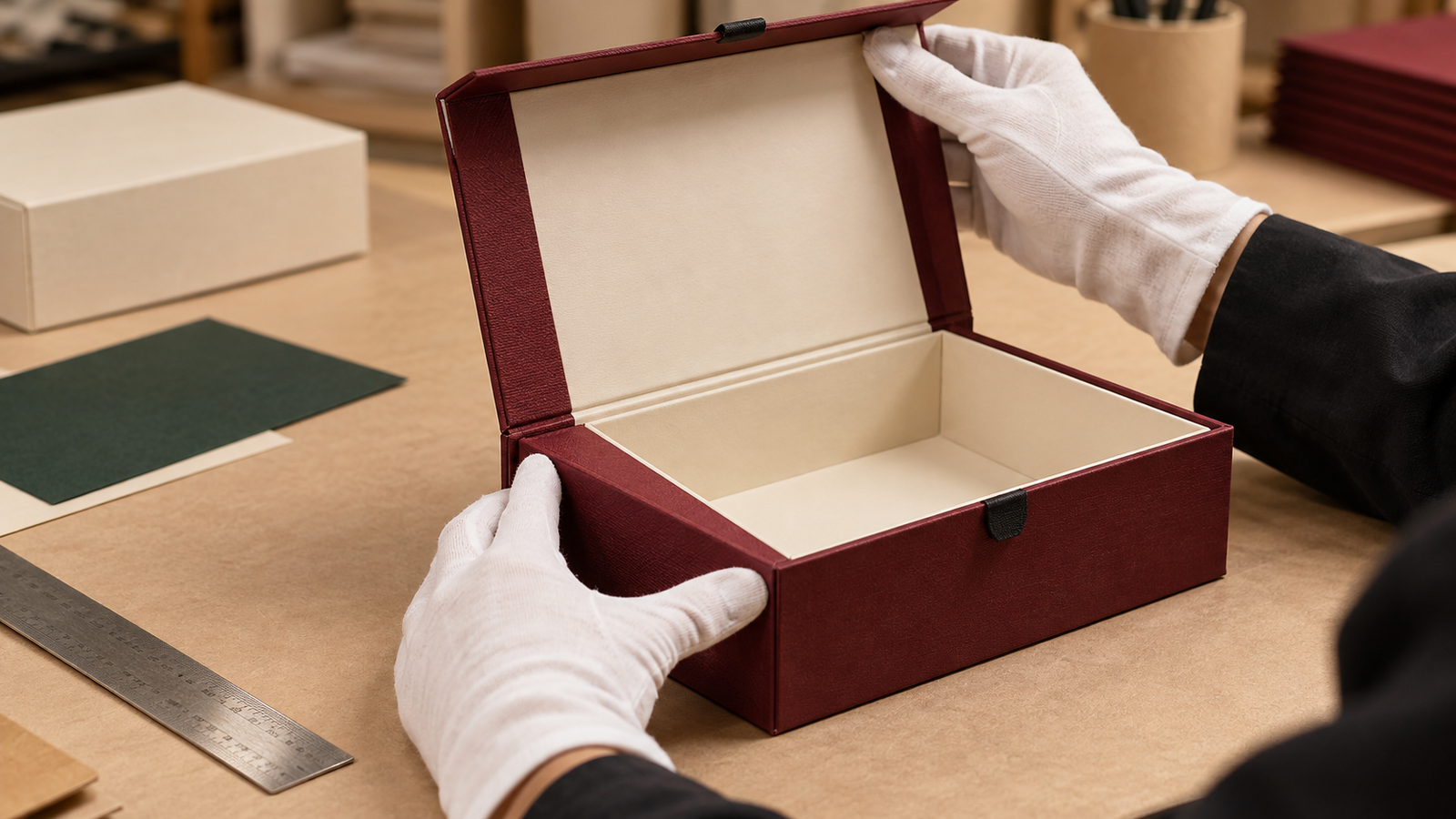
Before assembly
- flat dimensions and stack consistency;
- surface protection and absence of pressure marks;
- hinge scores and fold direction;
- corner components, tapes or locking parts present;
- artwork registration across moving panels.
After assembly
- walls square and base flat;
- corners retained under realistic loading;
- lid and front flap aligned;
- product secure and removable;
- repeatable pack-out by intended operators;
- closed box fits the selected paper bag.
Use a structural prototype to resolve geometry, a printed sample to approve colour and finish, and a fully converted pre-production sample to combine both. If the box is intended to be opened, flattened and rebuilt repeatedly, define a realistic cycle and acceptance criteria. Do not market it as reusable merely because it can collapse.
How should storage and distribution evidence be planned?
Test the configuration that will actually travel. Flat boxes may face compression, rubbing and corner pressure inside a master carton; assembled boxes with products face a different load path. ISTA distinguishes screening, partial-simulation, general-simulation and route-specific approaches. Select a method from the distribution route and decision required, not from a generic promise that the package is “shipping safe.”
Warehouse and export stacking also need an identified pack level. ISO 2234:2000, confirmed current in 2022, covers static-load stacking tests for complete filled transport packages and unit loads. Record whether the test applies to flat presentation boxes in cartons, assembled retail boxes inside transport packaging or a finished pallet.
How do materials and decoration interact with folding?
The moving joints make surface choices especially important. Thick or brittle wrap papers may resist a tight hinge. Dark printed solids can reveal cracking or rub marks at repeated folds. Lamination may change hinge feel and recovery. Foil, embossing or spot effects placed across a moving joint can distort or weaken visually even when they look perfect on a flat proof.
Approve decoration through the full motion
Review the pack flat, during assembly, fully open and closed. Keep critical logos, foil edges and fine patterns away from supplier-defined hinge and locking zones unless a converted sample proves the intended result.
How should environmental claims be handled?
Start with function and eliminate unnecessary material or components. ISO 18602:2013, confirmed current in 2024, addresses optimisation of packaging weight or volume while maintaining the required functions. Flat shipment may improve logistics efficiency, but that does not by itself prove a lower overall environmental impact.
Assess the finished construction, including board, wrap, lamination, adhesives, magnets, tapes, ribbons and insert. The 4evergreen Circularity by Design Guideline Version 4 provides current guidance for paper-based packaging across collection, sorting and different paper-mill pathways. FSC chain-of-custody certification can support traceability and eligible finished-product claims, but a certified paper description alone does not authorise a finished-box label.
For packaging placed on the EU market, Regulation (EU) 2025/40 now applies on a phased basis from 12 August 2026. Review minimisation, recyclability, labelling and producer obligations for the actual market and pack. Keep “recyclable,” “reusable,” “recycled content” and “responsibly sourced” as separate claims with separate evidence.
How should the box work with a luxury paper bag?
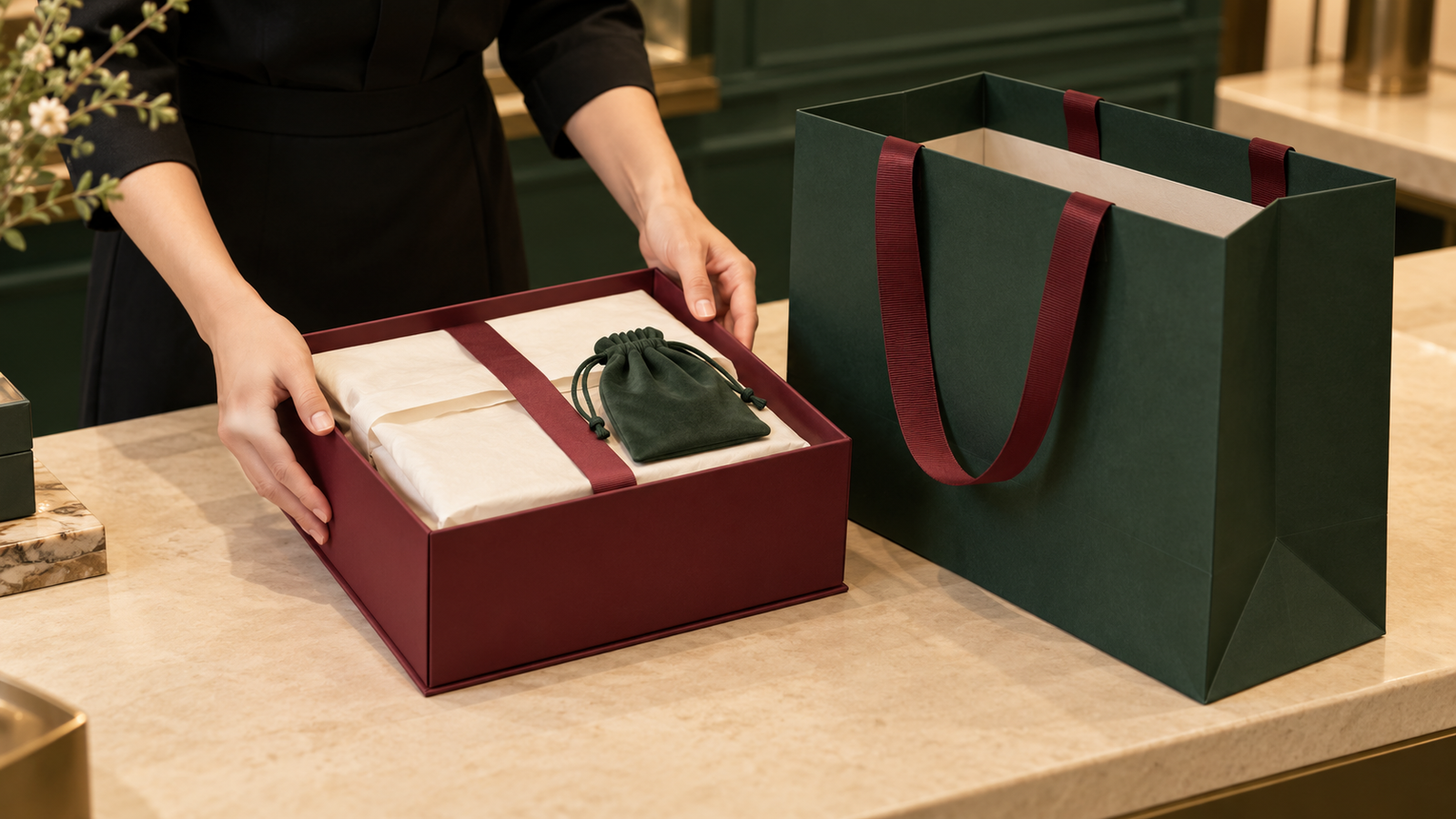
The collapsible box solves inbound and storage questions; the luxury paper shopping bag handles the final retail carry. Assemble and close the box with the real insert, product, tissue paper, ribbon and documents. Then test loading clearance, bag base support, gusset opening, top clearance and handle balance.
Do not make the box larger merely to create a grander bag. A coherent set uses proportion and a controlled visual hierarchy: for example, a burgundy box, forest-green bag, ivory tissue and one repeated ribbon colour. The paper bag is a retail carrier, not a substitute for the transport packaging used to deliver the presentation box.
What belongs in a collapsible rigid box RFQ?
- product samples, dimensions, weight, orientation and accessories;
- insert function, material direction, cavities and removal method;
- assembled internal and external dimensions plus folded footprint;
- board, wrap, lining, hinge, corner-lock and closure proposal;
- artwork, colour references, finish layers and no-print hinge zones;
- assembly steps, operator location and expected pack-out volume;
- sample stages, test plan and written acceptance criteria;
- quantity by size and design, flat-pack count per carton and pallet plan;
- delivery destination, route, incoterm and required date;
- matching luxury paper bag, tissue and ribbon requirements.
Ask suppliers to separate tooling, samples, unit price, insert, assembly aids, packing and delivery. Quotations are not comparable if one assumes magnetic corners and another assumes adhesive tape, or if one price includes export protection and another stops at the factory gate.
Frequently asked questions
Are collapsible rigid boxes the same as folding cartons?
No. Both can arrive flat, but a collapsible rigid box typically uses thicker wrapped panels and dedicated flexible joints, while a folding carton is cut and creased from folding boxboard or a related sheet material. Compare function, material use, assembly, protection and presentation rather than the word “foldable.”
Do all collapsible rigid boxes use magnets?
No. Magnets are common in some closures and corner systems, but adhesive strips, locking tabs and other mechanisms also exist. Require the supplier to identify every component and show how it behaves in assembly, use and end-of-life assessment.
Can a collapsible box be assembled more than once?
Possibly, but the answer depends on hinge construction, wrap, locks, load and handling. If repeated collapse and reassembly is part of the brief, specify a cycle test and acceptance criteria rather than assuming unlimited reuse.
What should the first physical sample include?
Use the real or representative product, insert, proposed board build, corner mechanism and closure. Even a plain structural sample should demonstrate the flat stack, assembly sequence, fitted product, closed box and paper-bag fit before decorative approval begins.
Develop the flat pack and retail set together
Share your product, insert, assembled dimensions, folded footprint, assembly location, artwork, quantity and destination. Bespoke Packaging can develop custom collapsible rigid boxes and coordinate them with luxury paper bags, tissue paper and ribbon.