
JEWELRY RETAIL PACKAGING
Custom Jewelry Paper Bags: A Practical Buyer’s Guide
Plan custom jewelry paper bags around the finished box, the boutique handoff and a coherent brand system—not around an isolated bag specification.
Custom jewelry paper bags should be sized for the finished jewelry box, tissue, care card and retail packing method, then engineered to carry that complete pack securely. The best result is usually a small, disciplined family of premium shopping bags rather than a different bag for every ring, necklace or bracelet.
For a jewelry brand, the bag is the visible final layer of a more important protection and presentation system. It should support the box, feel comfortable in the hand, present the logo at an appropriate scale and make counter packing simple. This guide explains how buyers can turn those needs into a quote-ready specification.
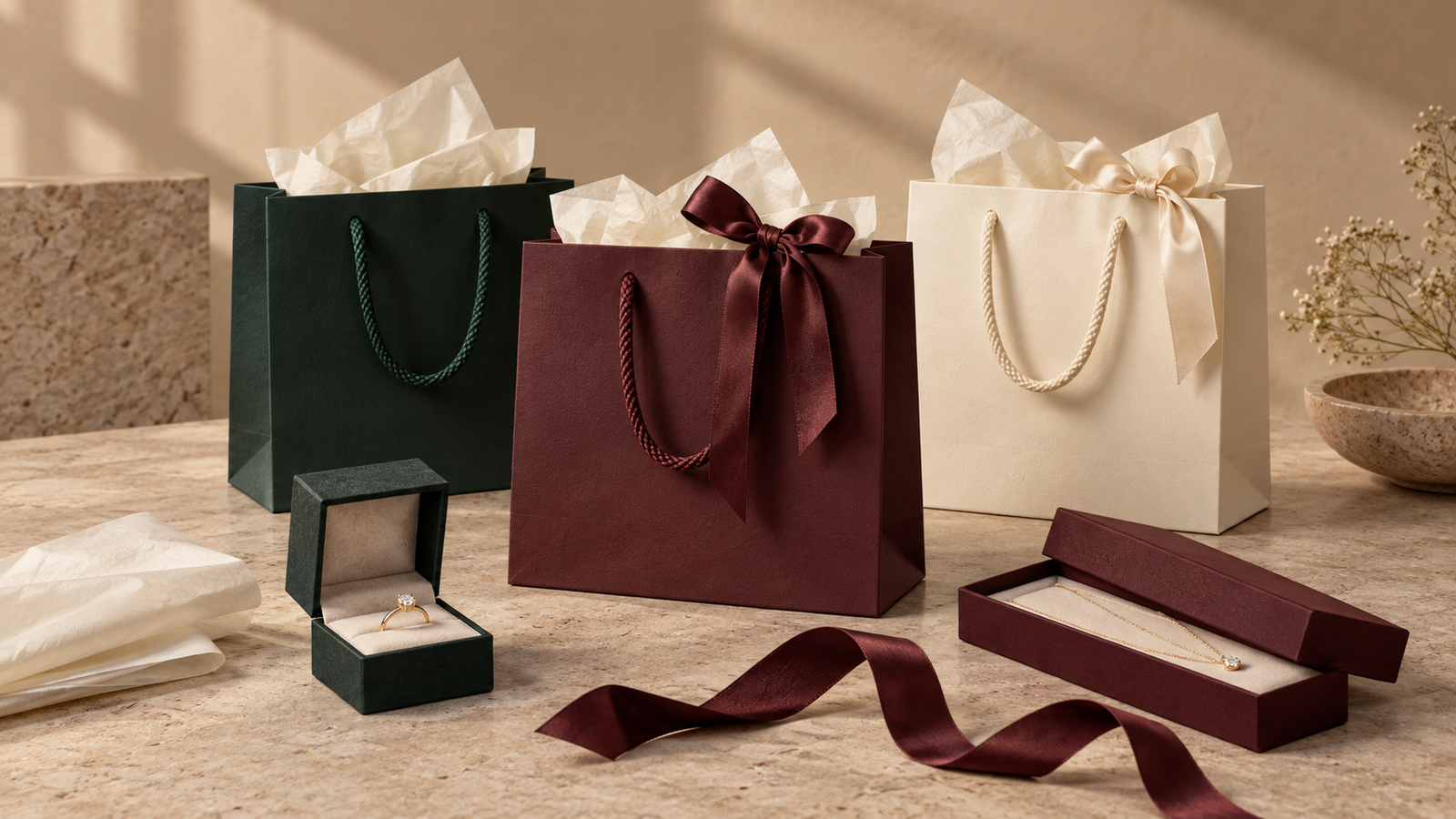
What should a jewelry paper bag actually do?
A jewelry shopping bag has several jobs at once. It carries a rigid box or pouch without tipping, protects the presentation from casual handling, gives the customer a comfortable handoff and extends the brand experience beyond the counter. Those functions are connected: an elegant bag that is too deep, weak at the handles or slow to pack is not a successful retail package.
- Fit: hold the finished jewelry box and its presentation materials without excessive empty space.
- Stability: keep the pack upright and supported as the customer carries it.
- Handling: give staff enough room to place and remove the box without crushing tissue or damaging the bag.
- Brand expression: reproduce the intended colour, logo and finish consistently across the bag, box, ribbon and paper.
- Practicality: stack, open and pack efficiently at the boutique counter.
Should jewelry go directly into the shopping bag?
No. A paper shopping bag is a carrier, not the primary protective container for a ring, pendant, watch or pair of earrings. The jewelry should first be secured in the appropriate lined box, case, pouch or insert. The Gemological Institute of America advises keeping pieces in a box or pouch and separating them to reduce scratches and impact damage. That makes the rigid box or protective pouch the starting point for bag sizing, not an optional extra.
Before asking a supplier for bag dimensions, assemble the real sellable pack: closed jewelry box, any outer sleeve, care or warranty card, receipt holder, tissue and ribbon. Measure that complete set and observe how staff pack it. A dimension taken from the jewelry item alone will produce the wrong bag.
How do you choose jewelry paper bag sizes?
Start with box width, depth and height, then add only the working allowance needed for tissue and easy placement. A bag that is much wider than the box can let the presentation slide or rotate. One that is too tight slows packing, abrades finished surfaces and makes the tissue look compressed. Use the method in our luxury paper bag size guide to translate product fit into width, gusset and height.
| Retail pack | Bag planning priority | Questions to test |
|---|---|---|
| Ring, earrings or small pendant box | Compact footprint and controlled depth | Can staff place the box flat? Does it remain upright when carried? |
| Necklace, bracelet or watch box | Longer footprint with adequate base support | Does the box sit on the base rather than bridge the gusset folds? |
| Multiple boxes or gift set | Load distribution and counter-packing access | Can tissue separate the boxes? Is the handle system approved for the complete load? |
| Seasonal or ceremonial presentation | Space for ribbon, card and gift wrap without loose volume | Does the added presentation still fit after the box is wrapped? |
Try to consolidate around the fewest sizes that genuinely serve the assortment. One compact bag may cover several ring and earring boxes; a second may fit longer necklace or bracelet boxes; a third may support multi-item purchases. Fewer sizes concentrate volume, simplify inventory and help stores avoid choosing between an oversized bag and a bag that is too tight.
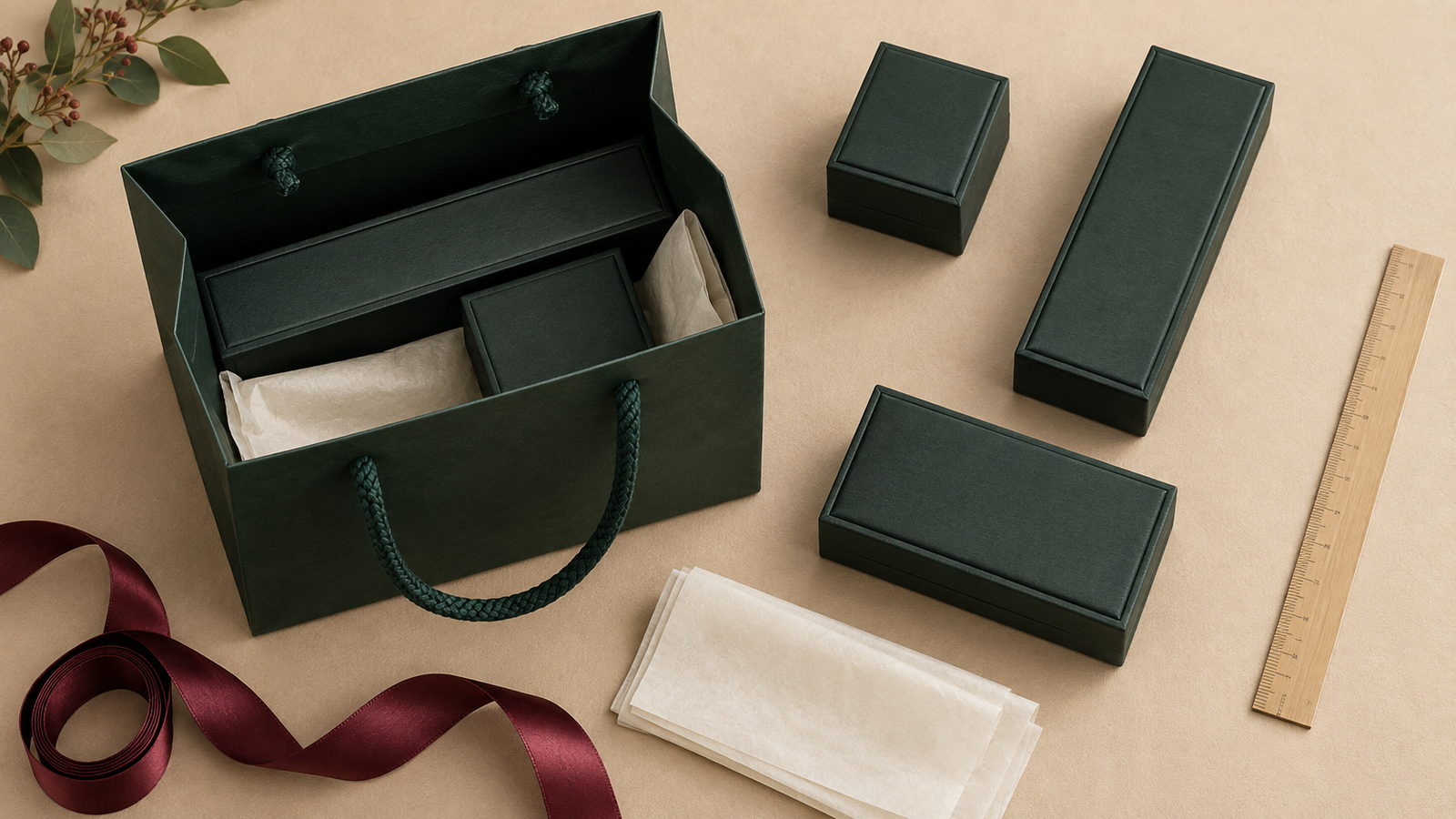
Which construction details matter for small luxury bags?
Small bags still need a complete load path. The paper panels, folded top, handle holes or attachments, reinforcement patches, side seam, gussets and base support work together. A heavy-looking paper does not compensate for weak handle anchoring or a box that sits poorly on the base.
- Folded turn-top: creates a clean rim and can support the handle area when correctly engineered.
- Handle reinforcement: spreads force around the attachment instead of concentrating it at a hole or knot.
- Base board: helps a small rigid box sit flat and can reduce distortion at the bottom.
- Gusset geometry: should open cleanly and match the box depth rather than folding underneath it.
- Side-seam position: should not interfere with artwork or become a weak point during packing.
Do not approve these elements separately. Test the converted bag with the heaviest intended retail pack and the final handle. Our paper bag construction guide explains how those components form one carrying system.
Which handles suit custom jewelry paper bags?
Cotton rope gives a familiar premium-shopping feel and is comfortable for many retail packs. Satin ribbon can create a softer gift presentation and coordinate closely with a jewelry box bow. Paper handles may support a simpler, more material-focused direction. The right choice depends on the bag size, total packed weight, desired handle drop, store workflow and end-of-life goals.
On a compact bag, handle scale matters. A very thick cord or long drop can overwhelm the proportions, while a short handle can make the bag awkward to carry. Ask for physical handle samples and specify material, diameter or width, colour, drop, attachment and reinforcement. Compare the options in our luxury paper bag handle guide.
How should logo, colour and finishes be planned?
Jewelry packaging often benefits from restraint. A compact mark, controlled colour and one tactile or reflective detail can read more clearly than several competing effects. Decide what the customer should notice first: the brand name, a monogram, a paper texture, a foil accent or an embossed surface.
- Scale the logo on the actual front panel, not on a zoomed-in screen view.
- Keep key artwork away from folds, gussets, handle holes and the side seam.
- Define spot colours and finish layers in the supplier dieline.
- Review contrast on the selected paper because uncoated, coloured and textured stocks can change the result.
- Approve foil, embossing or varnish on the intended material rather than assuming the same setting works across the whole packaging set.
Use the artwork guide for file preparation and the finishes guide to compare decorative processes. If the bag and jewelry box must match, tell the supplier whether the goal is an exact colour target, a deliberate tonal family or coordinated contrast.
How do you coordinate the bag, box, tissue and ribbon?
Treat the packaging as one sequence. The customer sees the shopping bag first, then tissue or ribbon, then the rigid jewelry box and finally the product. Repeating every colour and finish at every layer can feel busy. A stronger system gives each component a role.
- Let the paper bag carry the main brand colour and a clear exterior mark.
- Use the rigid gift box for product protection, fit and the close-up reveal.
- Choose tissue paper to protect surfaces, control the reveal and add a light tonal layer.
- Use ribbon as an accent or closure where it improves the opening ritual rather than merely adding material.
- Keep cards and receipt holders proportionate so they sit flat without distorting the pack.
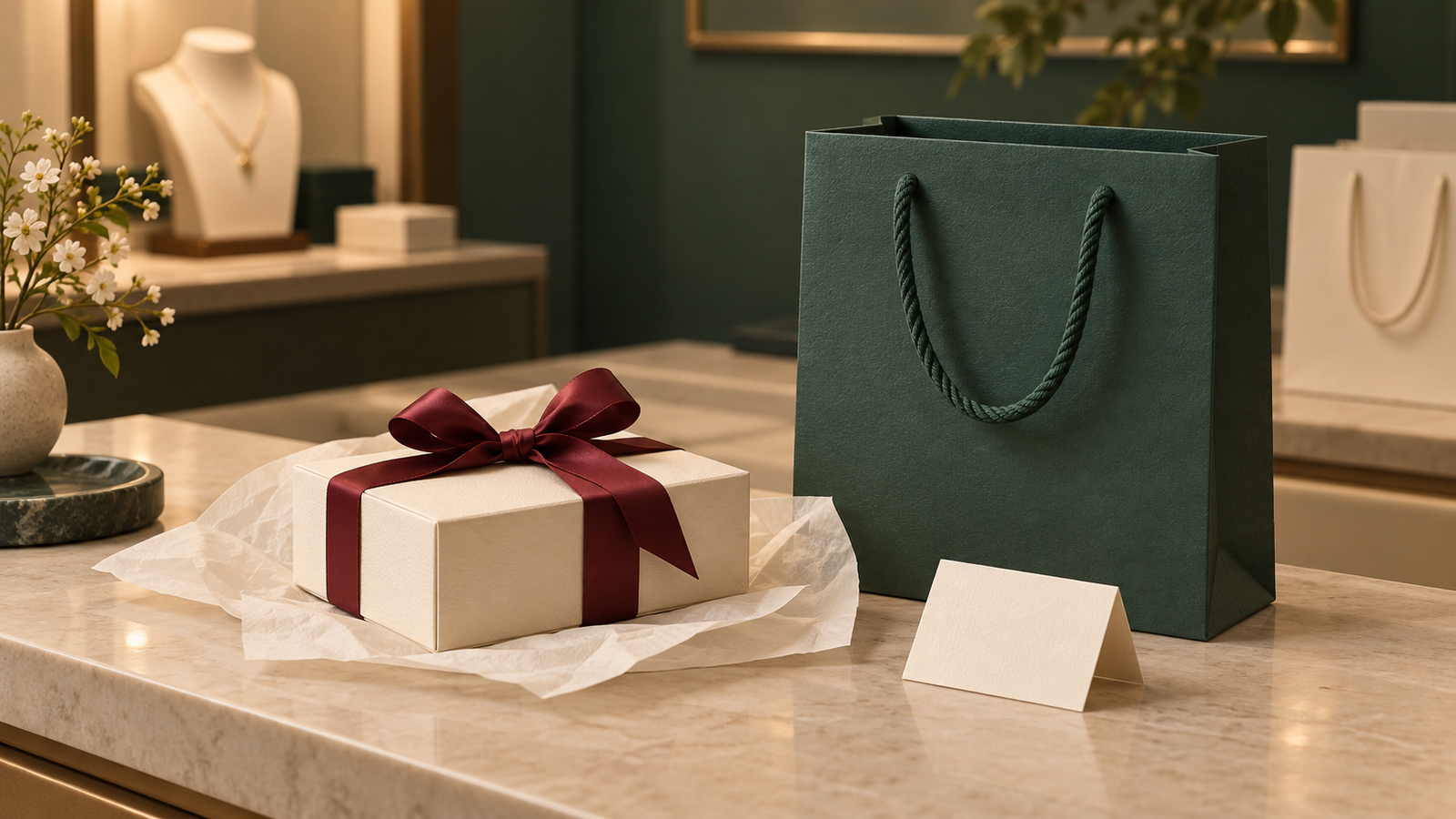
What should stores test at the counter?
A bag can look correct in a supplier photo and still create friction in use. Run a short counter trial with the final box family and the staff who will pack it. Time is not the only concern; the test should show whether tissue catches on the rim, whether the box drops flat, whether handles tangle in storage and whether the finished presentation can be handed over without adjustment.
- Open bags from their stored flat condition and check whether the gussets form cleanly.
- Pack each approved box size, including seasonal ribbon and cards.
- Lift and carry the heaviest approved combination by the handles.
- Place the packed bag on a counter and observe whether it stands as intended.
- Check for scuffing, colour transfer, foil abrasion and crushed corners after realistic handling.
- Record the approved packing sequence for stores and fulfilment teams.
How can jewelry packaging support privacy and a secure handoff?
The shopping bag should not be presented as security packaging, but the design can avoid unnecessary disclosure. Consider whether large product names, images or campaign copy reveal more than the brand intends outside the store. A well-fitted bag also reduces obvious movement of the inner box and helps staff maintain a composed handoff.
If a closure is required, define its purpose. A ribbon tie may support gifting but slows packing. A folded tissue seal can keep the presentation orderly but is not tamper evidence. Security labels or tamper-evident systems are separate technical decisions and should never be implied by an ordinary decorative closure.
What sustainability questions should buyers ask?
Begin with right-sizing and clear material identification. In the European Union, the Packaging and Packaging Waste Regulation has applied since 12 August 2026 and introduces phased requirements covering packaging minimisation, labelling and recyclability. The European Commission says all packaging must be recyclable by 2030. Buyers selling into the EU should confirm the rules and guidance that apply to their market, role and launch date rather than relying on a general “eco-friendly” description.
For paper-based packs, assess the whole construction: paper, coatings, laminates, foil area, inks, adhesives, handles, reinforcement and any base board. The 4evergreen Circularity by Design Guideline provides current industry guidance for paper-based packaging design. Use it as a technical reference, while checking local collection and recycling systems before making disposal claims.
If responsible forest sourcing is part of the brief, define the claim and documentation before ordering. FSC chain-of-custody certification tracks certified material through the supply chain and governs use of FSC labels and trademarks. Asking only for “FSC paper” is not enough when the finished product must carry a claim.
Which samples should be approved before production?
Use samples to answer different questions in sequence. Paper and handle swatches confirm colour and touch. A plain structural prototype checks box fit, gusset opening, handle drop and counter packing. A printed proof checks artwork and colour direction. Finish trials test foil, embossing or varnish on the selected paper. A fully converted pre-production sample brings the specification together.
Keep one signed or otherwise controlled approved master and record which aspects it governs. A digital image cannot reliably define paper texture, subtle colour, foil reflection or handle feel. Our custom paper bag sample guide explains how to build an approval sequence without asking one sample to prove everything.
What belongs in a quote-ready jewelry paper bag brief?
- List every finished jewelry box or pack the bag must carry, with dimensions and weight.
- State the proposed bag width, gusset and height, plus required working allowance.
- Give quantity by bag size, artwork, colourway, store or delivery batch.
- Define paper family, surface, colour, weight direction and required sourcing claim.
- Specify folded top, reinforcement, base board, seam and other construction details.
- Specify handle material, size, colour, drop, attachment and performance expectation.
- Provide print-ready artwork, colour references, logo scale and separate finish layers.
- List tissue, ribbon, cards and boxes that must coordinate with the bag.
- Define the sample stages, approved references, load checks and inspection criteria.
- State flat-packing, units per carton, protective packing, destination and delivery deadline.
Use consistent information for every supplier so quotations describe the same bag. Separate one-time tooling and sample charges from recurring unit cost, and compare delivery terms and packing assumptions. The custom paper bag cost guide provides a practical quote-comparison method.
Frequently asked questions about custom jewelry paper bags
What size paper bag is best for jewelry?
The best size fits the finished jewelry box, tissue, cards and packing method with enough clearance for easy placement but without loose volume. Measure the complete retail pack and test it in a structural sample.
Do jewelry paper bags need a base board?
A base board can help a rigid jewelry box sit flat and distribute load, especially when the box is small and dense. It is not automatically required for every bag; approve the complete construction through fit and carry tests.
Are ribbon handles better than rope handles?
Neither is universally better. Ribbon can reinforce a gift-led presentation, while cotton rope offers a familiar, comfortable carrier handle. Compare feel, proportional scale, attachment, packing speed and end-of-life needs using the final bag and load.
Should the bag match the jewelry box exactly?
Only if exact matching serves the identity and can be controlled across different materials. A deliberate tonal family or coordinated contrast may be more reliable. Define the colour relationship, physical reference and acceptable variation instead of asking vaguely for “matching.”
How many jewelry paper bag sizes should a brand order?
Use the fewest sizes that protect the real assortment and support fast packing. Many brands can group compact boxes into one size, longer boxes into a second and multi-item purchases into a third, but the correct family depends on actual box dimensions and order patterns.
Design the final handoff as one packaging system
A successful custom jewelry paper bag begins with the protected product and the way it is sold. Measure the finished box, reduce unnecessary space, engineer the handles and base for the approved load, and coordinate colour and finishes across the whole sequence. Then test the result where it matters: at the counter and in the customer’s hand.
Bespoke Packaging develops custom luxury paper bags together with rigid jewelry boxes, ribbon and tissue paper. Send us your box dimensions, bag quantities, artwork, destination and target presentation, and we can help turn them into a clear sampling and production brief.
Does your current shopping bag fit the protected jewelry pack—or only the product category?