
LUXURY PAPER BAG CONSTRUCTION GUIDE
Luxury Paper Bag Construction: What Makes a Bag Strong?
Understand how paper, folded tops, reinforcement cards, handles, gussets, seams and base boards work together—so your bag looks refined and carries the real product safely.
Luxury paper bag construction is the complete load-bearing system formed by the outer paper, top edge, handle attachment, reinforcement, panels, seams, gussets and base. A strong bag is not created by choosing a high paper grammage alone. Every component must transfer the weight of the packed product through the bag without tearing, peeling, distorting or making the customer carry it uncomfortably.
For packaging buyers, the practical question is not “What is the thickest paper?” but “What construction suits this product, journey and brand experience?” A lightweight scarf, a boxed fragrance and a multi-item gift set place different demands on the same-looking shopping bag. This guide explains the structure in clear purchasing terms and shows what to define before requesting a sample or quotation.
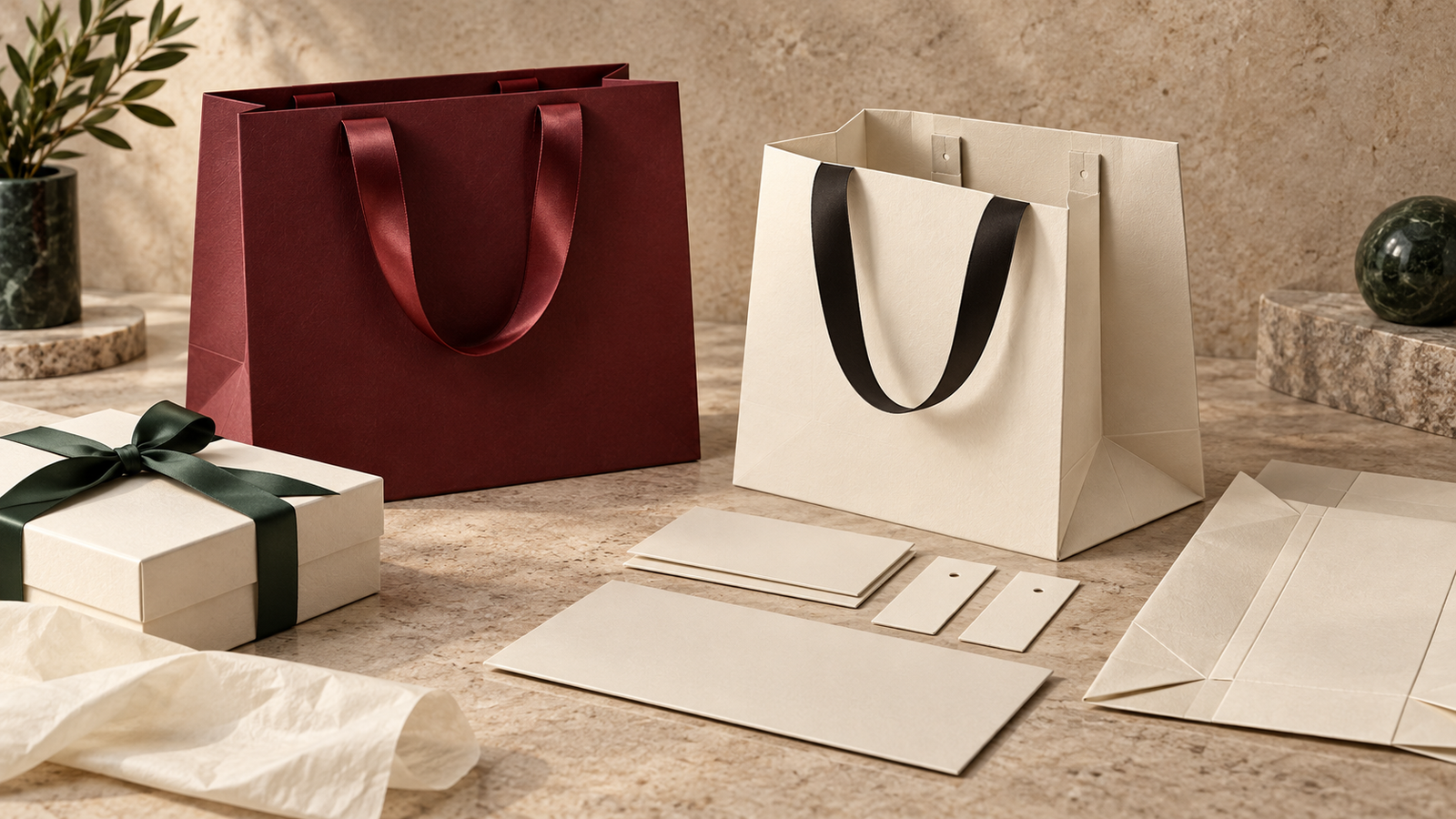
What are the main parts of a luxury paper bag?
A premium shopping bag is a converted structure, not simply a printed sheet with handles. The exact build varies, but most hand-finished luxury paper bags use the following elements.
| Component | Structural job | Buyer decision |
|---|---|---|
| Front and back panels | Provide the main printable faces and resist bending or bulging | Paper grade, stiffness, surface and finished dimensions |
| Side gussets | Allow the bag to open, control depth and fold flat for transport | Gusset depth, crease quality and opening behaviour |
| Turn-top or folded rim | Stiffens the opening and creates a clean upper edge | Fold depth, finish at corners and reinforcement method |
| Handle reinforcement | Spreads concentrated force around holes, knots or glued tabs | Card type, size, position and attachment design |
| Handles | Transfer the carried load into the reinforced top area | Material, width or diameter, drop length and fixing method |
| Side seam | Closes the body and resists peel forces when the bag expands | Seam position, overlap and adhesive performance |
| Bottom fold and base seam | Form the floor of the bag and transfer weight into the walls | Fold geometry, bonding area and compatibility with the product |
| Base board | Distributes concentrated loads and helps the bag stand neatly | Board size, thickness, placement and whether it is loose or fixed |
Decoration sits on top of this system. Foil, embossing, lamination and textured paper can improve appearance, but none of them compensates for a weak handle attachment, narrow glue seam or poorly supported base.
How does a paper bag carry weight?
Picture the load path from the product to the shopper’s hand. The product presses on the bottom of the bag. The bottom fold and base board spread that pressure into the front, back and side panels. Those panels transfer the load upward into the folded top and reinforcement cards. The handle fixings then carry it into the rope or ribbon held by the customer.
The bag is only as dependable as the weakest point in that path. Strong paper can still fail if a handle hole cuts into an unreinforced edge. A thick base board can still drop out if the bottom seam opens. A secure handle can feel uncomfortable if it is too narrow for the packed weight. Treat construction as a connected system rather than a list of premium features.
Concentrated loads need to be spread
A perfume box corner, bottle base or narrow jewellery case can create a much higher local pressure than soft apparel of the same total weight. A correctly sized base board spreads that point load across a larger area. At the top, reinforcement cards perform the same principle around handle holes or ribbon slots.
Dynamic carrying is harder than standing still
A bag on a table carries a static load. A customer walking, lifting the bag from the floor or stopping suddenly adds movement and short peaks of force. That is why a successful desk sample still needs a practical carry test using the intended product or a representative load. The test conditions and acceptance criteria should be agreed for the project rather than implied by appearance.
Why does paper GSM not tell you the whole strength story?
GSM means grams per square metre. ISO 536:2019 specifies a method for determining paper and board grammage. Grammage is useful for identifying and controlling a material, but it does not by itself describe how stiff, tear-resistant or suitable for folding that material will be.
Two papers with the same grammage can behave differently because of fibre composition, furnish, density, coating, calendering, recycled content, moisture, grain direction and manufacturing route. Even thickness and stiffness should not be treated as interchangeable. ISO 5628:2019, for example, describes methods for measuring bending stiffness, while ISO 1924-2:2008 covers tensile properties such as tensile strength and strain at break. ISO 2758:2014 addresses bursting strength for paper within its stated scope.
These standards show why “use thicker paper” is an incomplete specification. Material data can help compare candidates, but the finished bag still has folds, cut edges, adhesive joints, handles and reinforcements that must work together. Start with the real packed product, then select and sample the paper as part of the complete construction. Our luxury paper bag materials guide explains the print, touch and sourcing trade-offs in more detail.
What does the folded top do?
A turn-top folds the upper edge of the bag inward. It hides a raw cut edge, gives the opening a more deliberate finish and creates a double layer of paper around the rim. Many luxury bags also place a reinforcement card inside this folded area so the handle load is distributed beyond the immediate hole, knot or slot.
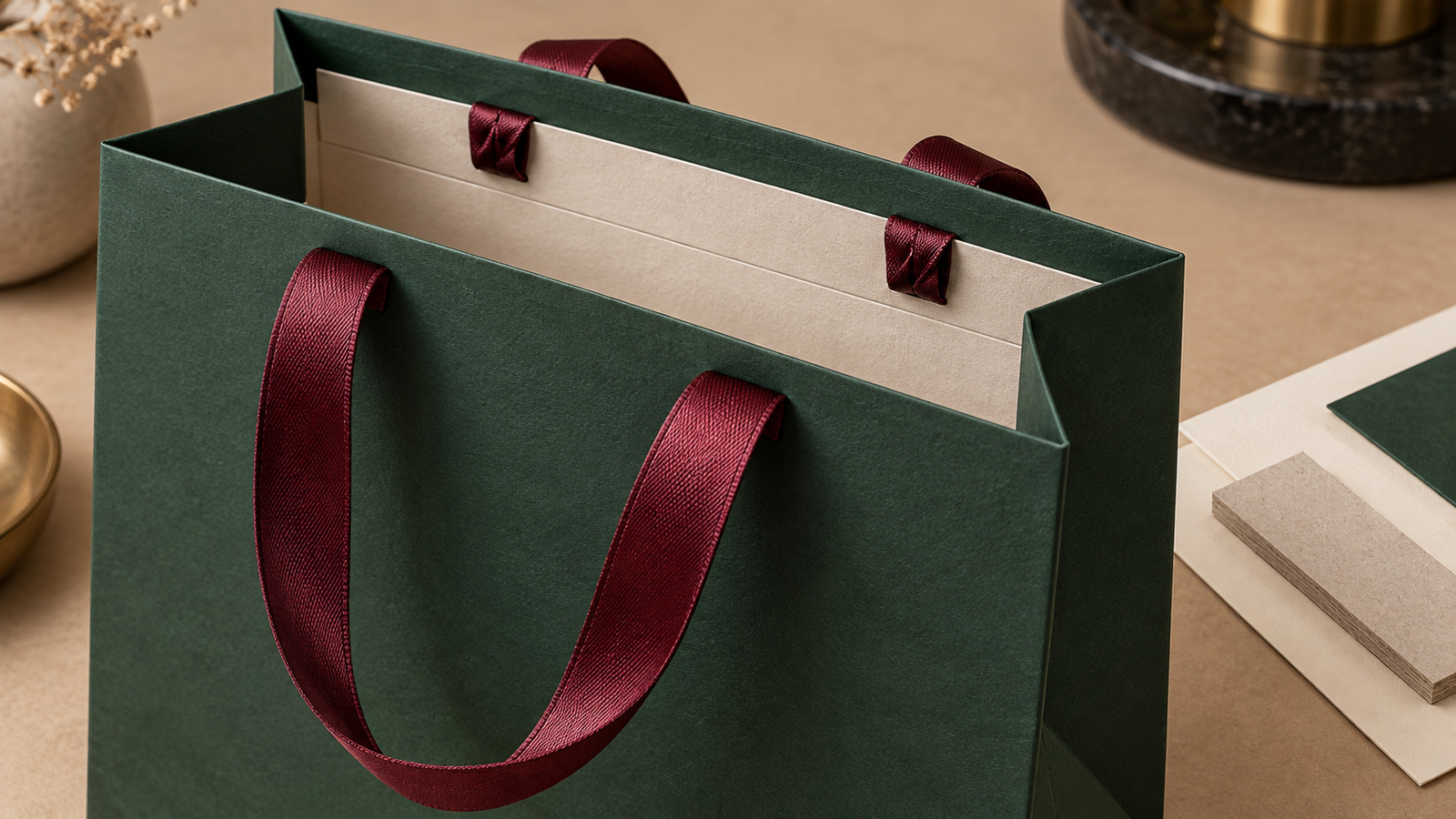
The correct fold depth and reinforcement layout depend on bag size, handle style, product weight and the visual design. Reinforcement should extend far enough to spread force without creating a visible ridge or interfering with side gussets and corner folds. The turn-top adhesive must bond the selected surfaces cleanly; a coated, laminated or highly textured sheet may require different preparation from an uncoated paper.
Turn-top, patch or no reinforcement?
- Folded top with a full reinforcement card: a common premium route when a rigid opening and secure cord or ribbon attachment are important.
- Local reinforcement patches: can support individual handle points while using less board, but placement and bonding need tight control.
- Folded paper without added board: may suit lighter applications when validated by the intended load and handle design.
- Unreinforced single edge: can be economical for light-duty bags, but it should not be specified as a luxury shortcut without testing.
The visible handle material is only one part of the decision. Use our paper bag handle guide to compare rope, ribbon, paper and die-cut options, then confirm how the chosen handle is fixed to the actual reinforced structure.
How do gussets, seams and the base control performance?
Side gussets create usable depth
The gusset is the folded side section that opens to create depth. It must be large enough for the product pack, but not so deep that the bag loses proportion or becomes difficult to control. Crisp, aligned creases help the bag open predictably and fold flat again. A gusset that is forced wider than designed pushes outward on the side seam and can distort the front artwork.
The side seam must resist peel
When the bag is filled, the body tries to open and the side seam experiences peeling and tension. Seam width, adhesive coverage, paper surface and curing all matter. A neat seam should be closed along its designed bond area without heavy squeeze-out, lifting edges or contamination. Place the seam where it will not interrupt important artwork or create an avoidable weak fold.
The bottom is a folded joint, not just a flat panel
The base must open squarely, carry the product and remain closed through handling. Fold geometry and adhesive area determine how force moves into the walls. A base board can improve flatness and distribute weight, but it needs the correct length and width: too small and it cannot support the corners; too large and it can buckle the gussets or prevent the bag from folding properly.
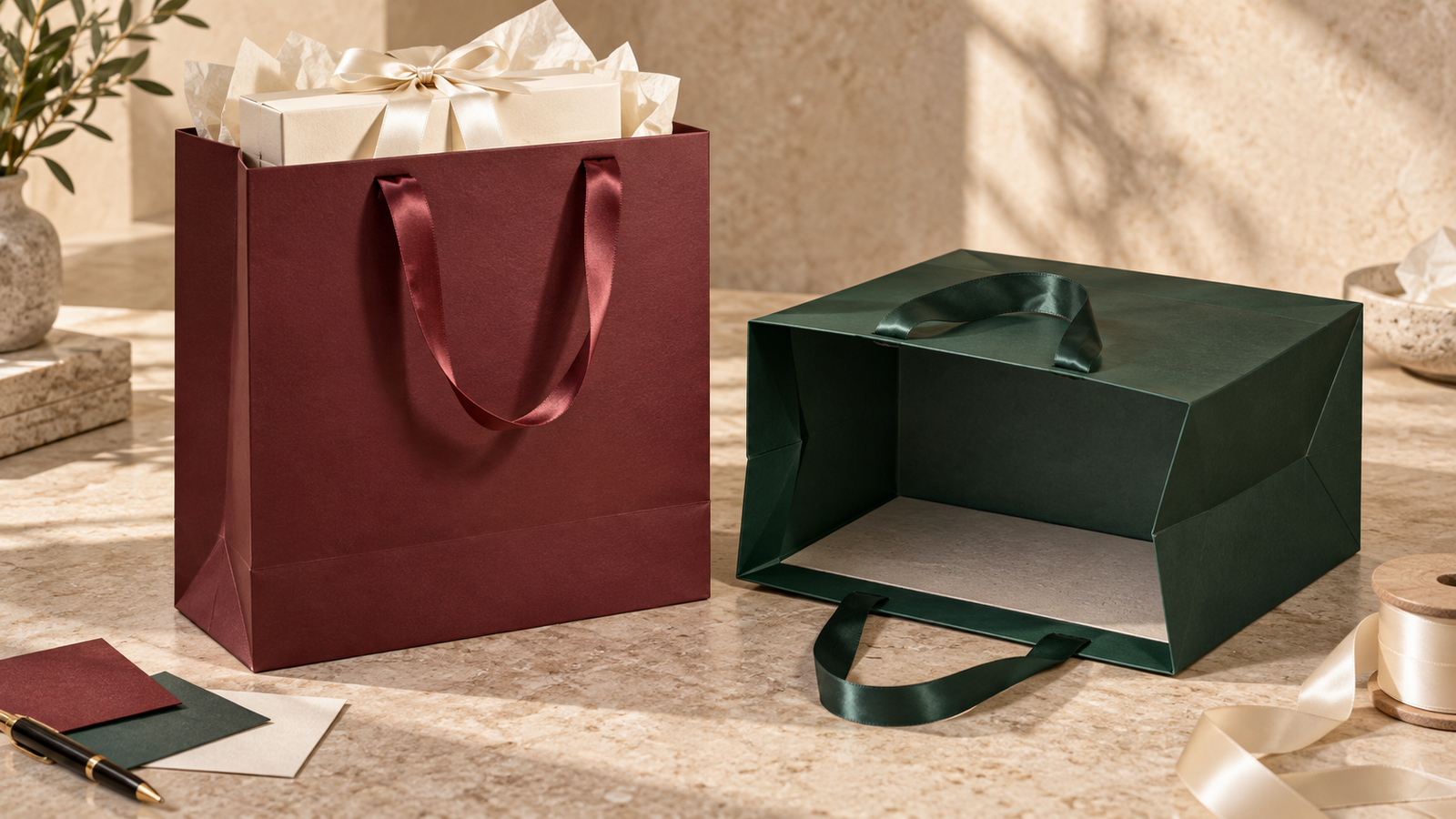
Which construction fits different luxury products?
There is no universal “luxury” build. Match the structure to the product pack, how it is loaded, how far it is carried and what the customer should feel.
| Typical packed product | Main structural concern | Useful sample focus |
|---|---|---|
| Jewellery or small accessories | Proportion, opening control and a refined lightweight feel | Handle comfort, small folds, logo position and product access |
| Boxed fragrance or cosmetics | Point loads, glass weight and keeping the bag upright | Base board coverage, handle reinforcement and loaded stability |
| Folded apparel | Volume without unnecessary board or a stiff carrying feel | Gusset opening, bag depth, tissue arrangement and handle drop |
| Shoes or medium rigid boxes | Fit, corner pressure and easy insertion | Clearance, base fold, side-seam stress and customer carry test |
| Multi-item gift set | Uneven weight distribution and movement inside the bag | Representative pack-out, dividers or tissue, base support and tilt |
| Bottles or tall products | High centre of gravity and concentrated bottom loads | Bag proportions, base board, upright stability and handle control |
Always size the bag around the complete presentation: product, retail box, protective insert, tissue and any ribbon closure. The luxury paper bag size guide shows how width, gusset and height should relate to the finished pack rather than the unboxed product alone.
Does lamination make a paper bag stronger?
Lamination can change scuff resistance, moisture response, surface feel and the way a printed sheet folds, but it should not be treated as a substitute for a sound load path. A film can also affect creasing, adhesive selection, recycling routes and how a torn area propagates. Specify lamination for a clear performance or design reason, then test it with the chosen paper and construction.
Decorative processes can interact with structure too. Heavy ink films, foil or relief placed across a crease may crack or distort. Keep critical artwork clear of gusset folds, the base fold, the side seam, handle holes and reinforced turn-tops unless the converter has developed and sampled the detail. See the luxury paper bag finishes guide for process-specific approval points.
How should you test a construction before production?
Start with a physical sample made to the latest specification. If temporary paper, handles, reinforcement or adhesive are used, mark the differences and do not assume the sample proves final performance. A visual mock-up can answer questions about proportion and artwork, but only a representative construction can support a meaningful carry test.
- Pack the exact product presentation or a documented representative load.
- Check insertion and removal without snagging, crushing tissue or forcing the gussets.
- Lift the bag smoothly, carry it for an agreed time or distance and include realistic starts and stops.
- Observe handle comfort, hole elongation, top-edge distortion, seam lift, base movement and panel bulging.
- Set the bag down repeatedly and check whether it stands as intended.
- Open, close and refold it enough times to expose crease cracking or delamination relevant to use.
- Record the sample version, load, conditions, duration, observations and pass/fail criteria.
Material tests and finished-bag tests answer different questions. ISO methods can characterize paper properties under defined conditions; they do not automatically certify a complete retail carrier bag for a buyer’s product. Build project-specific checks around the expected load, handling and environment, then use the approved sample and written specification as control references. Our quality-control checklist covers inspection from incoming materials through export packing.
How do you write a quote-ready construction specification?
A supplier can quote more accurately when the construction is defined by function and measurable decisions. Include the following information in your request for quotation.
- finished width, side gusset and height, with the measurement method;
- product description, packed dimensions, weight and any sharp or concentrated load points;
- outer paper grade or performance direction, colour, surface and certification requirement;
- required top construction, including turn-top depth and reinforcement expectations;
- handle material, width or diameter, colour, drop length and attachment method;
- side-seam and bottom construction where these differ from the supplier’s standard;
- base-board material, dimensions, placement and colour if visible;
- print, foil, embossing, coating or lamination and their position relative to folds and seams;
- expected use, carry distance, climate or moisture concerns and agreed test load;
- pack-flat method, nesting, abrasion protection, carton quantity and delivery destination;
- sample type, approval stages, inspection criteria and required in-hand date.
If you do not know every construction detail, provide the product pack and intended experience, then ask the supplier to state the proposed build in the quotation. Avoid accepting vague lines such as “strong paper” or “reinforced handles.” Name the paper reference, reinforcement arrangement, board dimensions and sample test that will make those terms checkable.
How can a strong bag avoid unnecessary material?
Efficient construction places material where it performs a defined job. A targeted handle patch may be more appropriate than increasing every panel. A correctly sized base board may control a concentrated load without making the whole bag heavier. A better fit can reduce unused volume while improving stability. Validate these choices rather than removing components by appearance alone.
For products sold in the European Union, Regulation (EU) 2025/40 on packaging and packaging waste makes packaging minimisation and recyclability important design considerations while recognising that packaging still has to perform its functions. Construction decisions should therefore be documented, market-specific and reviewed with current compliance advice rather than justified only as luxury decoration.
If an FSC claim is required, define it before sourcing and artwork approval. The Forest Stewardship Council explains that chain of custody tracks eligible forest-based material through production and distribution. A paper’s certified sourcing claim and the finished bag’s structural performance are separate questions; both need the correct evidence.
What construction mistakes should buyers avoid?
- Specifying only GSM: grammage does not define stiffness, tensile behaviour, fold quality or finished-bag strength.
- Testing an empty bag: fit, point loads, balance and handle comfort appear only with the real pack.
- Upgrading the handle but not its attachment: a premium ribbon or rope can still tear through a weak top edge.
- Using an oversized base board: more board is not always better if it interferes with gussets and folding.
- Ignoring paper grain and crease behaviour: a beautiful sheet can crack or resist folding in the wrong direction.
- Placing decoration across structural zones: folds, holes and seams can disrupt foil, relief and large ink areas.
- Approving undocumented samples: a sample cannot control production when its materials and revision are unclear.
- Changing size without reviewing structure: scaling artwork and dimensions does not automatically scale handle spacing, reinforcement or base performance.
Frequently asked questions
What makes a luxury paper bag strong?
A strong luxury paper bag has a continuous load path: the base supports the product, folds and seams transfer weight into the panels, the top reinforcement spreads force around the handle attachments, and the handles remain comfortable under the intended load. Paper choice matters, but construction and testing determine how the complete bag behaves.
Does every luxury paper bag need a base board?
No. A base board is useful when the product creates concentrated loads, needs a flatter presentation or must help the bag stand. A light, soft product may not need one. Decide from the packed product and sample test, not from a generic premium specification.
Is a turn-top the same as handle reinforcement?
Not necessarily. A turn-top is the inward fold at the bag opening. It creates a double paper layer and a neat edge. Additional reinforcement card may be placed inside that fold to spread the handle load. Ask the supplier to describe both the fold and any inserted board.
Can one construction be used for every bag size?
Only after it is reviewed and validated. A larger bag changes panel spans, gusset behaviour, handle spacing and the leverage applied during carrying. A smaller bag can create tighter folds and less room for reinforcement. Treat every size as a defined variant.
When should construction be approved?
Approve the construction before bulk production, using a named sample version and matching written specification. Record any temporary material or open point. The custom paper bag lead-time guide shows where specification, sampling and approval sit in the wider schedule.
Design the load path before decorating the bag
Luxury paper bag construction works when every layer has a purpose. Begin with the packed product, define the customer’s carrying experience, map the force from the base to the handles, and prove the design with a representative sample. Once the structure is sound, paper texture, print, foil and ribbon can create a premium finish without hiding avoidable risk.
Bespoke Packaging develops custom luxury paper bags as part of coordinated packaging sets with rigid gift boxes, ribbon and tissue paper. Share your product pack, target size, order quantity, finish direction, expected carry load and delivery destination, and we can propose a practical construction and sample plan for quotation.
Does your current bag specification define a complete load path—or only a paper weight and handle style?