
LUXURY PAPER BAG QUALITY CONTROL
Luxury Paper Bag Quality Control: A Buyer’s Checklist
Turn a beautiful approved sample into a repeatable bulk order with a practical inspection plan for paper, dimensions, colour, finishes, handles, loaded performance and export packing.
Luxury paper bag quality control is the documented process used to confirm that production bags match the approved specification and remain fit for their real retail use. It should cover appearance and construction together: paper, finished dimensions, print, surface finishing, folds, seams, handles, reinforcement, load performance, quantity and packing.
A premium bag can look correct in a photograph and still fail when a customer carries a boxed product. It can also pass a simple lift test yet arrive with scuffed foil, crushed gussets or inconsistent colour. The safest buyer approach is to define the reference, risks, inspection method and evidence before mass production—not after a shipment is ready.
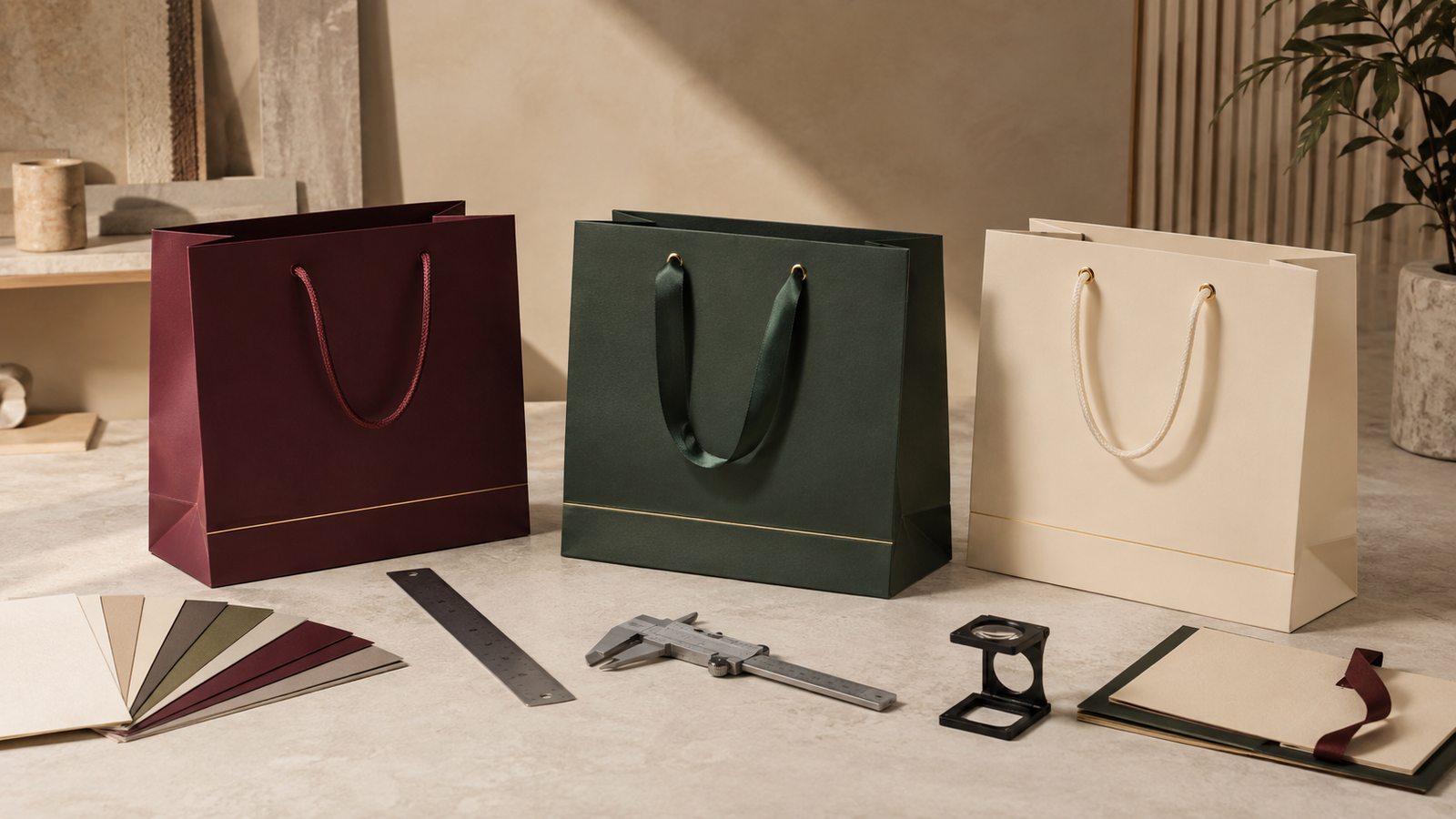
What does quality control mean for a luxury paper bag?
Quality control turns design intent into checkable requirements. “Deep burgundy,” “strong handles” and “premium finish” express a goal, but they do not tell an inspector what reference to use, where to measure or what makes a unit unacceptable. A production-ready quality plan connects each important feature to a sample, drawing, material record, tolerance or functional test.
- Identity: correct style, size, artwork version, colourway and delivery batch.
- Materials: agreed paper family, shade, grammage, thickness, handles, reinforcement, adhesives and finishing components.
- Conversion: cutting, creasing, folding, turn-top, gussets, side seam and base construction.
- Appearance: colour, registration, foil, embossing, coating, surface cleanliness and presentation.
- Function: opening, packing, carrying, handle comfort, base stability and performance with the intended product.
- Delivery condition: count, nesting, protection, cartons, labels, palletisation and moisture controls.
The finished bag is a system. Paper strength cannot compensate for a poorly bonded handle patch; perfect printing cannot compensate for a base that opens; careful production cannot compensate for an export carton that allows rubbing. Inspect both the individual components and the assembled bag.
What should be locked before bulk production?
Begin with a controlled specification rather than a collection of messages. Record the finished width, side gusset and height; paper and handle construction; artwork revision; colours; finish locations; reinforcement; expected packed product; order quantity; pack count; destination and agreed approval stages. Mark which details are visual references and which have measurable tolerances.
Use an approved master sample correctly
A signed production sample is valuable because it shows how paper, colour, finish and construction work together. Identify it with the project, date and artwork version, and keep an equivalent reference with the supplier. State whether it is the final standard or whether any written corrections still take priority. A handmade sample may demonstrate appearance without representing the exact machinery, adhesive application or speed of the production run, so also approve the first production output when risk is high.
Do not use an old sample after the paper mill, print route, laminate, handle, adhesive, dimensions or packing method changes. Each change can affect both appearance and performance. Our guides to luxury paper bag materials, paper bag printing and premium finishes can help you identify which variables belong in the approval record.
How should defects be classified?
Classify defects by their effect on safety, use, brand presentation and saleability. The names “critical,” “major” and “minor” are common, but their meaning must be written for the project. A defect can move between classes depending on the product and market.
| Defect class | Practical meaning | Paper bag examples to define |
|---|---|---|
| Critical | Creates an unacceptable safety, legal or fundamental-use risk | Handle or base failure under the agreed load; sharp exposed component; wrong mandatory information where applicable |
| Major | Likely to cause rejection, complaint or material loss of function or brand presentation | Wrong artwork; severe colour departure; loose handle; open seam; crushed bag; missing finish; product does not fit |
| Minor | Limited departure that does not materially affect intended use, but exceeds the agreed appearance standard | Small surface mark in a defined non-critical area; slight fold variation; isolated removable dust |
These examples are prompts, not universal acceptance rules. A tiny mark on the back of a takeaway carrier may be minor; the same mark across a foil logo on a luxury launch bag may be major. Create photographs or diagrams for difficult boundaries, define the inspection distance and lighting where appearance is important, and agree whether rework is allowed.
How many bags should be inspected?
Do not choose a sample size by convenience. Define the production lot, defect classes, inspection level, sampling plan and acceptance criteria before inspection. ISO 2859-1:2026 provides AQL-indexed sampling schemes for lot-by-lot inspection by attributes. It replaced the 1999 edition in January 2026 and includes single, double and multiple sampling approaches.
An AQL is not a promise that every accepted shipment is defect-free, and there is no responsible universal AQL for every luxury bag order. The buyer and supplier must agree the plan, lot size and defect definitions. Functional tests that damage the sample may use a separate quantity from visual inspection. Small launch orders, high-value retail events or previous quality concerns may justify tighter control or broader inspection.
- draw units across the lot rather than from one easy-to-reach carton;
- include different production times, machines or lines when relevant;
- keep colourways and sizes identifiable instead of blending unlike items into one result;
- record the sampling plan and actual units inspected;
- separate visual, dimensional and destructive functional test results.
What should a paper bag inspection checklist cover?
- Confirm identity and quantity. Match the purchase order, artwork revision, size, colourway and carton count.
- Check paper and components. Compare shade, feel, grammage or thickness evidence, handles, ribbon, eyelets, reinforcement and bottom card with the approved specification.
- Measure finished construction. Check width, gusset, height, turn-top, handle position, fold alignment and product fit at agreed reference points.
- Inspect print and finishes. Review colour, registration, image sharpness, foil coverage, relief, coating, scratches, set-off and contamination under agreed conditions.
- Examine seams and glue. Look for openings, weak bonds, excess adhesive, staining and distortion at the side seam, base and handle attachments.
- Test the complete bag. Pack the real product or a representative arrangement, then lift, carry, stand and open it using the written method.
- Inspect protective packing. Check nesting, separators, abrasion risk, moisture protection, carton strength, pack count, labels and pallet plan.
- Record and decide. Link photos, measurements, failures, rework and release approval to the production lot.
How do you verify paper without judging GSM alone?
Grammage is mass per unit area; it is not a complete strength rating. ISO 536:2019 specifies how paper and board grammage is determined, while ISO 534:2011 covers thickness, density and specific volume. Two papers with the same nominal GSM can differ in thickness, stiffness, fibre composition, surface and direction-dependent strength.
For incoming material control, compare the supplier’s material identification and certificates with the agreed paper, then use appropriate measurements or laboratory tests when the risk justifies them. ISO 1924-3:2005, confirmed current in 2025, describes a constant-rate method for tensile properties. ISO 2758:2014, confirmed in 2025, covers bursting strength for paper in its stated range. These material results help diagnose and control paper, but the converted bag still needs its own functional test.
Also inspect paper shade, texture, coating uniformity, grain direction where specified, cleanliness and damage from storage. If moisture exposure matters, ISO 535:2023 provides the Cobb method for water absorptiveness under standard conditions. Its result should not be translated into a blanket claim that a finished bag is waterproof.
How do you inspect dimensions and construction?
Define exactly how the finished bag is placed, flattened and measured. Width, side gusset and height can be interpreted differently if the reference points are unclear. Note whether the measurement includes a folded top, where the base begins and how handle drop is measured. Check the bag against the actual boxed product as well as the drawing.
- panels are square and the bag stands as intended;
- side gussets open cleanly and fold in the correct direction;
- creases are positioned and do not crack beyond the agreed appearance;
- the turn-top is even, bonded and free from trapped debris;
- handle holes, knots, eyelets or glued tabs align symmetrically;
- reinforcement patches and bottom boards are the correct material and position;
- side and base seams are closed, clean and not excessively distorted;
- the product can be inserted and removed without snagging or over-stressing the opening.
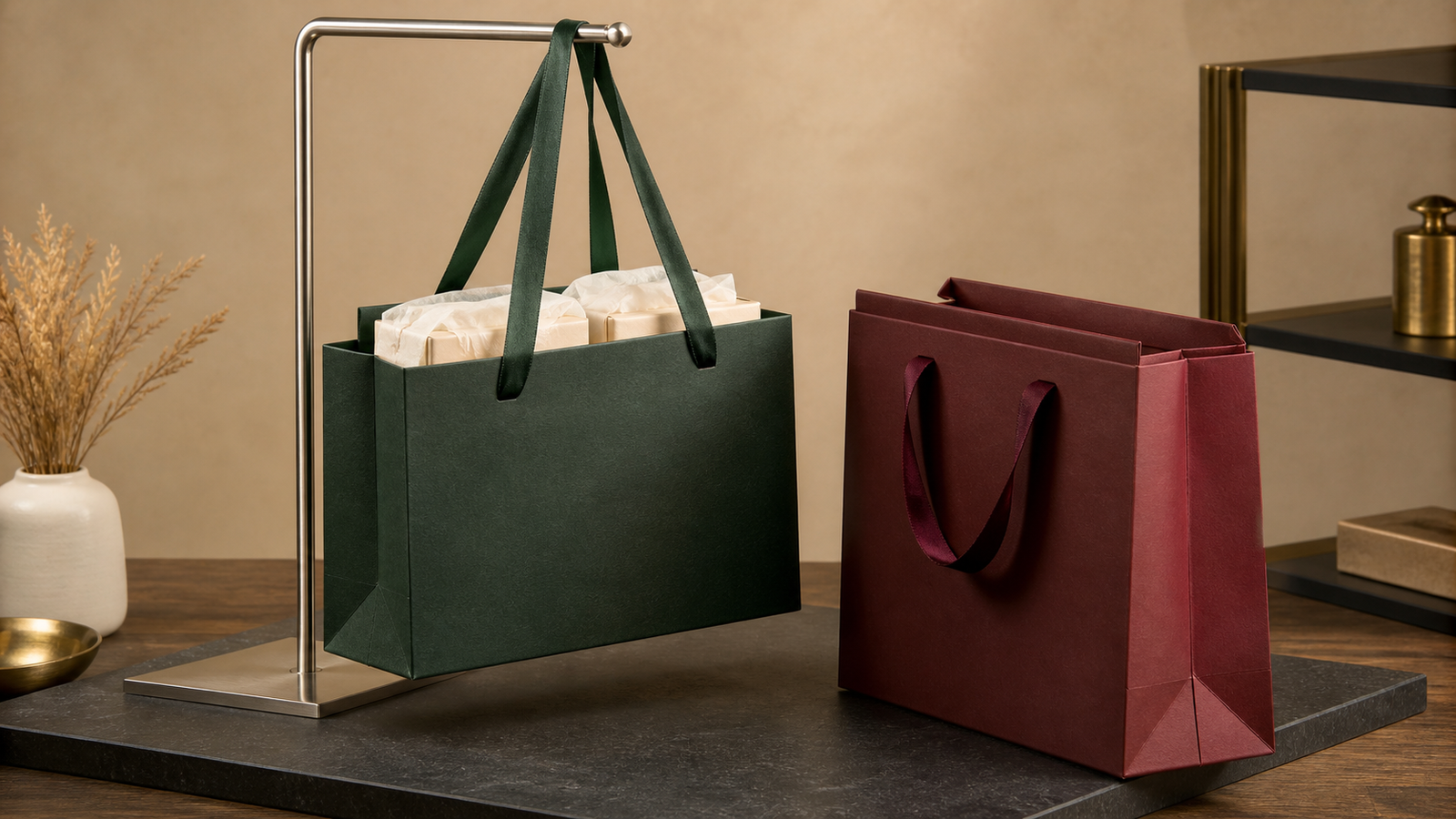
How should you test the complete load path?
Test the assembled bag, not only the rope or ribbon. The load travels through the handle, attachment, reinforcement, top edge, panel, gusset, seams and base. A strong handle can remain intact while the surrounding paper tears. A firm bottom card can still fail if its fold or adhesive bond opens.
The written test should identify the bag construction, product or representative load, weight distribution, carrying orientation, number and speed of lifts, hold time, travel or swing condition, environmental conditioning and pass/fail observations. Avoid copying a kilogram claim from another bag: capacity changes with size, paper, grain direction, handle geometry, reinforcement, adhesive, folding and the shape of the contents.
The European Commission’s criteria for paper carrier bags cite EN 13590:2003 as the reference test method for durability. A project can use an applicable recognised method, a customer method or a justified supplier protocol, but the method and rated use must be agreed. For premium retail projects, a practical loaded-product trial often reveals fit, balance, corner pressure and handle comfort that an isolated material result cannot show.
Record what happens after the test
- tearing or whitening around handle holes;
- ribbon slip, knot movement or separation of glued handle tabs;
- stretching, delamination or lift at reinforcement patches;
- opening of the side seam or bottom bond;
- permanent base sag, panel bowing or unstable standing;
- creases or finish cracking caused by the real packed shape;
- product corners creating local pressure or visible damage.
For handle construction choices and buyer questions, see our luxury paper bag handles guide.
How do you inspect print and luxury finishes?
Compare production with the correct reference under agreed viewing conditions. Check content and orientation first, then colour, registration, solids, fine detail and defects. Review the finished bag, because folds and handles change how centred artwork appears. A flat printed sheet cannot reveal every conversion issue.
- Print: wrong file, missing elements, colour shift, mottling, banding, set-off, scuffing, hickeys, pinholes or misregistration.
- Foil: incomplete transfer, filling of fine detail, unwanted flecks, edge breaks, double impression or incorrect position.
- Embossing and debossing: weak relief, crushing, cracking, misalignment or excessive show-through on the reverse.
- Lamination or coating: bubbles, silvering, edge lift, scratches, cloudiness, curl, blocking or delamination near folds.
- Cleanliness: fingerprints, dust, glue marks, oil, rubbing and damage transferred from adjacent bags.
Set realistic tolerances for paper-based production and identify the zones that matter most. A controlled colour reference, approved drawdown or press sheet is more useful than an uncalibrated phone photograph. For a coordinated bag and rigid gift box, define which component is the colour master and how acceptable material differences will be judged.
Why do temperature and humidity matter?
Paper exchanges moisture with the surrounding air. Changes can affect dimensions, curl, stiffness, folding, adhesive behaviour and the way a bag carries a load. ISO 187:2022 specifies standard atmospheres and procedures for conditioning paper, board and pulp before testing. If a result is meant to be comparable, record the conditioning and test environment rather than reporting only a pass.
Factory tests also need to reflect the real use case. A bag intended for a humid summer retail environment, a cold destination or a long ocean shipment may need project-specific conditioning, adhesive checks and packing controls. Do not assume a dry-room sample predicts every destination. Where necessary, agree storage limits and allow cartons to acclimatise before opening so condensation is not introduced onto paper and finishes.
What evidence should a buyer request?
- the approved specification, dieline and artwork revision;
- photographs or retained samples showing agreed appearance boundaries;
- material identification and relevant supplier certificates;
- incoming, in-process and final inspection records linked to the lot;
- measurement results with method, equipment and tolerance;
- functional test records naming the load, condition, duration and result;
- defect counts by class and the sampling plan used;
- quantity and carton pack verification;
- corrective-action and re-inspection records when a check fails;
- release approval identifying who accepted the shipment and when.
Generic certificates can support supplier qualification, but they do not prove that today’s production lot matches today’s order. Ask which records are batch-specific and which describe only a management system or raw material family. Keep evidence concise enough to review; a folder of unrelated documents is not traceability.
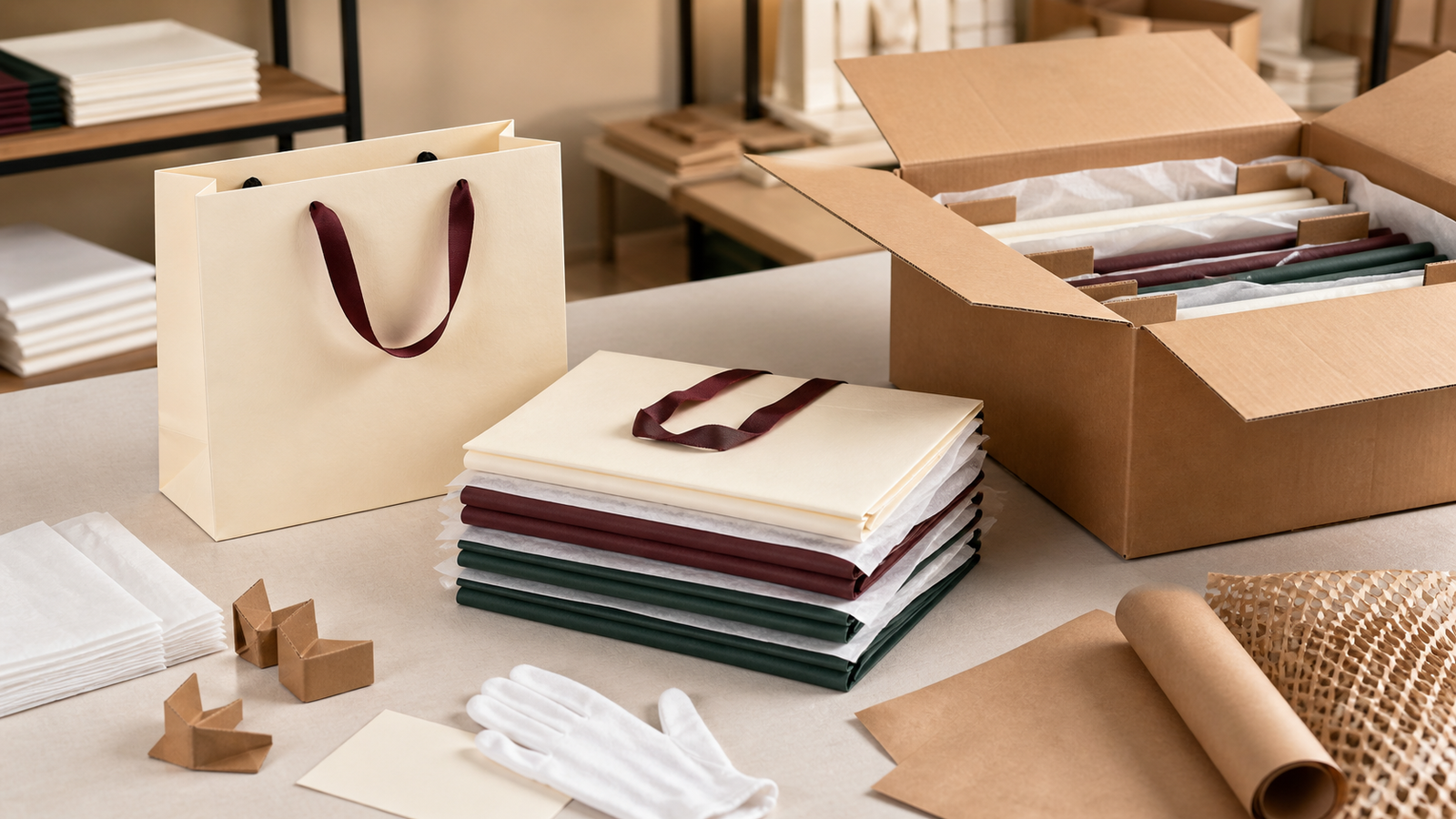
How should luxury paper bags be checked before shipping?
Final inspection is incomplete until packing is examined. Luxury surfaces are vulnerable to abrasion, pressure, moisture and transfer from handles or hardware. Check how bags are nested, whether handles are contained without sharp bends, where tissue or paper separators are needed and whether foil or dark coated surfaces rub against each other.
- verify units per bundle and carton against the packing list;
- confirm bags are fully dry, clean and free from trapped debris before nesting;
- protect high-risk printed or finished faces with the agreed paper separator;
- keep handles, eyelets and knots from embossing or scratching adjacent panels;
- check inner and outer cartons for fit, compression risk and moisture exposure;
- confirm carton markings, destination, pallet pattern and maximum stacking arrangement;
- inspect representative cartons from different pallet positions before release.
If paper bags ship with boxes, ribbon and tissue, inspect the complete packaging suite and its quantities. A launch can be delayed by missing tissue or mismatched ribbon even when every bag is acceptable. Coordinate the set under one project schedule and one version-controlled packing list.
A practical quality-control workflow
- Risk review: identify the costly failure points for the product, retail use, artwork and delivery route.
- Specification: convert design choices into drawings, references, tolerances, tests and defect definitions.
- Sample approval: test the intended product fit and complete bag, then retain an identified master reference.
- Incoming control: verify paper, handles, reinforcement, inks, finishes and other components before conversion.
- In-process checks: monitor print, cutting, creasing, folding, gluing, finishing and handle fitting early enough to correct drift.
- First production approval: compare actual line output with the signed sample and written corrections.
- Final inspection: apply the agreed sampling plan, classify defects, perform functional tests and inspect packing.
- Release and learning: keep evidence, correct failures, re-inspect when required and update the next reorder specification.
What belongs in a paper bag quality brief?
- bag dimensions, construction drawing and measurement method;
- product dimensions, packed weight, arrangement and expected carrying use;
- paper, handle, reinforcement, base board, adhesive, print and finishing specification;
- approved artwork, colour references, physical sample and correction notes;
- tolerances for dimensions, colour, registration and finish position;
- critical, major and minor defect definitions with visual examples where useful;
- lot definition, sampling plan and acceptance criteria;
- functional test method, conditioning and pass/fail requirements;
- inspection stages, records, photos and retained-sample expectations;
- packing count, separators, cartons, pallet and destination requirements;
- rework, replacement, re-inspection and release responsibilities.
Frequently asked questions about paper bag quality control
Is a pre-production sample enough to approve a bulk order?
Not always. A sample locks design and expected appearance, but a handmade or separately produced sample may not represent every production condition. Use it with a written specification, then approve first production output and inspect the final lot according to risk.
Does higher paper GSM guarantee a stronger bag?
No. Grammage measures mass per area. Strength and bag performance also depend on fibre and paper properties, grain direction, dimensions, folds, adhesive, handles, reinforcement, base construction and the packed load. Test the finished bag.
What is the most important paper bag load test?
The most useful test represents the real complete bag and agreed use. Define the product arrangement, total load, lift and hold conditions, environment and acceptable result. An isolated handle test can support diagnosis, but it does not replace testing the handle-to-base load path.
Should every bag be inspected?
That depends on order value, defect risk, process capability and the agreement. A defined sampling plan is common for lot acceptance, while some critical checks or automated process controls may cover more units. The plan should be decided before the shipment is presented.
Can a third-party inspector replace supplier quality control?
No. Independent inspection can provide useful release evidence, but the factory still needs incoming and in-process controls that prevent defects rather than merely count them at the end. Give any inspector the same current specification, samples and test methods used by the supplier.
Build a bag specification that can be repeated
Luxury paper bag quality is not a final photo or a single strength number. It is the repeatable result of a controlled reference, clear defect rules, appropriate sampling, measured materials, careful conversion, realistic loaded testing and protective delivery packing. The best inspection plan concentrates on the failures that would matter to your product, customer and launch.
Bespoke Packaging develops custom luxury paper shopping bags together with rigid gift boxes, ribbon and tissue paper. Share your product, bag size, expected load, artwork, quantity and delivery market, and we can help plan the sample, production checkpoints and coordinated packaging set.
Which bag failure would be most costly to discover after your products reach the store?