
CUSTOM PAPER BAG LEAD TIME GUIDE
Custom Paper Bag Lead Times: A Buyer’s Planning Guide
Plan specification, artwork, sampling, production, inspection and delivery as one connected schedule—then protect the launch date before approving a custom luxury paper bag order.
A custom paper bag lead time is the complete period from a workable packaging brief to the point when finished bags are available where you need them. It can include specification and quotation, dielines, artwork, material sourcing, physical samples, approval, mass production, inspection, export packing, freight, customs and local delivery. The factory production window is only one part of that calendar.
For a first bespoke order, plan in weeks rather than days and separate development time from manufacturing and transport. A simple repeat order using approved materials and unchanged artwork can move faster, while specialty paper, several colourways, ribbon handles, foil, embossing, testing or a fixed launch date can require more preparation. There is no honest universal number: ask for a dated, stage-by-stage schedule tied to your exact specification and approval responsibilities.
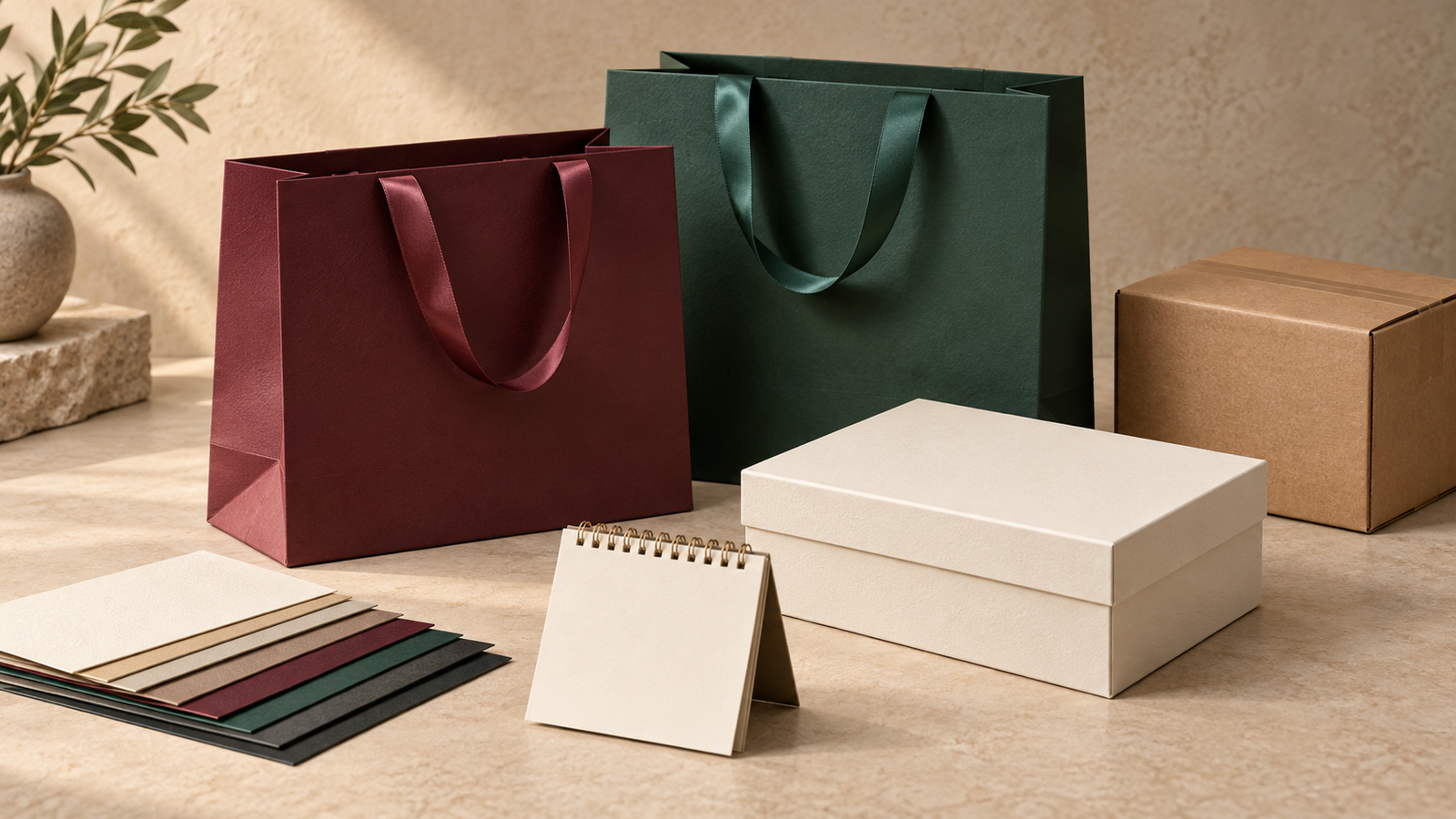
How long do custom paper bags take to make?
A realistic first-order plan usually contains several days of commercial and artwork alignment, days or weeks for the chosen sample route, weeks for material preparation and mass production, and a separate delivery window. Published supplier estimates vary widely because “lead time” may begin at enquiry, deposit, artwork approval or sample approval—and may stop at factory completion rather than arrival at the buyer’s warehouse.
| Stage | Useful planning scale | What closes the stage |
|---|---|---|
| Brief and quotation | Days | Agreed size, quantity, material, print, finish, handle, packing, destination and commercial basis |
| Dieline and artwork | Days to weeks | Production-ready files approved against the final structure |
| Sampling | Days to weeks | The required physical reference and written corrections approved |
| Material and production planning | Days to weeks | Paper, handles, tooling, print route and factory slot confirmed |
| Mass production | Weeks | Converted bags complete and ready for final inspection |
| Inspection and packing | Days | Accepted lot packed, counted, labelled and released |
| International delivery | Days to weeks | Goods arrive at the named destination after the agreed transport and clearance steps |
These are planning scales, not a delivery promise. The correct schedule must show calendar dates, dependencies and who owns each approval. If a quotation says “three weeks” but does not state when those three weeks start, what they include or where they end, the date is not yet safe for launch planning.
When does the production clock actually start?
Mass-production lead time normally starts only after the order is commercially confirmed and every production-critical input is released. A supplier cannot reserve the correct paper, make tooling or print a live order while size, artwork, colour, handles or finishes remain open. Ask the quotation to define the trigger in plain language.
- final bag width, gusset and height are approved;
- quantity is confirmed for every size, artwork and colourway;
- paper, handle, reinforcement, print and finish specifications are frozen;
- the final dieline and production artwork are signed off;
- the required physical sample or proof is approved with corrections recorded;
- commercial terms, deposit or credit requirements are complete;
- packing method, destination and requested delivery date are confirmed;
- any certification, labelling or destination-market documents are agreed.
Schedule rule: “approved” should mean approved for production, not merely approved as a concept.
Record the file revision, physical sample, written corrections and approval date that release the order.
A late artwork change does not always add only the time needed to edit the file. It can invalidate a proof, alter foil or embossing tools, change ink coverage, affect a folded edge or cause the order to miss its reserved production slot. Build a clear change-control point into the schedule before mass production begins.
Which parts of a luxury paper bag add time?
Luxury paper bags often combine processes that must happen in a fixed sequence. Paper may be printed as flat sheets, protected or laminated, foil stamped or embossed, cut and creased, folded and glued, then fitted with ribbon or rope handles, reinforcement cards and base boards. Drying, curing, conditioning and inspection cannot always be compressed simply by adding labour.
Special paper and certified material
A readily available paper is easier to schedule than an imported texture, custom shade or uncommon thickness. If an FSC claim is required, say so before quotation and confirm the claim, product scope and documentation route. The Forest Stewardship Council explains that chain of custody identifies and tracks eligible material through the supply chain; a generic promise that paper is “sustainable” is not a substitute for the correct certified material and claim process.
Colour, print and decorative finishes
Spot colours, heavy ink coverage, foil, embossing, debossing, spot gloss and full-surface films add approval and production dependencies. A screen PDF can confirm content and position, but it cannot prove paper shade, metallic reflection, relief depth or the way a finish behaves across a crease. Our paper bag printing guide and finishes guide explain what to approve for each route.
ISO 12647-7:2016 defines requirements for hard-copy digital proofs intended to simulate a specified printing condition. That gives a formal proof a clear purpose, but it still does not make the proof a finished-bag sample. Choose the approval tool for the risk you need to close instead of assuming one sample can answer every question.
Handles, reinforcement and manual assembly
Custom-dyed ribbon, woven ribbon, unusual rope, metal eyelets, concealed handle fittings and reinforced turn-tops may involve separate suppliers or manual work. The attachment must also be tested with the intended load. Changing a handle after sample approval can affect hole positions, reinforcement, top-fold depth, usable space and production time. Compare practical options in our luxury paper bag handle guide.
Several sizes, artworks or matching components
One order containing three bag sizes and four colourways is not operationally identical to one large run of one design. Each SKU needs identifiable artwork, material allocation, production records, inspection and packing. Coordinated rigid boxes, ribbon and tissue paper can share a colour direction, but they use different substrates and processes. Schedule the complete packaging set around the slowest approved component rather than assuming every item will finish together.
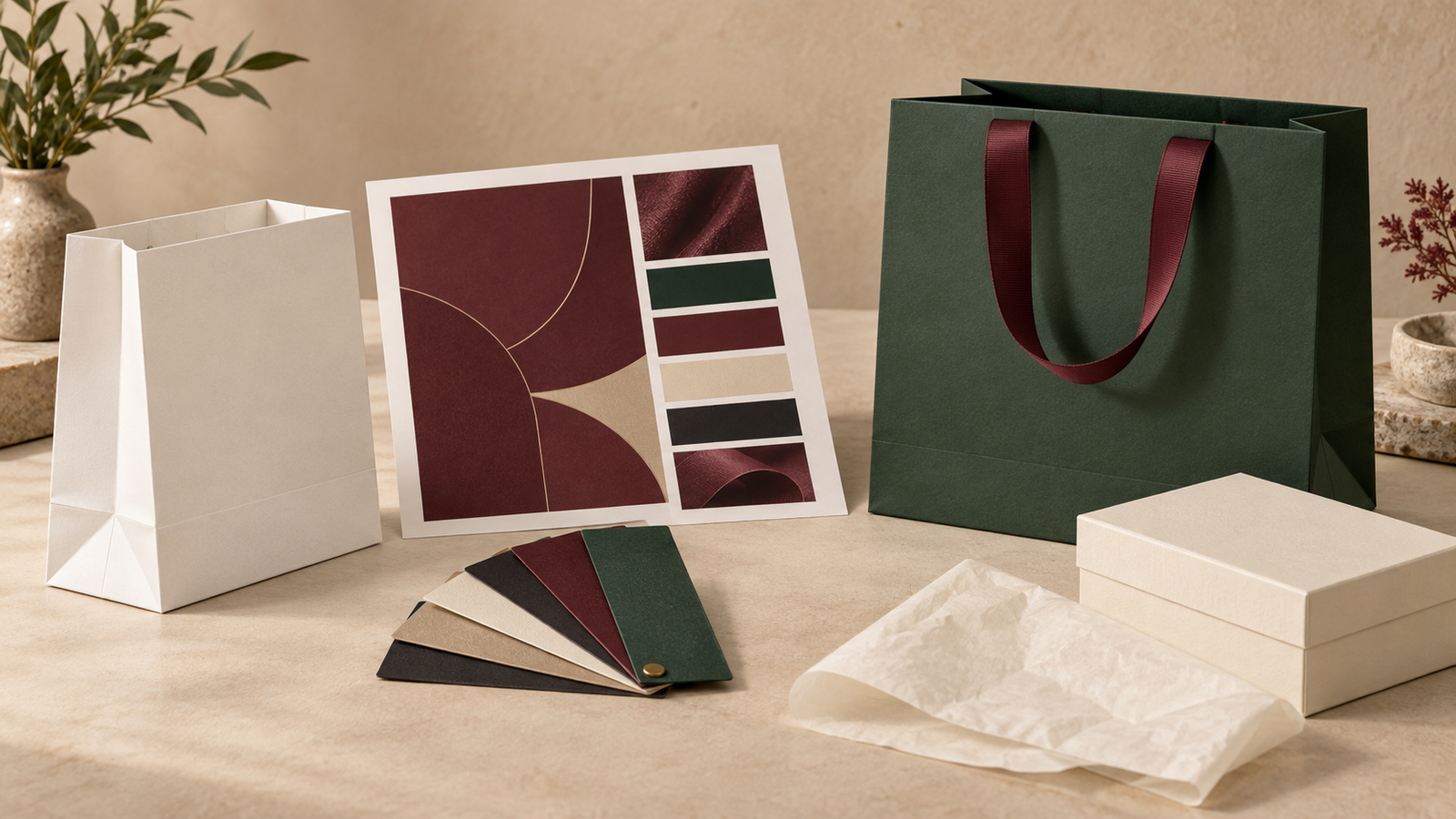
Which paper bag sample saves the most time?
The fastest sample is the one that answers the current decision without pretending to prove more than it can. Use a staged route when several risks exist. Approving structure early prevents finished artwork from being built on the wrong dieline, while approving colour on the relevant paper reduces surprises later.
| Approval tool | Best question it answers | What it cannot fully prove |
|---|---|---|
| Digital mock-up or PDF | Is the artwork version, position and basic layout correct? | True colour, paper feel, bag strength and finish behaviour |
| Material swatch | Is the paper, ribbon or tissue direction suitable? | Converted bag shape, print result and carrying performance |
| Plain structural dummy | Do size, gusset, opening and product fit work? | Production colour and decorative finish quality |
| Printed proof | Does artwork reproduce acceptably under the stated proof condition? | Every feature of the finished converted bag |
| Finished pre-production sample | Does the complete specification look and function as intended? | Variation across the full production lot |
| First production unit | Does live-line output match the approved reference? | Final lot consistency without ongoing checks |
Do not spend a week waiting for a decorative sample when the unresolved question is simply whether a gift box fits through the opening. Equally, do not approve a premium burgundy colour from an uncalibrated screen when the launch depends on matching a box and ribbon. Match sample fidelity to decision risk, set a response deadline and identify who can approve it.
How do peak seasons and holidays affect paper bag lead time?
Production capacity is not evenly available throughout the year. Retail launches, gifting seasons, trade fairs, major local holidays and shipping peaks can increase demand for paper, print, finishing, labour, freight space and customs handling at the same time. A supplier’s normal production estimate does not guarantee the same slot during a peak period.
- share the required in-warehouse date, not only the intended order date;
- ask which factory closures, material deadlines and carrier cut-offs affect the route;
- reserve time for brand, legal and procurement approval before supplier production;
- avoid placing the first full order on the critical path of a store opening or campaign;
- approve repeat-order forecasts early enough to secure paper and production capacity;
- keep contingency between expected arrival and the date stock must be distributed.
Does shipping time belong in the lead time?
Yes—if the buyer needs an in-hand date. Factory completion, handover to a carrier, port departure, destination arrival and delivery to a warehouse are different milestones. Courier and air can shorten transit for samples or urgent quantities, while sea freight can suit larger volumes but requires more calendar room. Actual timing depends on origin, destination, service, booking availability, customs, local delivery and the agreed commercial term.
Incoterms do not create a transit-time guarantee. The International Chamber of Commerce’s Incoterms 2020 guidance explains that the rules allocate buyer and seller obligations, costs and risks. State the chosen rule with a precise named place, then separately record who books transport, which service is assumed, what documentation is required and which date is promised.
Packaging for export also needs protection. Nested bags can rub, distort or absorb moisture if packing is treated as an afterthought. The International Safe Transit Association’s design and testing guidance recommends understanding the actual distribution environment, using representative packaged products and documenting test conditions and results. If transit testing, trial shipments or special packing approval is required, include it before the launch calendar is fixed.
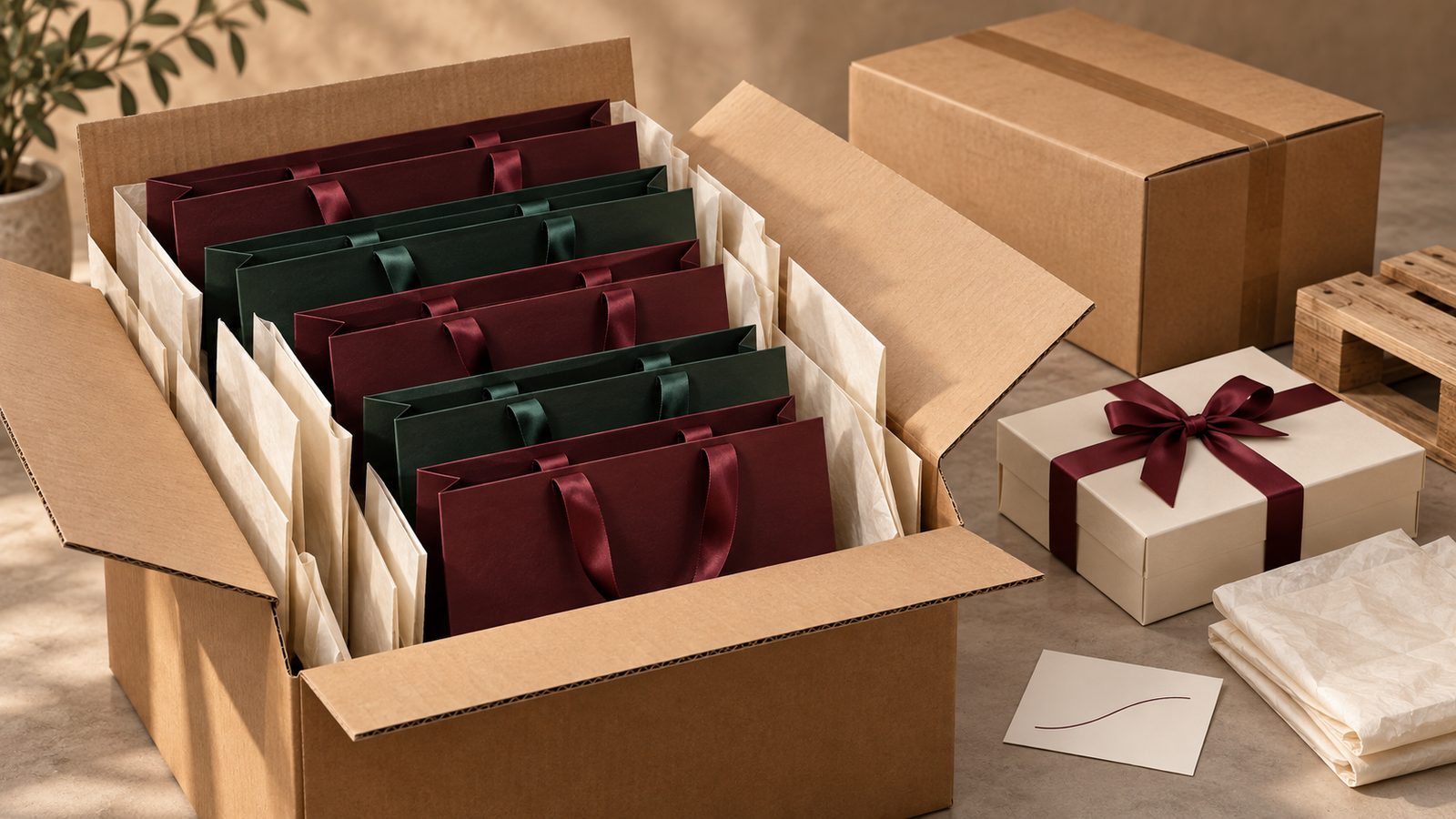
How can buyers shorten lead time without increasing risk?
- Send a complete RFQ. Include size, quantity, material direction, print, finishes, handles, destination and required date in the first brief.
- Freeze the structure before final artwork. Build design on the supplier’s approved dieline rather than resizing artwork after it is complete.
- Use existing practical formats where they fit. An established die or available material may reduce development, but only if product fit and presentation remain right.
- Choose sample fidelity deliberately. Use a plain dummy for fit, a relevant proof for colour and a finished sample for combined appearance and function.
- Appoint one approver. Consolidate feedback from design, marketing, procurement and logistics into one marked revision.
- Approve within an agreed window. A sample waiting on a desk can consume more calendar than its production.
- Reduce avoidable SKU variation. Consolidate sizes or artwork only where product fit and brand clarity are preserved.
- Separate must-haves from optional finishes. Let the supplier show which feature drives the critical path and what a simpler alternative changes.
- Plan split delivery only when justified. A small urgent quantity by air and the balance by sea can protect a launch, but it adds packing, coordination and freight cost.
- Keep an approved reorder specification. Preserve artwork files, colour references, sample records, packing requirements and lessons from the first run.
“Rush” should never mean skipping the checks connected to the largest business risk. It may be reasonable to simplify a finish, use an available paper or choose a faster freight service. It is less reasonable to release unapproved dimensions, ignore handle performance or send final artwork after production begins.
How should you build a launch-ready reverse schedule?
Start with the date finished packaging must be available at the warehouse, store or fulfilment partner. Then work backwards through contingency, local delivery, customs, main transport, export handling, final inspection, production, sample approval, artwork and specification. Put decisions owned by your team on the same calendar as supplier tasks.
- Need date: bags are received, counted and usable.
- Buffer: time reserved for transport variance, distribution or corrective action.
- Delivery plan: named destination, commercial term, service and booking responsibility.
- Release plan: final inspection, documents, packing and handover milestone.
- Production plan: material readiness, print, finishing, converting, handle fitting and in-process checks.
- Approval plan: sample type, approver, review window and consequence of a change.
- Development plan: brief, dieline, artwork, material and quotation decisions.
Ask the supplier to mark the critical path: the chain of dependent tasks that determines the earliest completion date. If the custom ribbon cannot begin until its colour is approved, or the foil tool cannot be made until artwork is frozen, those are schedule-driving approvals. Faster feedback elsewhere will not recover time lost at that dependency.
What timing information belongs in a paper bag RFQ?
- required in-hand date and the business event behind it;
- delivery country, city, postcode and receiving constraints;
- quantity for every size, design and colourway;
- finished dimensions, expected packed weight and product-fit requirements;
- paper, certified-content claim, print, finish, handle and reinforcement preferences;
- artwork status and the date final files can be supplied;
- sample type required and named person responsible for approval;
- acceptable substitute materials, finishes or formats if the preferred route misses the date;
- inspection, lab test, documentation and labelling requirements;
- packing count, carton limits, pallet or moisture-protection requirements;
- preferred Incoterm, named place and transport responsibilities;
- whether a partial urgent delivery should be quoted separately;
- the start trigger, completion milestone and exclusions in the quoted lead time.
Pair this timing brief with the dimension method in our luxury paper bag size guide, the quantity questions in our MOQ guide and the release criteria in our quality-control checklist. A date is meaningful only when the product, specification, quantity and acceptance method behind it are equally clear.
Frequently asked questions about custom paper bag lead times
Is sampling included in paper bag production time?
Not always. Many production estimates begin after sample and artwork approval. Ask for sampling and mass production as separate calendar lines, plus the trigger that moves the order from one stage to the next.
Are repeat orders always faster?
They can be faster when artwork, size, materials, handles, finishes and packing are unchanged and the approved records are complete. Paper availability, capacity, tooling condition, destination rules or requested quantity can still change, so obtain a new dated confirmation for every reorder.
Can production start before the sample is approved?
Starting at risk may save calendar on paper but can create expensive rework if the sample changes. Safer parallel work might include reserving capacity, checking artwork or sourcing agreed materials while approval is pending. Define what is reversible, what cost is committed and who authorises the risk.
Do luxury finishes always add lead time?
They usually add process and approval dependencies, but the calendar impact depends on tooling, artwork, material compatibility, capacity and sequence. Ask the supplier to show which finish is on the critical path and whether a simpler effect can meet the same design goal.
Should a buyer choose air freight for a launch?
Air or courier may be appropriate for samples or a limited urgent quantity, but compare cost, volume, customs handling and the real need date. A split shipment should be quoted and packed as a deliberate plan, not improvised after production finishes late.
When should seasonal paper bags be ordered?
Begin before the normal schedule becomes critical. Work backwards from warehouse receipt, add transport and contingency, then include production, sample and internal approval. Ask about factory holidays, paper availability and carrier cut-offs for the specific origin and destination.
Plan the whole path, not one production number
A reliable custom paper bag lead time connects specification, approvals, materials, production, quality control and delivery. Define when the clock starts, where it stops, which decisions drive the critical path and how much contingency protects the need date. That turns “How many days?” into a schedule a buyer and supplier can actually manage.
Bespoke Packaging develops custom luxury paper bags together with rigid gift boxes, ribbon and tissue paper. Share your bag size, quantity, artwork status, finish ideas, delivery destination and required in-hand date, and we can map a practical sample, production and shipping plan for the complete packaging set.
Is your quoted lead time tied to a launch-ready calendar—or only to the days after final approval?