
LUXURY PAPER BAG MOQ
Luxury Paper Bag MOQ Explained: How to Plan Order Quantities
Understand why minimum order quantities change, how specifications and SKU count affect price, and what to ask before committing cash and storage space to a custom paper bag order.
A luxury paper bag MOQ is the smallest production quantity a supplier will accept for one defined bag specification. It is usually applied per size, artwork, colourway or construction—not automatically across every bag in a mixed order. The practical question is therefore not simply “What is your MOQ?” but “What is the MOQ for this exact bag, for each SKU, using this production route?”
There is no responsible universal MOQ for custom paper bags. A supplier may be able to make a small digitally printed pilot using available materials, while a custom-dyed paper, special handle, offset print, foil, embossing and hand assembly may require a larger commitment. Equipment, sourcing network, capacity, quality requirements and delivery plan also change the answer. This guide helps buyers compare quotations without treating the lowest headline minimum as the best commercial choice.
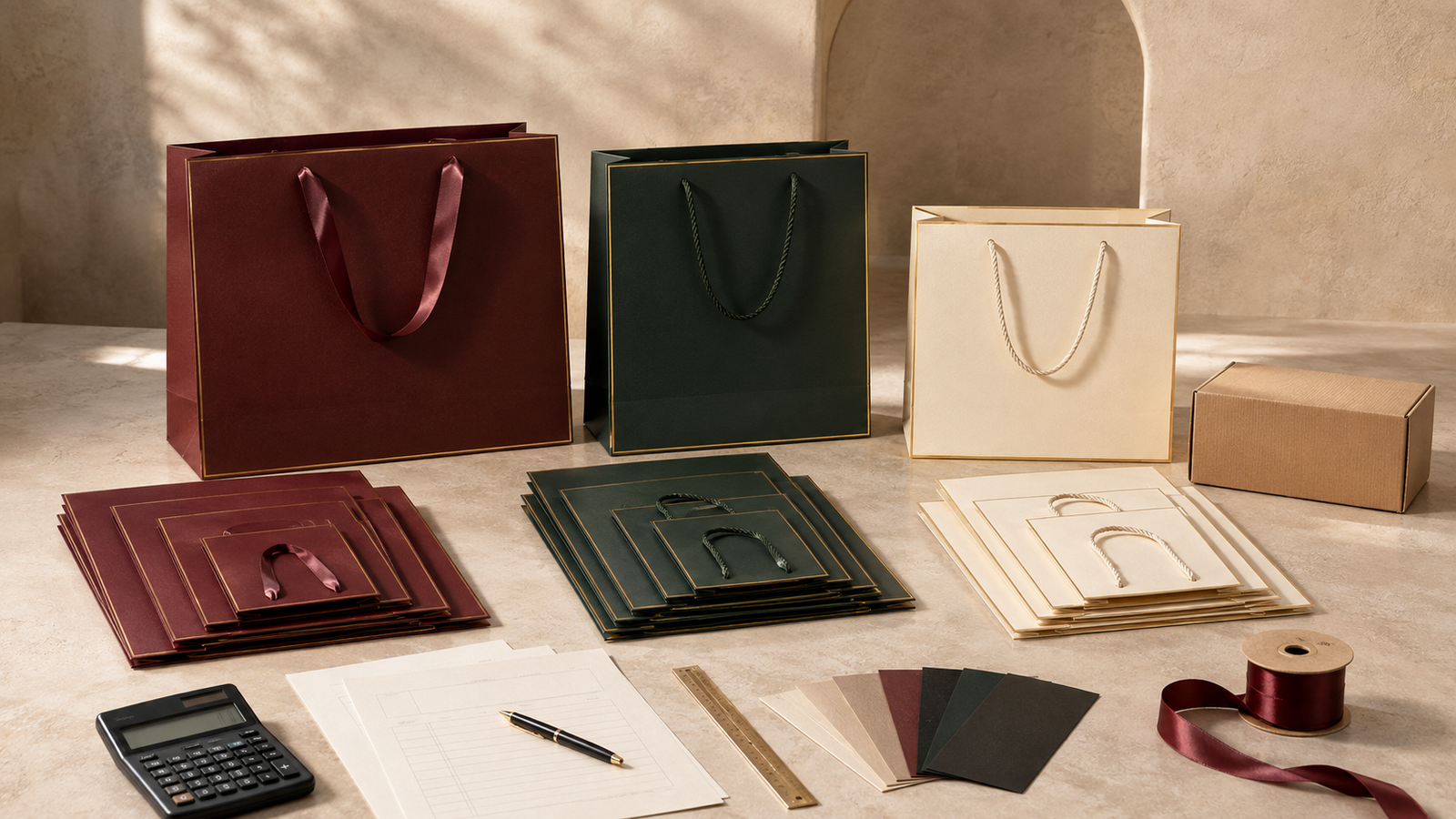
What does MOQ mean for custom paper bags?
MOQ means minimum order quantity. For a stock carrier with a simple overprint, the minimum may relate mainly to the printing service. For a fully custom luxury paper shopping bag, it can reflect the economical batch for paper purchasing, printing, converting, handles, reinforcement, finishing, assembly and packing.
MOQ is not a quality grade and it is not a guarantee of the lowest total cost. It is an operating boundary within a particular supplier’s process. The same artwork can receive very different minimums from two factories because their presses, converting equipment, standard materials and order portfolios differ.
Public evidence also shows how wide the market can be. The U.S. International Trade Commission’s 2024 paper shopping bags report recorded substantial variation in reported minimums for customised bags and noted both machine-changeover considerations and the storage burden that larger minimums can create for smaller buyers. Those figures describe the investigated U.S. market and period; they are not a price list for a luxury bag project. Their useful lesson is that an MOQ only makes sense in context.
Why do luxury paper bag MOQs exist?
Every custom order contains work that happens before the first acceptable finished bag is packed. The supplier checks artwork, prepares colour and production files, schedules materials, sets machines, makes plates or screens where required, sets cutting and creasing, prepares finishing tools, adjusts handle placement, establishes glue and folding conditions, and approves the first production output. These tasks consume time and material whether the order contains a modest pilot or a long production run.
The familiar cost logic is simple:
Indicative unit economics = allocated setup cost per bag + variable production cost per bag.
This is a planning model, not a supplier quotation. Freight, duties, storage, inspection, finance and waste still need to be considered.
As quantity rises, the fixed preparation cost is allocated across more usable bags. But the curve is not perfectly smooth. A larger order can cross a material-purchase threshold, require another production batch, fill a different number of export cartons or change the suitable printing route. Ask for quantity breaks rather than assuming that doubling volume will halve the unit price.
Which specifications have the greatest effect on MOQ?
| Specification choice | Why it can affect the minimum | Useful buyer question |
|---|---|---|
| Custom size and structure | May require a dedicated cutting form, machine setup or more manual conversion | Is there an existing size or construction close to our product fit? |
| Paper and colour | Special stocks, mill colours or custom-dyed paper may have their own purchase quantities | Which available papers meet the visual and performance brief? |
| Printing route | Digital, offset, screen and flexographic production carry different setup and run economics | Which route is proposed at this quantity, and what changes at the next break? |
| Foil, embossing or special coating | Tools, dies, setup sheets and separate passes can add minimum economic work | Can one finish create the priority effect without stacking processes? |
| Handle and reinforcement | Custom colour, width, material, attachment and hand assembly can create component minimums | Is the handle available from stock, and how is it attached and tested? |
| Number of SKUs | Each size, artwork or colour may trigger a separate setup or material allocation | Is the MOQ per design, per size, per colour or across the total project? |
| Certification and claims | Certified inputs, traceability and label approval must match the production route | Can the supplier substantiate the exact claim and approve the label artwork? |
Bag size and construction
A standard factory construction using an existing size range may be easier to schedule than an unusual proportion, shaped opening or complex folded detail. That does not mean the bag should be oversized to fit an existing tool. Product fit, filled weight, handle position and presentation come first. It means buyers should ask whether a small dimensional adjustment preserves the intended experience while using a more efficient format.
Paper, handles and finishing components
Paper merchants, mills, ribbon suppliers and other component makers can each impose their own batch or purchase conditions. A custom-coloured ribbon handle may therefore set a higher floor than the printed bag body. An available deep-green stock paper with a contrasting burgundy ribbon could be viable at one quantity, while a bespoke paper shade, matching ribbon dye and custom metal eyelet may need a different plan.
If an FSC on-product label is part of the brief, treat it as a controlled requirement rather than artwork decoration. FSC explains that chain-of-custody certification tracks certified forest-based material through manufacturing and distribution, and its brand guidance for on-product labels tells buyers to verify the final supplier’s certification, specify certified material and have label use approved through the certified supplier. Confirm the claim before artwork approval because substituting an available non-certified paper later can invalidate the intended label.
Printing and finishing route
Digital production can reduce some conventional prepress steps and is often considered for shorter or variable runs. HP describes its current Indigo packaging systems as supporting shorter runs and faster speed to market. Offset remains highly capable for premium packaging, and modern presses continue to reduce makeready: Heidelberg describes short-run packaging production through lower setup time and waste. These developments widen the available crossover range, but they do not create one universal quantity rule. Conversion, handles, finishing and assembly still remain after printing.
Use our luxury paper bag printing guide to compare offset, screen, digital and flexographic routes. For MOQ planning, ask which route is included in the quotation, whether colour or finish changes create separate setups, and whether the same physical bag can carry multiple artworks efficiently.
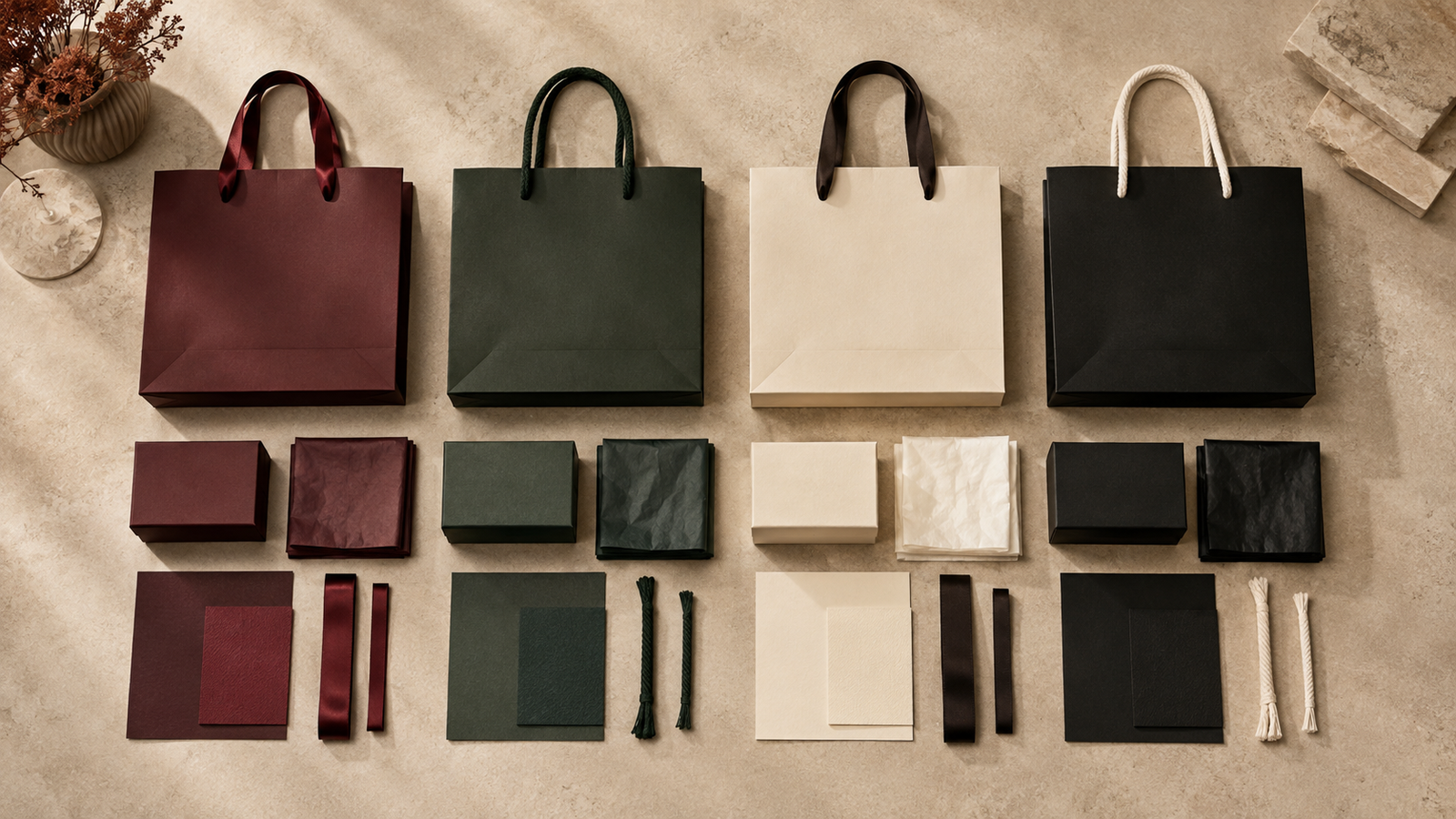
Is the MOQ per order or per SKU?
This is one of the most important questions in a paper bag enquiry. A SKU is a distinct sellable or operational version. For packaging, a change in size, artwork, language, colour, paper, handle or finish may create a separate production setup even when the brand is the same.
Suppose a launch needs one bag size in four seasonal colours. A quote described as “MOQ 1,000” might mean 1,000 total across four colours, or 1,000 for each colour and therefore 4,000 bags overall. If the four versions also use different ribbon colours, foil tools or papers, component minimums may apply separately. Never multiply a headline unit price by the total volume until the supplier has confirmed the SKU allocation.
- Size change: usually changes the cutting and folding setup and may change paper yield.
- Artwork change: may require new plates, screens, digital files or colour approval.
- Colourway change: can trigger ink wash-up, paper changes, handle changes and separate packing.
- Language or market change: may create an artwork version even when the visual design is similar.
- Finish change: can require another foil, embossing or varnish setup.
- Delivery split: may not reduce the production MOQ and can add packing, storage and freight handling.
How does order quantity affect paper bag price?
Unit price normally falls as setup, tooling and purchasing costs are spread across more bags, but the lowest unit price is not automatically the lowest business cost. A larger order ties up more cash, occupies storage, increases the risk of obsolete artwork and may exceed realistic demand. A smaller run may cost more per bag yet protect a launch from surplus inventory.
Compare at least three quantity scenarios using the same specification. Ask the supplier to identify any production-route change between them. Then calculate the expected landed and held cost, not only ex-factory unit price.
- production price and one-time tooling;
- pre-production samples, proofs and approval rounds;
- inspection, testing and replacement allowance;
- export cartons, palletisation and freight;
- import duties, taxes and customs charges where applicable;
- warehouse receiving, storage and internal handling;
- finance cost and cash committed before the bags are used;
- expected damage, design change or obsolete stock;
- reorder lead time and the cost of a stockout.
How can a brand reduce MOQ without weakening the bag?
- Standardise the physical bag. Use one carefully fitted size and construction across several launches when the products allow it.
- Reduce early SKU fragmentation. Launch with one or two strong evergreen colourways instead of dividing demand across many small versions.
- Ask for available materials. Compare stock paper, ribbon and rope options before commissioning custom colours, while still testing the complete bag.
- Prioritise one premium effect. A considered foil mark or blind emboss may communicate more than several processes layered together. Review our paper bag finishes guide before simplifying.
- Keep construction constant when artwork changes. If the size, paper and handle stay stable, a supplier may have more options for managing multiple printed versions.
- Separate sampling from launch inventory. Pay for a correct sample and approval path rather than treating a small sample batch as a substitute for controlled production.
- Ask about a staged call-off. A supplier may be able to produce an economical total and release it in planned batches, but ownership, storage conditions, payment and obsolescence must be written clearly.
- Share a realistic forecast. A credible annual requirement and reorder plan can help the supplier propose a route that a one-off question cannot reveal.
Do not reduce the minimum by removing structural elements that protect the product or carry the load. A thinner paper, weaker reinforcement or unsuitable handle can create waste through failure. Use the materials guide, handle guide and quality-control checklist to distinguish cost-saving simplification from performance risk.
When is a higher MOQ the better decision?
A higher quantity can make sense when demand is proven, the design is stable, storage is dry and suitable, cash flow can support the purchase, and the saving remains meaningful after freight and inventory costs. Evergreen retail bags used across several locations are different from event-dated bags, seasonal artwork or packaging carrying information likely to change.
Set a consumption model before ordering. Estimate average weekly use, seasonal peaks, opening stock, safety stock, approved lead time and the point at which a reorder must be placed. Test more than one demand scenario. If the project includes matching rigid gift boxes, ribbon and tissue paper, plan the consumption ratio for the whole set: an extra bag is not useful if the corresponding box or tissue runs out first.
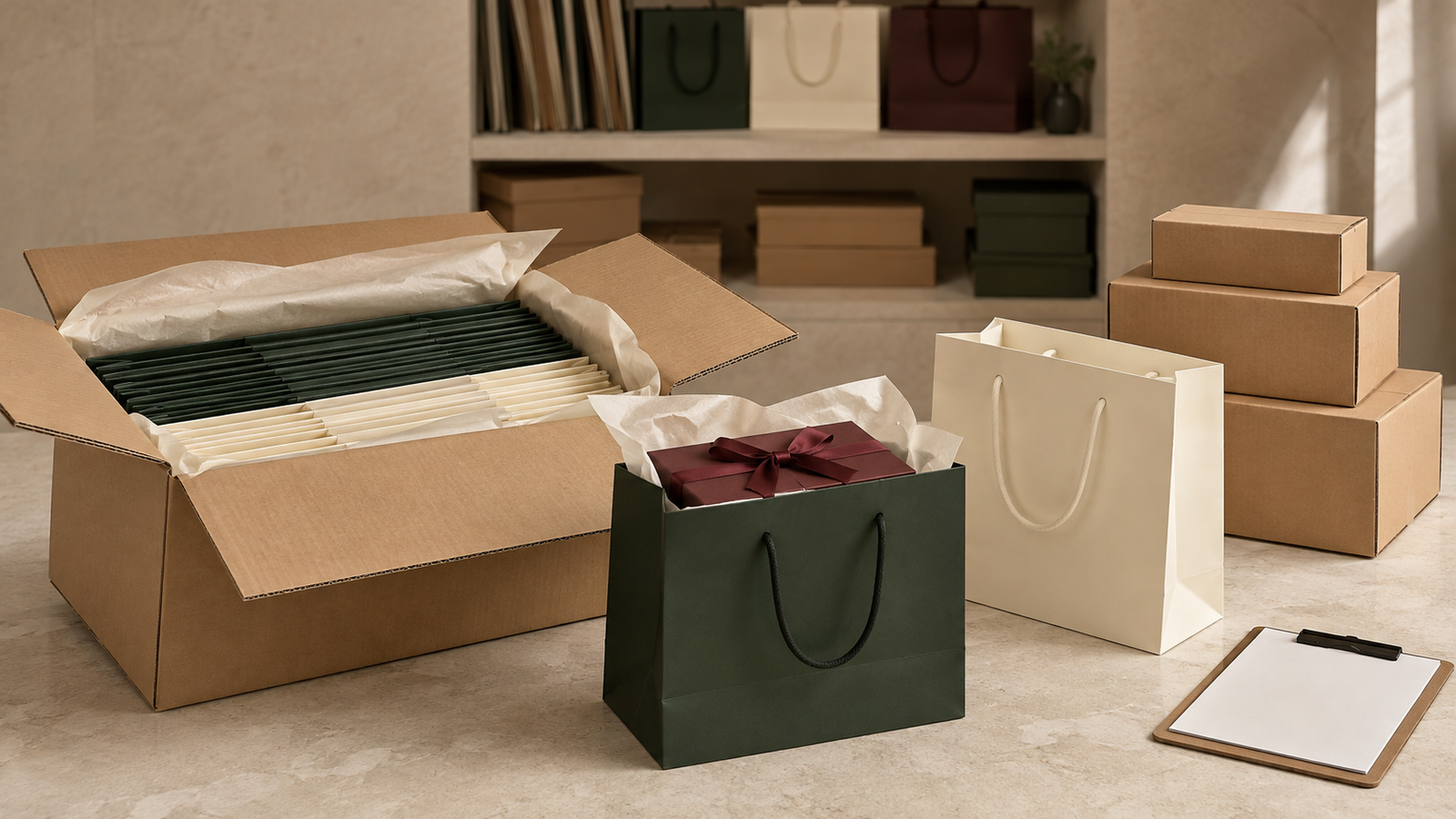
How should storage and shipping influence quantity?
Luxury paper bags normally ship nested or flat-packed, but they still occupy meaningful carton and pallet volume. Handles, folded tops, gussets and surface finishes can limit how tightly they pack. Excess compression can mark ribbon, distort folds or cause abrasion; excessive empty space can allow movement and crushing. Confirm units per inner pack, units per export carton, carton dimensions, gross weight, pallet configuration and moisture protection before deciding that a higher quantity is affordable.
Warehouses should protect paper packaging from water, high humidity, dust, direct sun, pests and crushing. Stock rotation matters when colour-sensitive papers, adhesives or finishes will be stored for an extended period. Ask whether split delivery changes freight efficiency and who carries risk for stock held at the factory or a fulfilment warehouse.
What should you send for an accurate MOQ quotation?
- finished bag width, gusset and height, plus the real product dimensions and maximum packed weight;
- quantity required for each size, artwork, language, colourway and delivery batch;
- target delivery date, destination, preferred shipping method and incoterm;
- paper family, colour, texture, grammage or performance direction, including required certification claims;
- artwork files, number of print colours, coverage, colour references and any variable versions;
- foil, embossing, debossing, spot varnish, lamination or coating requirements;
- handle material, colour, width or diameter, length, attachment and reinforcement;
- sample stages, colour proof, production approval and required tests;
- packing count, carton, pallet and storage constraints;
- matching gift box, ribbon and tissue-paper quantities;
- acceptable alternatives that preserve the brand and performance brief;
- the quantity breaks you want compared, using one unchanged specification.
Ask the supplier to return a line-item assumption sheet with the quote. If two quotations use different paper, print routes, handle construction or packing, their prices and minimums are not directly comparable. Resolve the assumptions first, then compare commercial terms.
Frequently asked questions about luxury paper bag MOQ
What is a typical MOQ for custom luxury paper bags?
There is no reliable universal figure. Minimums vary by supplier, size, material, print route, finish, handle, assembly method and number of SKUs. Request a quantity ladder for your exact specification and confirm whether the minimum is per design, size or colour.
Can different designs be combined to meet one MOQ?
Sometimes, but only when the supplier confirms it. Designs may share a construction yet still require separate print, colour, finish and packing setups. State the quantity for every version and ask which costs or minimums can genuinely be shared.
Does a lower MOQ always mean a higher unit price?
Often, because setup is spread across fewer bags, but production routes differ. A supplier may use a different print or conversion method for a short run. Compare appearance, durability, colour control, sample path and landed cost as well as unit price.
Is a sample included in the MOQ?
Do not assume so. A blank mock-up, digitally printed proof, fully finished sample and production unit serve different purposes and may be priced separately. Confirm what is included, which sample becomes the approval reference and whether sample fees are credited against production.
Can stock bags with a printed logo lower the minimum?
They can reduce custom construction and material setup, so they may suit a pilot or event. The trade-off is less control over proportions, paper, handle, colour and finish. Test product fit and carrying performance before treating a stock bag as a luxury retail solution.
Plan the quantity around the business, not the headline
The best luxury paper bag MOQ is not automatically the smallest number a supplier will accept or the largest volume with the lowest unit price. It is the quantity that fits a controlled specification, realistic demand, cash flow, storage, launch date and reorder plan. Make the SKU definition explicit, compare consistent quantity breaks and keep the bag’s structural performance intact.
Bespoke Packaging develops custom luxury paper bags together with rigid gift boxes, ribbon and tissue paper. Share your product, target bag size, quantity by SKU, artwork, delivery market and preferred materials, and we can help shape a quote-ready specification and coordinated packaging plan.
Would fewer, stronger SKUs create a better launch than a larger collection of underused bag variants?