
CUSTOM FLORIST BAG GUIDE
Custom Flower Paper Bags: A Florist Packaging Guide
Design a premium flower carrier around the real bouquet, moisture boundary and counter handoff—not around an empty bag sample.
Custom flower paper bags are wide-base paper carriers designed to present and hand-carry bouquets, vase arrangements or boxed floral gifts. The best specification starts with the finished arrangement: its base, height, weight, moisture treatment and customer journey. A florist bag should keep the presentation upright and easy to carry, while the wet stem treatment or vase remains a separate, controlled system.
The short buyer answer
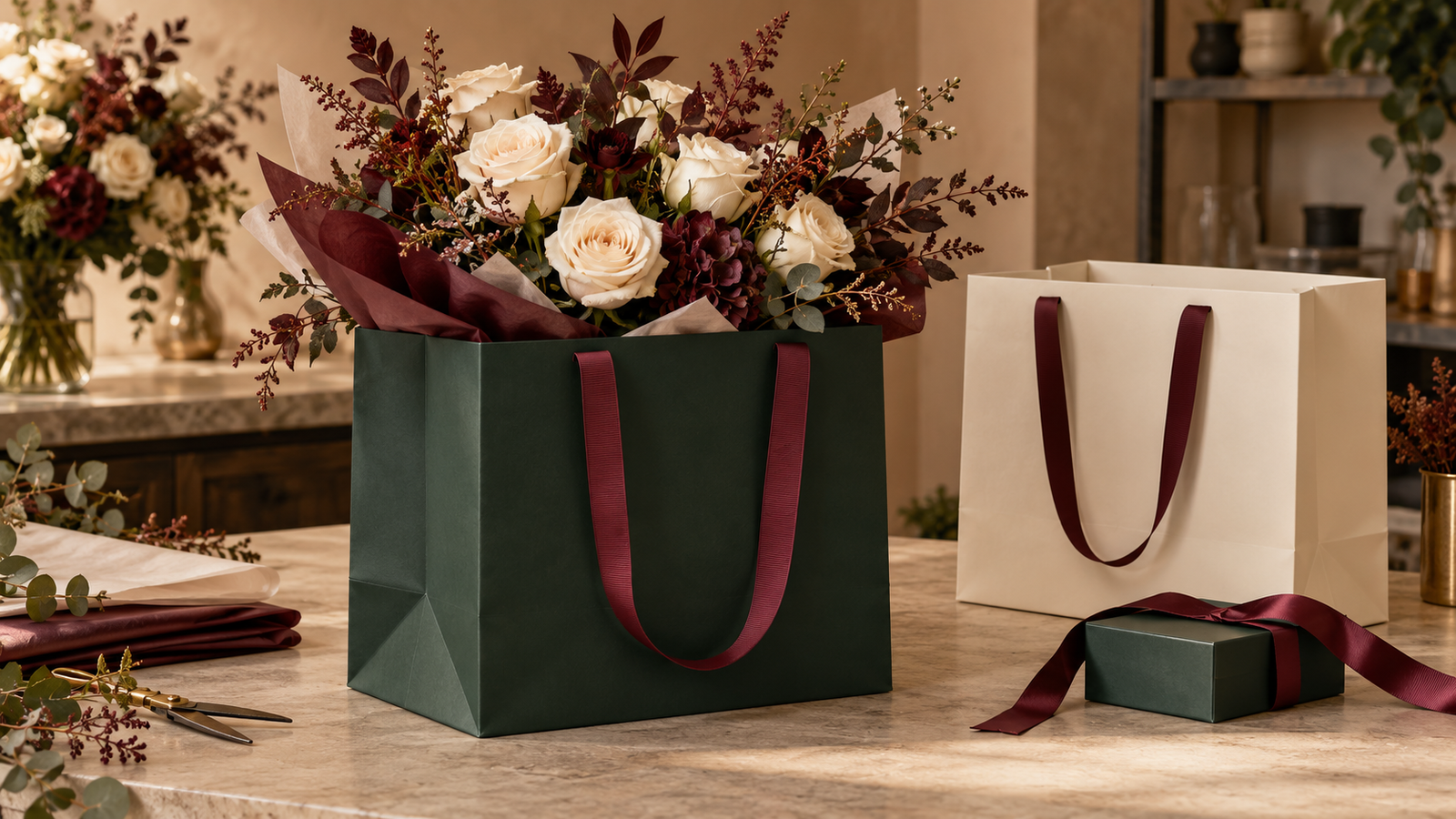
Choose the bag only after packing three representative orders: the narrow everyday bouquet, the fuller premium hand-tie and the arrangement with the widest base. Give the largest stable footprint enough clearance to load without crushing flowers, use handles long enough to clear the bouquet, and validate the paper, reinforcement and base with the real wet-stem solution in place. If water can reach the paper during normal use, redesign the containment before adding decorative finishes.
What makes a flower paper bag different from a standard shopping bag?
A conventional retail bag is usually sized around a box, folded garment or group of products. A florist bag may hold an irregular, top-heavy arrangement with delicate outer petals and a damp or water-filled component at the base. The load can shift while the customer walks, and the handles must clear foliage rather than closing tightly over a flat product.
Presentation job
- Frames the bouquet at collection
- Carries the florist’s colour and identity
- Hides functional stem protection
- Creates a gift-ready handoff
Engineering job
- Keeps the arrangement upright
- Provides a stable, correctly sized base
- Separates moisture from structural paper
- Places handles beyond fragile flowers
What it is not
A decorative florist carrier is not automatically a leakproof vessel, cold-chain pack or parcel-shipping container. Define those functions separately.
Which florist bag format fits your arrangements?
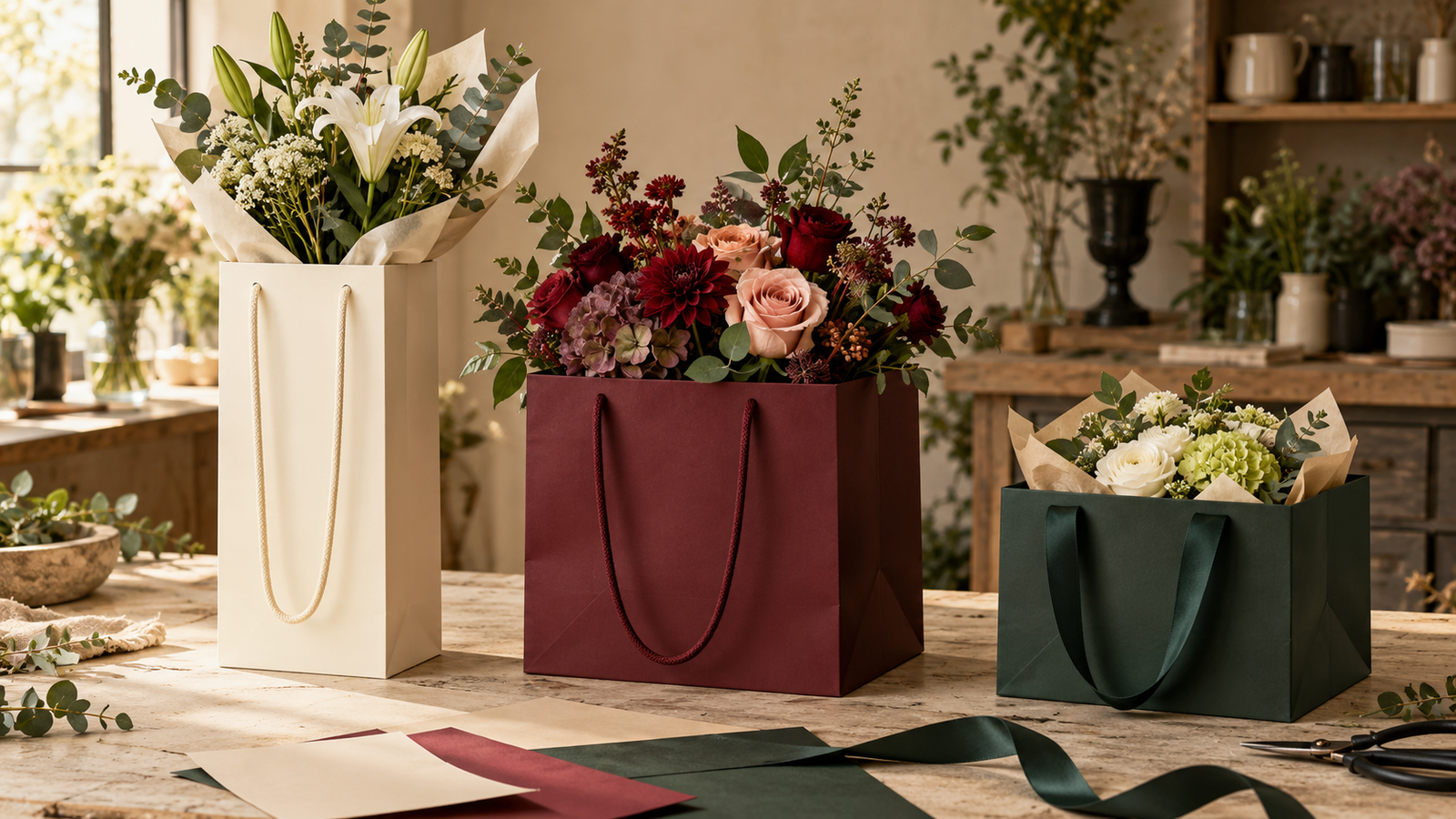
| Format | Best starting use | Main approval question |
|---|---|---|
| Tall narrow carrier | Long-stem hand-tied bouquets with a compact wrapped base | Can staff lower and remove the bouquet without catching petals or foliage? |
| Square wide-base bag | Round bouquets, small vases and compact premium arrangements | Does the base sit flat with enough clearance but without sliding? |
| Low wide carrier | Boxed flowers, hat-box arrangements and floral gift sets | Do the handles clear the arrangement and stay comfortable at the loaded centre of gravity? |
| Coordinated gift carrier | Flowers combined with a candle, confectionery or small rigid gift box | Are rigid components separated from stems and delicate petals? |
Do not select one size from the bouquet height alone. A tall bouquet can still have a small base, while a short table arrangement may require substantial depth. If the daily product mix is broad, a disciplined two- or three-size family often performs better than one oversized bag. Our luxury paper bag size guide explains the width–gusset–height convention in more detail.
How should you measure a bouquet or arrangement for the bag?
Measure the packed arrangement exactly as the customer receives it—not bare stems on the workbench. Include wrapping, water source or sealed stem treatment, vase or box, protective tissue, cards and any accessory. GS1’s current Package and Product Measurement Standard provides a common method for communicating package dimensions and weight; internally, florists should also record the maximum stable footprint and the point at which the arrangement becomes top-heavy.
- Build representative packs. Use actual stems, wrap, hydration treatment, vase or floral box and gift accessories.
- Measure the base. Record the widest and deepest stable footprint after wrapping—not the nominal vase diameter alone.
- Find the practical bag height. The paper should support the lower arrangement without hiding too much of the flowers or rubbing vulnerable blooms.
- Check loading clearance. Staff need room to lower the arrangement into the bag without forcing the gussets or snagging tissue.
- Weigh the finished order. Test the complete load, including water or gel contained at the stem end.
- Repeat the handoff. Lift from the counter, walk, turn, set down and remove the arrangement using the real handles.
Keep the measuring method consistent across locations and seasons. GS1 notes that measurements should be repeated when the product or package changes in a way that can affect dimensions or weight. For a florist, a new vase, thicker winter wrap or larger water source can be such a change even when the bouquet name stays the same.
How do you keep moisture away from the paper bag?
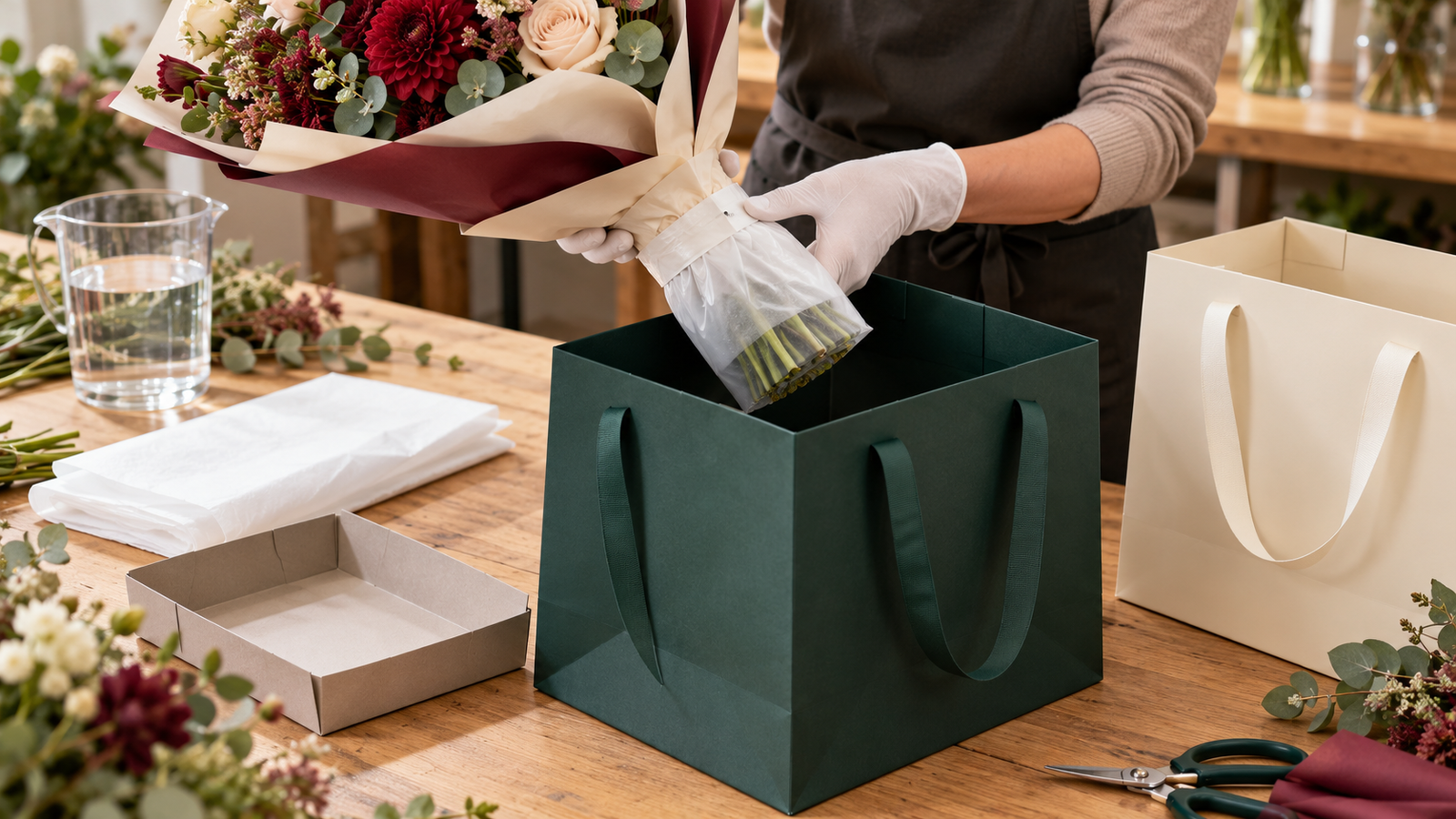
Start with a simple boundary: the floral system manages hydration; the paper carrier manages presentation and hand carrying. University of California guidance on post-harvest handling of cut flowers emphasises clean water, hydration and cool handling. Those needs do not disappear because a bouquet enters a luxury bag, so any wet stem wrap, reservoir or vase must remain upright and reliably contained.
Run a real moisture trial
- Prepare the bouquet using the normal wet-stem method or filled vase.
- Load it with the same tissue, wrap and inserts used at the counter.
- Carry and set down the bag repeatedly over the expected customer journey.
- Inspect the base, lower gussets, seams and any bottom board for dampness, staining or softening.
- Test failure cases such as a tilted bouquet or overfilled reservoir before production approval.
An inner coating, film, tray or absorbent component may improve short-term moisture resistance, but each changes the material system. Ask the supplier what the layer is, whether it is separable, what recovery route it is designed for and what evidence supports any recyclability claim. Never describe a bag as waterproof solely because the paper is laminated.
What construction details matter most?
A base that stays flat
The base should match the arrangement footprint and remain stable during loading and setting down. Any board or tray must sit flat, cover the intended area and avoid sharp edges that mark the bag.
Gussets that open cleanly
Deep side gussets create room for broad bouquets, but the score pattern must open without buckling or pushing the arrangement off centre. Review the bag both flat and loaded.
Long, reinforced handles
Ribbon or soft rope handles can suit premium florist branding, but their drop length, attachment and reinforcement must work as one load path. The customer should lift clear of the flowers without pinching the arrangement.
A controlled top edge
A reinforced turned top helps the opening retain shape, yet it should not form a hard edge against petals. Confirm handle holes, knots or glued ends cannot catch the wrap.
The industry guidelines for high-quality paper carrier bags from CEPI Eurokraft and EUROSAC explain how paper, dimensions, handles, glueing and conversion collectively influence durability. Treat their performance target as guidance for the bag types within its scope, not as an automatic rating for a custom florist carrier. Define and test your own finished load. See also our luxury paper bag construction guide and handle selection guide.
Which paper, print and finish should a florist choose?
Begin with the handling environment. Uncoated or coloured papers can give a tactile, natural impression. Coated paper may support precise colour and detailed print. Lamination can change scuff and moisture behaviour, but it also adds another material and should be assessed against the target recovery route. Dark solid colours show edge wear and water marks differently from warm kraft or ivory stock, so review converted samples in the actual shop.
- Keep decoration away from stress zones. Fine foil, embossing or heavy ink near gusset folds and the base should be tested after conversion.
- Coordinate rather than duplicate. A restrained bag can frame expressive flowers; use printed tissue or custom ribbon for seasonal variation.
- Approve colour on the final paper. A digital screen cannot predict the interaction between paper shade, ink, coating and finish.
- Plan for shop handling. Test wet hands, counter abrasion, stacking, opening and repeated contact with stems and leaves.
How should sustainability claims be checked?
Separate three questions: where the fibre came from, how the complete bag is constructed and what collection and recycling route exists in the destination market. FSC explains that a finished-product label depends on verified chain of custody through the supply chain; simply requesting “FSC paper” is not the same as approving an on-product claim.
The February 2026 4evergreen Circularity by Design Guideline Version 4 evaluates paper-based packaging as a complete system, including coatings, barriers, adhesives, inks and other components. In the EU, Regulation (EU) 2025/40 began applying on a phased basis from 12 August 2026, according to the European Commission. Buyers should confirm obligations and claims for each sales market rather than copy a generic environmental statement onto every bag.
How do you approve a florist bag before production?
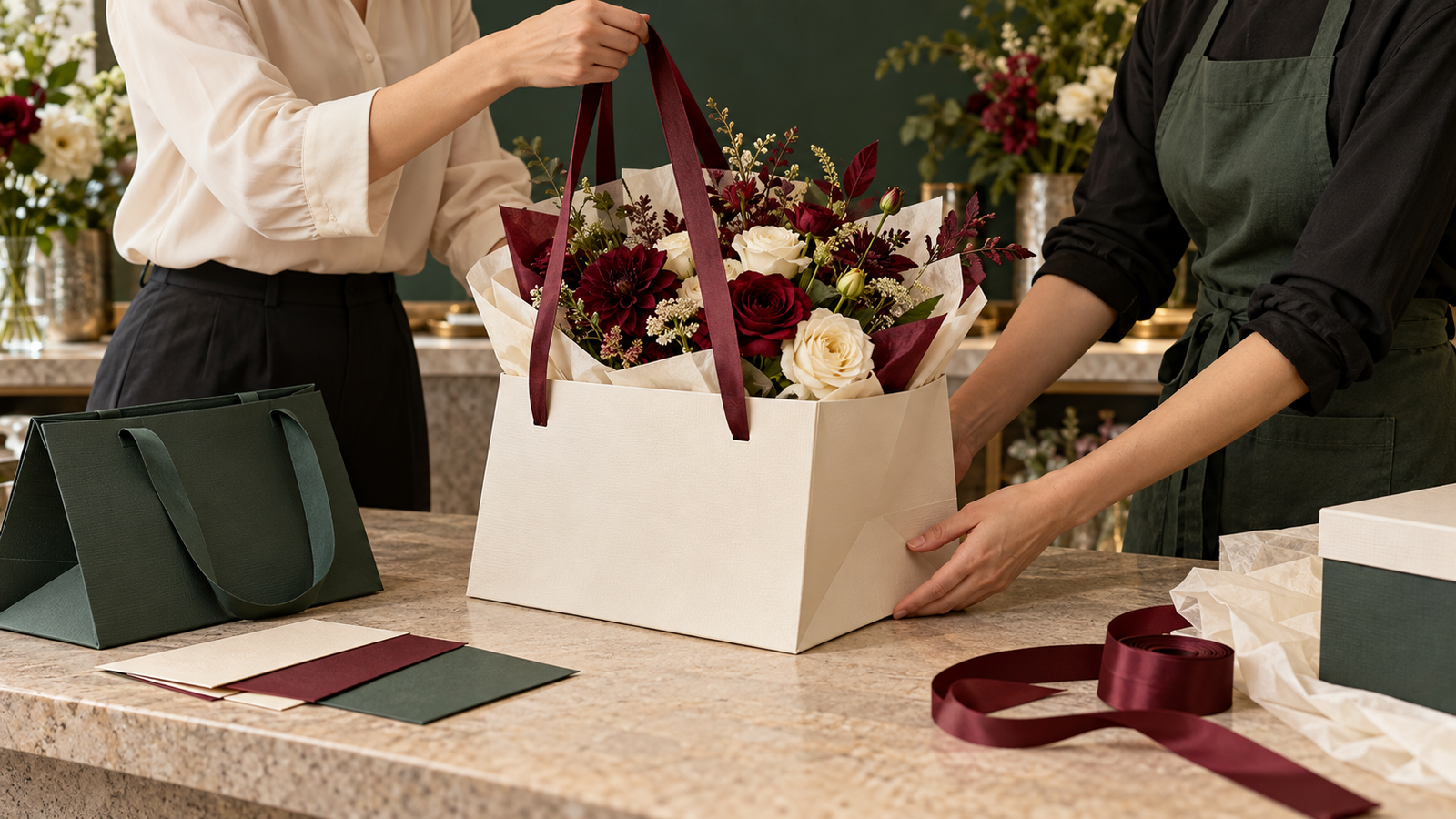
- Review material swatches. Confirm paper shade, print, ribbon or rope and any moisture-management component.
- Approve a plain structural sample. Load the widest and heaviest representative arrangement before paying for full decoration.
- Approve the decorated converted sample. Check colour, logo placement, finish, gusset opening, top edge, handle clearance and base stability together.
- Run the counter trial. Ask several staff members to assemble, load, lift, walk, set down and remove the product.
- Keep a signed master. Record dimensions, packed weight, components, artwork revision and observable quality limits for production.
- Inspect across the order. Sample multiple cartons and check both dry empty bags and loaded bags against the approved master.
If the bag will be shipped filled as part of a packaged product, the distribution pack needs its own route-relevant test plan. ISTA notes that test selection should reflect the actual distribution environment and the decision the test must support. A boutique carry trial and a parcel-distribution test answer different questions.
What belongs in a quote-ready florist bag brief?
- Arrangement types and sales mix
- Maximum packed base and height
- Loaded weight and centre-of-gravity concerns
- Moisture or water-containment method
- Bag width, gusset and height by size
- Paper, colour and sourcing requirements
- Handle material, drop and attachment
- Turned top, reinforcement and base board
- Print, finish and artwork files
- Sample stages and loaded tests
- Quantity by size and artwork
- Packing, destination and required date
Frequently asked questions
Are custom flower paper bags waterproof?
Not automatically. Paper, coating, lamination, seams and the base each behave differently around moisture. Contain water at the bouquet or vase first, then test the complete carrier under realistic use. Ask for evidence before making any water-resistance or recyclability claim.
Should a bouquet bag be square?
A square base often suits round bouquets and compact arrangements, but it is not a universal rule. Let the stable packed footprint determine the bag proportions. A narrow hand-tie and a wide vase arrangement may need different formats.
Which handles work best for florist bags?
Long ribbon or soft rope handles are common premium choices because they can clear the bouquet and feel comfortable. Performance depends on handle drop, attachment, top reinforcement, bag dimensions and loaded weight, so approve the complete converted bag.
Can one bag size cover every flower order?
Usually only if the assortment is narrow. One oversized carrier can let small arrangements move, waste material and weaken presentation. Group real orders by base footprint and height, then test whether two or three sizes cover most sales cleanly.
BUILD THE BAG AROUND THE ARRANGEMENT
Request custom flower paper bags for your florist brand
Share photos and dimensions of your finished bouquets, floral boxes or vase arrangements, plus packed weight, moisture treatment, quantities, artwork and delivery market. Bespoke Packaging can develop luxury paper bags with coordinated gift boxes, tissue and ribbon for a complete premium handoff.