
EU PAPER PACKAGING COMPLIANCE
Does EUDR Apply to Paper Bags and Boxes? A 2026 Buyer’s Guide
How to decide whether paper bags and gift boxes fall within the EU Deforestation Regulation, identify the responsible operator and prepare a traceable packaging brief.
The EU Deforestation Regulation can apply to paper bags, cartons and boxes when they are placed on the EU market or exported as products in their own right. The same item may be outside that packaging scope when it is presented with another product and used only to support, protect or carry that product. A buyer therefore needs to check the customs classification, the way the packaging is supplied and the role of each company before deciding what evidence is required.

The short buyer answer
Do not decide from the word paper, from an FSC claim or from the visual design. Start with the product code and transaction. The European Commission’s July 2026 EUDR guidance identifies paper bags, cartons, boxes and related containers under HS code 4819. It says those articles are covered when placed on the market or exported in their own right, but not when used as ordinary packaging to support, protect or carry another product presented with them. Classification and the facts of the supply remain decisive.
What is EUDR?
Regulation (EU) 2023/1115 is the EU Deforestation Regulation. It covers listed commodities—cattle, cocoa, coffee, oil palm, rubber, soya and wood—and specified products made from them. For products in scope, the relevant operator must show that they are deforestation-free and produced legally in the country of production.
When does it apply?
The Commission’s current roles and responsibilities guidance gives 30 December 2026 for large and medium enterprises and 30 June 2027 for most micro and small enterprises. Micro and small enterprises already covered by the EU Timber Regulation use the earlier date. Company status and activity should be checked rather than inferred from order size.
Are luxury paper bags and gift boxes in scope?
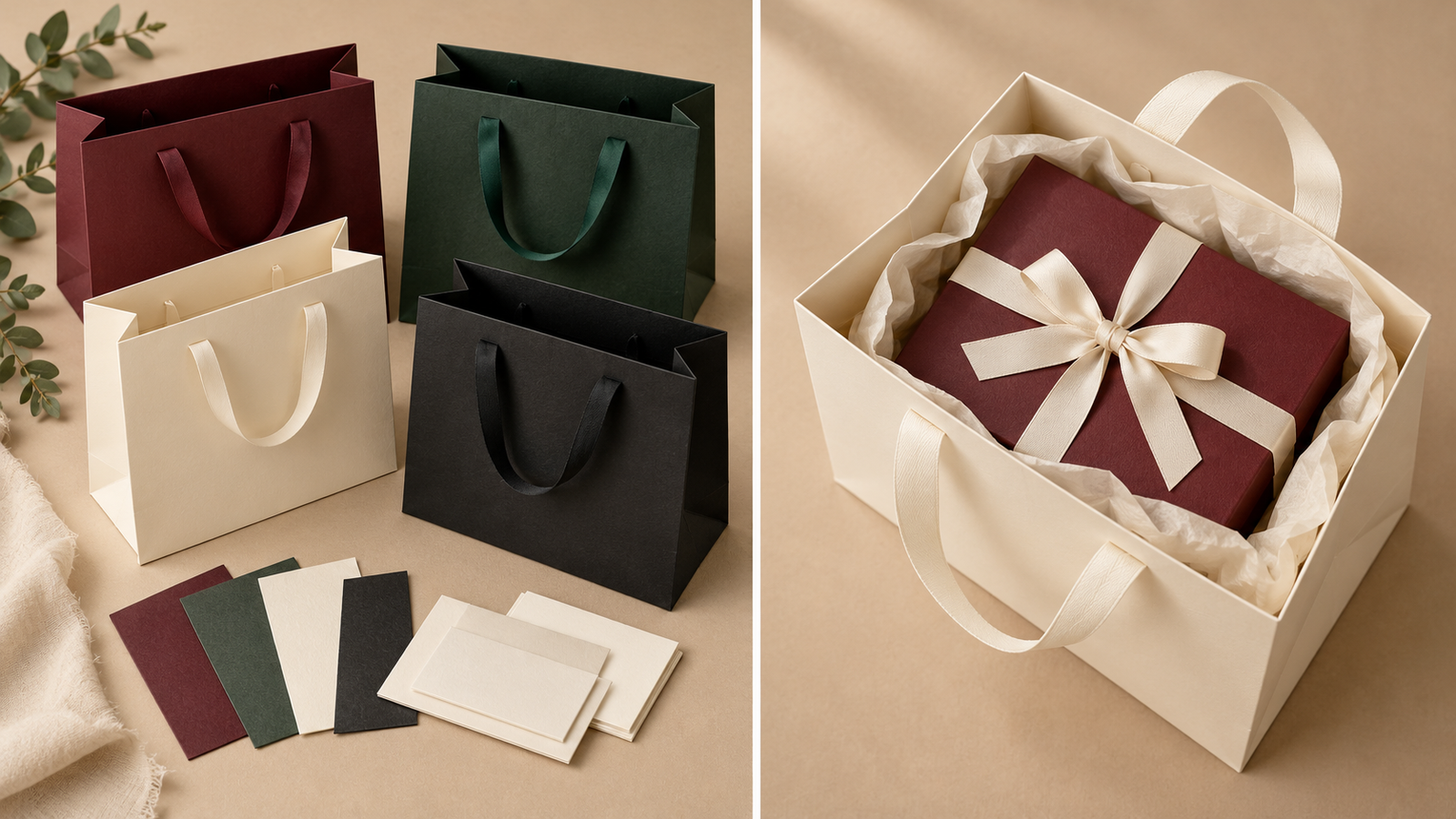
They can be. Annex I uses customs classifications, not marketing descriptions. HS code 4819 covers cartons, boxes, cases, bags and other paper or paperboard packing containers. A shipment of empty custom luxury paper bags or empty gift boxes sold to an EU buyer as packaging products is the clearest situation in which the packaging is being placed on the market in its own right.
By contrast, an ordinary paper bag or box supplied with goods inside and used only to support, protect or carry those goods is generally classified with the goods for this purpose and is not covered as a separate EUDR packaging product. The 2026 guidance also discusses containers that give a product its essential character and packaging suited to repetitive use. These edge cases require the actual product, transaction and customs treatment—not a generic website description—to be reviewed.
| Commercial situation | Useful starting view | What the buyer should verify |
|---|---|---|
| Empty paper bags imported and sold to a retailer | The bags are products in their own right and may be in scope under code 4819 | CN/HS code, importer role, paper composition, origin data and due-diligence route |
| Empty rigid paperboard boxes imported for later pack-out | The boxes may be products in their own right | Classification, whether other materials change the code, operator and supporting evidence |
| Paper bag presented with a retail product inside | Ordinary packaging used only to carry the goods may not be separately covered | How the complete product is classified and whether the bag has a separate commercial role |
| Decorative or durable container central to the product | Do not assume the ordinary-packaging exclusion | Essential-character and long-term-use questions with customs or legal specialists |
Who is responsible when packaging is imported into the EU?
The company first placing an in-scope product on the EU market is normally the upstream operator for that transaction. For imported empty bags or boxes, that may be the EU importer rather than the overseas packaging factory. The Commission explains that non-EU suppliers do not have EUDR obligations unless they themselves place products on the EU market, but they may need to provide production, legality and geolocation information so the EU operator can comply.
Downstream operators and traders have lighter duties under the simplified 2025 framework, with differences for SMEs and non-SMEs. Avoid copying a responsibility matrix from another project. Record the legal entity that imports or first places the packaging, the entity that sells it onward, company-size status and whether the product has already been covered by upstream due diligence.
What information does EUDR due diligence require?
The Commission’s current due-diligence guidance describes three stages: collect information, assess risk and mitigate any risk that is more than negligible. For an in-scope paper packaging product, the data set can include:
- the product description, quantity and applicable product code;
- the wood species common and scientific names where required for products made using wood;
- the country of production and geolocation of the plots where the relevant wood was produced;
- supplier and customer identity information;
- evidence that the product is deforestation-free and that the commodity was produced legally;
- risk-assessment findings and any mitigation taken; and
- the due diligence statement or simplified declaration details required before placement or export.
The operator remains responsible for the conclusion. A packaging buyer can help by freezing the paper specification, mapping suppliers and mills, controlling substitutions and asking early whether the necessary upstream information can be linked to the intended production quantity.

Is an FSC certificate enough for EUDR?
No certificate should be treated as an automatic substitute for EUDR due diligence. The Commission’s 2026 guidance says certification and third-party verification can provide complementary information for risk assessment and mitigation when the information meets the Regulation’s requirements. The operator must still check scope, traceability, legality, geolocation and risk for the relevant product.
FSC evidence can still be useful for a separate sourcing and chain-of-custody objective. Our FSC-certified paper bags guide explains how to verify certificate scope, invoice claims and label approval. Keep that work connected to—but not confused with—the EUDR file.
How are EUDR, PPWR and packaging claims different?
EUDR
Addresses deforestation-free and legal production for listed commodities and products. It uses product codes, supply-chain roles, due diligence and regulatory declarations.
PPWR
Regulation (EU) 2025/40 governs packaging placed on the EU market and packaging waste, including future design, labelling, prevention and producer-responsibility requirements. The Commission maintains a separate PPWR implementation page.
Voluntary claims
Certified sourcing, recycled content and recyclability are different claims with different evidence. Our recyclable paper bag guide shows why the complete construction and destination recovery route matter.
What should a packaging buyer ask the supplier?
- What exact paper or paperboard grades, coatings, laminations, reinforcement cards and base boards are proposed?
- Which legal entity manufactures each component, and can substitutions occur without written approval?
- What CN or HS code is expected for the finished empty bag or box?
- Which mills or upstream suppliers can provide country, species, harvest and geolocation information if required?
- Who will be the EU importer or first placer, and who will submit or reference the regulatory declaration?
- How will production batches, purchase records and due-diligence references be connected?
- Which claims will appear on the bag, box, website or sales documents, and what evidence supports each one?
How should EUDR readiness change the packaging brief?
Add compliance data without weakening the physical specification. A traceable bag that fails in use is still a failed packaging product. The brief should define product fit, dimensions, packed weight, paper grade, handle material, reinforcement, print, finishes and samples alongside product code, supplier identity, permitted material sources and change control. Our paper bag materials guide and construction guide cover those performance decisions.
Do not let an unsupported “EUDR compliant” line replace the evidence file. Ask who made the determination, which product and quantity it covers, which version of the specification it matches, and what happens if the mill, paper grade or producing plot changes.

A practical preparation sequence for 2026
- Screen the product. Confirm the likely CN or HS code and whether the packaging is supplied in its own right or with goods inside.
- Map the companies. Identify the overseas manufacturer, EU importer, first placer, downstream buyers and traders.
- Freeze the material route. Define paper, board, mills, coatings, handles, reinforcement and allowed substitutions.
- Test data availability. Request a sample evidence pack before the production order, not at customs clearance.
- Connect evidence to quantity. Keep purchase orders, production batches, shipping documents and declaration references aligned.
- Control changes. Recheck classification, risk and supporting data when a supplier, mill, grade or production source changes.
Frequently asked questions
Does EUDR cover every paper bag?
No. The product must be within the listed scope, and the way it is supplied matters. Empty paper bags placed on the market in their own right can be covered under HS code 4819. Ordinary packaging presented with goods and used only to carry or protect them is treated differently.
Does buying from an FSC-certified supplier prove EUDR compliance?
No. Certification can support the evidence and risk process, but the responsible operator must complete the applicable EUDR assessment and declaration duties.
Should a non-EU packaging factory submit the due diligence statement?
Not automatically. The responsible upstream operator is tied to who first places the relevant product on the EU market or exports it. A non-EU supplier may nevertheless need to provide detailed upstream information to the EU operator.
Can the same packaging be in scope in one transaction and not another?
Yes. A shipment of empty bags sold as packaging products and a bag presented with retail goods can have different scope treatment. Confirm the classification and commercial facts for each route.
This article is practical procurement guidance, not legal or customs advice. Use the current Regulation, Commission guidance and FAQ, and confirm difficult classifications with the relevant customs adviser or EU Member State competent authority.
Build the paper specification and evidence route together
Bespoke Packaging can help you define luxury paper bags, rigid boxes, tissue and ribbon as a controlled packaging set, with the materials, samples and supplier information visible before production.