
RECYCLED PAPER / LUXURY RETAIL
Can Recycled Paper Bags Still Feel Luxurious?
Specify recycled fibre, surface quality, bag strength and claim evidence as one luxury paper-bag system—not as a percentage in isolation.
Recycled paper bags can deliver a refined retail experience, but the brief must define more than “eco paper.” A buyer needs to state the recycled-content claim, distinguish pre-consumer from post-consumer material, approve the exact paper surface, test the converted bag with the real pack-out and retain evidence for any claim used on the bag or in marketing.
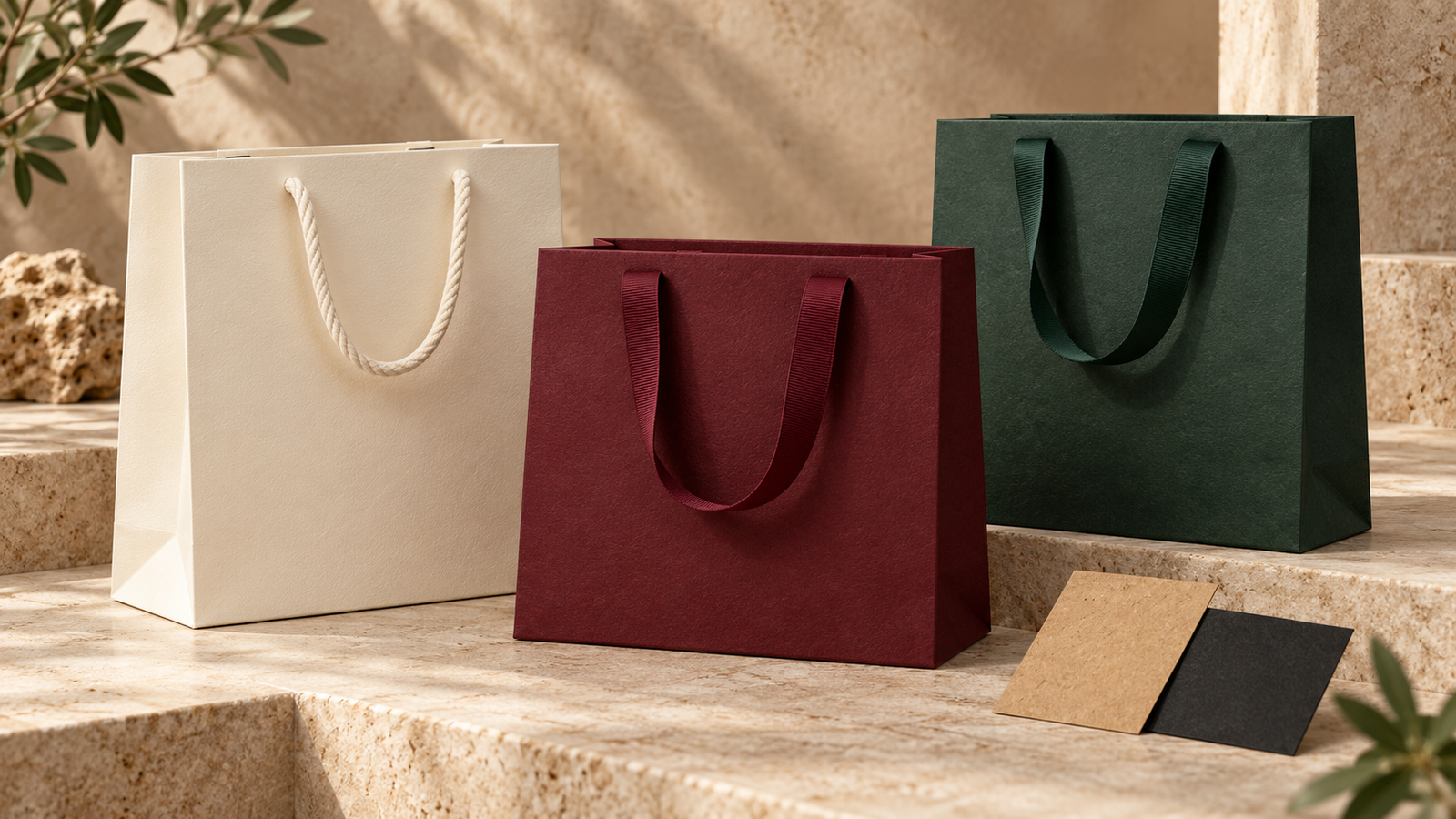
Define the claim
Record the percentage, whether it applies to the body paper or the complete bag, and the split between pre-consumer and post-consumer material.
Approve the experience
Choose the shade, texture, print route, handles and finish from physical samples of the proposed recycled grade.
Prove the bag
Test the finished construction with the actual product, gift box, tissue and any uneven or concentrated load.
What is a recycled paper bag?
A recycled paper bag uses paper containing material recovered from a waste stream and reprocessed into new fibre. The current ISO 14021:2026 framework defines recycled content by mass and distinguishes pre-consumer material, diverted during manufacturing, from post-consumer material, recovered after people or organisations have used a product for its intended purpose.
That distinction matters. “100% recycled fibre” does not automatically mean “100% post-consumer fibre.” If the source mix matters to your policy or customer claim, write both the total recycled percentage and the pre-/post-consumer split into the purchase specification.
Recycled is not the same as recyclable
Recycled content describes where material came from. Recyclability asks whether the complete bag can be collected, sorted and processed through a real recycling route. FSC certification is a separate chain-of-custody and sourcing claim. A paper bag may satisfy one, two or all three ideas, but none should be used as shorthand for the others.
How much recycled content should a luxury paper bag use?
There is no universal percentage that creates the best luxury bag. The useful target is the highest substantiated content that still meets the required appearance, converting route and loaded-bag performance. Start with the claim your brand needs, then compare real grades rather than assuming a higher number is automatically better.
| Decision | What to write in the brief | What to verify |
|---|---|---|
| Recycled-content target | Exact percentage or permitted range for the named paper component | Supplier declaration, paper specification and chain-of-custody evidence |
| Source split | Pre-consumer and post-consumer percentages where relevant | Definitions, calculation basis and the documents behind the figures |
| Claim boundary | Body paper, handle paper, reinforcement, base board or complete bag | That artwork and marketing do not imply a broader claim than the evidence supports |
| Performance target | Actual pack-out, handling route and acceptance checks | Converted sample results, not paper data alone |
| Appearance target | Approved shade, texture, print colour and permitted variation | Production-relevant paper and a signed physical master |
Can recycled paper still look and feel luxurious?
Yes. Recycled paper is a fibre source, not one visual style. It can appear naturally flecked, smooth and warm white, deeply coloured or softly textured. The right direction depends on the brand: visible fibre character can communicate material honesty, while a smoother grade may suit precise typography, restrained foil or a quieter fashion presentation.

Approve the paper before finalising artwork. Recycled grades can vary in shade, formation and surface character between products and batches. A colour target printed on a coated virgin sheet is not a reliable approval reference for an uncoated recycled sheet. Ask for paper swatches, a printed drawdown or proof and, for a high-value programme, a fully converted sample.
Does recycled fibre make a paper bag weaker?
Not automatically. Recycled-content percentage alone cannot predict bag strength. Fibre furnish, papermaking, grammage, tensile strength, tear resistance, stiffness, glue compatibility, folds, handle attachment and base construction all influence the finished result. The industry’s high-quality paper carrier-bag guidance treats tensile, tensile energy absorption, bursting and tear strength as separate material properties and recommends selecting paper against the intended load and reuse requirement.
The practical rule is simple: do not accept “recycled” as a structural specification. Define the finished paper bag construction, representative packed weight and handling route, then approve a loaded sample.
What should a recycled paper bag sample prove?

Structure and handling
- Product and gift-box clearance at the opening and gussets
- Handle comfort, attachment and reinforcement under load
- Side-seam, turn-top and base integrity through carrying
- Bag stability with the real weight distribution
- Recovery after packing, transport and normal handling
Appearance and workmanship
- Paper shade, texture and acceptable natural variation
- Ink density, fine detail and foil or relief registration
- Scuffing, fold whitening and cracking at converted areas
- Clean corners, opening shape and consistent handle drop
- Agreement between the sample, specification and claim wording
A swatch proves touch and colour; it does not prove a bag. Use the staged approach in our custom paper bag samples guide to separate material approval, print approval, structural testing and the final converted master.
How do printing and finishes behave on recycled paper?
Print and finish choices must follow the selected surface. An uncoated, absorbent recycled sheet may soften fine detail and colour density; a smoother grade can support sharper imagery. Foil, embossing, debossing, varnish and lamination each introduce their own adhesion, registration, fold and recovery questions. Test the exact stack—paper, ink, coating, adhesive and decoration—rather than approving each item separately.
Keep decoration proportionate to the job. A restrained foil mark or blind relief can create luxury without covering the material character. If a film laminate is proposed, record its type and mass and assess the complete construction against the target recycling route; recycled input does not excuse an end-of-life design that cannot be supported.
Which bag components are included in the recycled-content claim?
A premium shopping bag is a multi-component product. The body sheet may be recycled while the turn-top reinforcement, base board, paper handles, cotton rope or ribbon are different materials. State the boundary of every claim. If the evidence covers only the body paper, say so; do not let a large front-panel message imply that the complete bag has the same composition.
- Body paper: grade, grammage, recycled percentage, source split, shade and finish.
- Turn-top and handle patches: paper or board grade, coverage and attachment.
- Base board: material, size and whether it is loose or fixed.
- Handles: paper, cotton, ribbon or other fibre; recycled claims need separate evidence.
- Surface layers: inks, varnishes, foil, coatings and any film laminate.
What evidence should support a recycled-paper claim?
ISO 14021:2026 strengthened documentation and chain-of-custody expectations for self-declared environmental claims, including recycled content. Ask for a dated paper specification, the calculation boundary, source categories, supplier declaration and records that connect the approved material to the order. If a mass-balance or credit model is used, the claim wording must reflect how attribution works.
If you request an FSC claim, verify the final supplier’s chain-of-custody scope and plan trademark approval before printing. FSC explains that only certified organisations can apply FSC labels, while the FSC Recycled label identifies products made with 100% recycled fibre. That label still does not replace your need to define the performance, finish and exact product scope.
How should recycled content and recyclability be designed together?
Recycled fibre closes an input loop; design for recycling protects the next loop. The February 2026 4evergreen Circularity by Design Guideline Version 4 considers the complete paper-based pack, including inks, varnishes, adhesives, barrier layers and other components, across different paper-mill pathways. Use the applicable local assessment route and test unfamiliar combinations where guidance requires evidence.
For a component-by-component review, use our guide to recyclable luxury paper bags. Keep recycled content, responsible sourcing and recyclability as three explicit fields in the brief.
How do you coordinate recycled paper bags with boxes, tissue and ribbon?
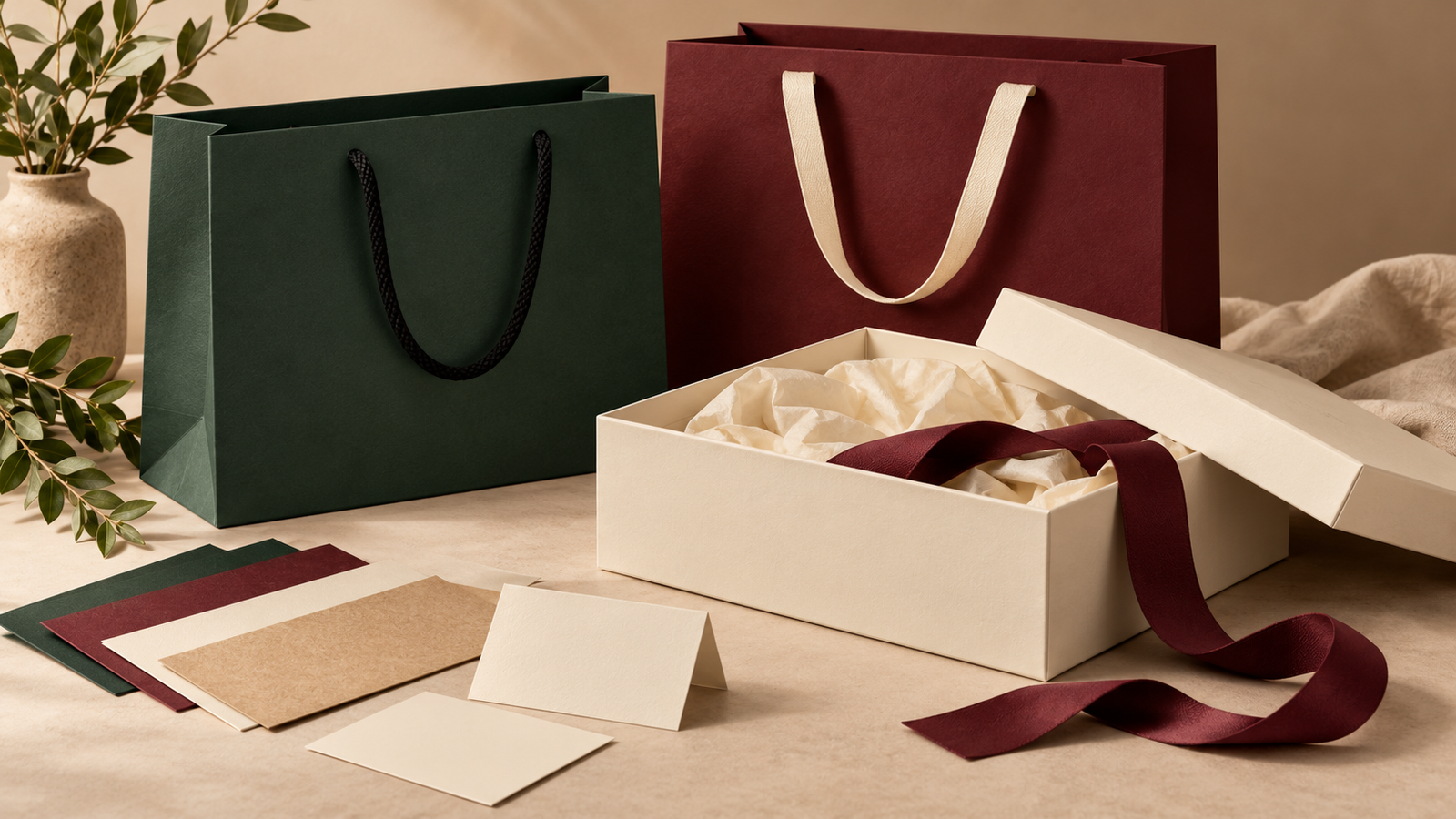
Coordinate the whole handoff without forcing every component to look identical. A softly textured recycled bag can carry a smooth rigid gift box; printed tissue paper can repeat one quiet brand colour; and custom packaging ribbon can connect the box closure to the bag handle. Test the closed box, tissue and ribbon inside the bag so the premium presentation is approved as a system.
What belongs in a quote-ready brief?
- Finished size and quantity by SKU
- Actual packed product and weight
- Paper grade, grammage and shade
- Recycled percentage and source split
- Claim boundary and evidence route
- Handles, reinforcement and base board
- Print colours, finish coverage and tolerances
- Physical sample and loaded test plan
- Artwork and label approval responsibility
- Packing, delivery and change control
Frequently asked questions
Are recycled paper bags always brown or speckled?
No. Recycled papers are available in natural, light, coloured and smoother surface directions. The achievable shade, texture and print result depend on the exact grade, so approve physical samples rather than choosing from a generic description.
Is 100% recycled paper the same as 100% post-consumer paper?
No. Recycled material can include pre-consumer and post-consumer sources. Ask the supplier to state the total recycled content and the split used for the named paper or bag component.
Can a recycled paper luxury bag use foil or ribbon handles?
Yes, if the chosen paper and converted construction pass the required visual and performance checks. Record foil, handle and reinforcement materials separately, and assess how those components affect the complete bag’s recovery route and claim wording.
Should recycled paper be tested with the real product?
Yes. Paper data helps compare grades, but only a converted sample with the intended product, box, tissue and carried weight can show fit, handle comfort, base stability, seam performance, scuffing and presentation.
Develop a Recycled Paper Bag That Still Feels Premium
Share your product dimensions, packed weight, target recycled-content claim, artwork, quantities and delivery market. Bespoke Packaging can develop custom luxury paper bags with coordinated boxes, tissue and ribbon, then sample the complete pack before production.