
CUSTOM EVENT PAPER BAGS
Custom Event Paper Bags: A Planning Guide for Branded Kits
Plan the bag around the guest kit, handout workflow and venue journey—then approve the complete packed experience before production.
Custom event paper bags work best when they are designed as part of the guest journey, not ordered as an isolated printed item. The right bag must fit the real gift kit, feel comfortable during the event, move efficiently through assembly and check-in, and arrive at the venue without crushed corners, marked surfaces or tangled handles.
For conferences, product launches, press previews, hotel events and premium client gifting, that means defining the contents, handout point, carrying time, artwork ownership and delivery plan before finalising the bag. This guide turns those decisions into a practical specification for luxury paper bags, with custom gift boxes, tissue paper and ribbon coordinated where they add a clear function.
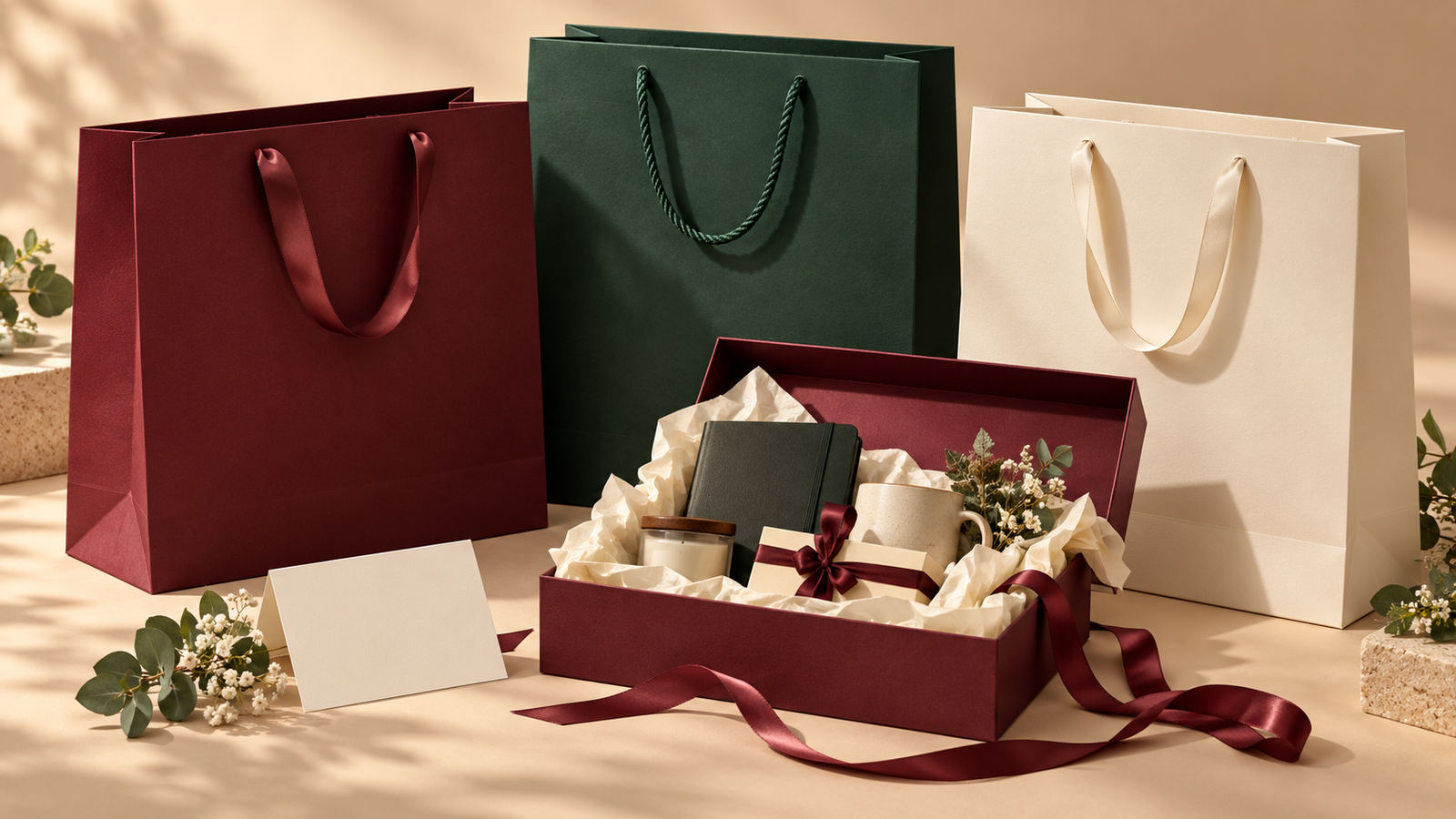
What is a custom event paper bag?
A custom event paper bag is a branded carrier produced for a defined occasion and guest kit. Unlike an everyday retail bag, it may need to combine a host brand, event identity, partner marks, date-sensitive artwork and a one-time delivery schedule. It may be handed out empty, pre-packed off-site, assembled at the venue or used to carry a boxed product after a launch demonstration.
The short answer
Specify the bag from the heaviest and largest approved guest-kit configuration. Confirm how it will be packed, transported, staged and carried; then approve structure, print and logistics together. Event artwork is temporary, but the bag still needs production-quality decisions.
Start with the guest kit, not a stock bag size
Contents
List every object in the final configuration: rigid gift box, sample cartons, notebook, card, tissue, ribbon and any product with an awkward shape. Record the combined packed weight, not just the weight of the hero item.
Handoff
Decide whether guests collect the bag at registration, find it on a seat, receive it after a presentation or take it from a hospitality suite. The opening, handles and packing order should suit that moment.
Journey
Map how far the bag will be carried, where it may be set down and whether guests also need to hold a phone, badge or drink. A beautiful bag that is awkward in the venue is not a successful event package.
Measure the completed kit in its intended orientation. The current GS1 Package and Product Measurement Standard provides a repeatable method for communicating package dimensions and weight between trading partners. It is not a bag-sizing formula, but it helps teams describe the same finished pack consistently and recommends remeasurement when a product or package change can affect dimensions or weight.
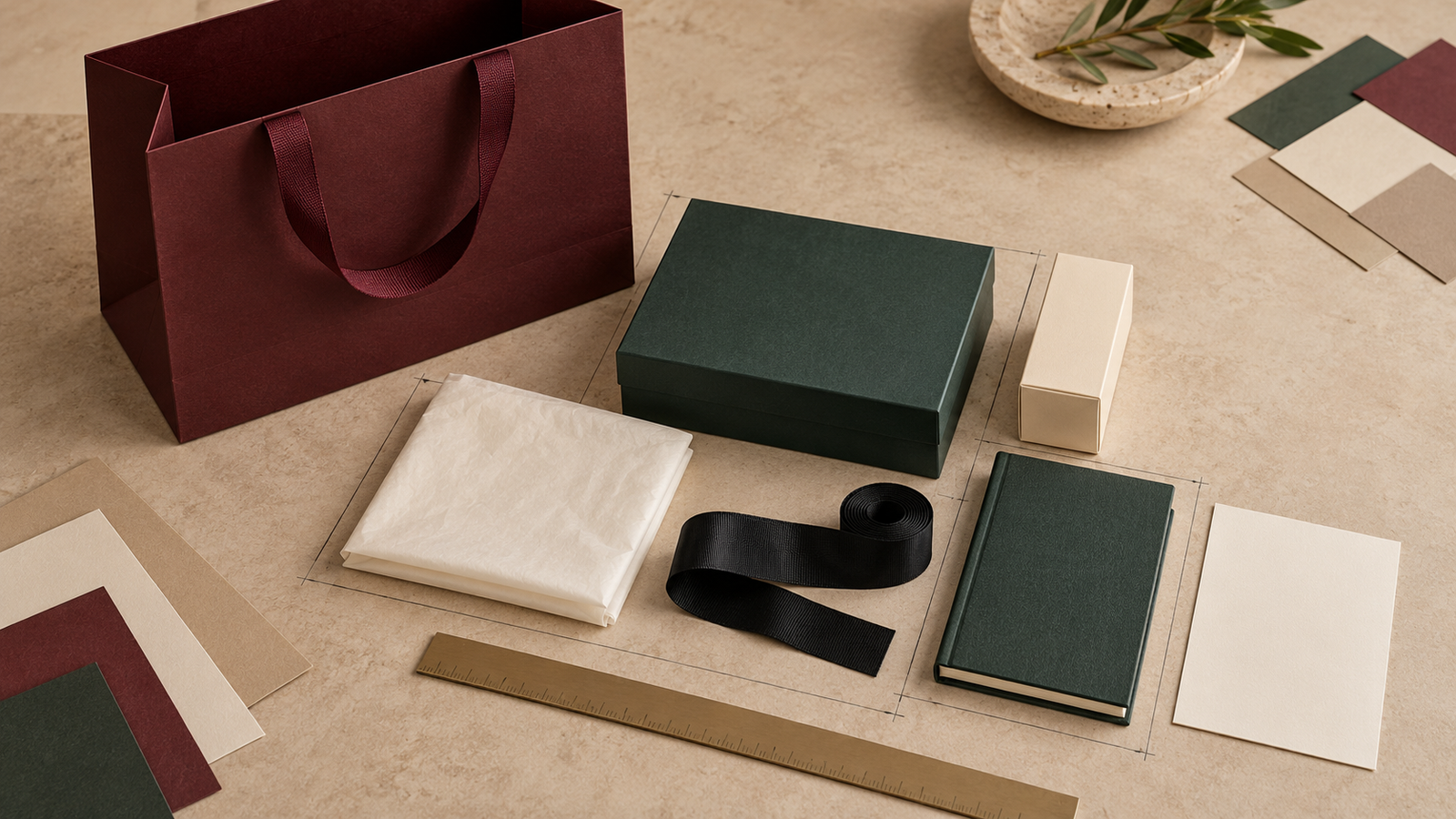
How do you size event paper bags for mixed contents?
Build the kit exactly as a guest will receive it. Close every carton, fold the tissue, add cards and accessories, then identify the widest, deepest and tallest points. Add only the clearance needed for efficient loading and clean removal. There is no universal allowance: soft garments, rigid boxes, tall bottles and several small cartons behave differently.
- Choose the carry orientation. Decide which face remains upright and which item forms the stable base.
- Measure the production-intent kit. Use final packaging wherever possible, not an early product-only estimate.
- Test the opening. Staff should be able to load the kit without scraping a box finish or crushing tissue.
- Check the filled silhouette. The bag should stand and close naturally without excessive empty space or bulging panels.
- Walk the route. Carry the filled sample through a realistic registration, seating and departure sequence.
The luxury paper bag size guide explains width, gusset and height in more detail. If one event has VIP, press and general-attendee kits, first ask whether a single modular bag can serve them with different inserts or tissue arrangements. A second bag size is worthwhile only when it improves fit or operations enough to justify another artwork, sample, carton and inventory line.
Which bag structure and handles suit an event?
| Event condition | Design response to consider | What to test |
|---|---|---|
| Compact premium kit | Structured paper bag with restrained proportions and rope or ribbon handles | Handle comfort, base stability and box-finish abrasion |
| Several light handouts | Simple opening, practical gusset and an efficient handle construction | Loading speed, item movement and top-edge behaviour |
| Dense boxed product | Reinforced turn-top, handle fixing and base board engineered as one load path | Filled carry test, seam integrity and repeated set-down |
| Long venue dwell time | Comfortable handle length and a bag that does not swing into the guest | Walking, queuing, seating and coat-check handling |
Do not choose paper GSM, handle material or reinforcement independently. A paper bag carries through a connected structure: handle, fixing, folded top, reinforcement patch, side seams, gussets and base. Our paper bag construction guide shows how that load path works. Test the finished bag with the heaviest approved event kit and the exact handle attachment proposed for production.
How should event branding be organised?
Separate permanent brand assets from event-specific information. The host logo and core colour system may remain stable; a campaign title, date, venue or partner list may change until late. Give one owner authority over final artwork and one supplier-ready file version. Uncontrolled sponsor additions are a common way to disrupt hierarchy, crowd finishing areas and delay approval.
Keep fixed in the master design
- bag dieline and panel orientation
- host-brand clear space and colour references
- handle, paper and finish specification
- barcode or identification zones if required
- approved claim and label locations
Control as event variables
- campaign title, date and venue
- partner marks and legal approvals
- guest tier or market version
- language and regional information
- quantity allocated to each destination
Colour should be approved on the real paper. Pantone explains that the same colour can look different on coated and uncoated stock because the papers interact with ink differently. For artwork that runs to a cut edge, use the supplier dieline and agreed bleed; Adobe defines bleed as artwork extending beyond the trim boundary and advises confirming the required amount with the print provider.
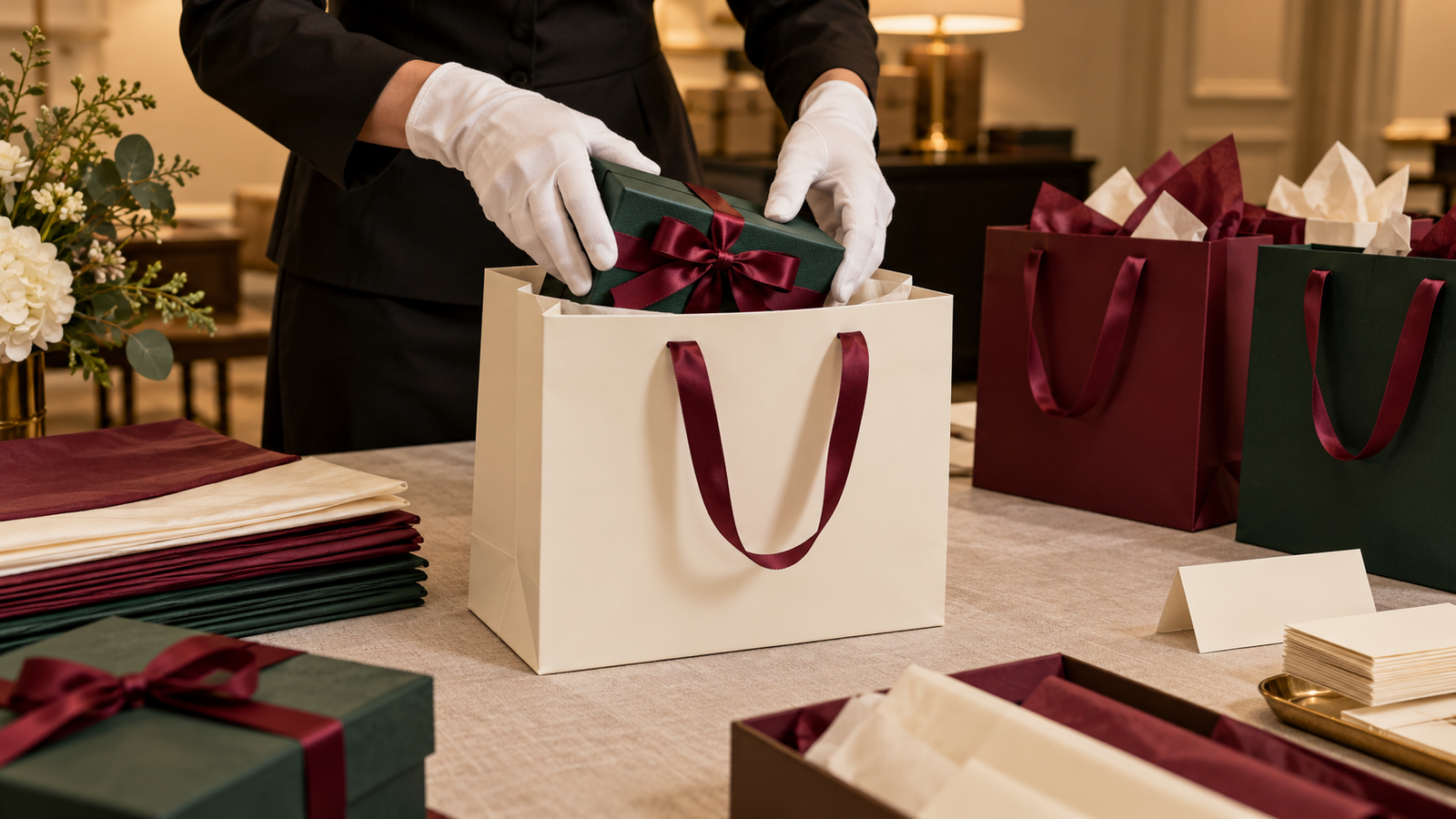
How do you plan efficient bag assembly?
Design the packing sequence before the venue becomes busy. Decide whether bags arrive flat and are erected on site, or are pre-opened and filled by an assembly partner. Create one approved pack-out sample and a visual instruction showing item order, tissue fold, card placement and final count. The instruction should be understandable without relying on the person who designed the kit.
- Set a clean work area with separated components and clear replenishment paths.
- Place the heaviest stable item first and keep fragile surfaces away from sharp edges.
- Use tissue to support presentation or separation, not to disguise an unstable fit.
- Add ribbon only when it has a defined closure or presentation job and can be packed consistently.
- Count finished bags into manageable groups and keep one signed master nearby.
- Quarantine incomplete or damaged kits rather than correcting them inside finished counts.
If the guest experience includes a rigid presentation box, approve the box inside the bag rather than as a separate photography sample. Tissue and ribbon can coordinate the reveal; our guides to custom printed tissue paper and custom packaging ribbon cover the relevant material, artwork and handling decisions.
When should event packaging be ordered?
Work backward from the date the packed bags must be physically available at the venue or assembly site—not from the public event date. Reserve time for specification, artwork ownership, partner approvals, materials, structural or printed samples, mass production, inspection, packing, freight, customs where applicable and a receiving buffer.
Protect the decision dates. A need-on-site date is not a production plan. Name who approves structure, colour, partner artwork and sustainability claims, and record what happens if an approval is late.
Ask the supplier for a schedule tied to the actual specification and quantity. Do not borrow a generic lead time from another bag. The custom paper bag lead-time guide explains how artwork, sampling, production and freight form one connected critical path.
How should bags be packed and delivered to the venue?
A luxury paper bag is a retail or event carrier, not a shipping carton. Define how empty bags will be nested, protected and counted inside export cartons; how handles will be prevented from tangling or marking panels; and whether cartons need to be split by venue, date, guest tier or assembly station. Label the outer carton for operations without placing unapproved event information on the bag itself.
If completed kits travel through a parcel, pallet or international route, specify separate transit packaging around them. The International Safe Transit Association distinguishes screening tests from procedures that simulate defined distribution hazards and stresses choosing a method for the intended outcome. Match the test to the actual route; do not assume a decorative paper bag protects the contents in transit.
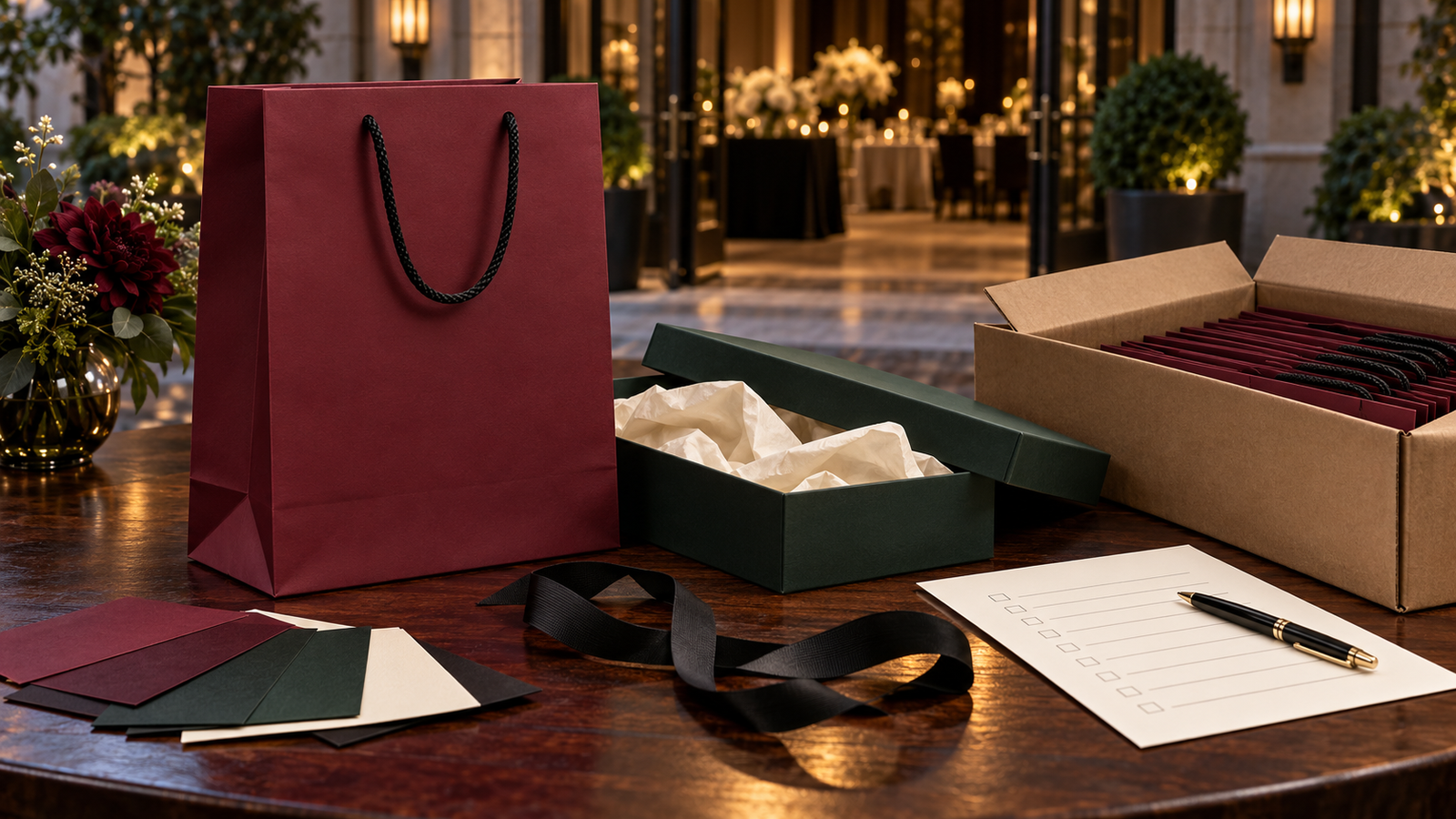
What sustainability evidence should an event buyer request?
Temporary artwork does not remove the need for a defensible material brief. Start by reducing unnecessary sizes, inserts and decorations. Record the paper, handles, reinforcement, coatings, inks, adhesives and labels in the approved construction, then ask what collection and recycling route is relevant in the destination market. The 4evergreen Circularity by Design Guideline, Version 4 provides technical guidance for paper-based packaging across different recycling pathways.
If FSC-certified material or an on-product FSC claim is requested, verify the supplier scope, sales-document claim and artwork approval route. FSC chain of custody verifies eligible forest-based material through the supply chain; it does not by itself prove that a finished bag is recyclable, reusable or plastic-free. For EU programs, the European Commission’s packaging-waste overview confirms that Regulation (EU) 2025/40 began applying from 12 August 2026 on a phased basis. Obtain market-specific compliance advice rather than using a generic environmental claim.
What should be approved before production?
Bag and guest kit
- final contents, dimensions and packed weight
- loading clearance and carry orientation
- paper, handle, reinforcement and base
- standing, walking and set-down behaviour
- box, tissue, ribbon and card placement
Artwork and logistics
- host and partner approvals
- colour and finish on production materials
- quantity by venue, version and delivery
- assembly instruction and signed master
- carton protection, labels and route plan
Use each sample stage to answer a defined question. An unprinted structural prototype proves fit and handling; a print or finish proof evaluates artwork; a complete production-intent bag proves how all components work together. The custom paper bag samples guide explains what different proof types can and cannot establish.
What information should go into an event paper bag quote?
- Event type, handout point, venue city and need-on-site date.
- Final guest-kit contents, packed dimensions, weight and carry orientation.
- Bag size or a request for size development from the completed kit.
- Quantities by artwork, guest tier, language, venue and delivery batch.
- Paper, colour, print, finish, handle and reinforcement preferences.
- Gift-box, tissue, ribbon, card or insert components that must coordinate.
- Host, partner and legal approval owners with target decision dates.
- Sourcing or environmental claims and the evidence required.
- Assembly location, carton count, transit route and receiving constraints.
- Sample stages, inspection criteria and the approved master reference.
Mark unknowns clearly instead of turning them into assumptions. A good supplier can then propose a defined starting specification, explain trade-offs and quote comparable options.
Frequently asked questions about custom event paper bags
What size paper bag is best for an event gift kit?
The best size fits the completed production-intent kit in its chosen orientation, with only enough clearance for efficient loading and removal. Measure and weigh the full kit, then test a physical bag rather than selecting from the largest item alone.
Should every sponsor logo appear on the bag?
Only if the event’s brand and legal owners approve that hierarchy. Too many marks can reduce clarity and trigger late artwork changes. A card, sleeve or insert may hold variable partner information while the bag keeps a cleaner host-brand design.
Can event paper bags arrive pre-packed?
Yes, if the assembly partner, transit protection, carton configuration, destination labels and receiving plan are defined. Test a complete shipped kit and separate the decorative bag’s job from the outer transit packaging.
How can one bag work for different guest tiers?
Use one bag when the heaviest and largest configurations both fit well and the variants can be identified through cards, tissue, ribbon or an internal box. Create another size only when it materially improves presentation, handling or packing efficiency.
What should be sampled first?
Prove the physical kit and bag structure first. Once fit, loading, carrying and assembly work, approve print, finishes and the complete packed master. This sequence reduces the risk of decorating a format that later needs structural changes.
Turn the guest kit into a production-ready bag brief.
Share your event date, venue, kit contents, quantity and brand direction. We will help specify luxury paper bags, gift boxes, tissue and ribbon for sampling, assembly and delivery.