
CUSTOM PAPER BAG SAMPLE GUIDE
Custom Paper Bag Samples: What to Approve Before Production
Learn which sample proves artwork, colour, structure, finishes and carrying performance—so you approve the right evidence before luxury paper bag production begins.
A custom paper bag sample is a defined pre-production reference used to approve one or more parts of the bag before bulk manufacturing. It may be a paper swatch, an unprinted structural prototype, an artwork proof, a printed sheet, a fully finished bag or a signed master sample. These are not interchangeable: each answers a different buyer question.
The safest sampling plan starts with the decisions that carry the greatest commercial risk. If fit is uncertain, prove the dimensions and construction first. If brand colour is critical, approve a production-relevant colour target. If the bag uses foil, embossing, special paper or ribbon handles, see those materials and processes together before release. This guide explains what each sample can prove, what it cannot prove and how to record an approval that production can follow.
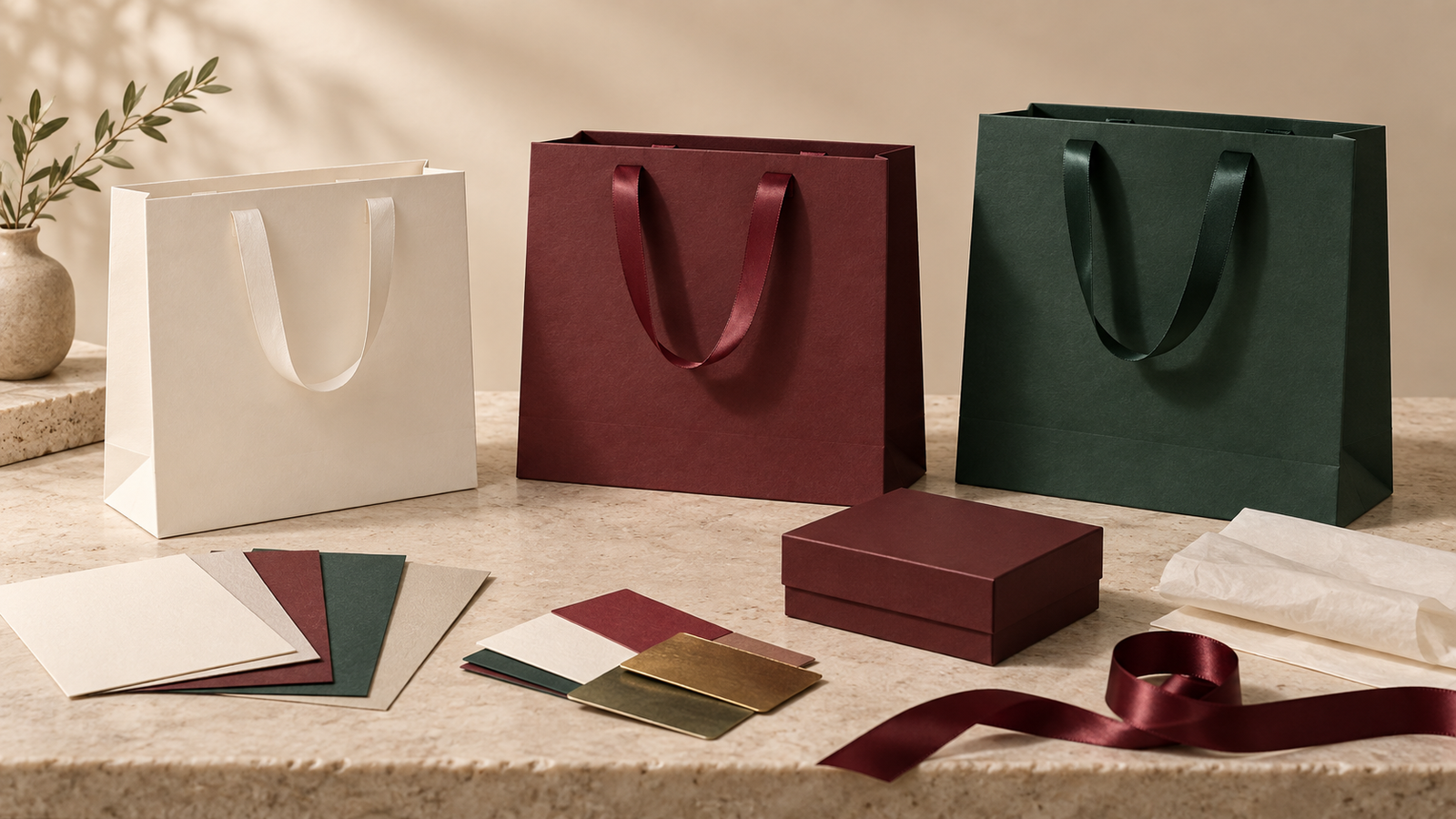
What types of custom paper bag samples are available?
Suppliers use different names, so define the deliverable rather than relying on “prototype” or “production sample” alone. Ask which materials, machines, tools and manual processes will match bulk production, and list every known substitution.
| Sample type | What it can prove | What it cannot prove by itself |
|---|---|---|
| Material and handle swatches | Paper shade, texture, basic print response, ribbon or rope colour and hand-feel | Finished size, folds, handle comfort, load performance or final registration |
| Plain structural prototype | Dimensions, gusset opening, product fit, proportions, handle position and basic construction | Final colour, print, foil, embossing or production surface quality |
| Digital artwork proof | Content, spelling, scale, panel position, dieline alignment and version control | Reliable physical colour, paper texture, finish or finished-bag behaviour |
| Hard-copy colour proof | A controlled simulation of an agreed printing condition when prepared for that purpose | Every production paper, special ink, foil, coating, fold or converting result |
| Printed sheet or finish strike-off | Ink or foil on a relevant substrate, detail, coverage, registration and finish interaction | Complete bag fit, handles, seams, base or carrying performance |
| Fully converted pre-production sample | The combined appearance, construction, pack-out and handling experience | Automatic proof that every bulk unit will match; production inspection is still required |
| Approved master sample | A named physical reference against which production and inspection can be compared | Features that were undocumented, temporary or different from the approved sample |
A project may need more than one stage. For example, approve an unprinted mock-up to lock the size before paying for foil tooling, then approve a printed and finished sample before mass production. Sequencing the decisions prevents an expensive sample from being built around an unresolved structure.
Which paper bag sample do you actually need?
Choose the lowest-cost sample that can answer the next irreversible question, then increase fidelity as risk moves from concept to production. A useful plan separates four approval gates.
1. Prove the physical format
Use a plain structural prototype when the product fit, width, gusset, height, opening or handle drop is uncertain. Pack the actual rigid box, cosmetics, jewellery case, apparel or gift set—not only the bare product. Add the tissue paper, cards, ribbon and other components that change volume or weight. Our luxury paper bag size guide explains how to measure that complete pack.
2. Prove artwork and colour intent
Use a digital proof to approve content and placement. Add a controlled hard-copy proof, printed substrate sample or production strike-off when colour and ink behaviour matter. A PDF on a monitor is valuable for version control, but it is not a physical colour standard and cannot show how a cream, kraft, coloured or textured paper changes the result.
3. Prove special processes
Request a finish sample when foil colour, relief depth, spot gloss, lamination, edge behaviour or ribbon attachment is central to the design. A generic supplier sample shows capability; a project-specific strike-off shows how your artwork behaves on your selected material. Our luxury paper bag finish guide lists the main approval points for foil, embossing, spot UV and lamination.
4. Prove the complete experience
Use a fully converted pre-production sample when several decisions interact: heavy contents, precise brand colour, dark print, complex finishing, unusual handles, a fitted product pack or a high-visibility launch. This is the stage for opening, packing, carrying, photographing and reviewing the bag as a customer would experience it.
Can a digital proof approve a luxury paper bag?
A digital PDF can approve artwork content, dimensions, panel allocation, logo position, copy, barcodes and revision number when it is tied to the correct dieline. It should show trim, crease, gusset, turn-top, seam, handle and finish zones clearly enough for the buyer and supplier to review the same geometry.
It should not be used as the sole approval for physical colour, paper texture, opacity, gloss, foil reflectivity, emboss depth, fold cracking or handle comfort. Screens emit light, while printed colour is produced by ink interacting with a physical substrate and viewing conditions. Even two correctly calibrated screens are not substitutes for the selected production material.
ISO 12647-7:2016 specifies requirements for hard-copy digital proofing systems intended to simulate a defined printing condition; ISO confirmed the edition in 2022. This distinction matters: a contract-quality proof has a defined simulation target and control process, while an ordinary office print is mainly a layout reference. Ask the supplier to state what the proof is designed to represent.
How should you approve structure and product fit?
Begin with the complete packed product and the intended carrying method. Insert and remove the product several times. Confirm that corners do not scrape the paper, the box does not force the gussets outward, tissue can be arranged without crushing, and the bag remains easy for retail staff to pack. Check that the base sits flat and that a heavy or concentrated item is supported rather than balanced on a narrow fold.
- Measure finished width, gusset and height using the agreed orientation.
- Confirm usable internal space after turn-tops, knots, base boards and folds are included.
- Check handle drop and grip with the bag filled to the intended weight.
- Carry the sample through a realistic route, including lifting, walking and setting it down.
- Observe tearing around handle holes, reinforcement movement, seam lifting, bottom distortion and uncomfortable pressure.
- Photograph the packed sample from consistent front, side, top and base views.
- Record the representative product, total load and test duration rather than writing only “passed”.
The sample should prove a connected structure, not just a paper weight. If the bag contains a boxed fragrance, for example, the base board, bottom folds, side panels, turn-top, handle reinforcement and ribbon all share the load. See our paper bag construction guide for the complete load path.
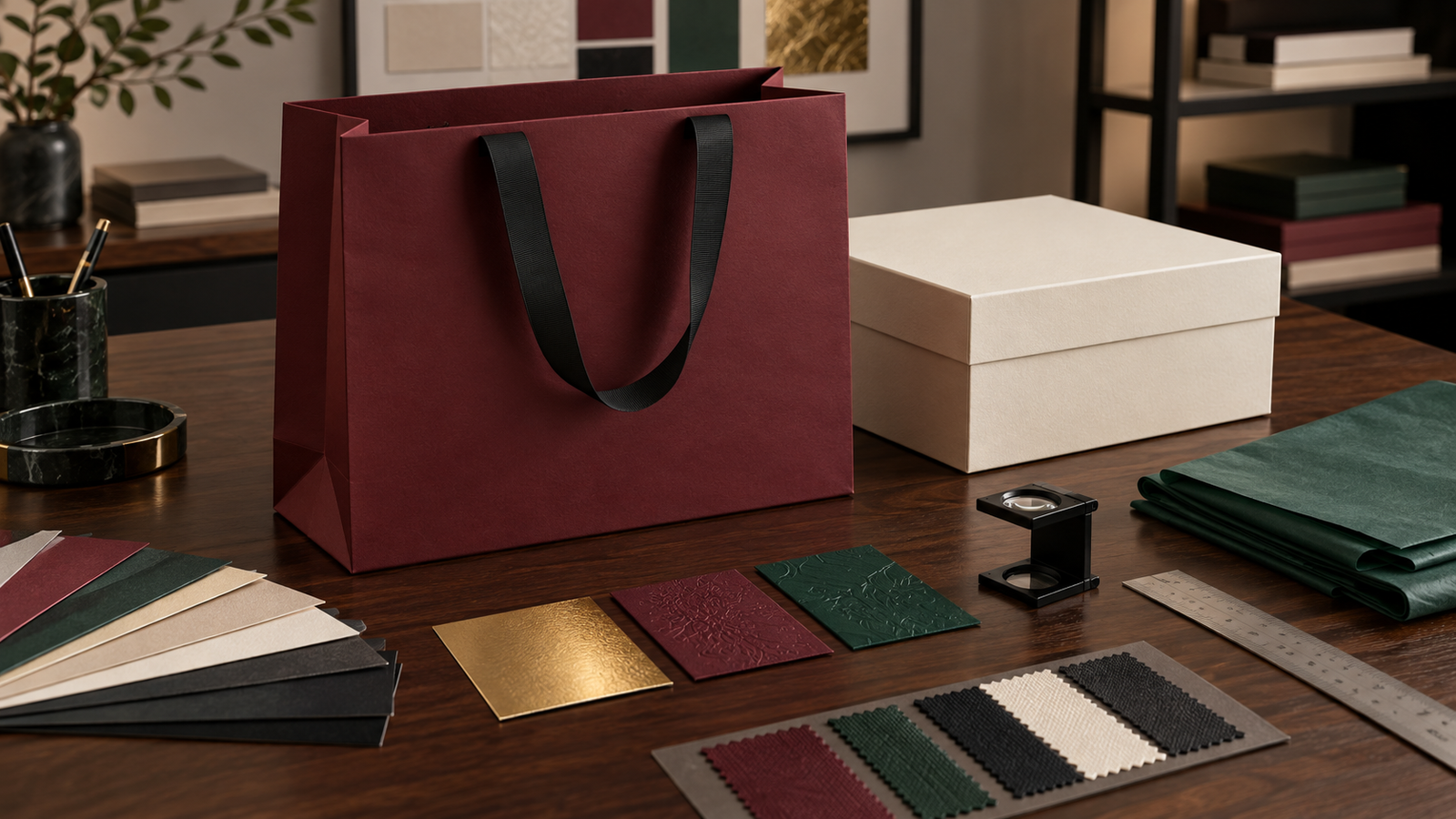
How do you approve paper, handles and finishes?
Do not approve materials as disconnected adjectives such as “premium paper”, “wine ribbon” or “soft-touch”. Record the supplier reference, colour, surface, thickness or grammage where relevant, and the exact sample on which it was reviewed. Natural, recycled and coloured papers may show acceptable variation, but the expected range still needs agreement.
- Paper: check shade, texture, opacity, stiffness, fold response, scuffing and how it supports the intended print.
- Ribbon or rope: check fibre, weave, width or diameter, colour, sheen, fraying, knots or tabs, handle drop and comfort.
- Foil: approve colour, reflectivity, coverage, fine detail, registration and performance across the selected texture.
- Embossing or debossing: approve tool shape, depth, reverse-side effect, alignment and clearance from folds or handle holes.
- Lamination or coating: review gloss, touch, fingerprints, rub marks, fold behaviour and any recyclability constraint for the destination market.
- Tissue and box coordination: view the bag beside the actual rigid gift box, tissue paper and ribbon under the same light.
If a material in the sample is temporary, label it visibly and state what will change in production. “Close alternative paper” is not an approved production reference unless both parties understand the difference and decide how the final material will be checked.
How do you approve print and brand colour?
Separate colour intent from achievable production colour. Provide the brand reference, identify whether the artwork uses process colour or spot colour, and state the substrate and finish. A Pantone number is useful only when the correct library and physical reference are understood. Pantone advises using a recent, non-faded physical standard when work moves from the digital realm into physical production.
Review colour under agreed lighting and place the reference beside the sample. Paper shade, texture, ink film, varnish, lamination and foil can all change perception. For a dark full-coverage bag, also inspect mottling, rub resistance, edge whitening, set-off and consistency through folds. Our luxury paper bag printing guide compares offset, screen, digital and flexographic routes and explains proofing limits in more detail.
What should be written on a sample approval record?
An approval is useful only when another person can identify what was accepted. Give the sample a unique revision and connect it to the quotation, artwork and specification. Mark every open point before anyone signs.
| Record field | What to capture | Why it matters |
|---|---|---|
| Project identity | Brand, SKU, bag size, purchase reference and supplier | Prevents one sample from being applied to another variant |
| Revision control | Sample number, artwork version, dieline version and date | Shows exactly which files and physical item were approved |
| Materials | Paper, reinforcement, base board, handle and finish references | Turns visual impressions into a reproducible specification |
| Dimensions and tolerances | Finished measurements, handle drop and agreed tolerances | Defines what production will be measured against |
| Colour references | Target, proof type, substrate, viewing condition and accepted sample | Separates a controlled target from an on-screen impression |
| Functional checks | Packed product, load, test method, duration and result | Makes “fit” and “strong enough” reviewable |
| Deviations | Temporary materials, missing processes and corrections required | Stops known differences from becoming accidental approvals |
| Decision | Approved, approved with listed corrections, or revise and resample | Gives production an unambiguous release status |
| Approval evidence | Names, dates, annotated photos and retained master location | Supports future production, inspection and reorders |
“Approved with comments” is risky when comments change colour, structure, tooling or materials. If a correction cannot be verified on the existing evidence, request a revised proof or targeted sample. A clean approval costs less than resolving an ambiguous instruction after bulk production has started.
Should the sample be tested before approval?
Yes, when the bag has a functional requirement. Testing can be simple and project-specific, but the conditions must be recorded. Use the intended packed product or a representative load, and include the way retail staff and customers will actually handle the bag. A static load on a desk does not reproduce lifting, walking, swinging, packing or contact inside a shipping carton.
Paper properties also respond to moisture and atmosphere. ISO 187:2022 specifies standard atmospheres and procedures for conditioning and testing paper, board and pulp. A buyer does not need to turn every sample review into a laboratory programme, but comparative tests should state the conditioning and environment—especially when climate, storage or moisture exposure could change the result.
- Fit and retail pack-out with all components present;
- loaded lifting and carrying using the agreed weight;
- handle attachment and comfort at the intended grip;
- base stability, gusset opening and seam behaviour;
- rub, scuff and fingerprint review on visible surfaces;
- folding and opening behaviour after flat packing;
- carton pack-out to check nesting, abrasion and compression risk;
- photography under the lighting used for brand and e-commerce review.
These pre-production checks establish the design reference. They do not replace representative inspection of the bulk lot. Once production begins, use the approved specification and master sample with a separate luxury paper bag quality-control plan.
What happens if something changes after sample approval?
Any change that can affect appearance, fit, performance, claims, cost or delivery should be disclosed and assessed before production continues. Typical examples include a substitute paper mill or shade, a new ribbon dye lot, revised artwork, moved handle holes, changed foil, different lamination, altered board thickness or another packing method.
Use change control rather than informal messages. Identify the old and new references, explain the reason, show the affected characteristics and decide whether a photograph, swatch, targeted strike-off or complete resample is needed. Update the revision number and retire obsolete files from the active production pack.
Keep at least one clearly identified approved master in protected storage when repeat orders are likely. Both buyer and supplier may retain matching masters. Note that a paper or ribbon master can age, fade or pick up moisture, so pair it with written specifications, colour data where available, photographs and the production date.
How do certification claims affect sample approval?
If the bag carries an FSC label or claim, treat it as a controlled artwork and sourcing requirement—not decorative copy added at the last minute. Confirm the supplier’s chain-of-custody scope, eligible material claim, label artwork and approval route before production. The FSC chain-of-custody standard covers sourcing, processing, labelling and sale of certified forest-based products.
FSC published its revised trademark standard, FSC-STD-50-001 V3-0, on 1 January 2026, with new requirements effective from 1 July 2026 and a transition period through 1 January 2029. Because this article is being prepared during that transition, buyers should ask the certificate holder which applicable route and artwork approval evidence will govern the order. Do not assume that a logo visible on a generic sample authorises the claim on your finished bag.
How much time should sampling add to the schedule?
There is no universal sample lead time. A plain hand-made mock-up can be faster than a fully printed sample requiring production paper, plates, foil tools, embossing dies, special handles and manual conversion. Courier transit, internal brand review and revision rounds also sit outside the supplier’s making time.
Plan from the required in-hand launch date. Define who will review artwork, colour, structure and commercial terms; allow time to receive a physical sample; and set a deadline for consolidated feedback. Approving in fragments can create contradictory revisions. Our custom paper bag lead-time guide shows how sampling and buyer approvals connect to material sourcing, production, inspection and freight.
What should you include in a sample request?
- finished bag dimensions and the actual packed product dimensions and weight;
- required paper, colour, texture, certification and performance direction;
- handle material, colour, width or diameter, drop and attachment;
- print method, colour references, coverage and approved artwork version;
- foil, embossing, coating, lamination or other finish with exact positions;
- turn-top, handle reinforcement, base board, gusset and seam expectations;
- the sample type and every characteristic it must represent;
- known substitutions or processes that will differ in bulk production;
- functional checks, acceptance criteria and required documentation;
- quantity, number of SKUs, delivery country, production deadline and sample in-hand date;
- approval contacts and whether buyer and supplier need retained master samples.
If you are requesting a coordinated set, provide the rigid gift box, ribbon and tissue paper specifications at the same time. Colour and proportion are easier to approve when the whole packaging system is visible together. This also helps the supplier identify shared materials, tooling or approval stages before quoting.
Frequently asked questions
Is a paper bag mock-up the same as a production sample?
No. A mock-up may use temporary paper, digital print, hand cutting or substitute handles to prove size and appearance. A production sample should state which materials and processes match bulk manufacture. Always ask for the represented and non-represented features in writing.
Do I need a physical sample for a repeat paper bag order?
Not always, but confirm whether anything has changed: artwork, paper, supplier, colour target, finish, handle, construction, production route or delivery requirement. A retained master and current specification may be enough for a true repeat; a changed material or long gap can justify new swatches or a resample.
Can I approve paper bag colour from a photo?
A photo can show placement, gross variation or a visible defect, but camera settings, lighting, compression and screens change colour. Use a defined physical or measured reference for colour-critical approval and treat photographs as supporting records.
Who should sign the approved master sample?
The people authorised to release the buyer’s design and the supplier’s production should be identifiable on the approval record. The exact roles vary by business, but the decision, date, sample revision, open points and retained-sample location should be clear to both sides.
Does an approved sample guarantee every production bag?
No. It defines the reference and acceptance intent. Bulk production still needs material controls, process checks and representative final inspection. Natural materials and manufacturing have variation, so measurable tolerances and defect criteria should accompany the visual master.
Approve evidence, not sample names
The right custom paper bag sample is the one that resolves the next important uncertainty. Use swatches for material direction, a plain prototype for fit, a controlled proof for colour intent, a strike-off for special processes and a complete pre-production bag for the combined customer experience. Then connect the accepted sample to a written specification and revision-controlled production release.
Bespoke Packaging develops custom luxury paper bags together with rigid gift boxes, ribbon and tissue paper. Share your product pack, bag size, quantity, artwork, colour and finish priorities, delivery market and launch date, and we can recommend a practical sampling route for quotation.
Does your current sample approval say exactly what production must match?