
CUSTOM PAPER BAG BUYER GUIDE
Custom Paper Bags With Logo: Stock or Fully Custom?
Choose between a stock-size bag with your logo and a fully custom luxury paper bag by comparing fit, brand control, approvals, quantity and total delivered cost.
Custom paper bags with logo generally follow one of two sourcing routes: print a logo on an existing stock bag, or manufacture a fully custom bag around your product and brand. Stock overprint is useful when speed, a modest quantity or a simple test matters most. Fully custom production is the stronger route when the bag must fit a particular rigid box, match brand colours, use premium paper and handles, or create a consistent luxury retail experience.
The right route is not the one with the most options. It is the simplest route that meets the real product, brand, quantity, schedule and delivery brief. This guide shows how to compare the two without treating every logo bag as the same product.
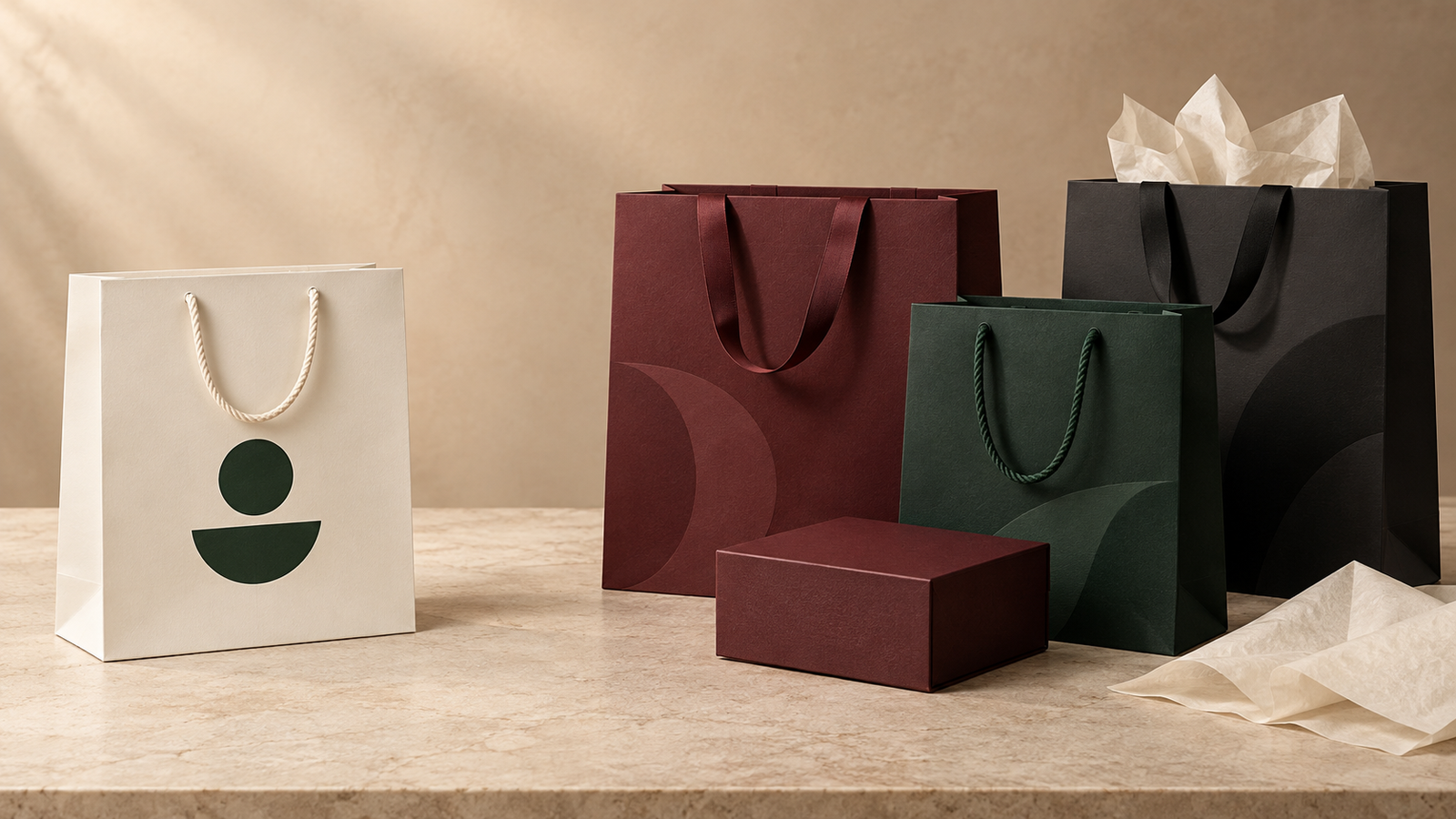
What is the difference between stock overprint and fully custom paper bags?
A stock overprint bag starts with a finished, unbranded bag in a supplier’s existing size, paper colour, handle and construction. Your logo or simple artwork is then added within the available print area. A fully custom paper bag is specified before production: width, gusset, height, paper, reinforcement, print, finish, handles and packing can all be developed for the project.
| Decision | Stock bag with logo | Fully custom luxury paper bag |
|---|---|---|
| Bag size | Choose from existing formats | Set around the finished product pack |
| Paper and colour | Limited to available stock | Selected for structure, print, feel and brand direction |
| Handles | Existing handle type and colour | Specified material, colour, width or diameter, drop and attachment |
| Artwork | Usually a defined imprint area and simpler coverage | Artwork can be planned across approved printable panels |
| Finishing | Limited by the finished stock surface and supplier process | Foil, embossing, spot effects or coatings can be designed into production |
| Best fit | Pilots, events, short campaigns and simple brand marking | Premium retail, repeat programmes and coordinated packaging systems |
These are sourcing categories, not universal technical standards. One supplier may offer a premium stock bag with several print options, while another may reserve the term “custom” for made-to-order dimensions and materials. Ask every supplier to state what is fixed and what can change.
Which option should a buyer choose?
- Choose stock overprint when a standard size fits well, the available paper and handles suit the brand, the artwork is simple and the project does not justify a complete manufacturing setup.
- Choose fully custom when product fit, structural performance, exact proportions, premium materials, specific handles, full-panel artwork or special finishing are central to the brief.
- Use both deliberately when a stock bag supports an early event or test while a fully custom repeat programme is being developed. Keep the visual hierarchy related so the temporary route still feels intentional.
Do not decide from quantity alone. A stock format can be a poor value if it wastes space, rubs a gift box or requires manual repacking. A fully custom bag can also be unnecessary if an existing format already meets the product and brand requirements. Compare the complete usable result.
Why should product fit come before logo placement?
A visible logo cannot correct a bag that is difficult to load or uncomfortable to carry. Begin with the finished pack-out: product, rigid box, tissue, ribbon, card and any retail protection. Measure its maximum width, depth and height, record the filled weight, then test how it enters and sits in the bag.
The current GS1 Package and Product Measurement Standard provides a consistent method for communicating product and packaging dimensions. It is not a custom shopping-bag specification, but its emphasis on repeatable orientation and measurement is valuable when brand, designer and supplier exchange size data.
- Assemble the exact product pack that will go into the bag.
- Measure the maximum external dimensions in a labelled orientation.
- Check loading clearance at the opening, not only internal space after the item is inside.
- Confirm the base supports the product without tipping or excessive movement.
- Fill and carry a physical sample using the expected weight.
- Inspect corners, gussets, handles, top reinforcement and printed surfaces after use.
Our luxury paper bag size guide explains width, gusset, height and functional clearance in more detail. If none of the stock formats gives a controlled fit, custom dimensions are solving a functional problem rather than adding decoration.
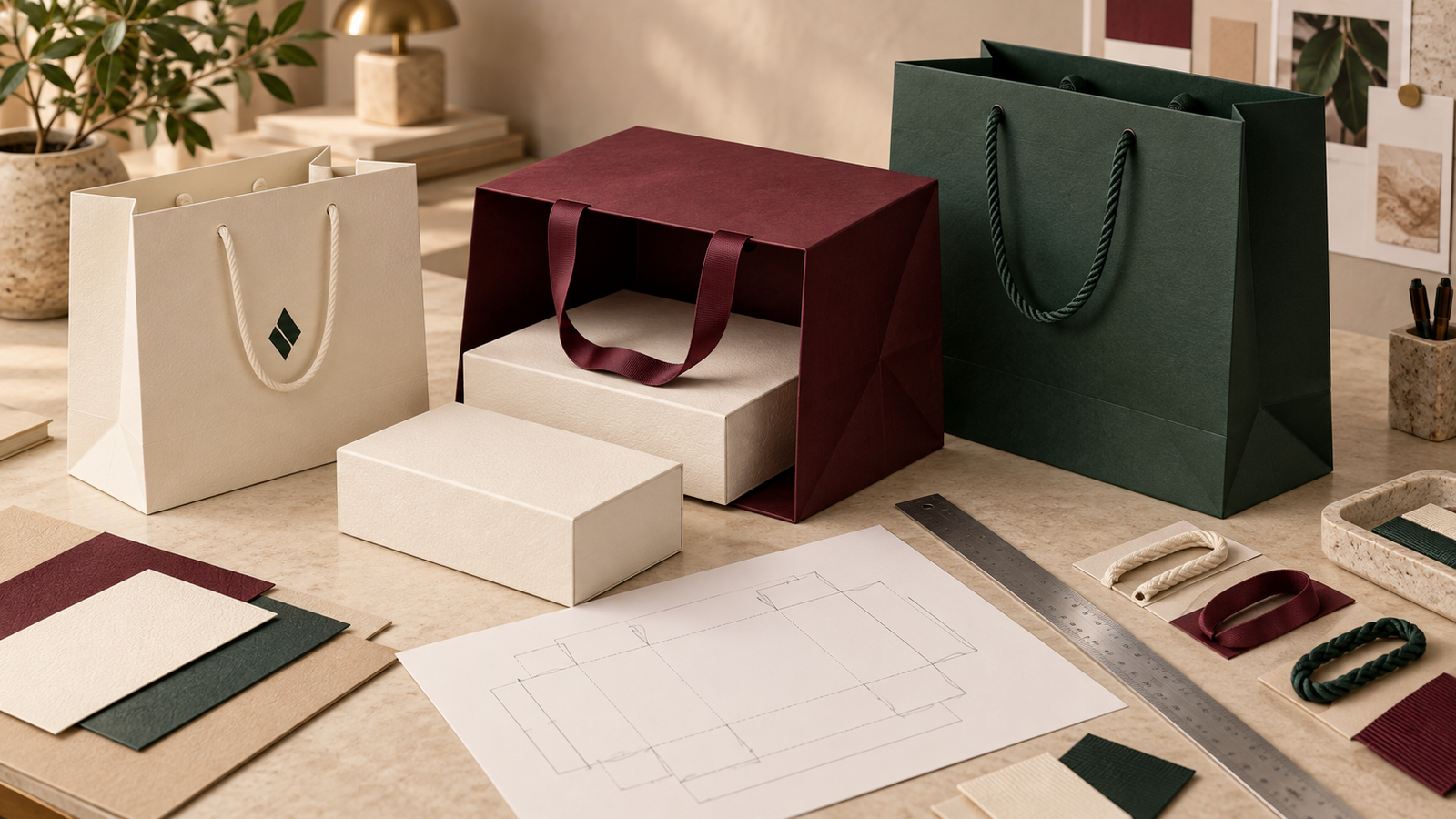
What does “custom with logo” actually include?
The phrase can describe very different products. A useful quotation should separate the base bag from the branding operation and list every included decision.
- Format: finished width, gusset, height and whether those dimensions are stock or made to order.
- Body paper: paper family, colour, texture, grammage direction and any coating or lamination.
- Construction: turn-top, reinforcement boards, seams, gussets, base board and method of assembly.
- Handles: paper, cotton rope, woven cord or ribbon; colour, dimensions, drop and attachment.
- Artwork: number of colours, process, coverage, printable panels and relationship to folds or handle holes.
- Finishing: foil, embossing, debossing, spot gloss or other defined effect.
- Approval: artwork proof, material swatch, structural sample, print proof or fully converted pre-production bag.
- Packing and delivery: units per carton, protection, destination, delivery basis and target date.
If a quotation says only “paper bag with logo,” the buyer cannot compare it responsibly. Two prices may cover different paper, print coverage, reinforcement, sample stages or freight responsibilities.
What can limit logo printing on a stock paper bag?
A finished stock bag already has folds, seams, handles and a defined surface. These features can restrict where equipment reaches and how large the imprint can be. The supplier may offer one or two sides, a maximum print area, a limited set of ink colours or a particular printing method. The exact limits belong on the quotation and artwork template.
- Keep critical artwork clear of gusset folds, base creases, seams, turn-tops and handle attachments.
- Check whether the bag is printed before or after it is formed; the route changes registration and access.
- Test ink or foil on the actual stock surface, especially if it is textured, coloured, coated or laminated.
- Judge contrast physically. A brand colour printed on kraft, ivory and white paper will not look identical.
- Confirm whether front and back printing require separate setup or artwork positions.
- Approve the held bag, not only a flat screen visual; handles and folds change the visual centre.
A stock overprint can still look refined when the mark is well scaled and the bag itself is well chosen. Restraint often works better than trying to make a fixed stock format imitate a complex fully custom design.
What extra control does fully custom production provide?
Fully custom production allows the identity to be designed with the bag rather than added afterward. The panel proportions can support the logo; paper can be selected for the required colour and tactile effect; handle colour can repeat a brand cue; and reinforcement can be developed for the real packed load.
That control also creates more approvals. The buyer must decide which variables matter and freeze them before production. Use the paper materials guide to shortlist the sheet, the handle guide to choose the carrying interface and the artwork guide to prepare the supplier dieline.
How should buyers compare quotations?
| Quote field | Question to resolve | Why it matters |
|---|---|---|
| Bag basis | Stock overprint or fully custom manufacture? | Defines which dimensions and components are fixed |
| Quantity | Per size, artwork and colourway or combined? | Prevents an unusable mixed-SKU assumption |
| Print and finish | How many positions, colours, passes and tools? | Changes setup, appearance and approval needs |
| Samples | Which physical stage is included? | Determines what the buyer can prove before production |
| Packing | How are bags protected and how many fit per carton? | Affects scuff risk, storage and freight volume |
| Delivery basis | What named place and trade term apply? | Clarifies allocation of transport costs and risk |
The International Chamber of Commerce explains that Incoterms® 2020 rules allocate specified obligations, costs and risk between seller and buyer, but do not replace the sales contract. Write the chosen rule with a named place and compare quotes on the same delivery scope.
Compare complete landed usable cost rather than the lowest unit line. The custom paper bag cost guide shows how specification, quantity, packing and delivery assumptions affect a fair comparison.
What should the proof and sample process confirm?
A PDF can confirm content, approximate placement and artwork version. It cannot prove paper feel, exact colour on the chosen substrate, handle comfort, ink adhesion, structural fit or finished-bag performance. Match the approval stage to the risk.
- Stock bag sample: proves actual size, paper, handles and construction before artwork is added.
- Digital visual: proves logo version, scale, panel position and orientation.
- Print or finish test: proves the intended mark on the real or agreed comparable surface.
- Fully converted sample: proves overall appearance, product fit, carrying experience and interaction among components.
- Approved master: becomes the physical production reference when both parties identify and retain it.
ISO 12647-7:2016, which ISO lists as current after confirmation in 2022, defines requirements for hard-copy digital proofing systems intended to simulate a printing condition. Such a proof can support colour-controlled print approval, but it does not substitute for a structural bag sample or a physical foil, embossing or handle approval.
The paper bag samples guide explains what each approval stage can and cannot demonstrate.
How should sustainability and certification claims be handled?
Do not treat “paper,” “recycled,” “FSC-certified,” “recyclable” and “reusable” as interchangeable claims. They refer to different questions about fibre sourcing, recycled content, finished-product certification, recovery and actual use. Define the claim, destination market and evidence before placing words or certification marks on the bag.
FSC’s official trademark requirements govern how certificate holders label and promote products. A supplier offering certified paper is not automatically evidence that every finished bag or logo artwork can carry an FSC label. Verify chain-of-custody scope, claim text and artwork approval for the order; our FSC-certified paper bags guide gives buyers a practical document trail.
For recyclability, review the complete construction: body paper, inks, coatings, laminate, handles, reinforcement, adhesives and metallic decoration. A stock bag may simplify some choices, but a fully custom paper-led construction can give more control. Neither route proves recyclability by name alone.
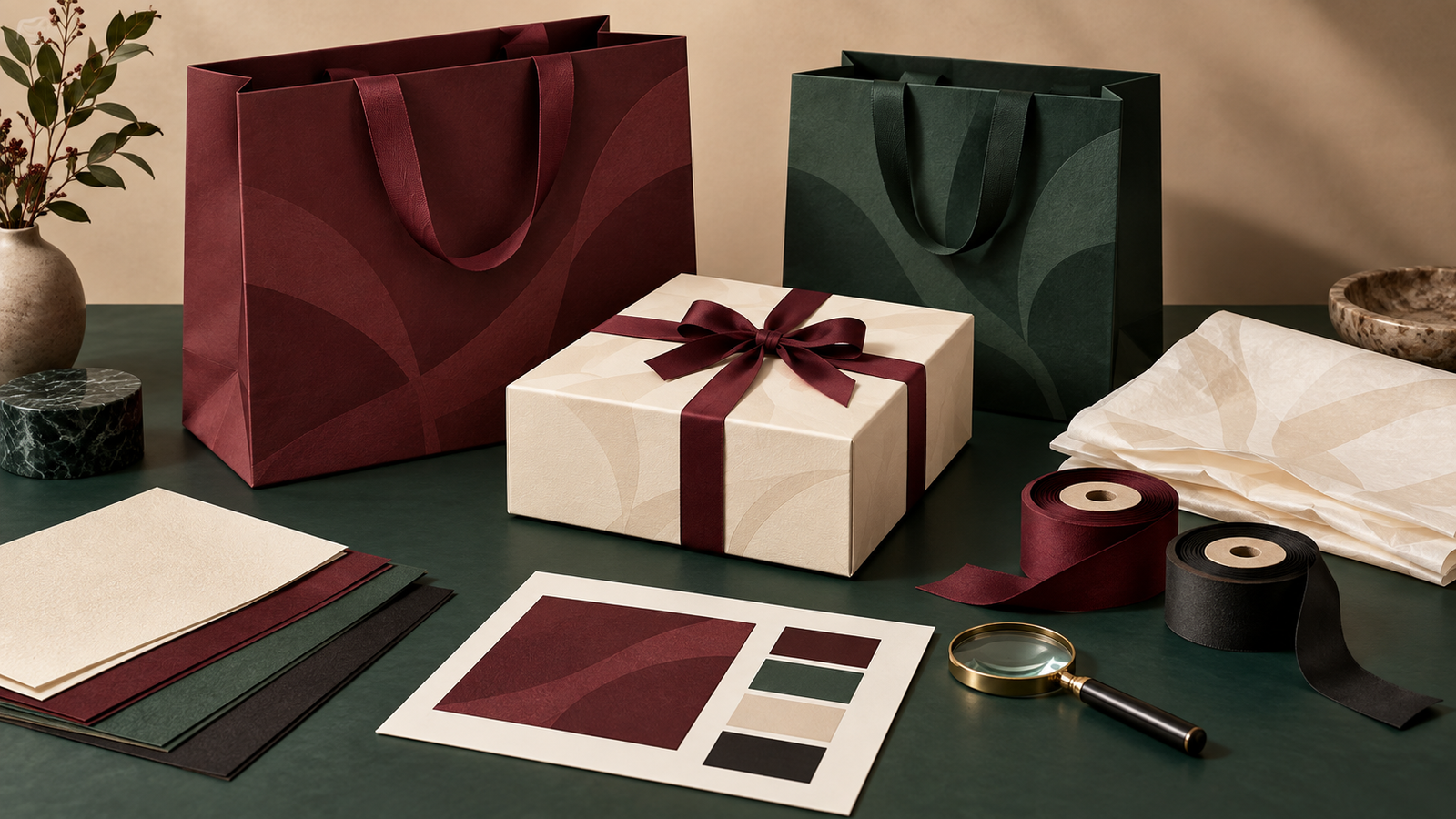
How can logo bags coordinate with boxes, tissue and ribbon?
The shopping bag is the public-facing carrier, while the rigid box, tissue and ribbon build the private reveal. Coordination does not require identical decoration on every layer. Repeat one or two controlled cues—colour, shape, paper character or ribbon texture—and allow each component to do its own job.
- Size the bag around the completed gift box rather than the bare product.
- Approve bag paper and box wrap beside one another under the same light.
- Use ribbon colour to connect the bag handle or box closure without forcing an exact cross-material match.
- Keep tissue printing lighter when the bag already carries a strong logo.
- Decide which component leads the hierarchy and which components support it.
- Build one sample set so fit, colour and opening sequence can be judged together.
Fully custom bags provide the greatest control over this system, but a carefully chosen stock bag can still participate through restrained overprint, tissue and ribbon. See the luxury packaging sets guide for a complete component-by-component planning method.
What affects MOQ, lead time and cost?
There is no responsible universal MOQ, price or lead time for all custom paper bags with logo. Stock availability, print setup, number of designs, paper purchasing, custom handles, tooling, sample route, production capacity, packing and delivery all change the answer.
- A stock overprint may avoid custom bag-making setup, but the chosen stock colour, size and quantity must actually be available.
- A fully custom run may combine paper purchasing, printing, finishing, conversion, handle fitting and hand assembly.
- Each size, artwork or colourway may be treated as a separate SKU with its own practical minimum.
- Special paper, dyed handles, foil dies or embossing tools can add separate setup and approval stages.
- Paper bags are light but bulky; flat packing, carton dimensions and delivery method can materially affect landed cost.
- Buyer approval time belongs in the schedule. Late artwork or sample decisions do not disappear from the critical path.
Ask for quantity breaks against one controlled specification. If a lower-quantity option changes the bag construction or print method, treat it as an alternative product rather than a directly comparable price.
What belongs in a quote-ready brief?
- State whether you are open to stock overprint, fully custom production or both.
- Provide the finished product-pack dimensions, maximum weight and a reference photo.
- List preferred bag dimensions or ask the supplier to recommend them from the pack-out.
- Describe the desired paper feel, colour and structure.
- Specify handle type, colour direction, dimensions and carrying method.
- Supply vector logo artwork and identify every required print or finish position.
- Give quantity by size, artwork, colourway and delivery lot.
- Name the required proof, sample and approved-master stages.
- Identify destination country, postcode, delivery basis and required date.
- List any sourcing, recycled-content, recyclability or certification claim that requires evidence.
- Include matching rigid box, tissue paper and ribbon requirements.
If some decisions are open, say what the bag must achieve: fit this box, carry this weight, feel restrained and premium, and arrive by this date. A useful supplier response should turn that objective into visible options and assumptions.
Frequently asked questions about custom paper bags with logo
Is a stock bag with logo the same as a fully custom bag?
No. A stock-logo bag uses an existing size and construction with added branding. A fully custom bag can change dimensions, paper, structure, handles, print and finishing before manufacture. Ask the supplier to list what is fixed.
Can a stock paper bag still look luxurious?
Yes, when the bag has good proportions, suitable paper and handles, a controlled product fit and restrained artwork. The limitation is choice: if the available construction conflicts with the brand or product, logo printing alone will not solve it.
What file is needed to print a logo on a paper bag?
Vector artwork is normally the safest starting point for a logo because it can be scaled and separated cleanly. Use the supplier’s artwork template, outline fonts when requested and keep print or finish layers clearly named. The supplier should confirm the accepted format and production limits.
Should the logo be printed on one side or both sides?
Choose by viewing context and budget. Two-sided branding gives visibility from more directions, while one controlled front mark may be enough for a boutique handoff. Confirm whether the back requires separate setup and approve both panel positions.
How large should a logo be on a shopping bag?
There is no universal ratio. Scale the mark on the finished front panel, leave safe distance from folds and handles, and judge it both close up and at normal carrying distance. A full-size printed mock-up is more reliable than a small screen preview.
Choose the route that makes the complete bag work
The best custom paper bag with logo is not defined by the logo alone. Start with the product fit and carrying requirement, decide how much control the brand needs, compare quotations on the same specification, and approve physical evidence at the right stage. Stock overprint can be a disciplined, efficient answer; fully custom production can turn the bag into a coherent part of a premium packaging system.
Bespoke Packaging develops custom luxury paper shopping bags alongside rigid gift boxes, tissue paper and ribbon. Share your product pack, target quantity, logo artwork, delivery country and timing, and we can compare a practical stock-logo route with a fully custom specification.