
OPTICAL RETAIL PACKAGING GUIDE
Custom Eyewear Paper Bags: A Buyer’s Guide for Optical Retail
Specify premium paper shopping bags around eyewear cases, presentation boxes, care accessories and the realities of an optical retail counter.
Custom eyewear paper bags should be sized around the complete purchase—not the spectacle frame alone. The hard case, retail box, lens cloth, care product, receipt folder, tissue and any gift presentation determine the usable bag size, load and counter workflow. A good specification protects that set, carries comfortably and presents the optical brand at the same level as the product inside.
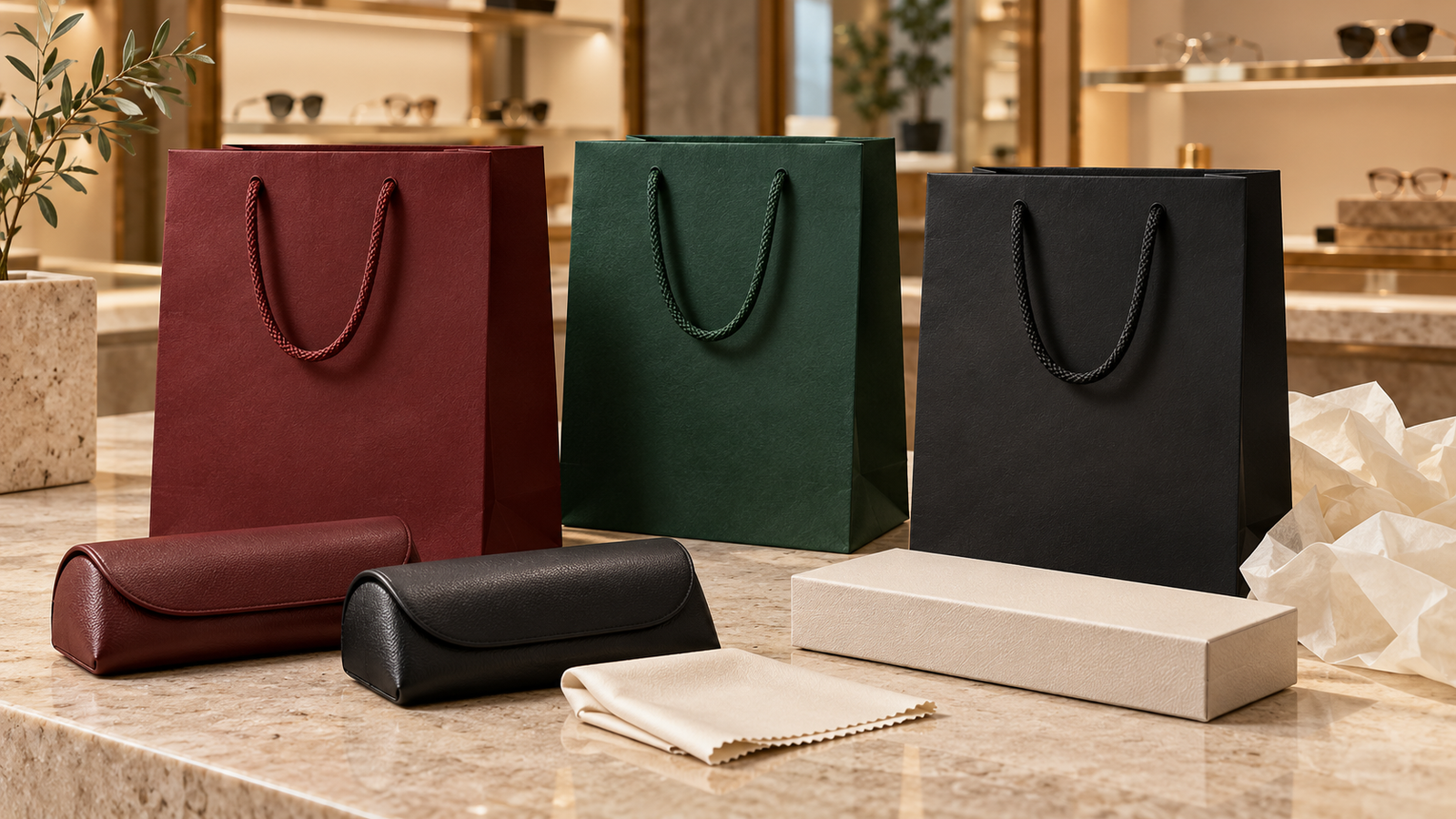
The short answer
Measure the largest finished eyewear pack in its real carry orientation, add practical loading clearance, engineer the bag body and handles for the complete load, then approve a converted sample at the retail counter. Do not choose a stock bag from frame dimensions or appearance alone.
What is a custom eyewear paper bag?
A custom eyewear paper bag is a branded retail carrier made around the products and service items supplied by an optician, sunglass label or eyewear boutique. It may hold a single hard case, a boxed frame, multiple cases, a cleaning kit, paperwork or a gift set. Unlike the primary case or presentation box, the bag is the outer handoff layer: it supports carrying, keeps the purchase together and remains visible after the customer leaves the store.
The category can include compact rope-handle bags for one case, wider formats for gift boxes and deeper shopping bags for several products. The right route depends on what is actually packed. A premium-looking but undersized bag can scrape the box during loading; an oversized one lets a small case move, tip and disappear visually.
Which eyewear purchase are you packaging?
Single-case handoff
One frame in a hard case, with a folded cloth, care card and receipt. The bag should be compact but easy for staff to open and load without forcing the case through the top.
Boxed premium purchase
A branded rigid or folding presentation box becomes the controlling dimension. Tissue, ribbon and accessories must fit without crushing the box corners or bowing the bag panels.
Multi-item or gift set
Two cases, sunglasses plus accessories, or an eyewear gift set may need a wider base, dividers inside the presentation box or a second bag size rather than one oversized universal carrier.
Map the range before requesting prices. A small family of well-used sizes is usually easier to purchase, store and pack than a unique carrier for every frame collection. Our luxury paper bag size guide explains width, gusset, height and fit allowance in more detail.
How do you size an eyewear paper bag correctly?
Start with the finished pack in the orientation in which staff will load and the customer will carry it. The current GS1 Package and Product Measurement Standard provides a repeatable method for recording height, width and depth and says maximum projections should be included. For an eyewear project, record each relevant level separately: the case, presentation box, assembled gift set and proposed paper bag.
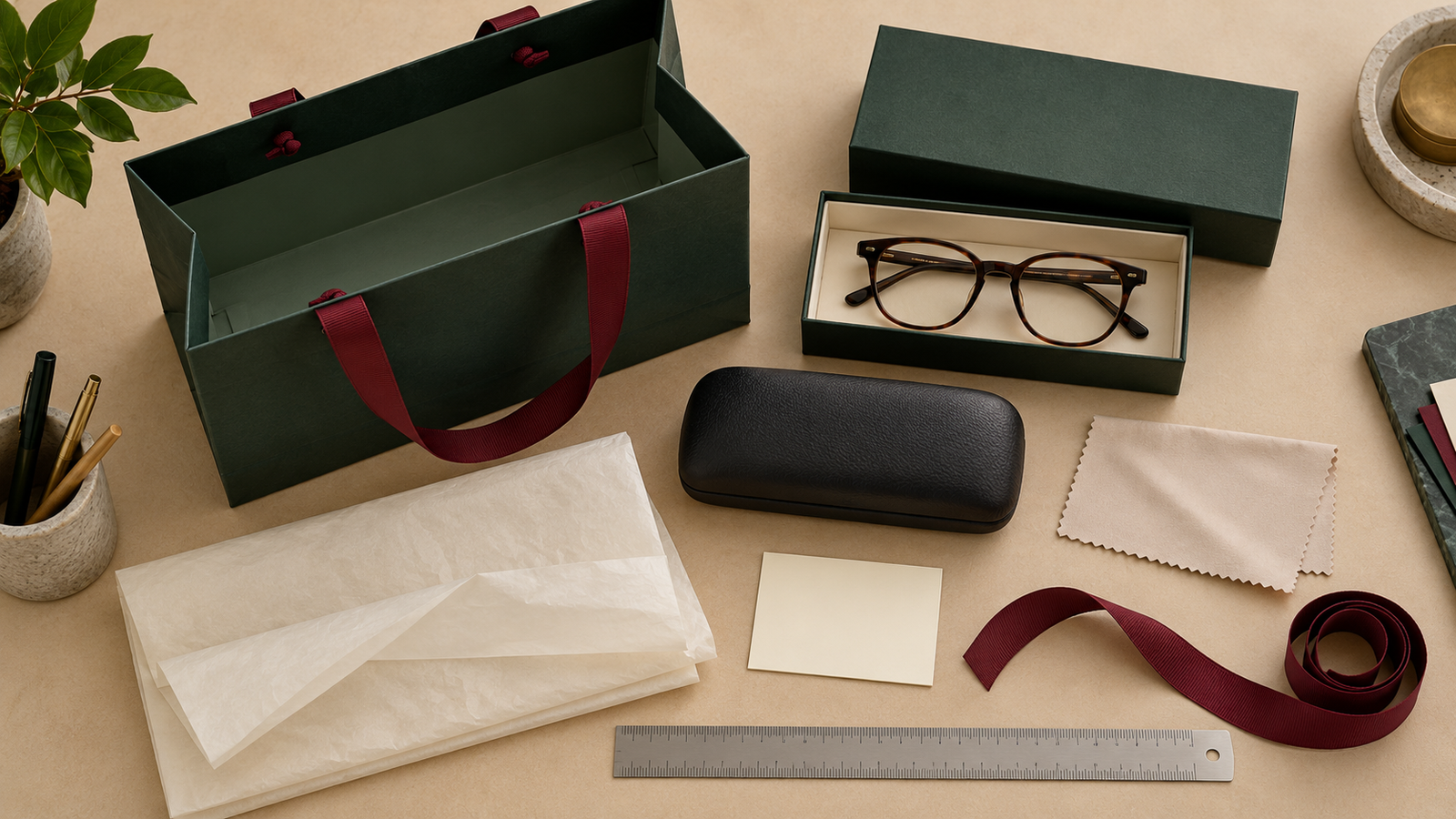
| Measure or observe | Why it matters | What to send the supplier |
|---|---|---|
| Maximum outside width, depth and height | Defines the minimum internal envelope of the bag | Dimensions in one agreed order, with photos of the carry orientation |
| Closures, sleeves, bows or projecting parts | These can catch during loading or increase the real size | Measurements that include every projection |
| Complete packed weight | Guides paper, reinforcement, base and handle decisions | Representative maximum load, not an empty case weight |
| Counter-packing movement | Controls practical top and side clearance | A short pack-out video or a physical sample set |
| Carry direction | A long case can sit horizontally or vertically and changes bag proportions | A marked sketch showing intended orientation |
Do not copy a generic clearance value from the internet. The needed allowance changes with box corners, tissue bulk, bag stiffness, top opening, gusset movement and how quickly staff must pack. Prototype at least the most demanding combination and test it at a real counter before freezing dimensions.
What construction works for optical retail?
The paper, top fold, handle reinforcement, side seam, gussets and base work as one load path. Eyewear packs are often light, but a compact rigid case can create a concentrated load and a wide gift set can press hard against the gussets. Specify construction from the largest approved pack rather than choosing a high GSM as a substitute for engineering.
- Body paper: choose coated, uncoated, kraft, coloured-through or specialty paper for the required print, touch, crease and scuff behaviour.
- Top treatment: a turned top can create a clean rim and contain reinforcement, but must still open easily during counter packing.
- Handle system: cotton rope or ribbon can suit premium optical retail; attachment spacing, knot or anchor and reinforcement matter as much as the material.
- Base support: consider a base card when the pack is rigid, concentrated or expected to stand neatly in the bag.
- Side gussets: allow the filled bag to open around the box without excessive bowing or corner pressure.
See the luxury paper bag construction guide for the full load path and the paper bag handles guide for rope, ribbon and paper-handle trade-offs.
Which materials and finishes look premium without becoming fragile?
Build the surface first
Uncoated and textured papers can create a quiet, tactile presentation. Coated papers support crisp imagery and dense colour. Mass-dyed sheets can reduce the visual contrast of edge wear compared with a dark flood printed on a light base. Check the actual paper under store lighting and beside the eyewear box.
Add one controlled focal effect
Foil, embossing, debossing or a restrained spot effect can focus attention on the mark. Prove fine lines, relief depth, registration and rub behaviour on the chosen substrate. More processes do not automatically create a more premium result, especially on a compact bag.
Optical stores handle bags near frame displays, mirrors and polished counters, so fingerprints, scuffing and corner wear deserve a production-representative check. Approve the bag filled, opened and handled—not only as a flat colour proof. Compare options in our paper materials and surface finishes guides.
How should the bag coordinate with the eyewear box, cloth and tissue?
Coordination does not require every component to be the same colour. Paper, wrapped board, fabric ribbon, microfiber and foil reflect light differently, so a forced “exact match” can fail in use. Choose a hierarchy: perhaps a deep-green bag carries the largest field of colour, a black rigid box anchors the product, burgundy ribbon provides an accent and cream tissue softens the reveal.
Keep regulatory or care information where it belongs on the product, label or supplied document. The outer shopping bag can carry brand graphics and practical contact details, but it should not be used to hide information that the eyewear product or its primary packaging must retain. Treat the bag, rigid presentation box, printed tissue paper and custom ribbon as a coordinated set with separate jobs.
What should a physical sample prove?
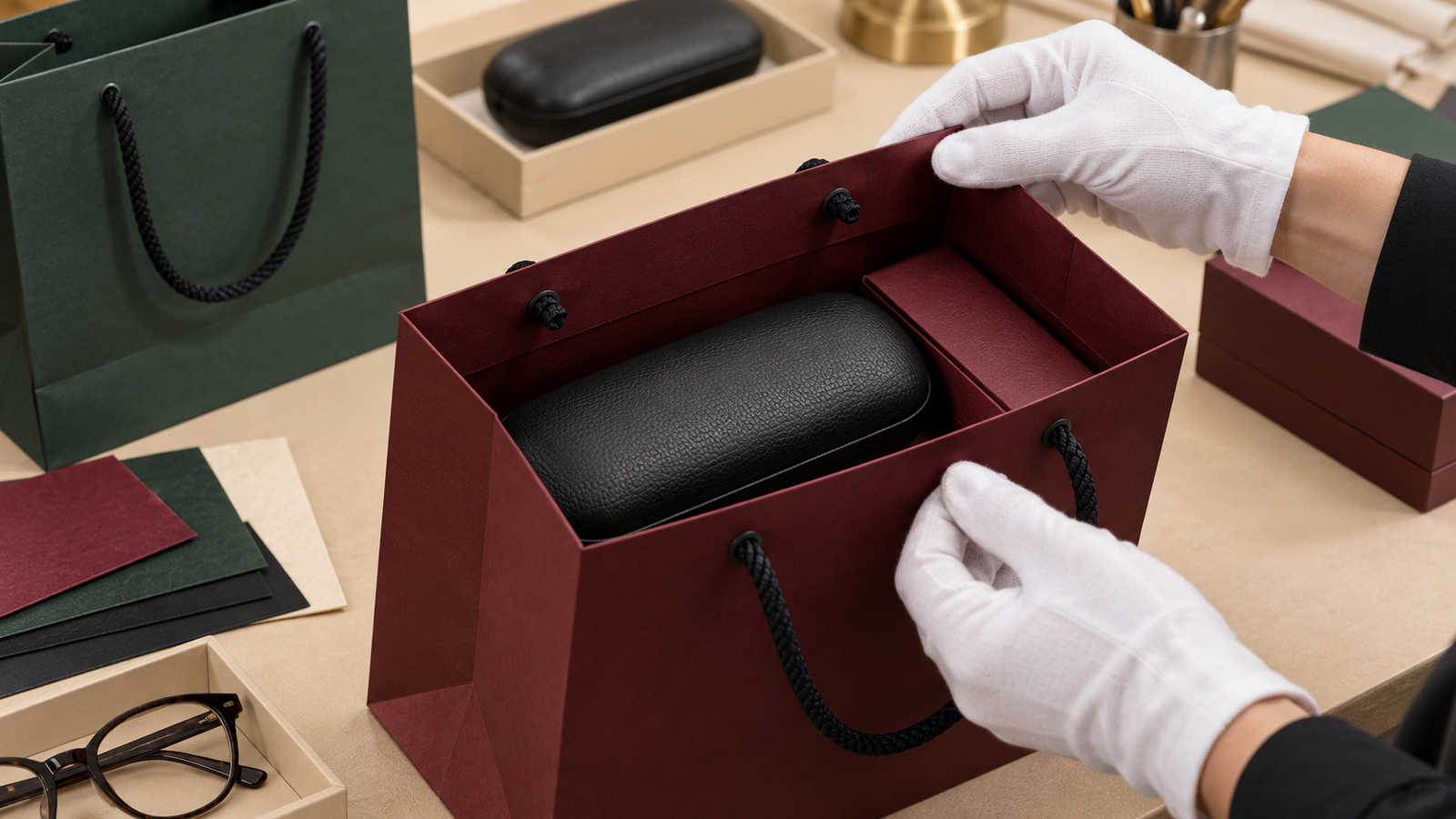
- Fit: the largest approved box or case enters and leaves without scraping, snagging or excessive empty space.
- Standing shape: the loaded base sits flat and the front panel does not collapse around a compact case.
- Carry balance: the bag remains comfortable and does not tip when the real contents are lifted and walked.
- Handle security: holes, anchors, knots and reinforcement remain stable under the representative load.
- Surface durability: print, foil, coating and paper tolerate realistic rubbing, opening and counter handling.
- Retail workflow: staff can open, fill, add tissue, close the presentation and hand it over without awkward steps.
- Brand coordination: bag, box, cloth, tissue and ribbon are reviewed together under agreed light.
A digital rendering can approve composition but cannot prove fit, feel, opening behaviour or load performance. Use the custom paper bag sampling guide to separate what swatches, proofs, strike-offs and fully converted samples establish.
How do you inspect production eyewear bags?
Inspect against a signed master and a written specification. Useful checks cover dimensions, paper identity, colour and finish, artwork position, crease and gusset alignment, seam and base bonding, handle location, reinforcement, count and protective packing. Include a representative loaded-bag test with the actual eyewear pack or a controlled equivalent; paper test results alone do not verify the assembled carrier.
A practical pre-shipment evidence pack
- approved artwork and physical master reference;
- measurement and quantity records by size;
- images of top, base, seams, handles and printed panels;
- results from agreed loaded handling checks;
- carton count, orientation and protective pack-out;
- record of any deviation and written disposition.
How should sustainability claims be specified?
Write the required evidence into the brief before material purchasing. FSC explains that chain-of-custody certification tracks eligible forest-based material through manufacturing and distribution. A finished-product FSC label therefore depends on the certified chain and approved trademark use; it is not created simply by selecting a paper described as FSC certified.
Minimisation must also preserve function. ISO 18602:2013, confirmed current in 2024, addresses optimisation of packaging weight or volume while maintaining required functions. For EU sales, Regulation (EU) 2025/40 on packaging and packaging waste applies across packaging materials and includes packaging-minimisation requirements. Assess the actual bag construction and market rather than making broad claims from paper alone.
What belongs in an eyewear paper bag RFQ?
- case, box and complete packed-set dimensions;
- maximum representative packed weight and carry orientation;
- bag quantity by size, colour and artwork;
- paper direction, colour and surface reference;
- print colours, artwork files and finish layers;
- handle material, width or diameter, colour and attachment method;
- top fold, reinforcement and base-board requirements;
- sample, test, inspection and acceptance plan;
- required sourcing or environmental evidence;
- pack-out, delivery destination and required date.
Ask every shortlisted supplier to quote the same controlled brief. If a suggested alternative changes paper, reinforcement, handle attachment, finish or pack-out, record it as a visible deviation rather than comparing unlike prices.
How should the final boutique handoff feel?
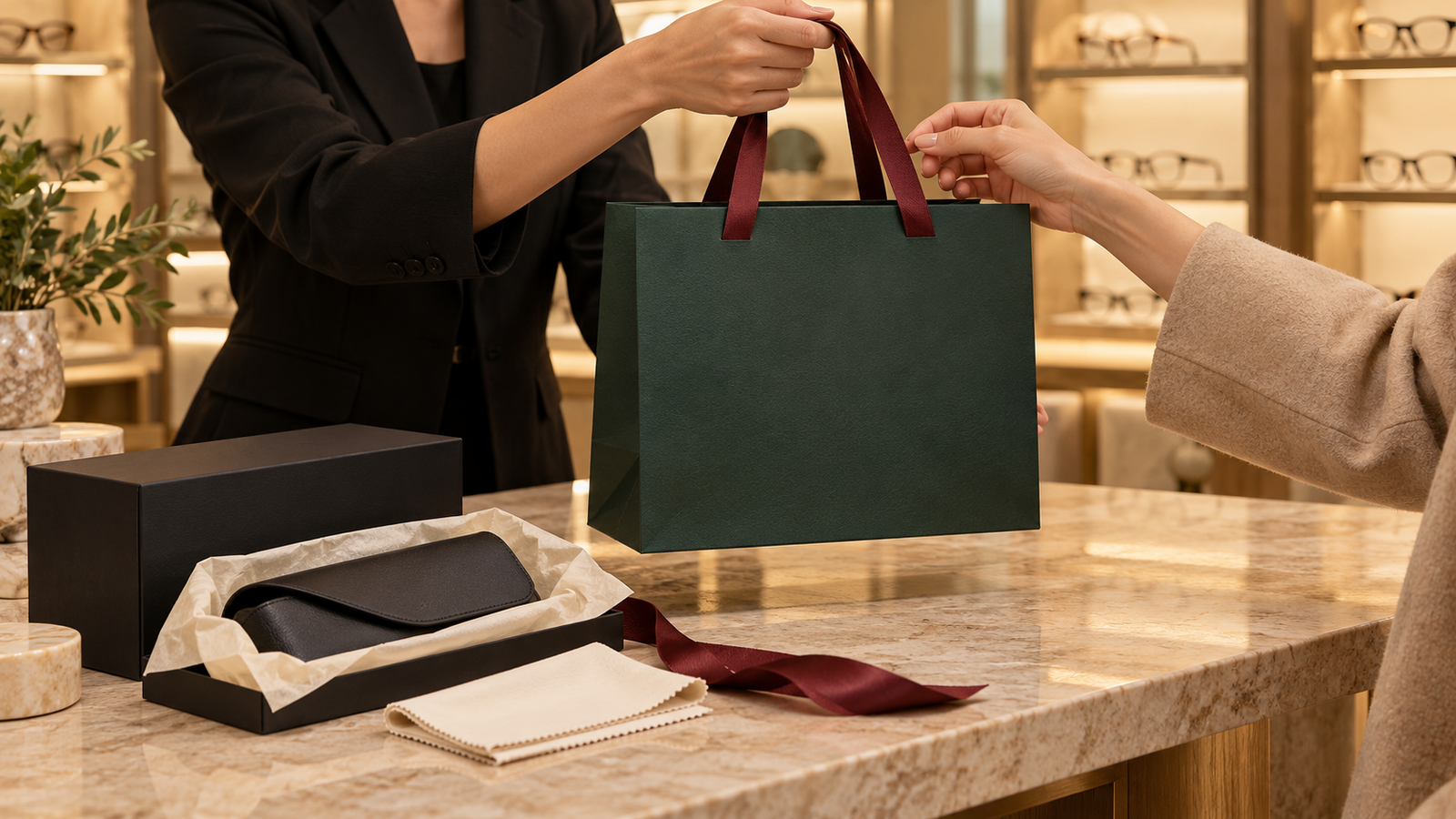
The ideal handoff is simple: staff can load the purchase without forcing it, tissue stays neat, the bag stands cleanly on the counter, handles sit naturally in the hand and the customer can carry the set without the contents tipping. That practical ease is part of luxury. It depends on measured product fit and controlled construction more than decoration alone.
Frequently asked questions
Should the bag fit the eyeglass case or the retail box?
Fit the largest complete pack the customer will receive. If the hard case sits inside a presentation box, the box controls the bag dimensions. Include tissue, ribbon, documents and accessories that are packed with it.
Can one paper bag size cover every eyewear purchase?
Sometimes one compact size covers most single-case purchases, but a larger gift set or multiple-case order may need a second size. Test real combinations before consolidating; one oversized universal bag can reduce presentation quality and use more material and storage space.
Are ribbon handles better than rope handles for eyewear bags?
Neither is universally better. Ribbon can coordinate closely with a gift box and creates a flat visual line; cotton rope offers a rounded grip and familiar premium-shopping feel. Comfort, attachment, reinforcement, bag proportion and brand direction should be evaluated together.
What is the best paper weight for an eyewear shopping bag?
There is no universal best GSM. Bag size, paper grade, stiffness, grain direction, reinforcement, handles, finish and load all affect performance. Compare fully converted samples with the intended contents instead of approving by grammage alone.
Build an eyewear bag around the complete retail pack
Share your eyewear case or presentation-box dimensions, packed weight, artwork, quantity and delivery market. Bespoke Packaging can develop custom luxury paper bags and coordinate them with rigid boxes, tissue paper and ribbon.