
MULTI-STORE RETAIL PACKAGING
Custom Department Store Paper Bags: A Multi-Store Buying Guide
How to build a coherent luxury paper bag programme across departments, store formats, seasonal versions, replenishment and customer handoff.
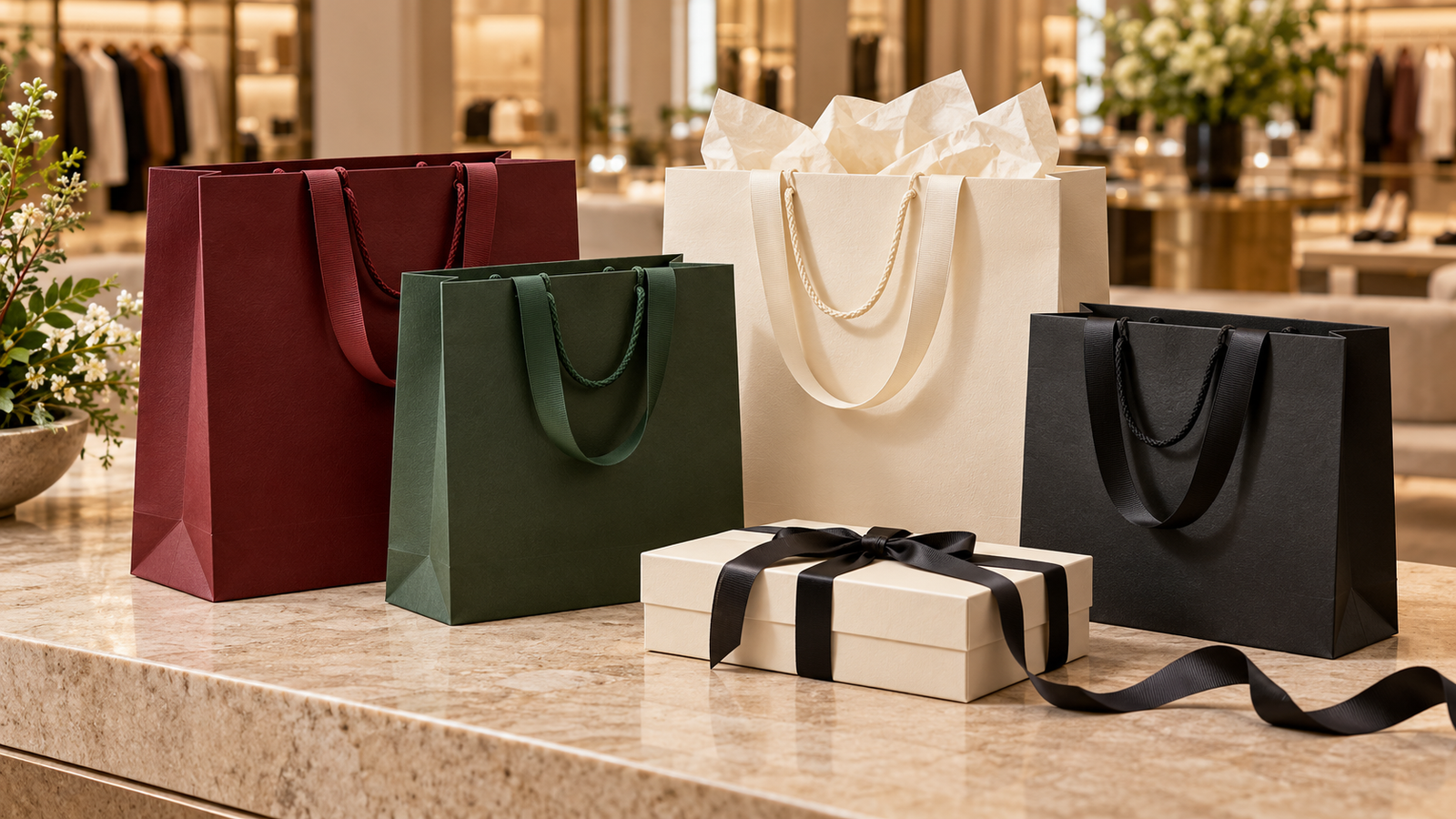
Custom department store paper bags are a planned family of premium retail carriers designed to serve different product departments, store formats and seasonal demands under one recognisable brand system. The strongest programme is not the one with the most bag sizes or finishes. It is the one that fits real purchases, carries them safely, stays easy for store teams to replenish and presents the brand consistently at every handoff.
What is a department store paper bag programme?
It is a controlled system of bag sizes, constructions, artwork versions and stock rules for a multi-category or multi-location retailer. The programme connects the customer-facing luxury paper bag with the products, boxes, tissue, ribbon, store operations and distribution plan behind it.
What should the buying team decide first?
- Which merchandise and finished presentation packs each bag must hold
- Which sizes are core, specialist or seasonal
- Which visual elements stay constant across stores
- How quantities will be allocated, replenished and counted
- What samples, tests and production evidence release the order
Why is this different from buying bags for one boutique?
A single boutique can often organise bags around a narrow merchandise range and one counter workflow. A department store may need to support jewellery, beauty, accessories, apparel, homeware and gifting across flagship, standard and smaller-format locations. Product sizes, packed weights, presentation boxes, sales peaks and storage space can vary substantially.
The earlier custom boutique paper bags guide focuses on a compact fashion-retail assortment. A department store brief adds assortment governance: which departments share a core bag, which purchases genuinely require a specialist format, how artwork remains consistent across versions, and how stock reaches each store without creating excess or shortages.
A useful governing principle
Standardise what customers should recognise and store teams must control. Create a special version only when product fit, carrying performance, presentation or an approved campaign makes it necessary.
How do you build the right bag size family?
Start with packed products rather than a supplier’s standard-size list. Collect representative purchases from each department, including the closed gift box, insert, tissue, ribbon, receipt folder and any secondary item that normally crosses the counter. Record the finished external dimensions, carry orientation and packed weight.
The current GS1 Package and Product Measurement Standard, version 3.3.0, provides a consistent framework for communicating dimensions and weight across retail and non-retail packaging levels. Its discipline is useful even when a bag itself is not managed as a trade item: use one dimension order, identify the packed state and remeasure when the pack changes.
- Map real pack-outs. Photograph and measure representative purchases by department and season.
- Group by usable fit. Combine products only when they load, carry and present well in the same bag.
- Choose the carry orientation. Keep rigid boxes and fragile presentation packs stable rather than merely fitting through the opening.
- Approve practical clearance. There is no universal allowance; tissue bulk, box texture, handle placement and packing speed all matter.
- Challenge every extra size. A new format should solve a recurring fit or handling problem, not a minor visual preference.

Should every department use the same bag design?
Usually the programme should share a strong core identity while allowing controlled exceptions. A recognisable colour, logo position, handle direction and material character can unite the family. Specialist departments can then change size, construction or a restrained secondary detail when the purchase genuinely demands it.
| Programme element | Good reason to standardise | Good reason to vary |
|---|---|---|
| Brand mark and hierarchy | Creates immediate recognition across stores and departments | Approved concession, co-brand or temporary campaign responsibility |
| Bag colour family | Simplifies recognition, purchasing and stock substitution | Permanent department code or a controlled seasonal expression |
| Size and proportions | Consolidates repeat pack-outs and improves buying leverage | A recurring product or box cannot load, carry or present safely |
| Handles and reinforcement | Creates consistent feel and repeatable quality checks | Packed weight, bag geometry or counter workflow requires another construction |
| Finish | Keeps samples, approvals and quality references manageable | A high-value category needs a justified tactile or decorative difference |
Avoid making every department a separate packaging brand. Too many paper, handle, foil and artwork combinations increase sampling, production setup, allocation and stock risk. A simple architecture also makes coordinated printed tissue paper and packaging ribbon easier to manage.
Which construction details must be approved?
Department-store bags encounter mixed loads. A compact jewellery box may create a concentrated base load, while folded apparel needs more volume and a wide opening. Paper grammage alone cannot establish finished-bag performance. The paper, grain direction, turned top, reinforcement patches, handle attachment, side seam, gussets, base closure and base board work together as one load path.
Customer-facing checks
- comfortable handle drop and grip;
- clean print, foil and fold appearance;
- stable proportions when loaded;
- easy loading and product removal;
- coordinated box, tissue and ribbon reveal.
Production and operations checks
- finished dimensions and opening;
- handle position and attachment;
- reinforcement and base formation;
- surface rub and fold durability;
- flat packing, carton count and store storage.
Use the luxury paper bag construction guide to define the complete load path, then test fully converted samples with representative purchases from the heaviest and most awkward approved pack-outs.
How should samples be approved across departments?
Separate appearance decisions from structural proof. Paper and ribbon swatches can narrow colour and texture. Artwork proofs can confirm content and placement. Finish samples can show a decorative process on the chosen surface. Only a converted bag can demonstrate finished proportions, loading clearance, handle comfort, stability and the interaction of print, folds and construction.
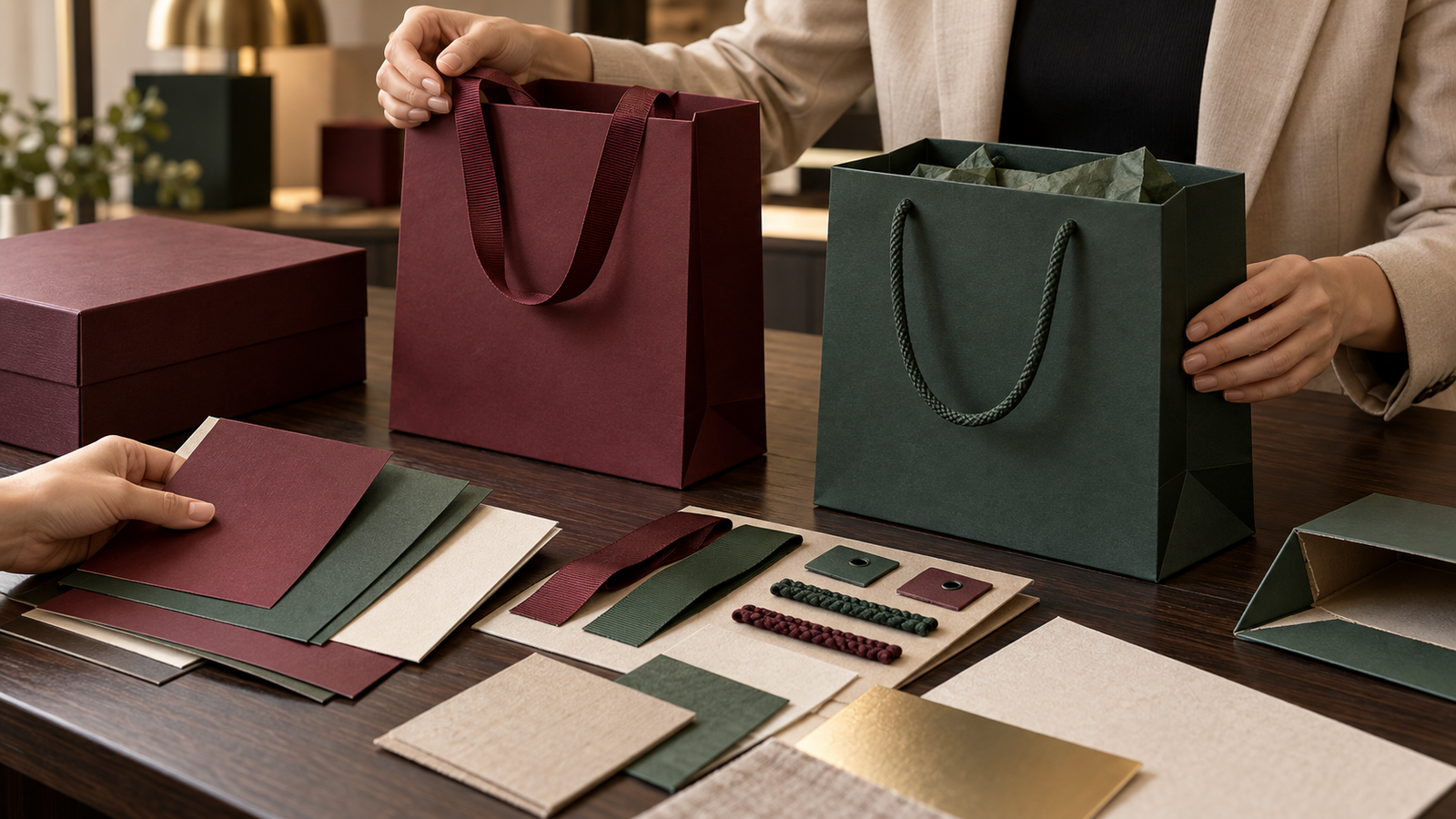
- Nominate one controlled master sample or signed approval record for each bag version.
- Run pack-and-carry trials with actual department products, not generic weights alone.
- Check the sample under store lighting and beside approved boxes, tissue and ribbon.
- Record acceptable tolerances, critical defects and the method used to inspect bulk production.
- Repeat approval when a material, size, handle, finish or production route changes materially.
The custom paper bag sample guide explains what each proof type can establish. For incoming orders, adapt the luxury paper bag quality-control checklist to the approved programme and actual defect risks.
How do you plan quantities and store replenishment?
Forecast by bag version and location, not only by total annual shopping transactions. Use recent department usage, store format, campaign dates, expected product mix, current usable stock, storage limits and replenishment frequency. Keep the assumptions visible so buyers can revise them when a store opens, a category changes or a campaign moves.
- Define the issue rule. Tell store teams which bag fits which approved pack-out and when substitution is allowed.
- Separate core from seasonal stock. Protect evergreen supply from campaign leftovers and obsolete artwork.
- Set a count unit. Align supplier cartons, warehouse records and store counts so one quantity means the same thing everywhere.
- Allocate by store need. Flag locations with small stockrooms, unusual category mixes or longer replenishment routes.
- Review actual usage. Compare issued, sold-through and remaining stock before repeating the order.
Do not hide uncertainty inside one large total
Ask the quotation to show quantity by size and artwork version, packing quantity per carton, production assumptions and delivery split. This exposes the real setup and inventory choices before the order is placed.
How should bags be packed and distributed to stores?
Protect the empty bags from crushing, scuffing, handle marking and moisture between production and the retail counter. Define how handles are laid, whether surfaces need separators, how inner bundles are counted, how cartons are labelled for stores and how long-term stock is stored. A luxury shopping bag is customer-facing packaging; it is not a substitute for the export carton or store-replenishment transport pack.
Testing should reflect the route and the decision required. ISTA’s current procedure overview distinguishes screening, partial simulation, general simulation and route-specific approaches. Map the actual movement from factory to distribution centre, mixed load, store receiving and stockroom before choosing a test. The paper bag shipping guide covers handle protection, export cartons and receiving checks in more detail.
What evidence supports material and environmental claims?
Treat certified sourcing, recycled content, recyclability and reuse as different claims. FSC chain of custody verifies certified forest-based material through the supply chain when its requirements are met; it does not by itself prove every claim about the converted bag. Ask for the supplier’s current certification scope, order-level invoice claim and approval for any on-product label.
ISO 18602:2013, confirmed current in 2024, addresses optimisation of packaging weight or volume while maintaining required functions. The February 2026 4evergreen Circularity by Design Guideline, version 4, evaluates paper-based packaging across different recycling pathways and considers the final construction. Use those frameworks to ask better questions, then substantiate the exact paper, coating, ink, adhesive, handle and reinforcement combination being ordered.
For bags placed on the EU market, the Packaging and Packaging Waste Regulation has applied on a phased basis since 12 August 2026. Confirm the role of each economic operator, destination markets, labelling and evidence duties for the final programme rather than assuming that one material certificate covers every store and use case.
What belongs in a quote-ready department store brief?
Merchandise and programme
- departments, store formats and destination markets;
- representative pack-outs, dimensions and weights;
- core, specialist and seasonal bag versions;
- quantity by size, artwork and delivery location;
- launch, replenishment and required-arrival dates.
Bag, approval and delivery
- finished size, paper, handles, reinforcement and base;
- artwork, colour, print and finish references;
- coordinated boxes, tissue and ribbon;
- sample, test, tolerance and inspection requirements;
- carton counts, allocation, transport and evidence needs.
Frequently asked questions
How many paper bag sizes does a department store need?
There is no universal number. Build the smallest family that fits recurring packed purchases, supports safe carrying and works at the counter. Confirm the grouping with physical pack-out trials rather than choosing sizes from a catalogue alone.
Can different departments share one luxury paper bag?
Yes, when the same construction fits and carries their approved pack-outs without awkward loading, damage or excessive empty space. Sharing a core bag can simplify stock and strengthen brand recognition, but it should be proven with real products.
Should seasonal artwork be printed on the main bag?
Only when the campaign value justifies a separate quantity, approval and leftover-stock plan. Tissue, ribbon, tags or cards can sometimes create a seasonal layer while preserving an evergreen core bag.
How should stores check bags when they arrive?
Check carton condition, counts, bag dimensions, colour, print, finish, folds, glue, handles, reinforcement, base formation and cleanliness against the controlled approval reference. Quarantine damaged or mixed versions and record evidence before issue to counters.
Build One Retail Bag System for Every Store Handoff
Share your department pack-outs, store formats, size requirements, artwork direction, quantities and delivery plan. Bespoke Packaging can develop luxury paper bags, rigid gift boxes, tissue paper and ribbon as one controlled multi-store programme.