
PAPER BAG SHIPPING GUIDE
How to Pack and Ship Luxury Paper Bags Without Damage
Protect handles, surfaces and shape from the packing bench to the retail stockroom with a route-specific carton, pallet and receiving plan.
To ship luxury paper bags without damage, keep them in their approved flat or nested form, control handles and surface contact, pack them in correctly sized export cartons, build a stable unit load and verify the complete pack against the actual distribution route. The right solution depends on bag construction, finish, climate, journey, handling and storage time—not on one universal carton or moisture rule.
Premium shopping bags are finished products before they enter the shipping carton. Their turned tops, base boards, gusset creases, rope or ribbon handles, printed surfaces and decorative finishes can all be marked or distorted in transit. A bag can pass production inspection and still arrive with bowed panels, rubbed foil, crushed corners or handle impressions if the transport pack was treated as an afterthought.
This guide is for brand, packaging and operations teams arranging bulk delivery of luxury paper shopping bags. It explains how to connect the bag specification, export carton, pallet or container, warehouse conditions and receiving check. For bag construction itself, use the separate luxury paper bag construction guide; for inspection criteria before release, see the quality-control checklist.

What damage should the shipping plan prevent?
Start with the unacceptable condition at arrival. “Pack securely” is not measurable, while a list of likely failure modes gives the supplier, freight partner and receiving team something they can prevent and inspect.
- Shape loss: bowed front panels, flattened gussets, distorted bases or top edges that no longer open squarely.
- Surface damage: abrasion, scuffing, fingerprints, pressure glossing, coating marks or transfer between adjacent bags.
- Finish damage: scratched foil, flattened embossing, cracked decoration near folds or impressions caused by hardware and handles.
- Handle damage: crushed rope, creased ribbon, colour transfer, loose attachments or handle ends marking the next bag.
- Moisture damage: softened cartons, cockled paper, staining, blocking between coated surfaces, odour or mould.
- Count and mix errors: wrong quantities, colours or sizes inside a carton, or labels that cannot be reconciled with the packing list.
Rank these risks for the actual design. A dark uncoated bag may show rub differently from a laminated light-colour bag. A deep emboss may need more surface separation than a plain print. A satin ribbon handle requires different control from a soft cotton rope. The approved production sample should therefore be reviewed alongside a proposed packed-carton sample, not only as a single display piece.
Should luxury paper bags ship flat or opened?
Most conventional luxury paper bags are delivered flat or carefully nested because that uses carton volume efficiently and supports the bag along its designed creases. However, “flat” does not mean forcing the bag below its natural converted thickness. Thick turn-tops, base boards, knots and rope handles create local high points. Excess compression at those points can emboss one bag into the next.
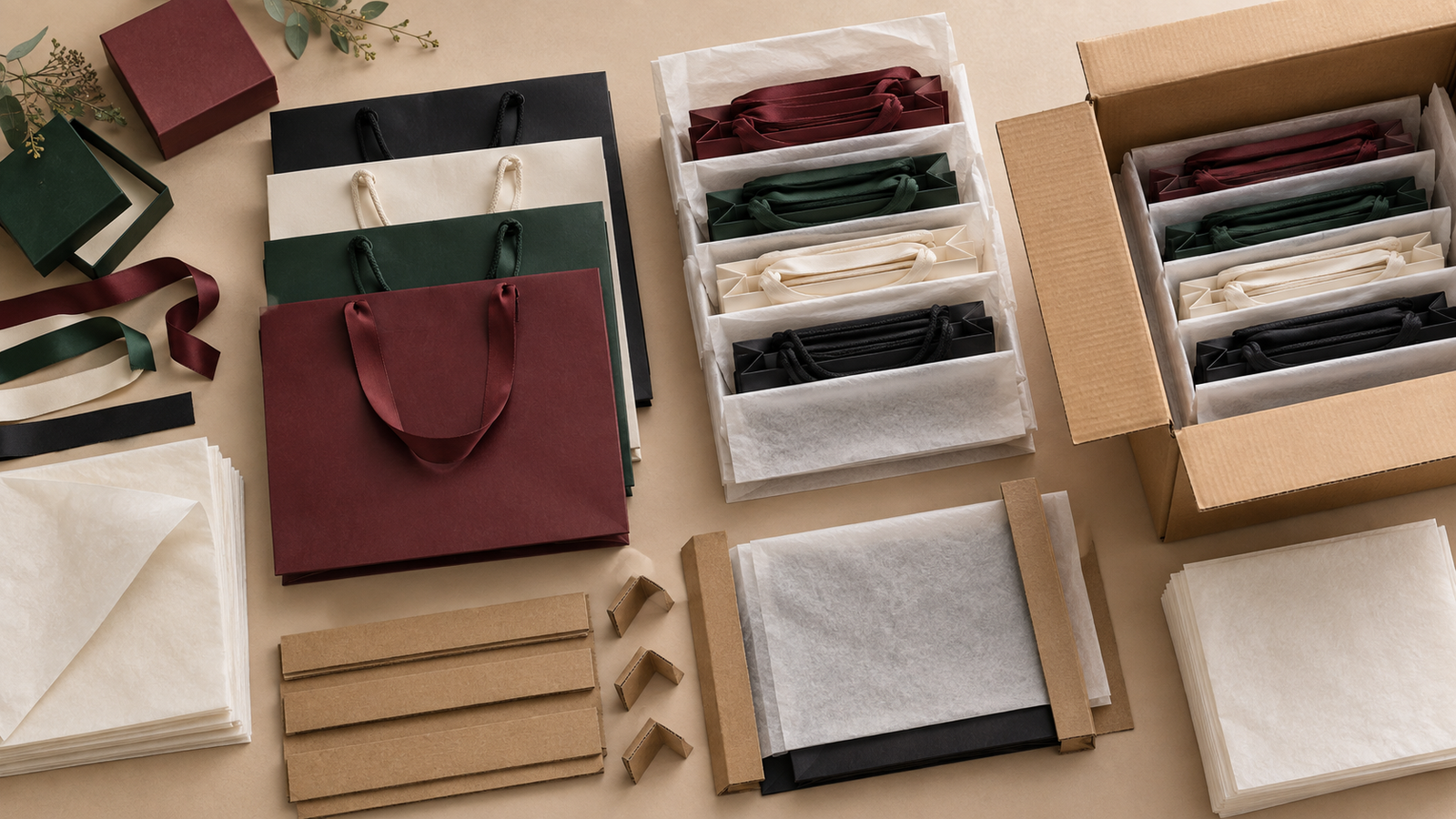
Ask the supplier to demonstrate the approved orientation and bundle count. The first and last bags in a stack may need clean separator sheets or boards. Handles can be laid inside the bag cavity, positioned in a consistent channel or protected in another proven arrangement so they do not press randomly across printed faces. Ribbon handles should not be sharply folded merely to reduce carton height.
Some structures do not collapse in the same way. A reinforced or unusual-format bag may be partly opened, nested or supported with a former. Treat that as a designed packing method with its own sample and carton count. Do not copy the flat-packing pattern from another bag just because the external dimensions look similar.
How should bags be protected inside the carton?
The purpose of interior packing is to stop uncontrolled movement and concentrated pressure without adding unnecessary material. Begin with clean, dry bags and a carton sized around the approved stack. A loose carton allows bundles to slide and strike its walls; an overfilled carton can transfer closing pressure into bag edges and handles.
| Risk | Possible control | What to approve |
|---|---|---|
| Face-to-face rub or finish transfer | Clean separator sheets, tissue or another surface-compatible interleave at defined intervals | Material, placement, frequency and removal method |
| Handle impressions | Consistent handle orientation, protected handle channel or a divider proven on the actual bag | Handle position after normal carton handling |
| Edge or corner crushing | Correct carton fit, edge boards or internal pads where the trial shows a need | Protection without pressure marks on the bag |
| Movement in a partly filled carton | Right-size the carton or use a clean, stable void-control method | No migration after the planned vibration and handling exposure |
| Dust or incidental moisture exposure | Closed inner wrap or liner selected for the route and recovery system | Material declaration, sealing method, disposal route and effect on the bags |
Do not assume that more wrapping always means better protection. An incompatible sheet can abrade a soft-touch surface; trapped moisture can be worse than an open pack; and excessive loose fill can make counting and retail unpacking harder. If plastic film or a moisture-control material is proposed, document why it is needed and keep its material and end-of-life claim separate from the recyclability claim for the paper bag itself. The recyclable luxury paper bags guide explains why the complete construction and local recovery route matter.
How do you specify the export carton?
An export carton specification should identify more than length, width and height. Agree the board construction or performance requirement, closure method, maximum gross mass, bag count, internal arrangement, handling orientation and marking. If carton performance is important, ask the converter or supplier which test data supports the proposed pack under expected storage and transport conditions.
ISO 4180:2019, confirmed current in 2025, establishes general rules for building performance-test schedules for complete, filled transport packages. It is useful because it starts with the distribution system rather than prescribing one identical test for every journey. The schedule may need to represent handling impacts, vibration, compression and atmospheric exposure in the order that matters for the route.
For stacking specifically, ISO 2234:2000, confirmed current in 2022, describes static-load stacking tests for a complete filled package or unit load. It can be used to investigate deformation, creep, collapse or failure. A buyer should not turn the standard title into an arbitrary pass load; the applied load, duration, stack geometry and conditioning need to reflect the intended warehouse and transport situation.
What should carton labels communicate?
Markings should help people handle and reconcile the shipment. Use agreed product code, colour, size, quantity, carton number and purchase-order reference, while avoiding unnecessary sensitive artwork or brand exposure on the outside. If orientation, moisture protection, stacking limits or careful handling are genuinely required, specify the relevant symbol and its placement.
ISO 780:2015, reviewed and confirmed in 2026, defines graphical symbols for handling and storage instructions on distribution packaging. Symbols communicate instructions; they do not replace adequate protective packaging. Confirm which marks the carrier, warehouse and destination team recognise, and make sure any text and regulatory markings are appropriate for the markets and transport modes involved.
How should cartons be palletised or loaded?
Build a unit load that stays square, supported and stable. Match carton footprint to the pallet plan, avoid unsupported overhang, keep the top surface level where practical and use restraint that stabilises the load without crushing carton edges. Confirm whether the route includes loose cartons, pallets, mixed loads, cross-docking or container floor loading; each creates a different contact and handling pattern.
The International Safe Transit Association’s testing guidance groups common distribution hazards into shock, vibration, compression and atmospheric conditions. It also warns that a test can only evaluate the hazards actually represented in the protocol. That is why a successful drop check alone does not prove resistance to long warehouse stacking, and a compression result does not prove surface protection during vibration.
- Map the route. Record factory storage, domestic transfer, port or airport handling, main carriage, customs, destination warehouse and final store delivery.
- Define the load. State cartons per layer, layers per unit, pallet type, total height and gross mass.
- Control contact. Check pallet deck gaps, straps, edge protectors, stretch wrap or alternative restraint against carton deformation and recovery requirements.
- Protect from mixed freight. Prevent heavy or irregular cargo from bearing on paper-bag cartons.
- Approve loading evidence. Request photographs of carton condition, pallet pattern, restraint and container placement before dispatch.
How do humidity and condensation change the plan?
Paper, corrugated board and some supporting materials respond to surrounding moisture. The risk is not limited to direct rain. Temperature changes during storage and ocean or land transport can change relative humidity and create condensation inside a closed cargo unit. A packing plan should consider the moisture condition of the goods, cartons, pallets and dunnage as well as the climate transitions on the route.
The joint IMO/ILO/UNECE Code of Practice for Packing of Cargo Transport Units identifies condensation damage as a risk in closed transport units and points to moisture in cargo, porous packaging, timber and humid loading conditions as possible contributors. It is a non-mandatory global code of practice, not a bag-specific recipe. Its practical message is to assess foreseeable climatic exposure and control moisture before loading rather than relying on a last-minute sachet or liner with no calculation.
Where conditioning is part of package testing, ISO 2233:2000, confirmed current in 2022, specifies a method for conditioning complete filled transport packages and unit loads. Agree the relevant atmosphere and sequence with a qualified laboratory or packaging engineer. Do not publish a single warehouse humidity target as if it applied to every paper, adhesive, coating, climate and journey.
What must the buyer and supplier agree before dispatch?
Separate physical packing requirements from commercial delivery responsibilities. The purchase order should identify the approved bag, packed unit, carton count, packing list, inspection evidence and acceptance criteria. The sales contract should also name the agreed delivery term and place precisely.
ICC’s official Incoterms® 2020 guidance explains that the rules allocate key buyer and seller responsibilities, costs and risks for transport and delivery in B2B contracts. An Incoterms® rule does not, by itself, define the internal bag packing method or the acceptable arrival condition. Put those product and pack requirements in the specification and contract instead of assuming the three-letter trade term covers them.
What should happen when the shipment arrives?
Receiving is part of quality control. Before cartons disappear into storage, record the condition of the unit load, any wet or crushed areas, seal integrity and carton count. Isolate suspect cartons and photograph them before unpacking. Compare labels and quantities with the packing list, then open a planned sample across the load rather than taking every check from one convenient top carton.
- Check carton surfaces, corners, seams and evidence of moisture or compression.
- Confirm product code, colour, size, count and carton sequence.
- Allow a cold or hot closed shipment to acclimatise under a defined local procedure before exposing contents to a sudden environmental change.
- Inspect bag shape, surface, finish and handles against the approved master and arrival criteria.
- Record defect location by carton and pallet position so patterns can be traced.
- Retain labels, photographs and samples needed for a carrier or supplier claim.

How should luxury paper bags be stored after delivery?
Keep accepted cartons in a clean, dry, stable area away from direct water, floor contact, heat sources, strong light, dust and chemicals with transferable odours. Preserve the designed carton orientation and safe stack plan. Do not leave part-used cartons open in a busy stockroom where bags can collect dust, fade unevenly or be crushed by unrelated inventory.
Use a stock-rotation system that can trace production batch and receipt date. If a carton is opened, close and identify the remainder. Before a seasonal launch or important retail event, sample stored stock early enough to replace damaged units. Luxury bags may be reusable by the customer, but they should not be treated as indestructible warehouse equipment before first use.
What should a shipping-ready RFQ include?
A useful RFQ connects the bag order to the destination. Add these logistics details to the size, paper, print, finish, handle and quantity information in your custom packaging brief:
- approved bag size, structure, finish and handle type;
- quantity by SKU, required bundle and carton count;
- requested flat, nested or supported packing orientation;
- surface separators, handle control and any moisture-protection requirement;
- export-carton specification, maximum gross mass and external markings;
- pallet or loose-carton plan and any destination restrictions;
- origin, destination, transport modes, transfers and expected storage period;
- named delivery place and agreed Incoterms® 2020 rule;
- performance-test or shipment-trial requirements;
- pre-dispatch evidence, receiving inspection and claim procedure.
Also share the complete retail pack. If the bag carries a rigid gift box, ribbon and printed tissue, verify both the inbound bag shipment and the final customer packing workflow. The luxury packaging sets guide can help align those components before separate suppliers create incompatible dimensions or colours.
Frequently asked questions
Can luxury paper bags be shipped flat?
Usually, if the bag is designed to collapse along its converted creases. Approve the orientation, bundle count and handle position on the actual bag. Do not force thick turn-tops, base boards or handles into a stack so tight that they leave impressions.
Do paper bags always need a plastic liner for export?
No universal rule applies. The decision should follow the route, climate, carton design, bag surface and moisture risk. If a liner or wrap is needed, specify its material, closure, disposal route and compatibility with the bags rather than adding it automatically.
How many luxury paper bags fit in one carton?
The safe count depends on finished bag dimensions, converted thickness, handles, separators, carton performance and maximum gross mass. Ask for a packed-carton sample and final external dimensions; do not estimate the count from flat paper size alone. The dimensions also affect freight, as explained in the packaging size and shipping-cost guide.
Should the carton be drop-tested?
A route-specific performance plan may include impact, vibration, compression and atmospheric conditioning, not just a drop. Use the actual filled pack and select tests that represent known hazards. A qualified laboratory can help translate the distribution map into an appropriate schedule.
What evidence should be requested before shipment?
Request the approved packing specification, carton and pallet counts, packing list, relevant test results, pre-shipment inspection record and photographs of representative open cartons, closed cartons, labels and the finished unit load. Agree in advance which evidence is required for release.
Protect the presentation all the way to the store
A premium paper bag is not finished when the handle is fitted; it is finished when the retailer can open the carton and use the bag in the condition the brand approved. Build shipping and storage into the specification early, test the complete filled carton against the real route and make receiving evidence part of the feedback loop.
Plan a shipping-ready luxury paper bag order
Send your bag dimensions, construction, handles, finish, quantity, destination and transport plan. We can help align the paper bag, export carton and coordinated gift packaging for a comparable quotation.