
ROUND RIGID BOX PACKAGING
Custom Round Gift Boxes: A Buyer’s Packaging Guide
How to specify the diameter, lid, insert, wrap, sample and retail paper bag for a custom round gift box that works beyond the first impression.
Custom round gift boxes are circular presentation packs made to a product-specific diameter and height, usually with a rigid paperboard body, a wrapped surface and a separate lid or telescoping section. Their shape can create a memorable reveal for candles, cosmetics, flowers, confectionery and gift sets, but the buying brief must control more than appearance. Product fit, lid movement, insert stability, wrap seams, packing volume and the final luxury paper bag all need to be approved as one system.
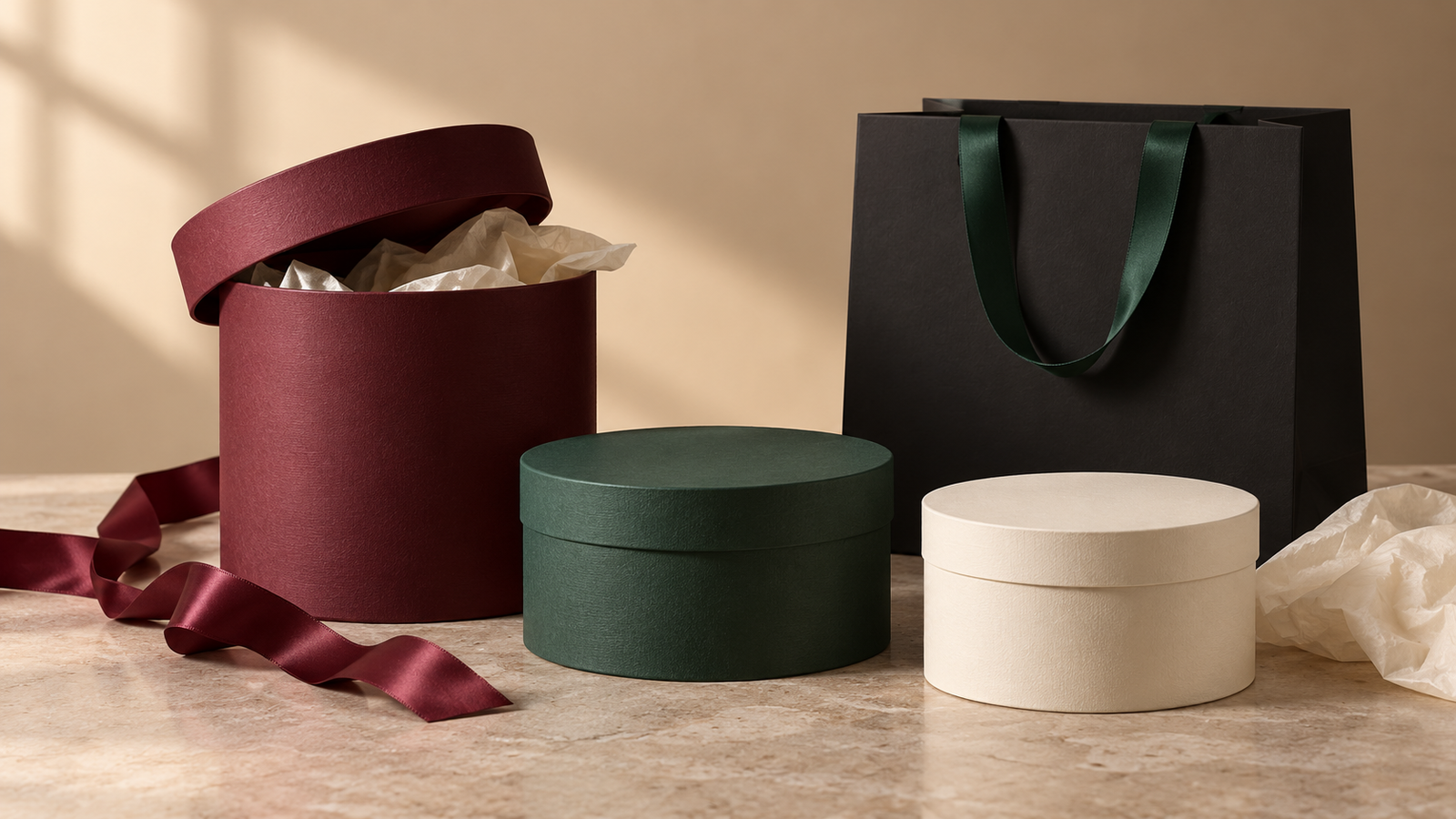
What is a round rigid gift box?
It is a circular set-up box or paper tube-style presentation pack that keeps its shape before filling. The body and lid may be built from formed or wound paperboard, then covered with printed or specialty paper. Unlike a folding carton, a conventional round rigid box is normally supplied assembled.
What should a buyer define first?
- the actual product and presentation components;
- the required internal diameter and usable height;
- the lid style and desired opening behaviour;
- the insert, removal method and packing sequence;
- the distribution and retail handoff route.
When does a round gift box make sense?
A round box is most convincing when the product, ritual or brand idea benefits from the circular form. A jar, candle vessel, rolled accessory, floral arrangement or curated gift set can feel naturally resolved inside it. The format can also create visual contrast in a range dominated by rectangular packaging.
Shape should not be chosen in isolation. Round boxes use storage and shipping volume differently from flat-packed cartons, and their curved walls change how artwork, seams and inserts are engineered. If the product is strongly rectangular, needs dense case packing or must arrive flat, another structure may be more efficient. The rigid box styles guide compares the broader family, while the collapsible rigid box guide focuses on flat-pack logistics.
| Decision | Round rigid box | Rectangular rigid box | Collapsible rigid box |
|---|---|---|---|
| Best starting point | A circular product, reveal or distinctive gift concept | Rectangular products, books, sets and efficient inserts | Premium presentation with reduced empty-box storage volume |
| Artwork planning | Curved wrap, circumference, seam and lid alignment | Panels, edges, corners and lid-to-base registration | Panels plus fold, hinge and closure behaviour |
| Insert planning | Concentric fit and control against rotation | Corner references and defined orientation | Insert fit after repeatable assembly |
| Logistics question | How assembled cylinders nest, separate and case-pack | How assembled boxes protect corners and surfaces | How flat units assemble and stay square |
How do you measure a custom round gift box?
Measure the complete product in its final packed state. Record the maximum diameter across any cap, label, ribbon, sleeve or irregular feature, then record the total height in the intended orientation. If several products form a set, build and measure the real arrangement rather than adding catalogue dimensions.
The official GS1 Package and Product Measurement Standard, version 3.3.0, provides a consistent methodology for communicating package dimensions and weight. Its discipline is useful here: define the measured state, use a repeatable orientation and remeasure when the product or presentation changes.
- Measure the product. Capture maximum diameter, height, packed weight and fragile or protruding features.
- Define the insert. Add the board, pulp, platform or cushioning needed to locate and protect the product.
- Set usable internal space. Allow for practical loading and removal without assuming one universal clearance.
- Confirm external size. Include wall construction, wrap, lid overlap and any raised base or shoulder.
- Test the complete pack-out. Check orientation, movement, removal and presentation with production-relevant samples.
Diameter is not the whole specification
A quote also needs usable internal height, external dimensions, lid depth, insert thickness, product weight and packing orientation. Two boxes with the same outside diameter can behave very differently when the lid and insert are changed.
Which round box structure should you choose?
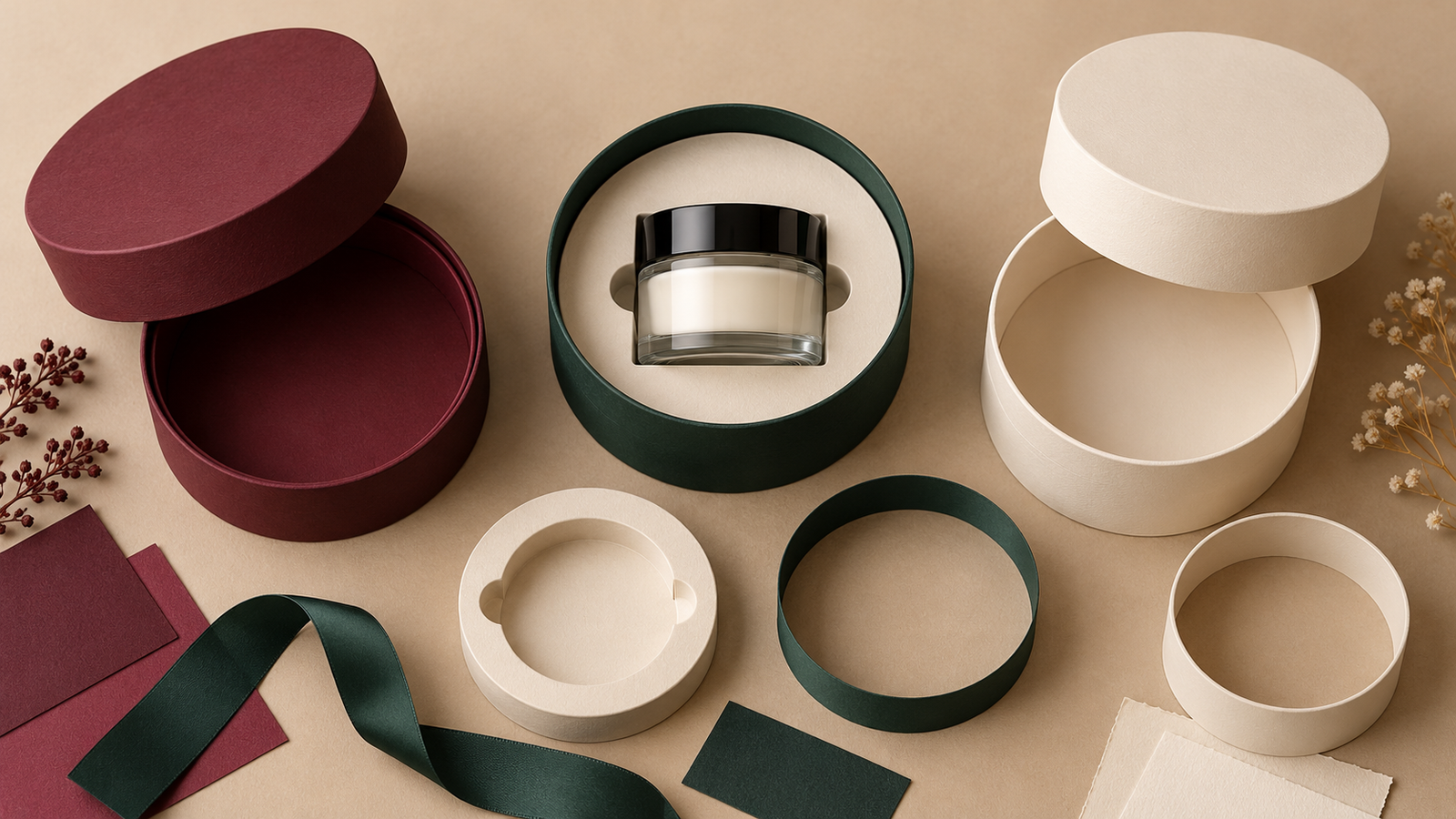
Lift-off lid and base
A separate lid slides over the base. Lid depth, wall tolerance and surface friction influence whether the opening feels controlled or awkward. Specify the target experience, then approve it on a converted sample.
Shoulder-and-neck construction
An internal neck rises above the base and seats the lid, creating a visible reveal line. Control neck height, exposure, lid seating and colour alignment. The same principles discussed in the shoulder-neck box guide apply to the round format.
Telescoping round box
A deeper lid covers more of the base and can create a long, steady opening movement. The overlap changes material use, artwork visibility and case-pack dimensions, so show the intended lid position in the drawing and sample.
Tall tube-style pack
A tall cylindrical body suits bottles, rolled products and vertical sets when the insert and closures control movement. Clarify whether the ends are paperboard and how every component should be separated or recovered at end of life.
How should the insert hold the product?
The insert must locate the product, protect its vulnerable areas, support the desired reveal and allow removal without damage. A circular cavity can control side movement, but it may not prevent rotation, lifting or contact with the lid. Test the exact product, including any cap, accessory, cable, booklet or ribbon.
Folded paperboard, corrugated board, moulded fibre, covered platforms and foam each solve different risks. The custom box inserts guide compares these routes in detail. For a round box, ask how the insert is retained inside the curved wall, where the finger access sits, how the product is oriented and whether the insert can be removed cleanly for material separation.
How do artwork and finishes change on a curved box?
Curved walls turn a flat wrap into a continuous surface. The artwork file should identify the visible circumference, wrap overlap, vertical seam, top and bottom turn-ins, lid edge and any alignment between lid and base. Keep important marks away from an uncontrolled overlap and approve how a pattern meets at the seam.
Foil, embossing, debossing, screen printing and specialty wraps can all be considered, but suitability depends on the chosen paper, process and artwork. Decoration is often applied to the wrap before mounting, so its final position and distortion must be assessed on the converted box—not only on a flat proof. Use restraint when several finishes compete around a small circumference.
- mark the seam and overlap on the approved drawing;
- define lid-to-base artwork registration where it matters;
- approve colour on the actual wrap paper and coating;
- inspect turn-ins, rim coverage, bubbles, wrinkles and glue marks;
- keep a signed physical sample as the visual reference.
What should a production-relevant sample prove?
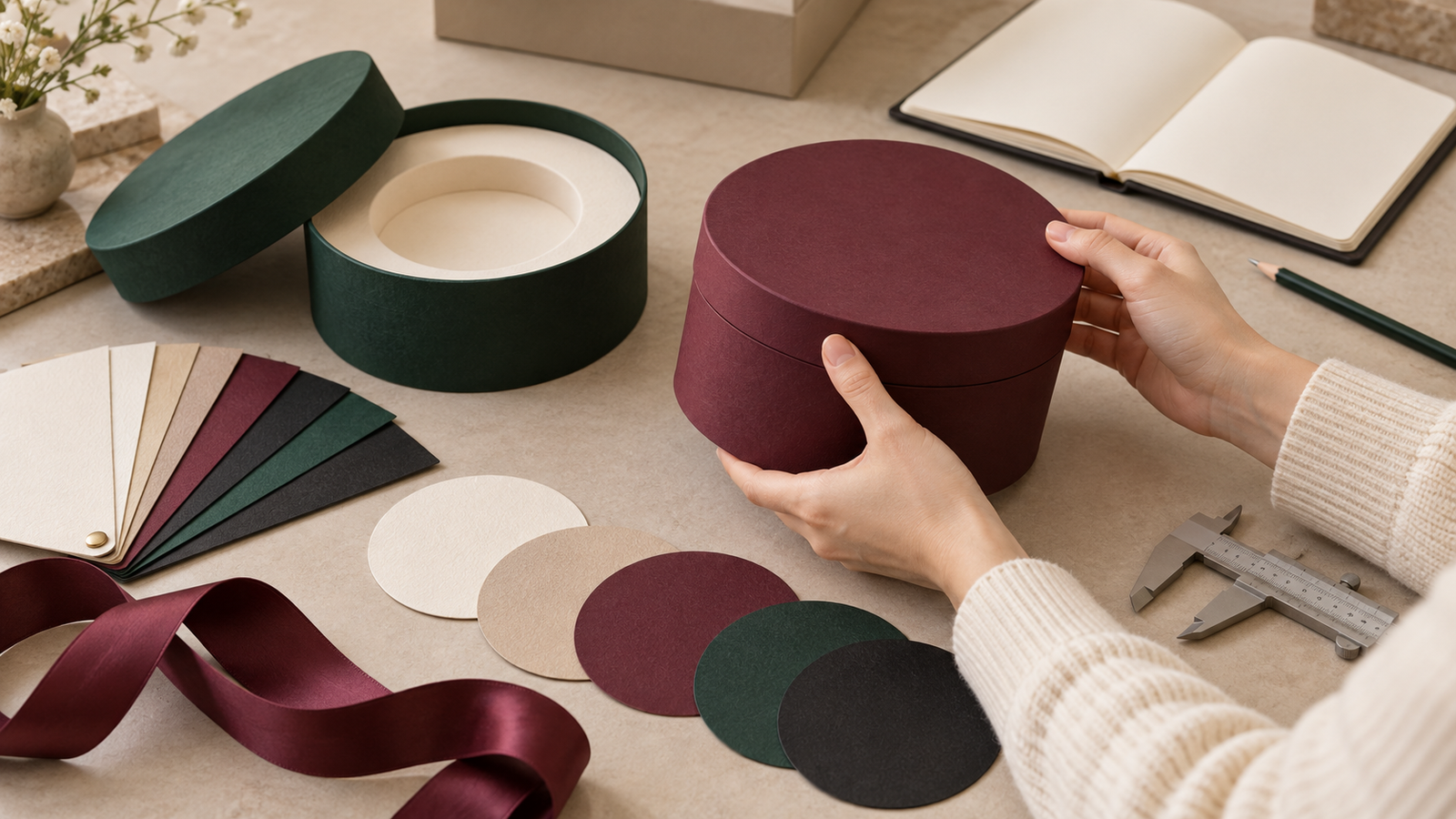
A digital rendering can confirm direction, but it cannot prove lid movement, roundness, insert fit or wrapped-surface quality. Approve a fully converted sample made with the intended construction and representative materials before bulk production. If final paper or decoration is unavailable, document every substitute and keep the affected checks open.
Structure and use
- internal and external dimensions;
- concentric body, lid and base;
- lid seating and removal force;
- insert retention and product removal;
- stability when filled and stacked.
Appearance and workmanship
- colour, print and finish against references;
- wrap seam position and pattern meeting;
- clean rims, turn-ins and covered edges;
- surface free from visible glue, bubbles and scuffs;
- coordination with tissue, ribbon and the retail bag.
How should round boxes be packed and tested for delivery?
Conventional round rigid boxes normally travel assembled, so empty-pack volume can be commercially important. Ask how lids and bases are paired, whether finished surfaces touch, how units are separated, how movement is limited inside the export carton and how cartons will be stacked. Do not use the decorative box as its own parcel shipper unless that role has been specifically designed and validated.
Testing should match the actual distribution route and the decision it needs to support. ISTA’s procedure overview distinguishes integrity screening, partial simulation, general simulation and other route-related approaches. Test the product, insert, gift box and transport pack together; a pass for an empty presentation box does not demonstrate protection for the filled system.
How do you coordinate a round box with a luxury paper bag?
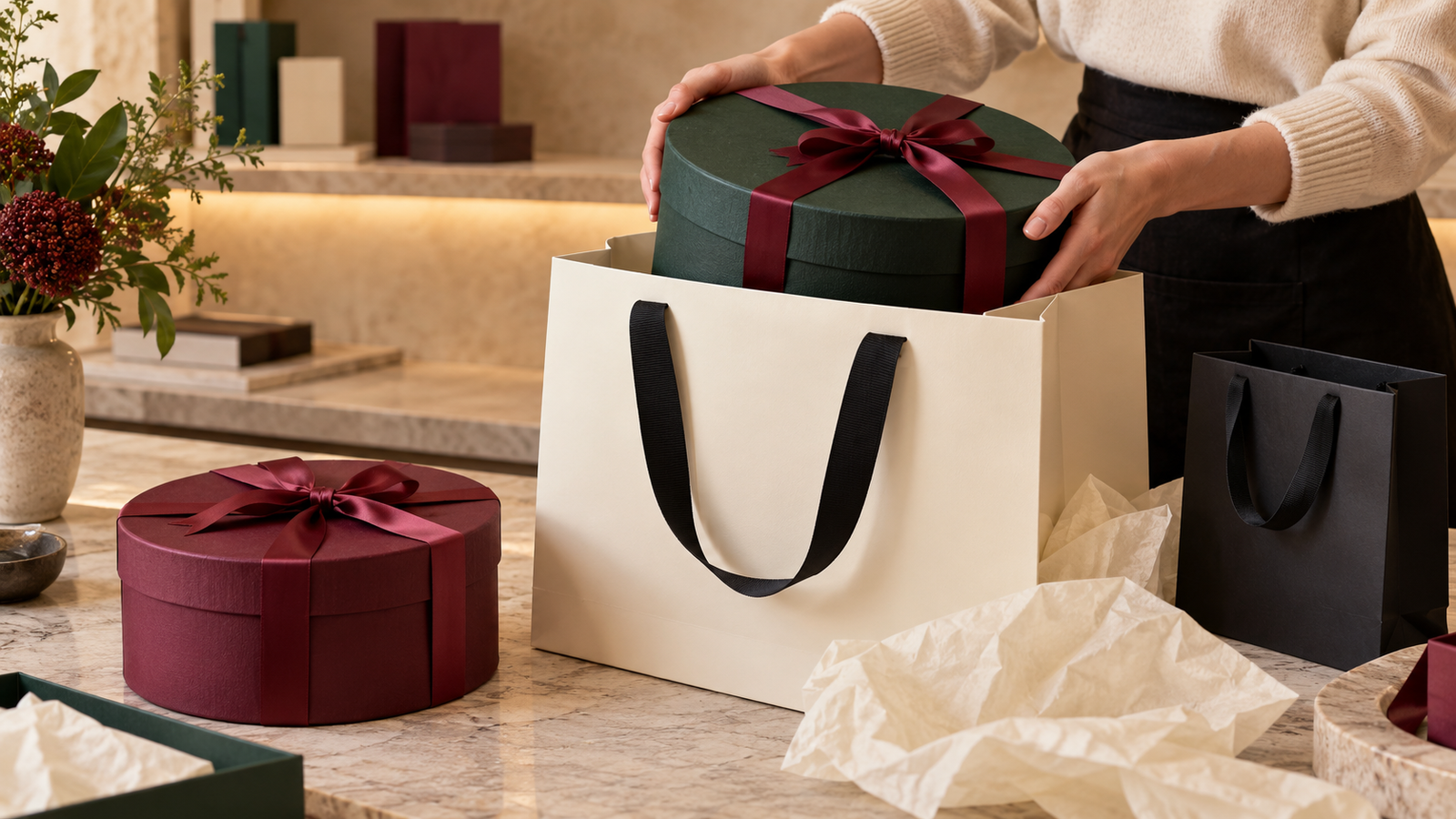
Size the shopping bag around the finished external box, not the product diameter. The bag opening, internal width, gusset depth and base must accept the round box without forcing, tilting or scraping the wrap. Add the tissue, ribbon, card and any secondary purchase before approving the pack-out. There is no universal clearance: the correct allowance depends on surface friction, bag construction, packing speed and the way the customer removes the box.
A wide round box can create a concentrated base load and may require a stable bag proportion, suitable base support and handles approved for the complete packed weight. Run a real counter trial: load the box, arrange the printed tissue paper, close or tie the packaging ribbon, lift the bag and remove the box again. The result should feel intentional at every step.
Approve the handoff, not just the two components
A beautiful round box and a beautiful paper bag can still fail as a pair. Use the production-relevant box to approve bag fit, base stability, handle comfort, tissue volume and removal at the retail counter.
What evidence supports responsible material claims?
Separate fibre sourcing, recycled content, recyclability, reuse and packaging optimisation as different claims. FSC chain of custody controls certified forest-based material through the supply chain. For an FSC on-product label, the final supplier must be authorised and the label use must follow the relevant approval process; a paper swatch alone does not authorise the finished-box claim.
ISO 18602:2013, confirmed current in 2024, addresses packaging-system optimisation while maintaining required functions. The February 2026 4evergreen Circularity by Design Guideline, version 4, considers the complete paper-based construction across different recycling pathways. Review the body board, wrap, inks, coatings, adhesives, insert and any non-paper component together, then substantiate the claim for the markets where the box will be sold.
For packaging placed on the EU market, Regulation (EU) 2025/40 has applied since 12 August 2026, with requirements and transition dates that vary by provision. Confirm the role of each economic operator, destination-market duties, technical documentation and future labelling milestones for the final round-box system.
What belongs in a quote-ready round box brief?
Product and structure
- product samples, maximum diameter, height and weight;
- packed orientation and removal method;
- internal and external box dimensions;
- lid style, overlap, shoulder and desired opening behaviour;
- insert material, fit and accessory positions.
Artwork, approval and delivery
- wrap paper, colour references, seam and finish layers;
- quantity by size, artwork and destination;
- sample stages, tolerances and bulk inspection plan;
- export packing, test route and required-arrival date;
- matching paper bag, tissue, ribbon and evidence needs.
Frequently asked questions
Are round gift boxes always rigid boxes?
No. Round packaging can also be made as folding cartons, spiral-wound tubes and other constructions. Confirm the board, wall build, ends, lid and supplied state instead of relying on the word “round.”
What products suit custom round gift boxes?
Common candidates include candles, cosmetic jars, flowers, confectionery, rolled accessories and curated gifts. Suitability depends on product geometry, protection, packing, display and distribution requirements—not the product category alone.
How tight should the lid fit?
There is no universal target. The lid should seat consistently and support the intended opening experience without sticking, rocking or releasing unexpectedly. Define the expectation and approve it on representative converted samples under relevant conditions.
Can a round rigid box be recyclable?
Potential recyclability depends on the complete construction and the available collection, sorting and paper-mill route. Review the board, wrap, coatings, decoration, adhesives, insert and closures together, and avoid claiming recyclability from the body paper alone.
Develop a Round Gift Box That Fits the Complete Handoff
Share your product dimensions, desired box style, insert needs, artwork, quantity and delivery market. Bespoke Packaging can coordinate custom round rigid gift boxes with luxury paper bags, tissue paper and ribbon as one production-ready packaging set.