
WATCH RETAIL PACKAGING
Custom Watch Paper Bags: A Buyer’s Guide for Retail
How to size, engineer and approve a premium paper carrier around the real watch presentation box, boutique workflow and complete customer handoff.
Custom watch paper bags are premium retail carriers designed around a watch presentation box, not around the watch alone. A reliable specification starts with the complete pack-out: the closed watch box, manuals or warranty materials, protective tissue, ribbon and any secondary gift components. The bag then needs enough usable space for a smooth counter pack, a stable base for the concentrated load and handles that make the finished purchase comfortable to carry.
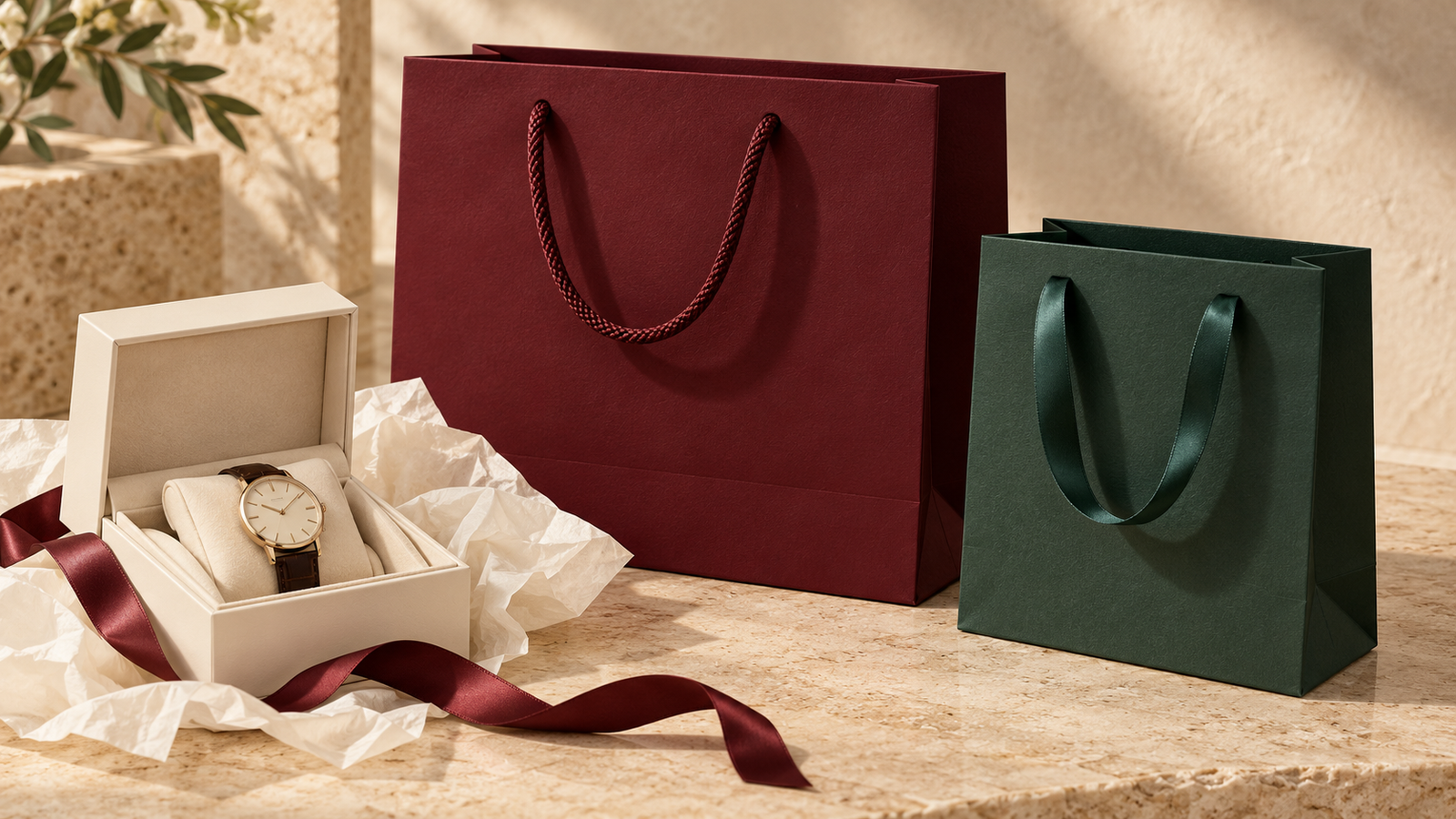
The short answer: what should a watch paper bag do?
- Fit the finished watch box in its intended carrying orientation, with practical loading and removal clearance.
- Keep a compact, sometimes relatively concentrated load stable through the base, gussets, turned top and handle attachments.
- Match the level of ceremony, discretion and brand detail expected at a watch boutique or authorised retailer.
- Coordinate with the rigid box, insert, tissue and ribbon without pretending the shopping bag replaces protective transit packaging.
Why does the specification begin with the watch presentation set?
A watch may be small, but its retail presentation can be substantial. One collection may use a compact hinged box; another may use a deep rigid case with a cushion, booklets and an outer sleeve. A gift order may add a second product, a travel pouch or a presentation card. The paper bag has to fit the configuration that actually crosses the counter.
Send the bag supplier physical production samples where possible, or at minimum provide the closed external dimensions, packed weight, photographs and intended orientation of every approved box. Do not size from an empty insert, an early CAD drawing or the watch diameter. If the box or sleeve changes, repeat the fit check before releasing the bag.
Single-watch sale
Start with the closed presentation box plus every document, tissue layer and closure used at handoff. A compact bag can feel more deliberate than an oversized carrier, provided loading remains easy.
Gift or multi-item sale
Decide whether items should sit side by side, stack in a stable arrangement or move into a larger coordinated bag. The packed trial—not a nominal capacity—should decide the format.
Service or collection
A collection bag may need a different level of branding, closure or document handling from a celebratory purchase bag. Treat it as a separate use case when the workflow is materially different.
How should a buyer measure a watch box for a paper bag?
Use one agreed orientation and record the maximum external width, depth and height of the fully closed retail pack. The GS1 Package and Product Measurement Standard provides a consistent framework for communicating package dimensions and recommends remeasurement when a product or package change can affect size or weight. That discipline is useful even when the watch box itself is not being entered into a retail data system.
- Build the real pack-out. Include sleeves, booklets, tissue, ribbon and any accessory that will travel inside the bag.
- Fix the carry orientation. Record which face stays on the base and whether staff load the box from above or at an angle.
- Measure more than one sample. Rigid boxes, wraps and handmade elements can vary; the bag should not depend on one unusually small sample.
- Ask the supplier to propose clearance. There is no universal allowance. It depends on box surface, tissue bulk, bag construction and the desired packing speed.
- Approve the result physically. Load, lift, carry, set down and remove the real box from a fully converted sample.
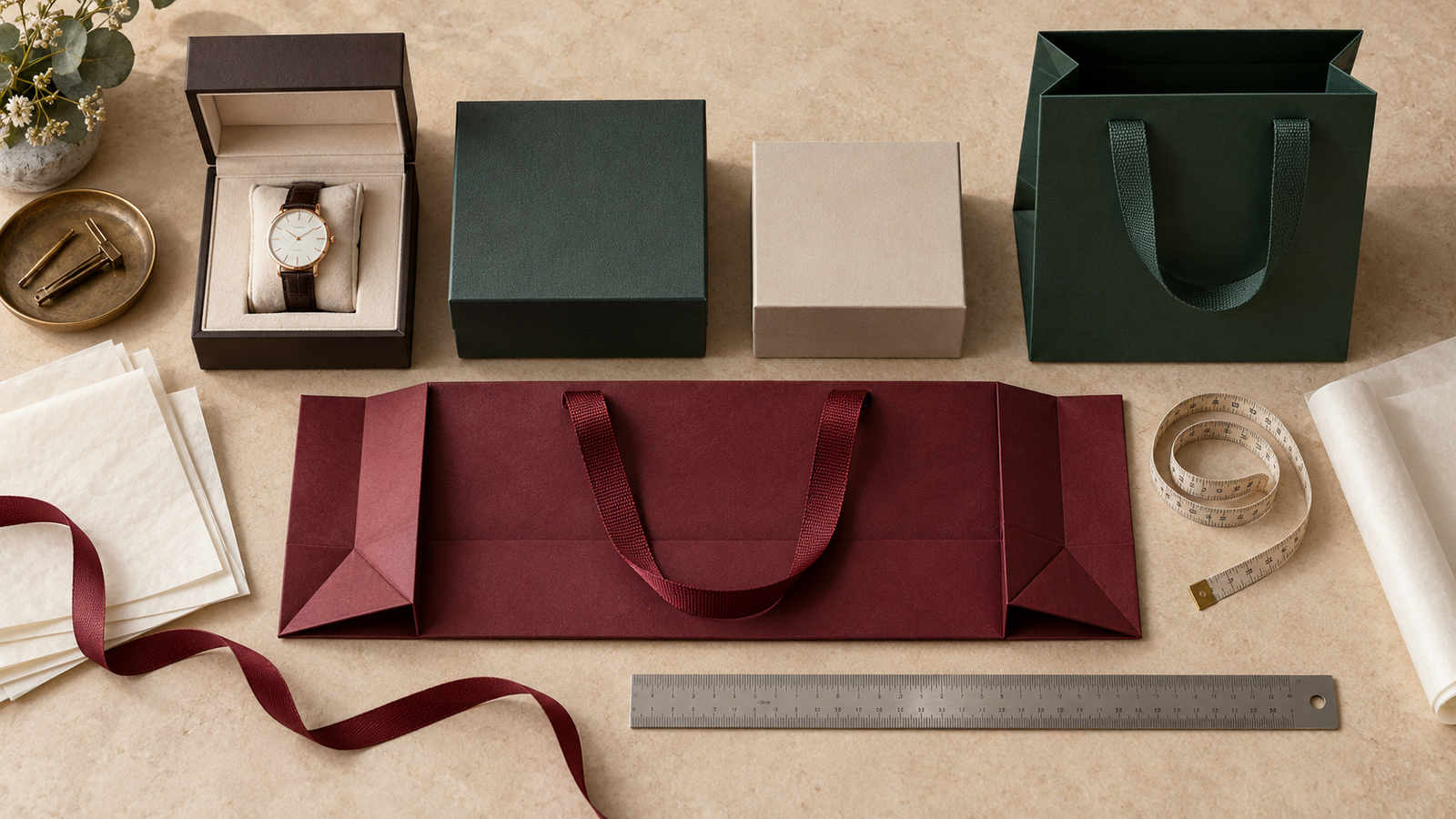
How many watch-bag sizes does a retail range need?
Use the smallest practical family that covers genuine pack-out groups. Too many nearly identical bags complicate artwork, purchasing and store stock. One bag forced across every watch box can create poor proportions, difficult loading or unnecessary material. Group the finished packs by footprint, height, packed weight and retail use, then test whether adjacent groups can share a carrier without compromising the handoff.
| Retail scenario | Pack-out evidence to collect | Bag decision to validate |
|---|---|---|
| Compact single-watch box | Closed box, sleeve, papers, tissue and packed weight | Small carrier with easy top loading and a stable base |
| Large presentation case | Maximum footprint, lid profile, surface sensitivity and orientation | Deeper gusset, suitable base support and removal clearance |
| Two boxes or gift set | Actual side-by-side or stacked arrangement | Stable layout without crushing, tipping or excessive empty space |
| Service or collection use | Documents, protective wrap, closure and privacy requirements | Separate format or restrained artwork where the workflow warrants it |
Which construction details matter for a boxed watch?
A premium watch box creates a compact load path. The body paper alone does not determine performance. The turned top, handle reinforcement, handle attachment, side seam, gusset creases, bottom closure and base insert work as a system. Our broader luxury paper bag construction guide explains how those parts share the load.
Top and handles
Choose rope or ribbon handles by comfort, appearance and attachment method. Check that the handle drop suits the carry style and that the reinforced top does not distort when the packed bag is lifted.
Base and gussets
The box should sit flat without forcing the gussets open unnaturally. A base insert may spread the load, but its material, fit and recovery route should be specified rather than assumed.
Ask the supplier to test the complete converted bag with the representative packed weight and agreed handling sequence. A paper swatch, board certificate or handle component test cannot by itself prove the performance of the assembled carrier.
Should a luxury watch bag be bold or discreet?
That is a brand and retail-operating decision, not a universal design rule. A flagship purchase may call for recognisable colour, foil or embossing. A retailer may also want a restrained exterior for collections, repairs or customers who prefer discretion. Define the use before deciding how prominent the mark should be.
Keep the hierarchy controlled: brand colour, paper texture, handle material and one well-executed decoration often communicate more than several competing finishes. Test foil, relief, ink coverage and lamination on the selected paper and on the converted bag, especially across folds and frequently handled areas. For a systematic finish comparison, see our luxury paper bag finishes guide.
How do the watch box, tissue and ribbon work as one set?
Give every layer a job. The fitted rigid watch box presents and protects the product at retail. Tissue can soften the reveal and prevent direct rubbing between components. Ribbon can close a box, form a gift detail or become the bag handle. The custom paper bag carries the finished set and extends the brand into the customer handoff.
Approval principle: colour references should be defined for each substrate. The same burgundy cannot be expected to look identical on uncoated bag paper, coated rigid-box wrap, translucent tissue and woven ribbon. Approve the coordinated relationship, not a false promise of identical appearance.
See the dedicated guides to custom printed tissue paper, custom packaging ribbon and complete luxury packaging sets when these components are being sourced together.
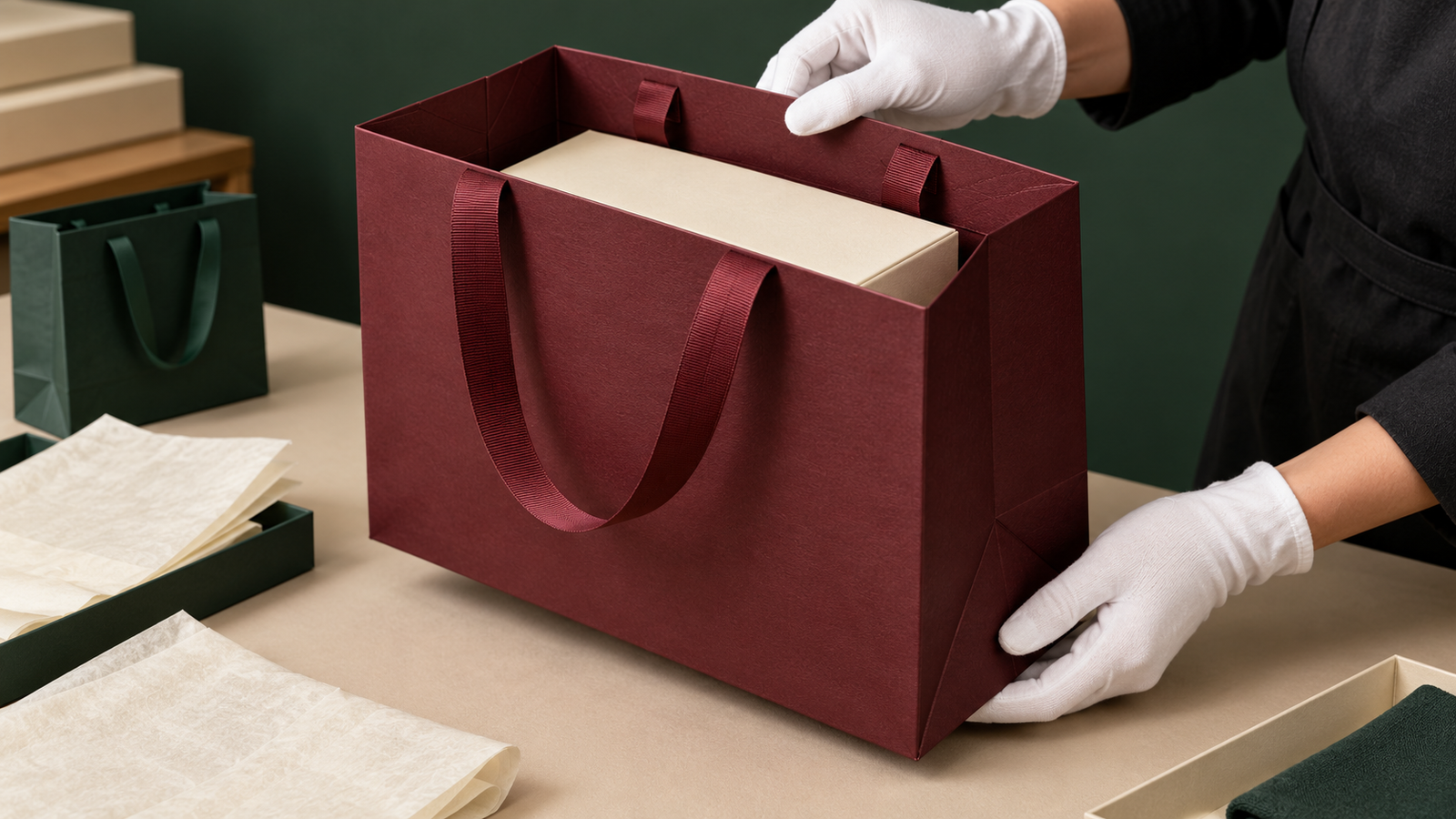
What should the sample approval prove?
Approve evidence in stages. Material swatches can compare paper, colour and finish direction. Artwork proofs can check content and placement. Finish strike-offs can show how a decoration behaves on the chosen surface. Only a fully converted sample can demonstrate bag proportions, loading clearance, handle comfort, base stability and the complete reveal.
- Confirm the final dieline, artwork version, colour references and decoration layers.
- Pack the production-intent watch box, papers, tissue and ribbon at the retail counter.
- Lift and carry the bag by its handles; inspect the turned top, holes or tabs, seams, gussets and base afterward.
- Check surface rub, foil or print damage where the box and hands contact the bag.
- Record the signed sample, photos, tolerances and any approved deviations as the production reference.
Our custom paper bag sample guide separates what each proof type can and cannot establish.
How should transport and environmental claims be handled?
The retail bag is not the shipping pack for a valuable watch. Export cartons, dividers, protective wrapping and pallet or parcel controls need to protect the empty bags before they reach the boutique; the watch product has its own distribution system. Where testing is needed, select it from the actual route and known hazards. ISTA’s official procedure overview distinguishes screening, partial-simulation, general-simulation and tailored approaches rather than presenting one test as suitable for every distribution route.
Environmental statements also need order-specific evidence. FSC explains that chain of custody verifies forest-based material through the supply chain and supports finished-product labelling and transaction claims when its requirements are met. It is not a blanket proof of recyclability. ISO 18602:2013, confirmed current in 2024, addresses packaging-system optimization while retaining required functions. For EU-bound packaging, review the applicable obligations and dates in Regulation (EU) 2025/40 with qualified market-specific advice.
Ask for the material specification, certification scope, invoice claim, label approval and any recyclability evidence relevant to the markets where the bag will be placed. Keep certified sourcing, recycled content, recyclability and reuse as separate claims unless each is substantiated.
What should be checked when production arrives?
Inspect incoming bags against the approved production reference before distributing them to stores. Use an agreed sampling and defect framework, then check dimensions, colour and print, finish placement, folds, glue, handle position, reinforcement, base formation, cleanliness, count and export packing. Repeat a representative loaded carry test rather than judging only empty bags. The luxury paper bag quality-control checklist provides a fuller inspection sequence.
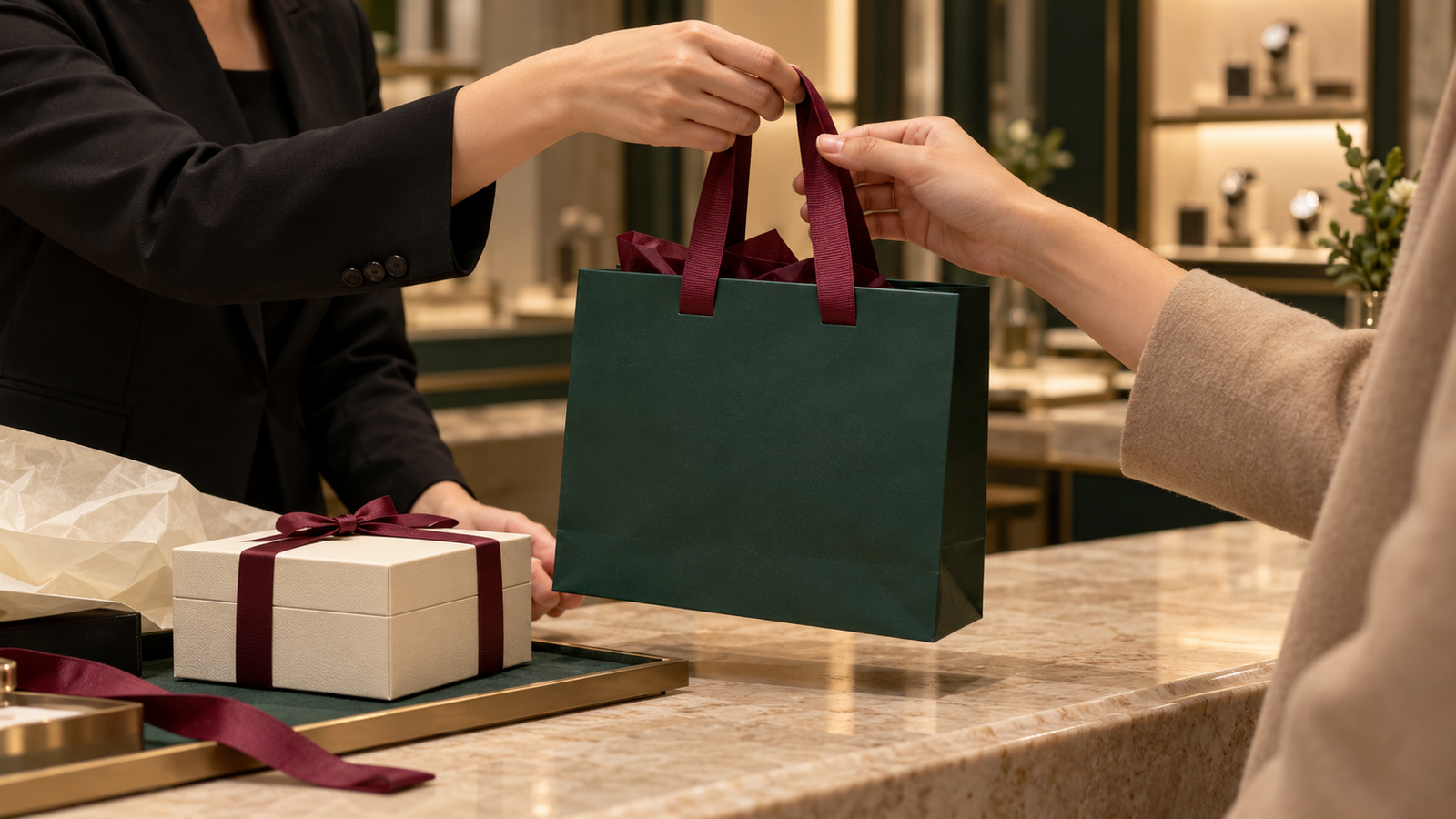
What belongs in a quote-ready watch paper bag brief?
- Use case, store market and expected handoff
- Closed box dimensions, orientation and packed weight
- Full contents, tissue, ribbon and documents
- Required size family and quantity by artwork
- Paper, colour, print and finish references
- Handle material, colour, drop and attachment
- Turned top, reinforcement and base specification
- Sampling, test and approval expectations
- Certification and market-claim evidence
- Inspection, packing, destination and delivery window
Frequently asked questions
What size paper bag fits a watch box?
There is no universal watch-bag size. Measure the fully closed presentation box and complete retail pack, fix its carry orientation, then approve practical loading clearance on a converted sample. The bag’s internal usable space can differ from its nominal flat dimensions.
Are ribbon handles suitable for boxed watches?
They can be, when the ribbon, handle drop, attachment, turned top and reinforcement are engineered and tested for the representative packed bag. Appearance alone does not establish carrying performance.
Should the watch box and paper bag use the same finish?
Not necessarily. The box and bag have different surfaces, folds and handling demands. A coordinated colour and finish hierarchy is usually more realistic than forcing identical effects across every material.
Can one bag cover every watch collection?
Only if physical pack-out trials show that it fits each approved box family without difficult loading, instability or excessive empty space. Many buyers achieve better control with a small rationalised size family rather than one universal bag or many near-duplicates.
Build a Watch Packaging Set Around the Real Handoff
Share your watch box dimensions, packed weight, artwork, preferred handles, quantities and delivery market. Bespoke Packaging can help develop coordinated luxury paper bags, rigid boxes, tissue paper and ribbon for sampling and production.