
WINE & SPIRITS RETAIL PACKAGING
Custom Wine Bottle Paper Bags: A Buyer’s Guide
Specify a premium bottle bag around the real bottle or gift box, then prove its stability, carrying performance and retail presentation before production.
Custom wine bottle paper bags should be designed for the exact filled bottle, bottle box or gift set they will carry—not from a generic “wine bag” size. A successful bag keeps the pack upright, transfers weight through the handles and reinforced body, gives staff enough room to pack it cleanly, and presents the brand without pretending to be protective shipping packaging.
The most useful buying brief connects five decisions: the product format, bag dimensions, carrying construction, internal separation and brand presentation. This guide explains how to specify single- and double-bottle luxury paper bags, plan samples and give suppliers comparable information for quotation.
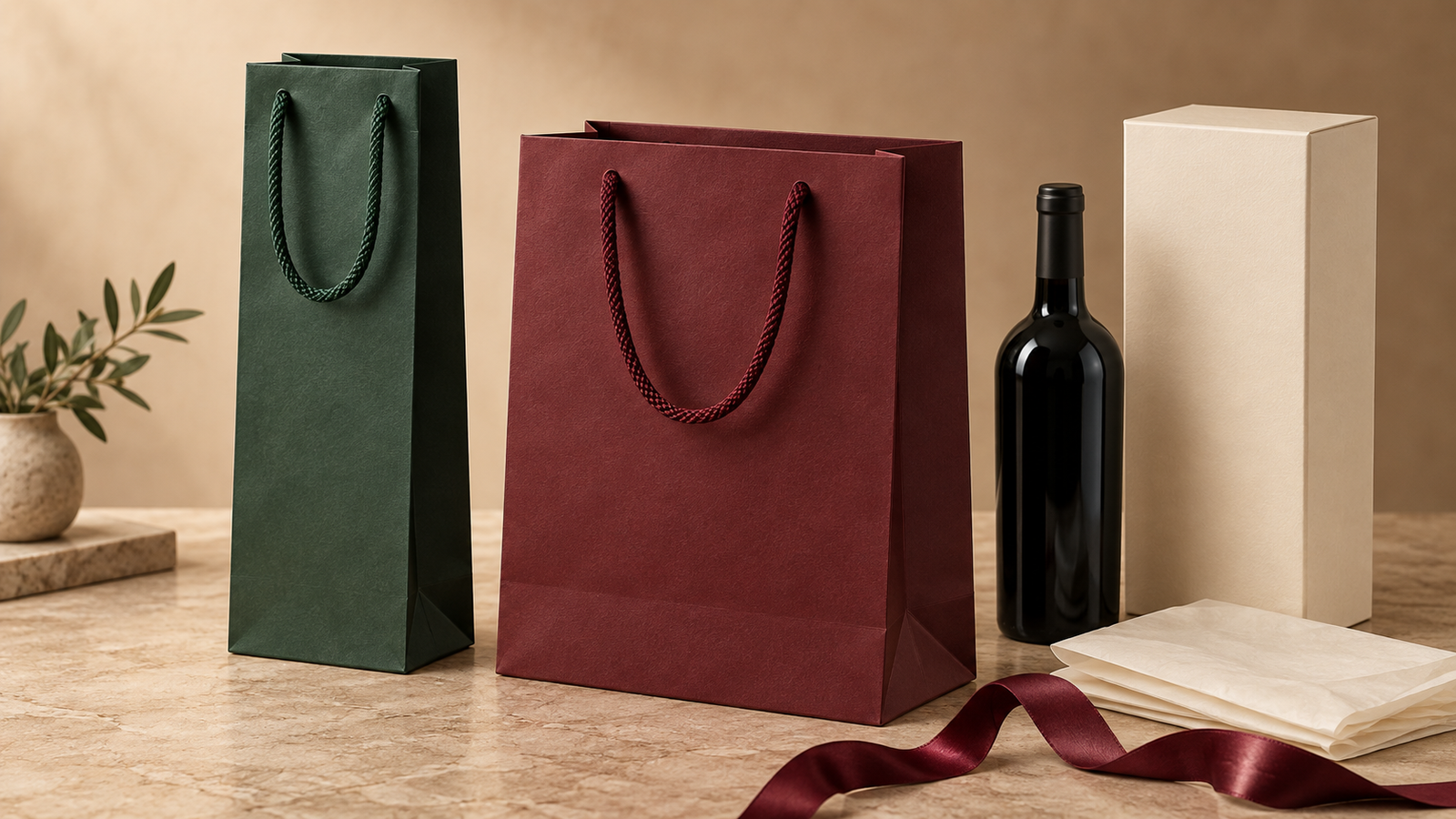
What should a wine bottle paper bag actually do?
A bottle bag is the visible retail carrier around a relatively tall, concentrated load. Its job begins after the bottle has its own primary container and closure. The bag should support the intended handoff from shop, tasting room, event or gifting counter while keeping the bottle or boxed presentation composed.
- Fit: accept the bottle, presentation box, tissue and card without forcing the opening or leaving uncontrolled empty space.
- Stability: provide a base footprint and gusset depth that let the packed bag stand as intended.
- Carrying performance: transfer the approved load through handles, reinforcement, panels, seams and base.
- Separation: prevent two bottles from striking each other when a double-bottle format is used.
- Brand presentation: keep artwork, paper, colour and finishes legible on a tall, narrow format.
- Retail usability: open, fill, store and hand over efficiently without catching tissue or damaging the bag.
How do you size a custom bottle bag?
Measure the finished item that will go into the bag. That may be a bare sealed bottle for a simple retail handoff, a rigid bottle box, a presentation sleeve, or a complete gift set with tissue and a card. Bottle shapes, shoulders, bases, closures and gift boxes vary, so a nominal volume such as 750 ml is not a reliable bag dimension.
Record maximum width, depth and height in a consistent orientation, then record the filled weight. The GS1 Package and Product Measurement Standard provides a repeatable discipline for measuring the maximum extent of a product or package. It is not a custom bag specification, but its emphasis on consistent orientation and maximum measurements is useful when buyers, designers and factories exchange data.
- Measure the widest part of the filled bottle or finished presentation box.
- Include closures, shoulders, sleeves and any element that projects beyond the main body.
- Define whether tissue wraps around the bottle, sits above it or lines the bag.
- Add only the working clearance needed for insertion, removal and realistic packing.
- Check the distance between the packed product and the handle attachment or folded top.
- Write dimensions as labelled width × gusset × height instead of sending three unexplained numbers.
Our luxury paper bag size guide explains the width, gusset and height convention in more detail. For a bottle project, the structural sample should confirm that the base sits flat, the opening is usable and the bottle cannot lever against the handle area.
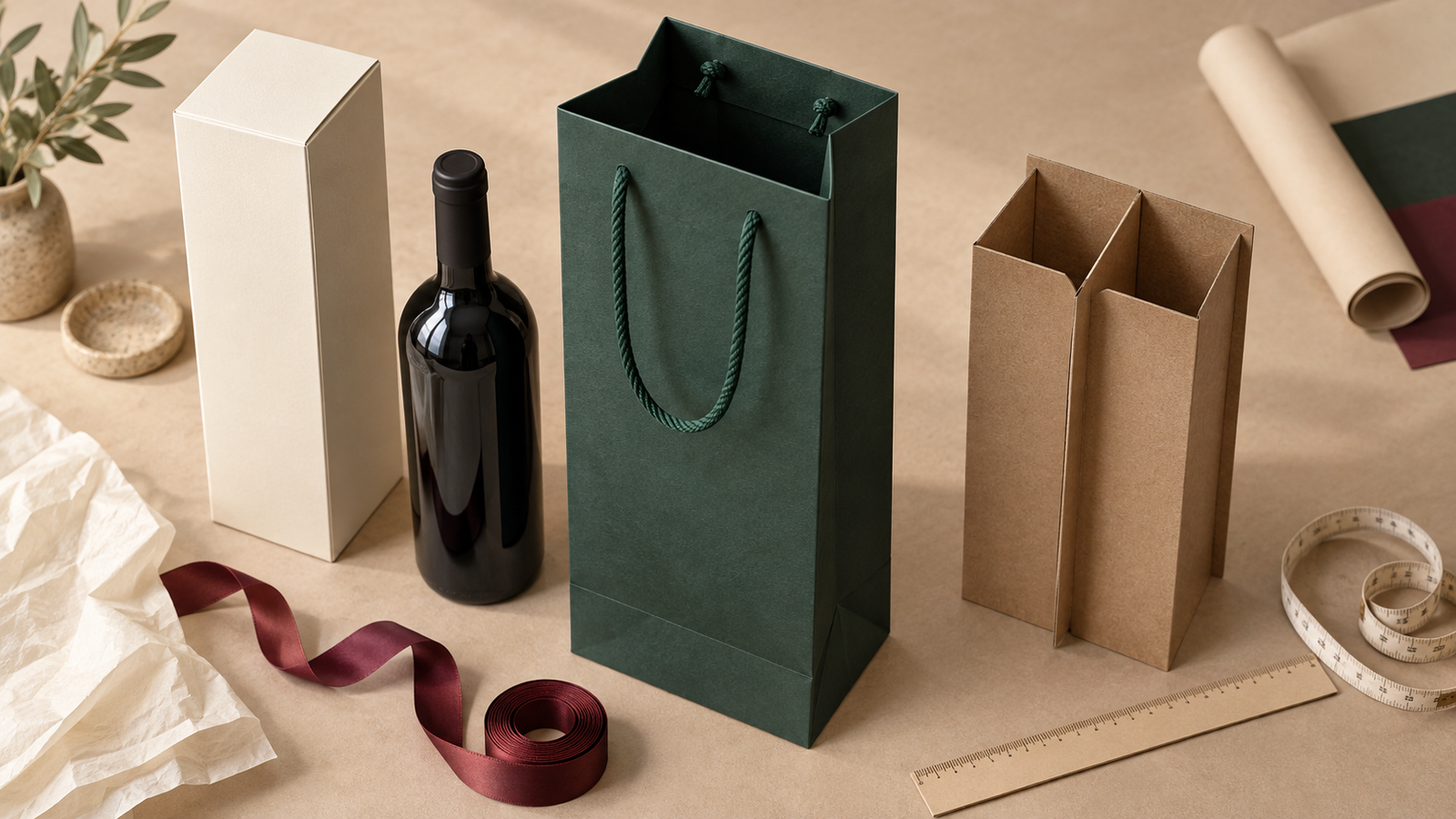
Should you choose a single- or double-bottle bag?
Choose the format from the real sales pattern. A single-bottle bag is usually the cleanest option for one bottle or one boxed bottle. A double-bottle bag can support gifting and multi-item purchases, but it needs a wider stable base, a separator and a carrying construction approved for the combined load. An oversized general shopping bag is rarely a good substitute because bottles can move, tip or collide.
| Format | Main design priority | What the sample must prove |
|---|---|---|
| Single unboxed bottle | Controlled base fit and easy insertion | The bottle stands predictably, the base does not distort and the closure stays clear of the handle area. |
| Single boxed bottle | Size the bag around the completed gift box | The box enters without abrasion, sits flat and leaves intentional top clearance. |
| Two bottles | Separation, combined load and balanced carrying | The divider stays in position, bottles do not strike each other and the bag remains stable when lifted. |
| Bottle plus accessories | Organised compartments and weight distribution | Glasses, cards or food items cannot damage the bottle, unbalance the bag or overload one panel. |
Do not create a double-bottle format simply by increasing the width of a single-bottle bag. The gusset, base board, handle spacing, reinforcement and divider all change. If mixed orders are common, it may be more reliable to offer one approved single-bottle bag and one purpose-built double-bottle bag rather than asking staff to improvise.
Which construction details matter most?
A wine bottle concentrates substantial weight over a small base. The bag therefore needs a complete load path rather than a heavy-looking sheet alone. Paper choice, fibre behaviour, folded top, handle attachment, reinforcement, side seam, gussets, base folds and base support must work as one system.
- Folded turn-top: creates a neat rim and can strengthen the handle zone when it is properly bonded.
- Handle reinforcement: spreads force away from individual holes, knots or glued tabs.
- Base board: supports the bottle footprint and helps reduce local distortion at the bottom.
- Gusset geometry: must open fully and create the approved base width without folding under the bottle.
- Side and base seams: need clean adhesion and enough area for the specified paper and load.
- Divider: should locate two bottles without damaging labels, finishes or the bag during packing.
Nominal paper grammage does not provide a complete strength rating. Ask the supplier to recommend the construction against the maximum packed weight, then test the converted bag with representative contents. The luxury paper bag construction guide shows how the components form one carrying system.
Does a two-bottle bag need a divider?
Usually, yes. Two glass bottles should not be allowed to knock together during ordinary carrying. A paperboard divider can create separate cells, reduce direct contact and help keep the load organised. Its material, height, locking method and fit should be developed with the bag rather than added after the body dimensions are fixed.
The divider does not turn a retail bag into transit packaging. It supports the retail carry scenario defined in the brief. If the bottles will move through parcel, courier or freight distribution, they need a separate protective packaged-product system designed and tested for that route.
Which handles work for premium bottle bags?
Cotton rope handles give a familiar premium feel and can be comfortable for a concentrated load when the diameter, drop and attachment are appropriate. Ribbon handles can coordinate beautifully with a gift box, but their width, edge feel and attachment must still be tested. Paper handles may suit a more paper-led design, provided the proposed handle and reinforcement meet the real carry requirement.
A tall narrow bag also needs the correct handle spacing. Poorly positioned handles can make the bag tilt or let a bottle push against one side. Specify handle material, size, colour, drop, attachment and reinforcement together, then approve comfort and balance with the heaviest allowed pack. Compare the main options in our paper bag handle guide.
Is a wine bottle paper bag suitable for shipping?
No ordinary luxury paper shopping bag should be presented as the protective shipping package for a glass bottle. It is a retail carrier. Parcel and freight distribution introduce drops, vibration, compression and other hazards that require an engineered outer package, cushioning or retention, closures and route-appropriate testing.
The International Safe Transit Association advises evaluating the complete packaged-product system against the hazards of its intended supply chain. ISTA also distinguishes early screening tests from general simulations of specific distribution environments. If a bottle gift set will be shipped, develop and test that transport pack separately; place the presentation bag inside it only when the protection plan allows.
How should logo, colour and finishes be planned?
A bottle bag gives the designer a tall, narrow front panel. Logo scale and position should be judged on the physical bag at carrying distance, not only on a flat artwork screen. Keep critical detail away from the base fold, gusset creases, side seam, handle holes and folded top. On dark burgundy, forest green or black papers, confirm ink opacity or choose foil and relief processes that are compatible with the selected surface.
- Use a restrained logo scale that leaves the tall proportion intentional.
- Approve colour on the actual coated, uncoated or coloured-through paper.
- Separate print, foil, embossing and varnish layers in the supplier dieline.
- Check fold cracking, scuffing and foil abrasion after realistic packing and carrying.
- Test whether bottle labels, gift boxes or tissue can rub against the bag interior and transfer colour.
Use our artwork checklist for file handoff and the finishes guide to compare foil, embossing, spot UV and lamination. The premium effect should survive the actual counter and carry journey, not only the sample-room photograph.
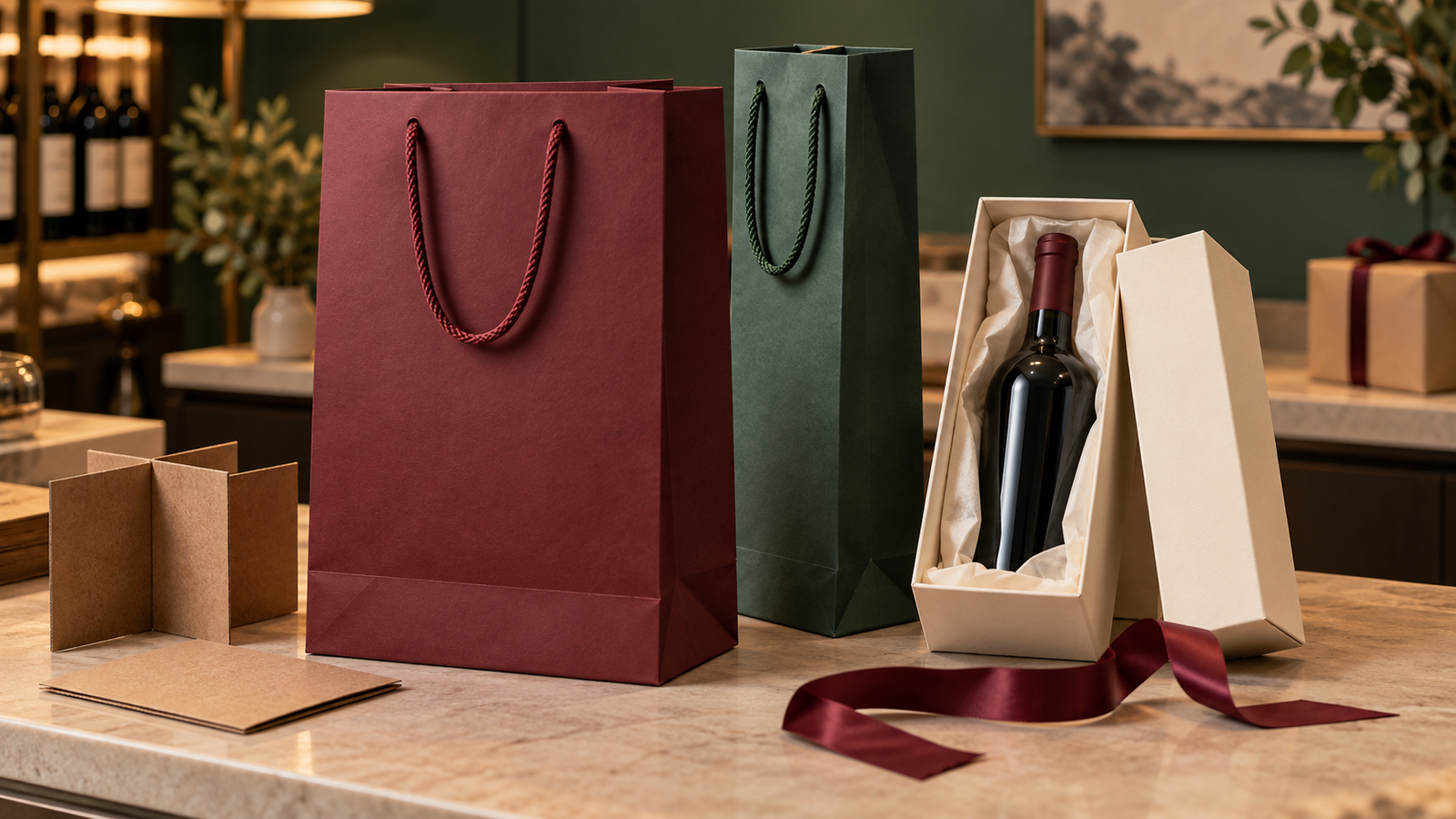
How do you coordinate the bag, bottle box, tissue and ribbon?
Treat the packaging as a sequence. The luxury paper bag is the visible carrier; the rigid bottle box creates presentation and product restraint; tissue protects surfaces and controls the reveal; ribbon adds a tactile accent or closure. The layers should relate without repeating every colour and finish.
- Let the bag carry the clearest exterior brand cue at retail distance.
- Use the rigid box for the close-up presentation and any fitted internal structure.
- Choose tissue volume only after checking the usable bag opening and clearance.
- Repeat one controlled colour, texture or motif across the set instead of covering every surface.
- Pack the complete set during sampling so bag fit is not approved with an empty box.
What should be tested before mass production?
Use staged samples because no single proof answers every question. A plain structural prototype checks fit, base stability, divider position and handle balance. Paper and handle swatches confirm touch and colour direction. Printed or finish trials test artwork on the selected paper. A fully converted pre-production sample brings the approved construction and appearance together.
- Pack every approved bottle, box and accessory combination.
- Lift, hold and walk with the maximum intended retail load.
- Observe balance, handle comfort, hole or tab distortion and base deflection.
- For two bottles, check divider retention and bottle-to-bottle clearance.
- Open bags from their flat-packed condition and check gusset formation.
- Inspect artwork, foil, folds and dark surfaces after packing and handling.
- Record the approved sample, test method and acceptable result for production inspection.
Our custom paper bag sample guide explains what each sample type can prove. For production, connect the approved master to the inspection plan in the quality-control checklist.
What sustainability and compliance questions belong in the brief?
Begin with right-sizing, material identification and the complete construction. In the European Union, the Packaging and Packaging Waste Regulation began applying on a phased basis from 12 August 2026. The European Commission’s current PPWR update says the requirement that all packaging be recyclable will apply from 2030. Buyers should confirm the obligations, labelling rules and implementation guidance relevant to their market and launch date rather than relying on a broad “eco-friendly” claim.
Assess the bag body, inks, coatings, decorative finishes, handles, reinforcement, base board, divider and adhesives together. If responsible forest sourcing is part of the specification, define the evidence and finished-product claim. FSC chain-of-custody certification governs how certified forest-based material is tracked and sold with FSC claims; a paper swatch alone does not prove the status of the finished bag.
What belongs in a quote-ready wine bottle bag brief?
- Identify each sealed bottle, finished box or gift set the bag must carry.
- Provide maximum product dimensions, packed weight and clear measurement orientation.
- State whether the bag is for one bottle, two bottles or a mixed gift set.
- Give proposed bag width, gusset and height plus required packing clearance.
- Define paper family, surface, colour and any sourcing or recycled-content claim.
- Specify folded top, handle reinforcement, base board, seams and divider construction.
- Specify handle material, size, colour, drop, attachment and carrying expectation.
- Provide artwork, colour references, finish layers and position on the supplier dieline.
- List the rigid box, tissue, ribbon and cards that must coordinate and fit inside.
- Define sample stages, load checks, approved references and inspection criteria.
- State quantity by size and artwork, flat-packing, units per carton, destination and deadline.
- Separate retail use from any protective parcel or freight packaging requirement.
Send the same controlled specification to every bidder. That makes paper, construction, printing, packing and delivery assumptions visible instead of comparing headline unit prices for different bags. Our custom paper bag cost guide provides a practical method for aligning quotations.
Frequently asked questions about custom wine bottle paper bags
What size paper bag fits a wine bottle?
There is no universal size that fits every bottle and presentation. Measure the maximum width, depth and height of the actual sealed bottle or finished bottle box, include tissue or accessories, and approve the working clearance in a structural sample.
Can one bag fit both wine and spirits bottles?
Only if the complete approved bottle range fits securely and the maximum weight has been tested. Spirits bottles can differ markedly in width, shoulder profile and mass. Test every intended limit rather than assuming a shared volume means a shared bag.
Do double wine bottle bags need a base board and divider?
They commonly benefit from both: the base board supports the combined footprint, while the divider reduces direct bottle contact. The correct materials and geometry depend on the bottles, bag and retail carry scenario, so approve them as part of the converted sample.
Are rope handles suitable for bottle bags?
They can be, provided the rope, attachment, folded top and reinforcement are engineered and tested for the maximum packed load. Comfort and balance should be checked on the finished bag, not inferred from handle appearance.
Can a luxury bottle bag replace a shipping box?
No. A retail paper bag is not a protective parcel or freight package for glass bottles. Use a separate engineered transport system and test the complete packaged product for the intended distribution route.
Design the bag around the bottle journey
A premium wine bottle bag succeeds when proportion, stability, carrying performance and presentation are resolved together. Begin with the actual bottle or gift box, create separate single- and double-bottle solutions where needed, engineer the complete load path, and prove the result through realistic packing and carry tests.
Bespoke Packaging develops custom luxury paper bags together with rigid bottle gift boxes, tissue paper and ribbon. Share your bottle or box dimensions, maximum packed weight, quantity, artwork, destination and target presentation, and we can help turn them into a clear sampling and production brief.
Is your bottle bag sized for the complete gift—or only for a generic bottle description?