
LUXURY CANDLE PACKAGING GUIDE
Luxury Candle Packaging: How to Coordinate Bags, Boxes and Inserts
Build the pack from the candle outward: protect the vessel, preserve required information and make the final paper-bag handover feel intentional.
Luxury candle packaging is a coordinated system, not a single decorative box. The candle unit must present required information; a carton or rigid box can locate and protect the vessel; an insert controls movement and removal; a premium paper shopping bag carries the finished retail purchase; and separate transit packaging handles the distribution route.
That distinction matters because an attractive retail bag is not a parcel shipper, and a beautiful rigid box is not automatically tested for every route. The most efficient brief gives each layer one clear job, then samples the complete pack with the real candle. This guide shows candle, home-fragrance and gifting brands how to specify luxury paper bags, custom gift boxes, inserts, tissue and ribbon as one coherent packaging range.
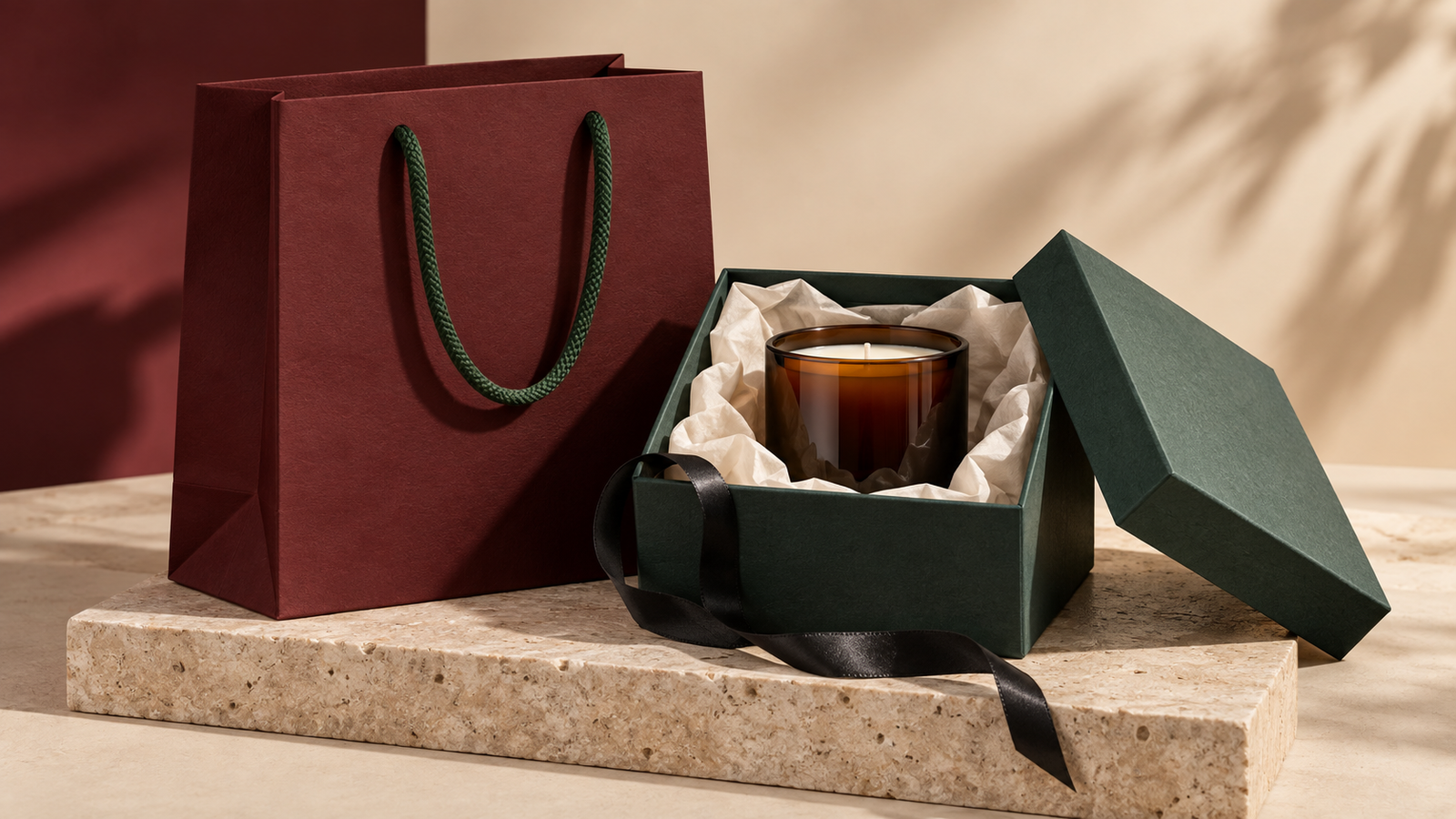
What does a luxury candle packaging system include?
Start with the unit the customer buys, then map every layer around it. A naked glass candle, a candle inside a folding carton and a candle inside a rigid gift box create different dimensions, weights, surfaces and information panels. The paper bag should therefore be sized around the final retail pack—not around a jar measured early in product development.
| Layer | Primary job | What buyers should confirm |
|---|---|---|
| Candle unit and label | Identify the product and carry applicable use, safety and market information | Final vessel, lid, label position, legibility and market review |
| Folding carton or rigid box | Present the candle and protect its surfaces during retail handling | Internal size, closure, board, print, finish and removal experience |
| Insert or divider | Locate one vessel or separate a set | Contact points, movement, access, material and packing method |
| Tissue and ribbon | Add presentation, separation or closure where those functions are useful | Sheet size, colour transfer, print, cut length and placement |
| Luxury paper bag | Carry the completed retail purchase and extend the brand beyond the counter | Finished box fit, filled weight, base, gussets, handles and reinforcement |
| Transit pack | Protect goods through the defined shipping route | Case count, dividers, cushioning, pallet or parcel route and test plan |
One component can support more than one function, but the brief should not hide gaps. Tissue may improve the reveal, for example, yet loose tissue should not be treated as a controlled insert for a heavy glass vessel. Likewise, a rigid presentation box can add useful structure without replacing the corrugated case and route-specific protection used for shipping.
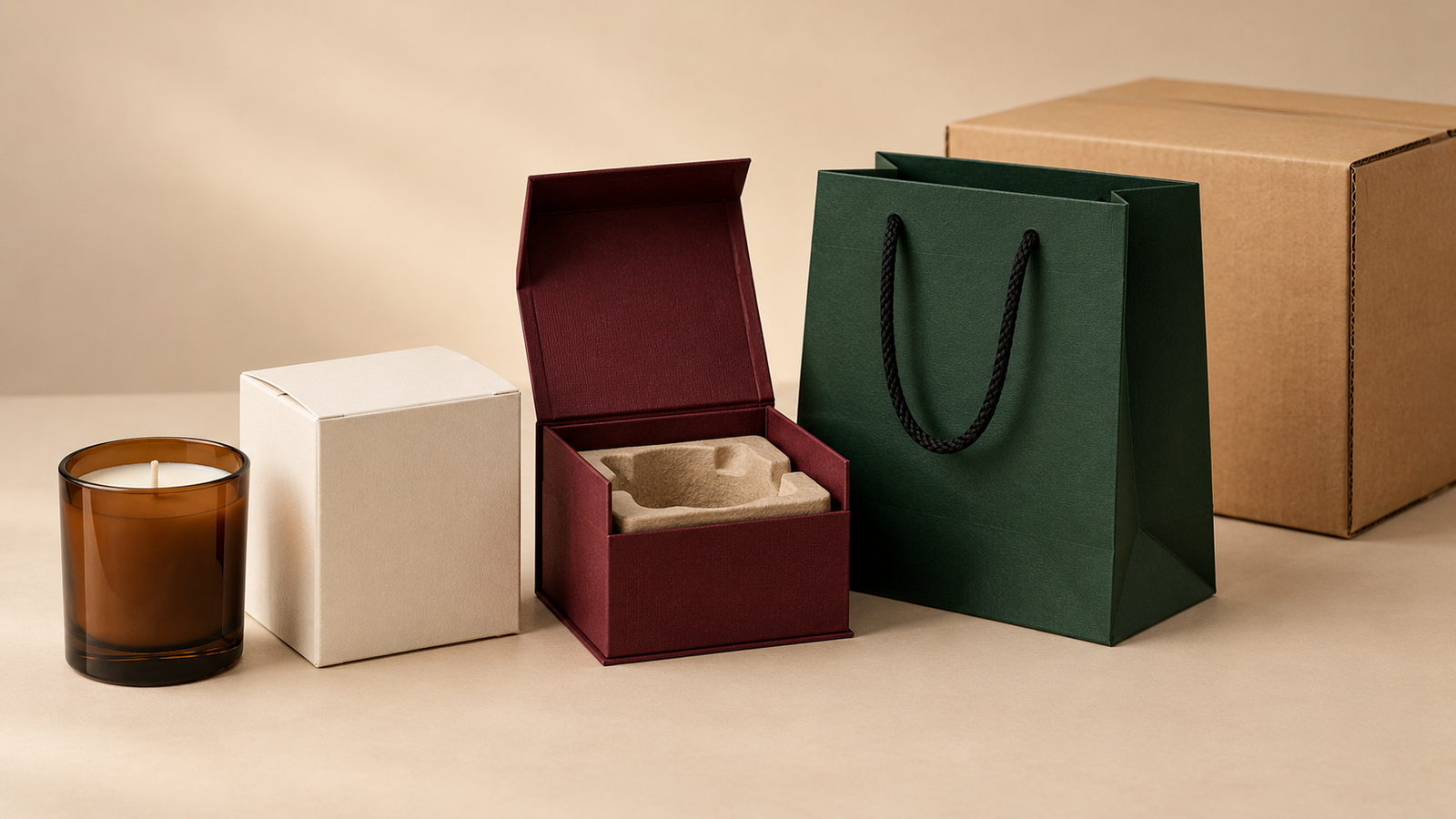
Where does the luxury paper bag fit?
For boutique, department-store, hotel, spa and event sales, the paper bag is often the most visible part of the packaging after purchase. It should make the candle easy to carry, hold the retail box in a stable orientation and give staff a predictable packing routine. It should not be excessively large simply to look generous: excess clearance lets a dense box move, wastes paper and can make the bag feel less considered.
The practical sizing rule
Measure the closed, production-intent candle box at its widest, deepest and highest points; weigh the heaviest finished configuration; decide its carry orientation; then add only the clearance needed for loading, tissue and easy removal. Confirm the decision with a physical sample.
The GS1 Package and Product Measurement Standard provides a current, repeatable method for exchanging product and package measurements between trading partners. It is not a custom-bag design formula, but its discipline helps prevent different teams from describing the same candle box in different orientations. Record both dimensions and packed weight, and repeat the measurement when the product or package changes.
How should the bag carry a dense candle box?
A candle may be compact but relatively dense, especially in glass, ceramic or concrete. The paper alone does not determine performance. Review the complete load path: handles, handle knots or fixings, folded top, reinforcement patch, side seams, gussets and base board. A square or near-square footprint can suit many candle boxes, but the best proportion is the one that keeps the real pack stable and comfortable to carry.
- Set the maximum retail load. Include the candle, lid, box, insert, tissue, ribbon, card and any accessories.
- Choose the carry orientation. Keep the candle box upright unless its approved construction permits another orientation.
- Define useful clearance. Allow staff to load the box without scraping finishes or crushing tissue.
- Engineer the load path. Match paper, base and handle reinforcement to the converted bag rather than choosing GSM alone.
- Test the complete sample. Lift, carry, set down and reload it using production-representative components.
Our luxury paper bag construction guide explains how these parts work together. If several candle formats share one bag, test the smallest and largest pack arrangements rather than assuming the largest size is suitable for every order.
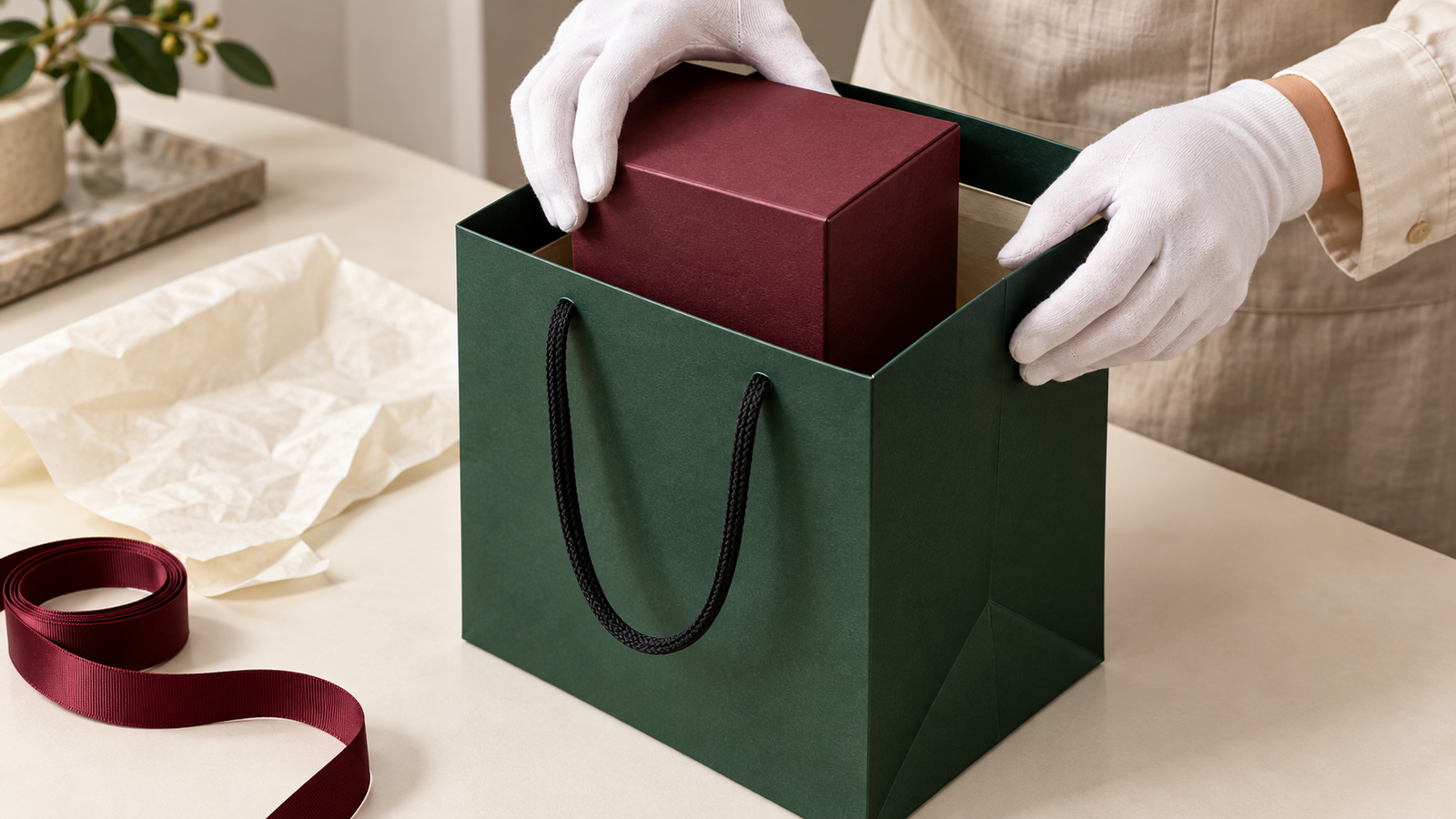
Does every candle need a rigid gift box?
Choose a folding carton when
- the candle needs a light retail sleeve or carton
- flat shipping and efficient storage matter
- the vessel and route do not require a complex presentation structure
- seasonal artwork changes more often than the underlying product
Choose a rigid box when
- the candle is positioned as a premium gift
- the opening sequence is part of the experience
- one or more vessels need a structured stage or fitted insert
- the box is intended to support a limited edition or presentation set
A rigid box is a presentation decision, not proof of transit performance. Select a structure—such as lift-off lid, drawer, book-style or shoulder-and-neck—around the vessel, insert, opening direction and packing process. The rigid box styles guide compares those formats, while the custom box inserts guide explains paperboard, pulp, corrugated and foam directions.
How should an insert hold a candle vessel?
Use an actual production vessel with its finished label, lid and base details. Identify where the insert may safely support the candle and where pressure could mark a label, chip a coated surface or load a vulnerable rim. The fit should limit unwanted movement without forcing the customer to pull on the wick, lid or decoration.
For multi-candle sets, consider weight balance as well as visual symmetry. A large and small vessel can create an off-centre load even when the layout looks balanced from above. Add finger access, a ribbon lift or an exposed edge only after checking that it remains reachable once the product settles. Test the insert inside the exact box, then test the closed box inside the exact paper bag.
What safety and label space must packaging preserve?
Packaging design should begin with the approved product and market information, not cover it at the last moment. In the United States, ASTM F2058-07(2021) covers fire-safety information on candle units of sale and requires that the warning remain visible at the point of sale. The National Candle Association’s label overview explains the familiar safety-message framework in plain language.
Those sources do not replace a legal review for every country, candle type or sales channel. Confirm the applicable product, chemical, fragrance, fire-safety, language, business and traceability requirements with qualified specialists. Tell the packaging designer which information must appear on the candle, carton, gift box or other unit of sale, and keep it legible after sleeves, ribbons, tissue and retail display arrangements are added.
How do you coordinate colour and finish without overdecorating?
Give each component a role in the visual hierarchy. The paper bag may carry the largest logo; the rigid box may use one quiet foil or blind emboss; tissue can introduce a repeat pattern; and ribbon can repeat a handle colour. Luxury usually comes from proportion, material fit and consistent execution—not from putting every available finish on every surface.
- Approve colour on each real substrate, because coated bag paper, uncoated box wrap, tissue and ribbon reflect light differently.
- Check abrasion where a finished box slides into the bag or where rope handles rest against a decorated panel.
- Keep fragrance or scent naming clear across cartons and gift sets so packers cannot confuse similar variants.
- Use one signed physical reference for colour, finish position and acceptable variation.
The luxury packaging sets guide shows how paper bags, boxes, tissue and ribbon can feel related without becoming identical. For detailed tissue and ribbon decisions, see our printed tissue paper and custom packaging ribbon guides.
How should candle packaging be tested for distribution?
Define the route before choosing a test. Store replenishment on pallets, courier parcels, international direct import and customer carry-out expose packaging to different hazards. The International Safe Transit Association distinguishes screening, partial-simulation, general-simulation and other procedures, and stresses matching the procedure to the intended outcome and distribution environment.
Test the packaged product, not an empty presentation box. Agree what counts as product damage and what package change is acceptable before testing. Inspect glass or ceramic integrity, lid security, wax or label condition, insert movement, box finish and closure after the chosen sequence. The retail paper bag can receive a separate loaded carry check; it should not be mistaken for the protective shipper used in parcel distribution.
How can candle packaging stay premium with fewer unnecessary layers?
Begin by removing components that have no clear function. A fitted paperboard platform may combine presentation and location; a well-sized bag may need less loose tissue; and a single restrained finish may communicate more clearly than several mixed decorative layers. Document why each component exists, its material, how it separates and which recovery system is relevant in the destination market.
For EU sales, the European Commission’s packaging-waste overview confirms that Regulation (EU) 2025/40 began applying in phases from 12 August 2026. Requirements and timing vary, so obtain product- and market-specific advice. The 4evergreen Circularity by Design Guideline, Version 4 is a practical technical reference for how paper-packaging constituents interact with collection, sorting and recycling pathways.
If FSC-certified material or an FSC claim is part of the brief, verify the supplier’s scope, transaction evidence and artwork approval route. FSC chain of custody tracks eligible forest-based material through the supply chain; it is not the same claim as recycled content, plastic-free construction or recyclability.
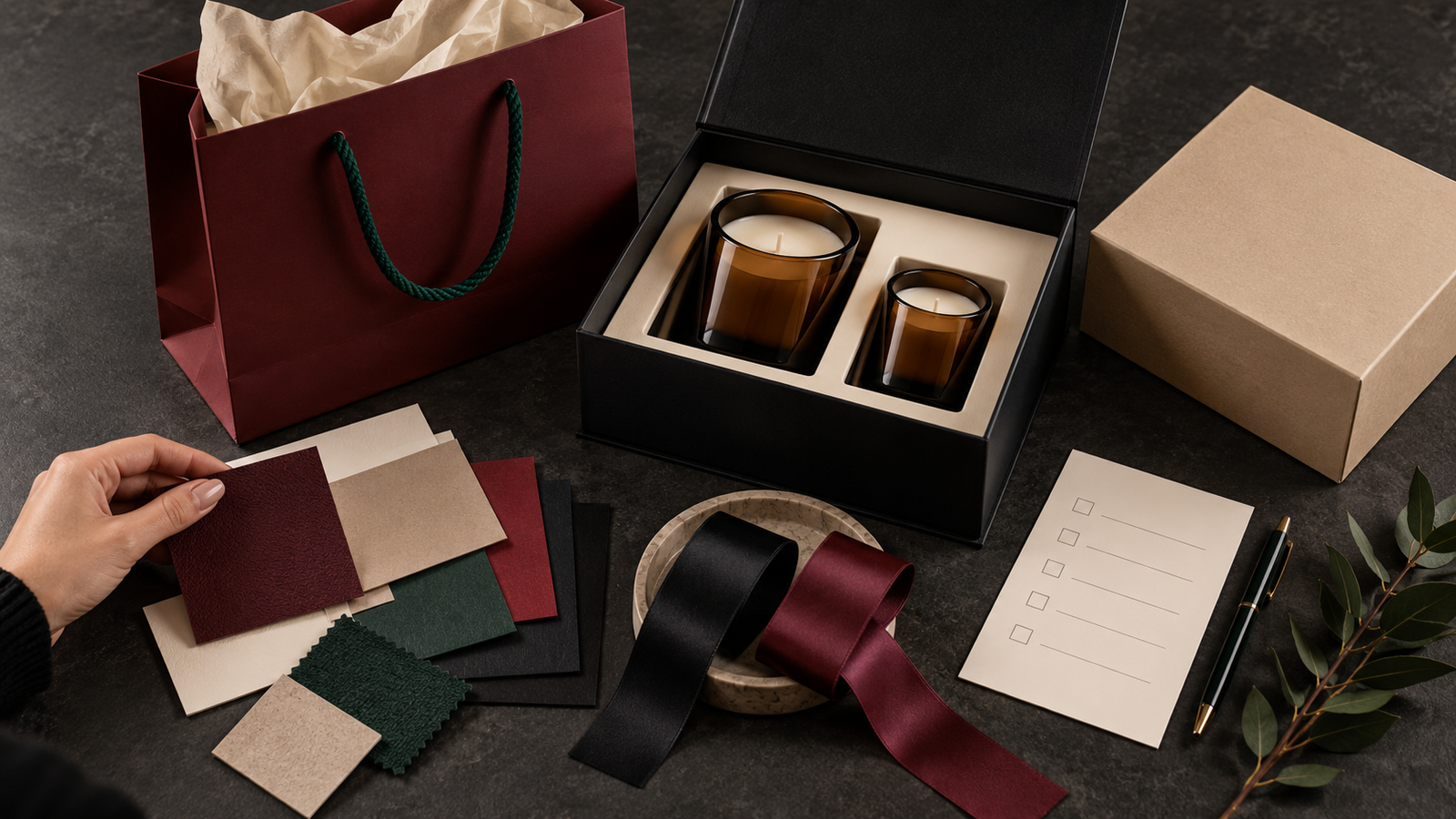
What should you approve before bulk production?
Approve in stages so each sample answers a specific question. Material swatches can narrow the paper and colour direction. An unprinted structural prototype can test fit, loading and removal. A printed proof can evaluate artwork and colour. A production-intent sample brings the approved vessel, label, insert, box, tissue, ribbon and paper bag together.
Product and structure
- final vessel, lid, label and packed weight
- box fit, closure and opening sequence
- insert contact, movement and removal
- paper-bag loading clearance and stability
- handle comfort, base and reinforcement
Artwork and operations
- required information and unobstructed labels
- colour and finish on production substrates
- SKU identification and packing sequence
- master cartons, case counts and route test
- signed samples, inspection criteria and records
Do not approve only the most photogenic configuration. Include the heaviest vessel, the tallest lid, the most abrasion-sensitive finish and any mixed gift set. If the product or label supplier changes, repeat the checks affected by that change.
What information creates a quote-ready candle packaging brief?
- Final candle-vessel dimensions, weight, material, lid and label details.
- Sales channels and destination markets, including required information supplied by your compliance team.
- Preferred retail-box direction, insert function and opening experience.
- Paper-bag width, gusset and height—or the completed box dimensions that must fit.
- Expected quantities by size, scent or artwork version.
- Paper, board, print colours, finishes, handles, tissue and ribbon preferences.
- Approved sustainability or sourcing claims and the evidence required.
- Distribution route, master-carton assumptions and intended test method.
- Sample stages, decision owners, delivery country and need-on-site date.
If some details are still open, mark them as decisions rather than filling the brief with assumptions. A supplier can then quote a defined starting point and show where a change in structure, material, quantity or finish affects cost and timing.
Frequently asked questions about luxury candle packaging
What is the best packaging for a luxury candle?
The best system fits the real candle and sales route. A folding carton may suit an efficient retail line; a rigid box with a fitted insert may suit a gift collection; and both can be presented in a correctly sized luxury paper bag. Transit protection should be specified separately.
Can tissue paper protect a glass candle jar?
Tissue can improve presentation and protect against light surface contact, but loose tissue is not a controlled substitute for a designed insert or tested transit pack. Use the structure appropriate to the vessel, weight and distribution hazards.
Should the candle box and paper bag be the same colour?
Not necessarily. A coordinated set can use one shared brand cue—such as a burgundy handle repeated as ribbon—while letting paper texture and colour vary by component. Approve every colour on its actual material.
How do you size a paper bag for a candle gift box?
Measure and weigh the closed finished box in its intended carry orientation, add practical loading and tissue clearance, then test a physical bag with the heaviest production-intent pack. Avoid relying on the candle jar size alone.
What should be sampled first?
Prove structure and fit before investing in every decorative detail. Start with representative materials and an unprinted prototype, then move to print, finishes and a complete production-intent sample.
Plan the candle pack as one system.
Share your candle or finished box dimensions, quantity, destination and preferred paper-bag or gift-box direction. We will help turn them into a practical sampling and quotation brief.