
PAPER BAG GSM GUIDE
Paper Bag GSM: How to Choose the Right Paper Weight
Choose paper weight by separating grammage from thickness, stiffness and finished-bag performance—then prove the complete specification with samples.
Paper bag GSM means the mass of the paper per square metre, expressed as g/m². It is an important purchasing specification, but it is not a complete measure of thickness, stiffness, luxury feel or how much a finished shopping bag can safely carry. The right GSM is the lightest well-engineered option that delivers the required shape, print result, handling experience and tested performance for the real packed product.
That answer is less convenient than a universal GSM chart, but it is more useful. Two papers with the same grammage can differ in fibre composition, density, surface, thickness and bending behaviour. Two bags made from the same paper can also perform differently because of their size, gussets, grain direction, folded top, handle patches, base board, seams and adhesives. Buyers should therefore use GSM to identify the sheet, then approve the bag as a complete construction.
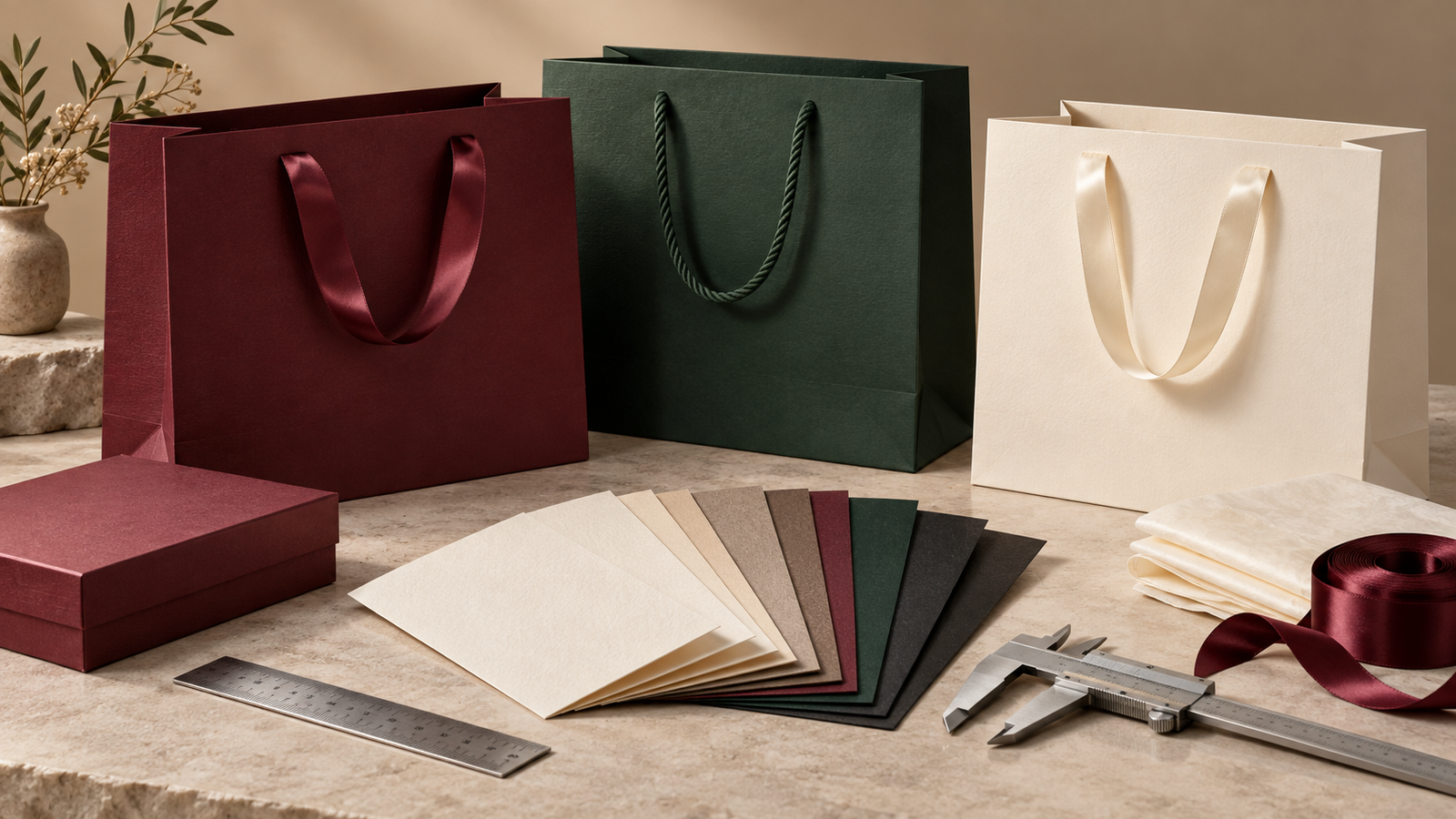
What does GSM mean for paper bags?
GSM is the common commercial shorthand for grams per square metre. In standards language, the property is called grammage: mass per unit area. ISO 536:2019, confirmed current in 2025, specifies a method for determining the grammage of paper and board. TAPPI/ANSI T 410 om-23 describes the same property and explains that North American trade may instead use basis weight or ream weight.
Because basis weight depends on a defined sheet size and sheet count, a value in pounds cannot be compared safely without knowing the paper category and basis dimensions behind it. For an international RFQ, ask the supplier to state grammage in g/m² and identify the exact paper grade. If a quotation uses pounds, request the original basis-weight convention as well as the converted GSM.
| Property | What it tells you | What it does not prove |
|---|---|---|
| Grammage (GSM) | Mass of the paper per unit area | Exact thickness, stiffness, tear resistance or finished-bag load capacity |
| Thickness or caliper | Distance between the two paper surfaces under a defined measurement method | Mass per area or complete-bag strength |
| Bending stiffness | Resistance of the sheet to bending under a stated method | Handle attachment, seam, base or packed-product performance |
| Finished-bag test | How the approved bag construction behaves with a defined load and handling sequence | Every future unit unless materials, production controls and inspection also remain consistent |
Is GSM the same as paper thickness?
No. Grammage measures mass per area, while thickness measures the distance between surfaces under specified conditions. ISO 534:2011, confirmed current in 2022, treats thickness, apparent density and specific volume as related but separate properties. A bulky, lower-density paper can feel thicker than a denser paper of the same GSM. Surface coatings, fibre furnish and manufacturing also change the relationship.
This distinction matters for luxury paper bags. A thick, tactile sheet may create a substantial hand-feel without being the highest grammage offered. A denser stock can feel compact and smooth while carrying the same mass per area. Specify the sensory and structural result you need instead of using “thick paper” and “high GSM” as interchangeable terms.
Is a higher GSM paper bag always stronger or more luxurious?
No. Raising GSM usually adds paper mass, but the finished bag still depends on the whole load path. A heavier panel will not repair an undersized handle patch, weak adhesive bond, unsuitable fold, poorly formed base or bag that is too large for its contents. It may add cost and packed shipping weight while leaving the actual failure point unchanged.
Luxury is also not a paper-weight contest. The impression comes from proportion, colour, touch, print control, crisp conversion, handle comfort and how the bag works with the product. An over-specified board can make small gussets awkward, create cracking at folds or produce a bag that feels rigid rather than refined. The aim is controlled performance, not the largest number on a swatch card.
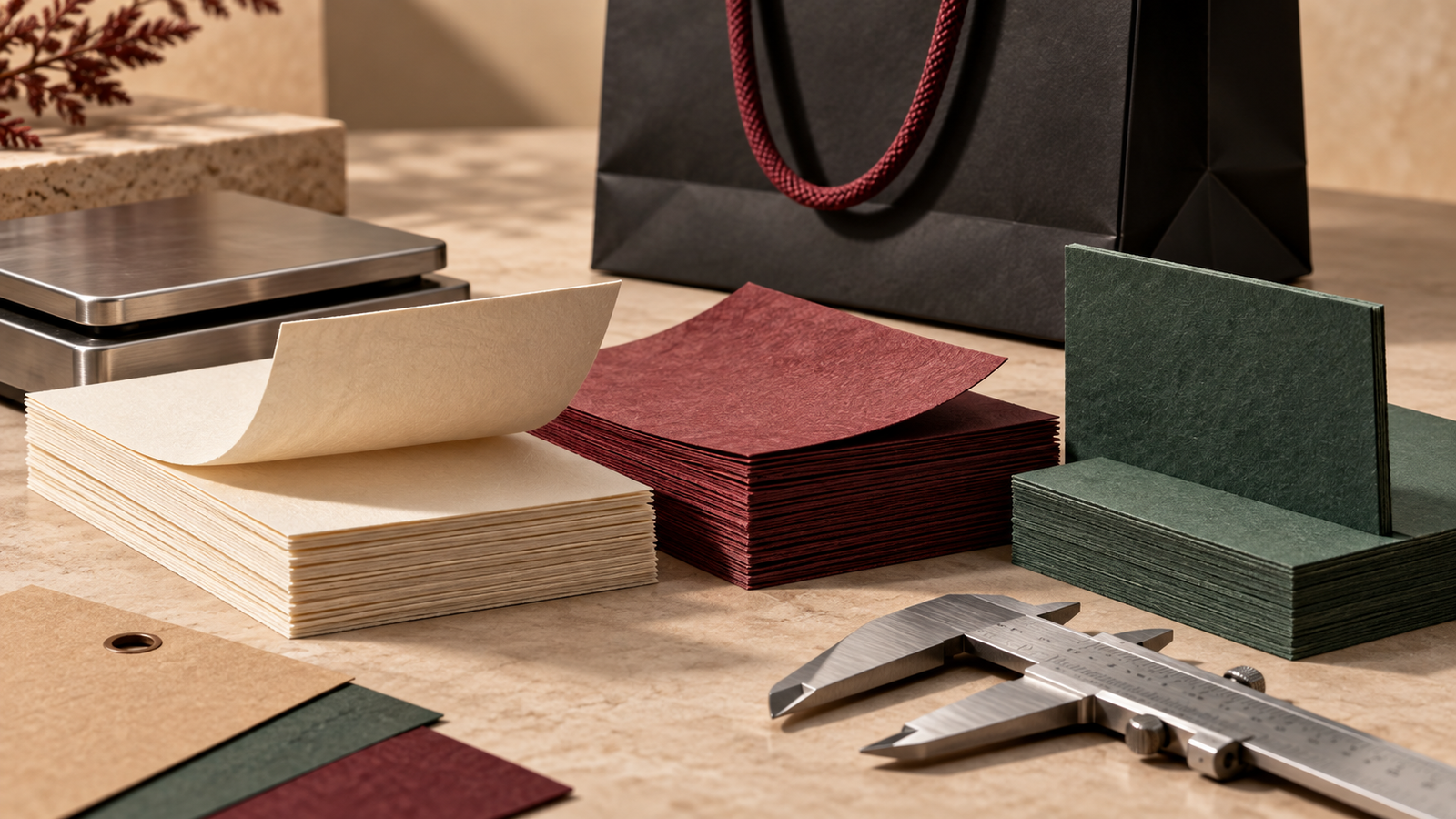
What should you compare besides GSM?
Paper grade, fibre and surface
Kraft, coated, uncoated, recycled and speciality papers can behave differently at the same grammage. The sheet must support the chosen print process, folds, surface finish and intended brand feel. Compare named paper samples rather than anonymous GSM values. Our luxury paper bag materials guide explains the broader material decision.
Thickness and bending stiffness
A sheet that resists bending can help a large bag hold a clean silhouette, while a more flexible paper can make a compact bag easier to open and fold. ISO 5628:2019, confirmed in 2024, sets out general principles for two-point, three-point and four-point bending-stiffness methods. Do not compare supplier stiffness figures unless the method, direction and conditioning are comparable.
Grain direction and conversion
Paper properties differ with direction, and the sheet must fold into a three-dimensional bag. Grain direction, scoring, fold geometry and moisture condition affect opening, side-wall shape and fold appearance. Ask the converter to select the paper and production layout together; a loose sheet test cannot reproduce every converting stress.
Handles, reinforcement, base and seams
The body paper is one link in the carrying system. Rope or ribbon handles transfer load into holes, knots or fittings and then into reinforcement patches and the folded top. The base board spreads load across the bottom, while side and base seams depend on suitable adhesive application and contact. The paper bag construction guide follows this complete load path, and the handle guide compares the main carrying options.
How do bag size and packed product change the paper-weight decision?
Start with the packed product, not the paper catalogue. Record the maximum intended load, product dimensions, centre of gravity, sharp edges, movement inside the bag and expected carrying time. A compact jewellery box and a wide footwear box can present different stresses even at similar weight. A tall bottle bag introduces another geometry and may need dividers or base control rather than simply more GSM.
- Measure the finished product, gift box, tissue and any protective insert together.
- Define bag width, gusset and height in the opened position.
- Allow practical loading clearance without creating excessive empty space.
- State the maximum packed weight for every bag size and product combination.
- Identify sharp corners, dense objects and products that may shift during carrying.
- Decide whether the bag is a short retail handoff, an event carrier or a reusable presentation piece.
Our luxury paper bag size guide covers product-fit measurement in detail. If a range uses several bags, test every meaningful combination instead of approving one GSM for the entire family by assumption.
How do printing and finishes affect the paper specification?
Paper weight cannot be separated from print and finishing. A coating or lamination can change hand-feel, surface resistance and folding behaviour. Heavy ink coverage, foil, embossing, debossing and selective coatings interact with the paper surface and conversion sequence. If the design places a finish near a score, fold, handle hole or seam, test that location on the intended stock.
Ask the supplier which papers have proven compatibility with the selected process, then approve the real artwork. The paper bag printing guide compares production routes, while the finishes guide covers foil, embossing, spot UV and lamination. GSM remains one line in the specification; it does not replace a print proof or finish sample.
How should buyers compare paper bag quotations?
Two quotes that show the same GSM are not necessarily equivalent. One may use a different paper grade, shade, coating, recycled-content composition, reinforcement, base board, handle attachment or packing method. Require suppliers to identify the complete construction so the comparison is like for like.
| Quote line | Minimum useful detail | Why GSM alone is insufficient |
|---|---|---|
| Body paper | Manufacturer or grade where available, paper family, colour, finish and nominal grammage | Different papers at one GSM can vary in surface, bulk and stiffness |
| Top reinforcement | Material, size, placement and attachment | The handle load transfers through this area |
| Base support | Board material, dimensions and placement | It distributes the packed product across the bag floor |
| Handles | Material, diameter or width, drop, colour and attachment | Comfort and load transfer depend on the handle system |
| Print and finish | Process, colours, coverage, coating, foil or relief details | Surface treatments can change appearance and conversion behaviour |
| Approval and testing | Required samples, load condition, inspection criteria and retained reference | A specification needs physical evidence and production control |
Material changes can affect both unit cost and carton weight. Compare the complete landed and usable result, not only the headline price or paper number. The custom paper bag cost guide shows how specification, quantity, packing and delivery assumptions interact.
How do you approve the right GSM before production?
Use a staged approval process. Begin with named paper swatches to compare colour, surface, bulk and flex. Move to a plain converted prototype to check size, opening, gussets, folds, handle position and product fit. Then approve print and finish on the chosen paper before releasing a fully converted pre-production bag.
- Define the use case. Record products, dimensions, maximum packed weight, retail workflow and carrying conditions.
- Shortlist complete paper specifications. Name the grade, colour, surface and nominal GSM; add thickness or stiffness requirements only when they are meaningful and measurable.
- Build structural samples. Include the actual bag size, folds, reinforcements, base and handles.
- Pack the real contents. Use the finished gift box, tissue, ribbon and inserts rather than substitute blocks alone.
- Run an agreed handling or load check. Define the load, duration, lifting method, repetitions, conditions and acceptance criteria before testing.
- Approve the decorated bag. Review print, finish, fold appearance, scuffing, opening and carry comfort together.
- Retain a signed master. Record paper identification, artwork revision, measurements, construction and approved test conditions for bulk inspection.
ISTA explains that packaging tests range from basic integrity screening to general simulations of distribution hazards, and that procedure selection must match the intended outcome. Its test-procedure overview is useful context for transport packs. A retail paper-bag carry test is a different question, so define a fit-for-purpose protocol with the supplier instead of borrowing an unrelated pass label.
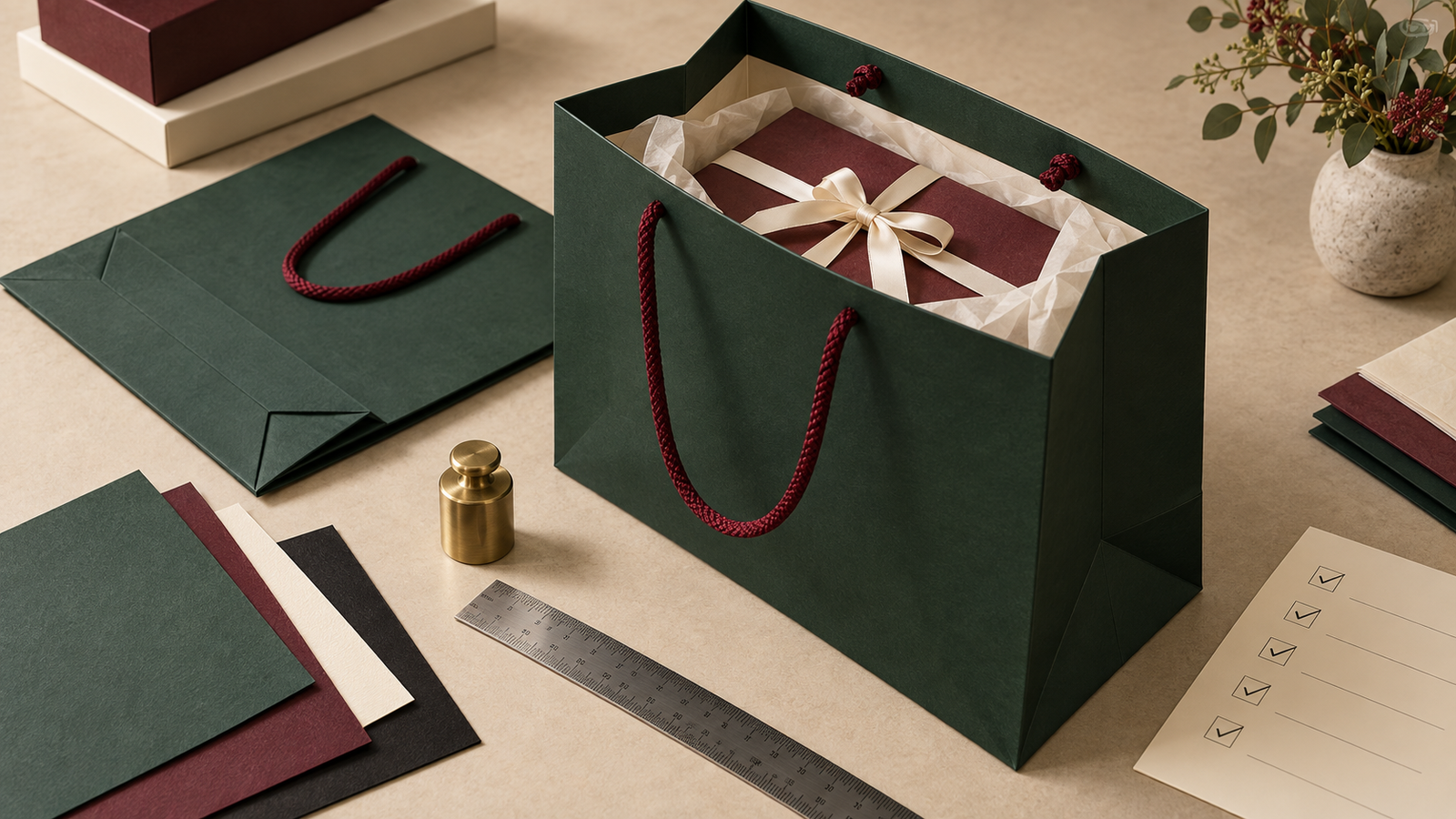
What should a paper bag GSM RFQ include?
A useful request for quotation makes the paper measurable and the bag testable. Include:
- Finished bag width × gusset × height for every size
- Product dimensions, maximum packed weight and planned combinations
- Paper family, colour, surface, nominal grammage and required evidence
- Any thickness, stiffness or direction requirement with its test method
- Folded-top, handle-patch and base-board construction
- Handle type, size, drop, colour and attachment method
- Printing process, colour references, ink coverage and artwork files
- Foil, embossing, coatings, lamination or other finishes
- Required swatches, prototypes, proofs and pre-production samples
- Finished-bag load or handling protocol and acceptance criteria
- Bulk tolerances, inspection plan, packing method and carton requirements
- Quantity by SKU, delivery destination, target date and commercial terms
If paper bags must match rigid gift boxes, ribbon or tissue paper, send those components or approved standards with the brief. The complete unboxing and retail handoff should be sampled as one system, even when separate factories make individual parts.
Frequently asked questions about paper bag GSM
What GSM is best for a luxury paper bag?
There is no universal best GSM. Choose a named paper that meets the desired surface, thickness and stiffness, engineer the finished bag around its real size and load, and approve a complete sample. A supplier should explain why the proposed GSM suits that construction instead of offering one number for every project.
Does higher GSM mean a paper bag can carry more weight?
Not by itself. Higher grammage adds paper mass, but carrying performance also depends on paper grade, bag geometry, folds, seams, adhesives, handle attachment, reinforcement, base support and the packed product. Test the complete bag under an agreed condition.
Is GSM the same as paper thickness or caliper?
No. GSM is mass per square metre. Thickness or caliper is a separate measurement. Papers of the same GSM can have different thickness and density, so request both only when both are relevant to the design.
Can two 200 GSM papers feel different?
Yes. Grammage alone does not identify fibre composition, density, bulk, coating, surface texture or bending stiffness. Compare named swatches and converted samples. A nominal value should also be paired with agreed tolerances and inspection references.
Should every bag size in one range use the same GSM?
Not automatically. A shared paper can simplify colour and purchasing, but large, deep or heavily loaded formats may need a different structure. Review each size-product combination, then decide whether common stock or a controlled variation gives the best range.
How should paper GSM be checked in production?
Reference an agreed method such as ISO 536 or TAPPI T 410, define the nominal value and tolerance, and confirm the paper identity through supplier records and incoming inspection. Then inspect the converted bags against the approved master because a correct sheet GSM does not prove correct construction.
Specify the paper, then prove the bag
Paper bag GSM is a useful control point when it is treated as grammage—not as a shortcut for every material and performance property. Separate mass, thickness and stiffness; connect the sheet to bag size, product load and construction; align print and finish; and approve the finished sample under written conditions. That approach produces a luxury bag that feels intentional and performs reliably without paying for paper weight that does not solve the real design problem.
Bespoke Packaging develops custom luxury paper bags alongside rigid boxes, ribbon and tissue paper. Share your packed product dimensions and weight, preferred paper feel, bag sizes, artwork, finishes, quantity, delivery market and target date so we can recommend a complete specification and sample plan.