
PRINT QUALITY / FOLD CONTROL
Why Do Printed Paper Bags Crack at the Folds?
How paper, artwork, coating, grain, moisture and crease setup interact—and what a packaging buyer should approve before a full production run.
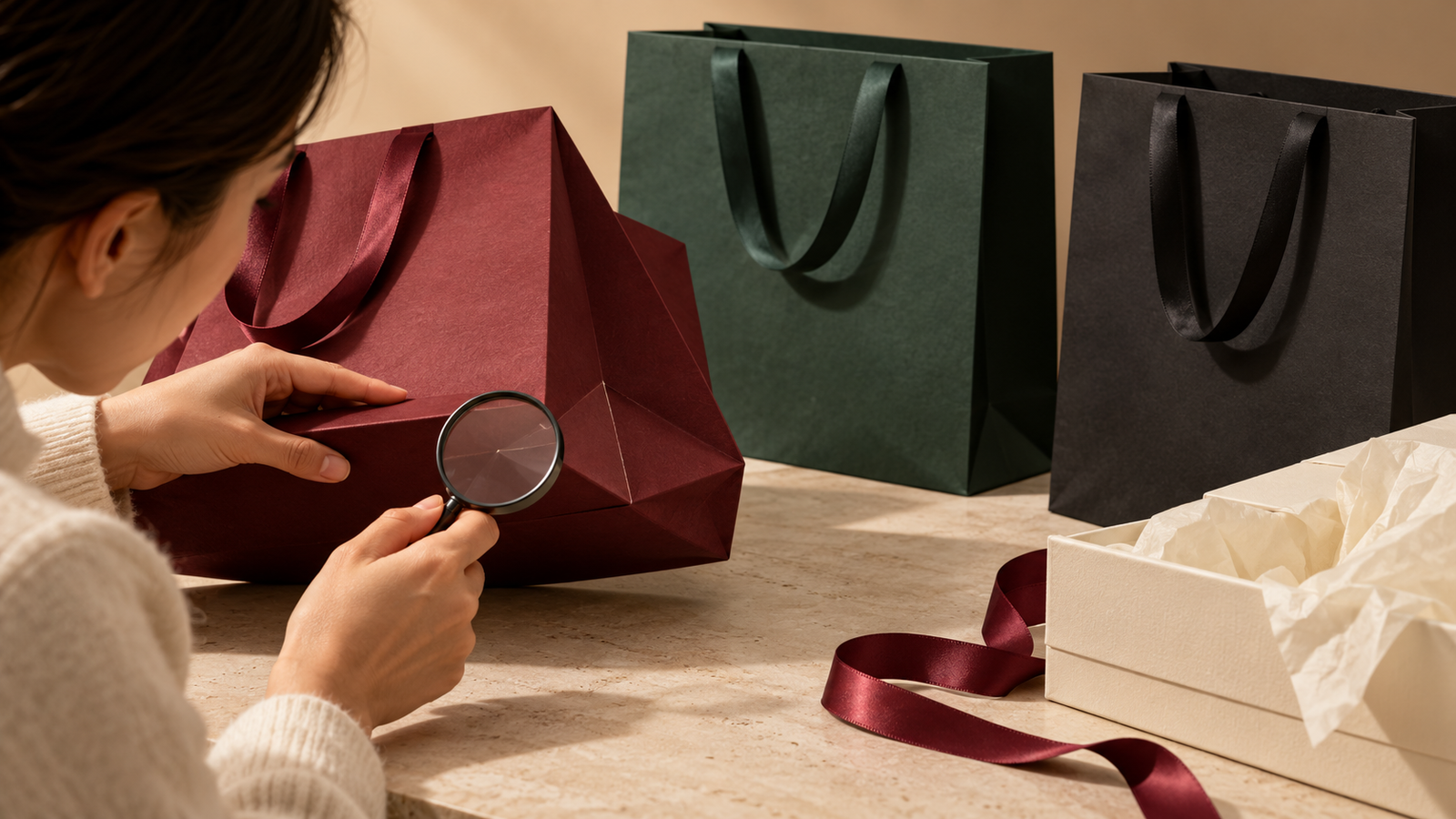
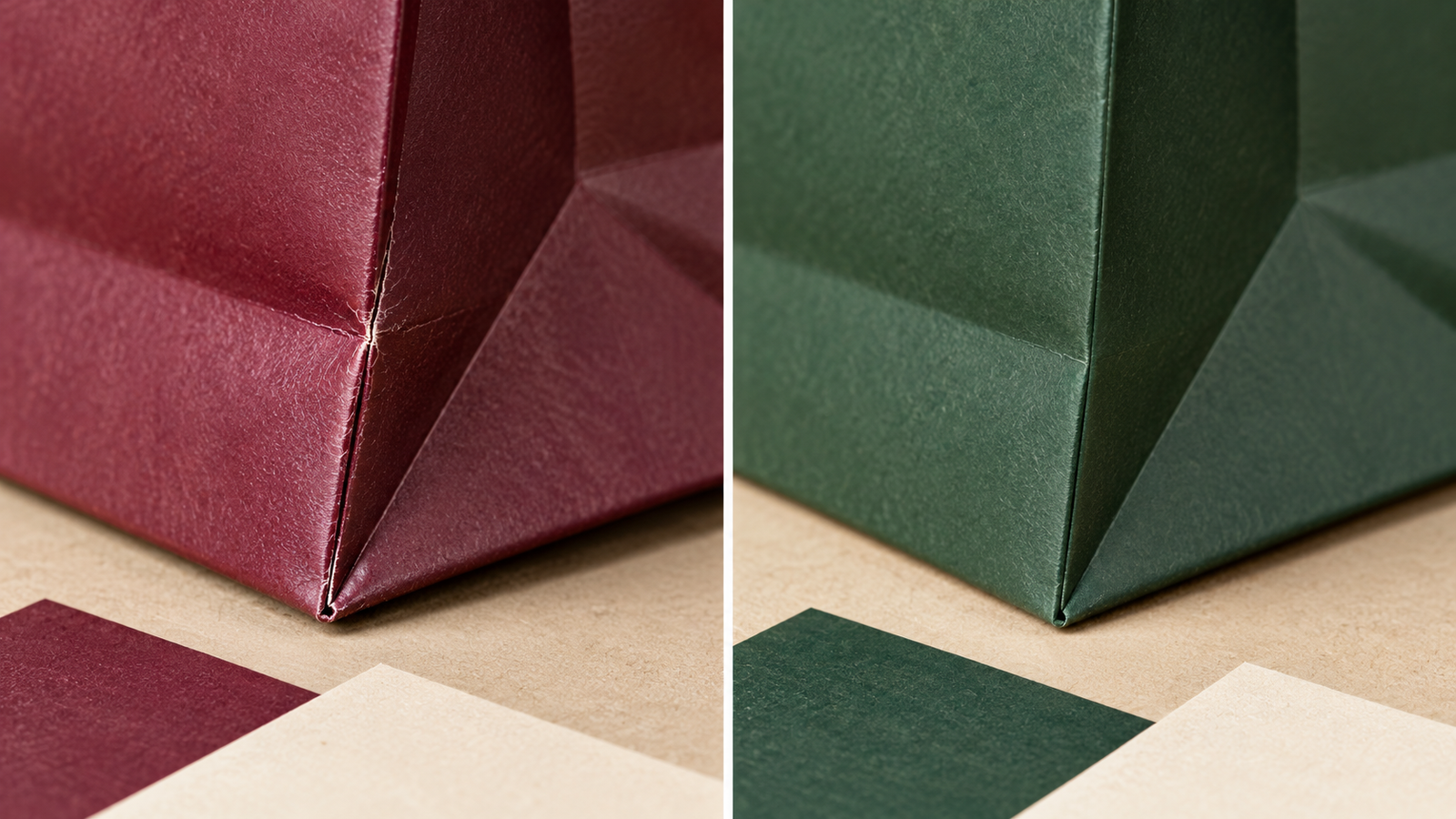
Paper bag fold cracking is the visible splitting or whitening that appears when a printed, coated or laminated sheet is converted along a side gusset, base fold or corner. It is most obvious on dark luxury paper bags, where a pale line interrupts an otherwise continuous burgundy, green or black surface. The defect is not caused by one variable alone: paper flexibility, ink coverage, surface finish, grain direction, moisture, crease geometry and folding pressure all meet at the same line.
The short answer
Printed paper bags crack at folds when the complete material stack cannot absorb the strain created during conversion or use. A heavier paper is not automatically safer, and lamination is not an automatic cure. The reliable route is to map structural folds on the artwork, choose a compatible paper-and-finish system, set the crease for the finished stack and approve a fully converted bag under realistic handling.
Is the defect only on the surface—or in the paper itself?
Surface cracking
The bag remains structurally intact, but ink, paper coating, varnish or film shows a pale, broken or flaked line. Dark solids make the contrast easy to see. Inspect the line under angled light and magnification, then compare it with an unprinted fold made from the same paper.
Fibre cracking or splitting
The paper layer itself tears, opens or loses strength at the fold. The defect may grow when the gusset is opened repeatedly or when the loaded bag is carried. This is a structural concern as well as an appearance concern and should be assessed with the actual bag construction and pack-out.
Sappi’s fold-endurance technical note makes the same useful distinction: stress may affect the ink and overcoat at the surface, or it may rupture fibres and lift paper and coating. That distinction should come before a supplier changes the paper, coating or crease setting.
What does each fold defect tell the buyer?
| What you see | First layer to investigate | Useful next check |
|---|---|---|
| Thin white line on a dark fold; sheet remains intact | Ink, coating, varnish or laminate | Compare printed and unprinted folds on the same paper; review coverage, curing and crease setup. |
| Jagged lifting or exposed fibres | Paper structure and fold direction | Open the gusset repeatedly and inspect whether the split grows or weakens the panel. |
| Film whitening, lifting or a sharp broken edge | Lamination and adhesive bond | Check film compatibility, adhesion, fold radius and the finished process sequence. |
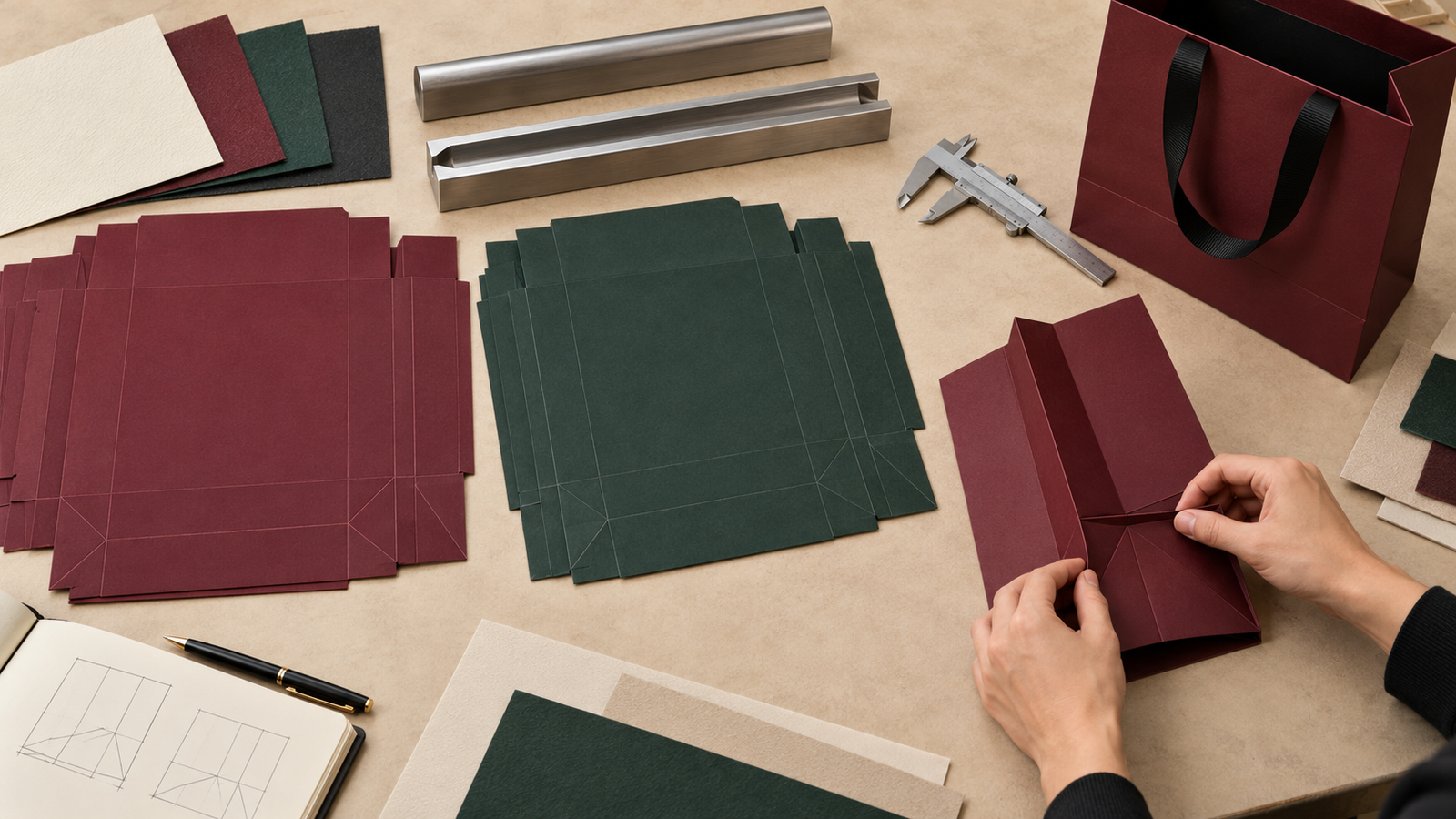
| Damage concentrated where folds intersect | Dieline geometry and local strain | Review the corner construction, crease intersections and conversion tooling. |
| Good sample but inconsistent production | Process control and conditioning | Compare retained samples by lot, machine setting, moisture condition and packing method. |
Why do luxury paper bags crack at the folds?
1. The paper and surface stack are too brittle for the fold
Coated paper can reproduce fine artwork and dense colour, but its surface layer has a different response to bending than the fibre base. Sappi notes that coated papers are generally more susceptible to crack-at-the-fold than uncoated papers and that heavier basis weights create a larger outside-fold strain. The practical lesson is not “avoid coated paper.” It is to approve the exact paper grade, coating, ink and finish as one converting system.
2. Dark artwork crosses a high-strain line
A white or light base sheet can make a small surface break look dramatic under a burgundy, forest-green or black solid. Heavy ink coverage and overcoats can also reduce flexibility locally. Place structural folds on the final dieline before approving artwork. If a critical logo edge, fine reversed type or uninterrupted dark field crosses a gusset, ask for a physical fold test rather than relying on a screen proof.
3. Grain direction and fold direction conflict
Paper bends differently with and across its dominant fibre direction. Sappi’s folding and creasing technical guidance recommends making the final fold parallel to the grain to reduce overstretching. A shopping bag has multiple vertical, diagonal and base folds, so grain is one design input rather than a universal single-fold solution. The converter should review it against the complete bag geometry.
4. Drying, curing or storage reduces flexibility
Paper exchanges moisture with its environment, while printing and curing introduce heat. Excessive drying, high curing energy or an uncontrolled dry finishing area can make the sheet less pliable. This is why a good laboratory swatch can still behave differently after printing, storage and conversion. Record the finished process sequence and inspect production samples—not only incoming paper.
5. The crease does not match the finished material
Crease width, depth, rule, channel and pressure need to suit the printed, coated or laminated stack. Too little definition forces the sheet to find its own fold. Excessive pressure can crush fibres or create an unnaturally sharp edge. The best setting for an unfinished paper is not necessarily the best setting after ink, varnish or film has been added.
6. A protective finish is treated as a guaranteed cure
Lamination or varnish can improve handling resistance, but every layer must still bend. A film may hide one kind of surface crack yet whiten, lift or split if the fold radius and adhesion are unsuitable. Review the complete choice in the laminated paper bag decision, then test it on the final fold.
How can fold cracking be reduced before production?
- Map every fold on the artwork dieline. Include side gussets, diagonal gusset folds, base turns, top turns and seam areas. Keep critical detail away from severe strain zones when the design allows.
- Choose the visual route and material route together. Compare coloured-through paper, printed coated paper, uncoated paper and laminated constructions against the required colour, touch and durability.
- Make test folds on the finished stack. Use the intended paper, print coverage, coating or film and curing sequence. A blank paper mock-up cannot prove the printed fold.
- Set creasing for the actual construction. Ask the converter to record the production-relevant rule, channel and pressure rather than treating scoring as an undefined line item.
- Approve a fully converted sample. Open the bag, form the gussets, inspect fold intersections and repeat the normal retail packing motion.
- Keep an approved reference and acceptance language. Define where minor whitening is acceptable, where no visible cracking is allowed and what becomes a structural rejection.
Fold behaviour can be measured as well as viewed. ISO/TS 23885:2022 specifies a method for evaluating coating strength in the inner fold for certain coated papers. Its scope is narrower than a converted shopping bag, so it should not be presented as proof of finished-bag performance. It does, however, reinforce an important point: coating strength at a fold is a distinct property that can be tested.
What should a converted-bag approval test include?
Appearance checks
- Inspect under diffuse light and angled light.
- Compare side folds, base folds and fold intersections.
- Check dark solids, fine type, foil and varnish near creases.
- Photograph the approved result at a consistent distance.
Functional checks
- Open and close the gussets through the intended packing motion.
- Load the actual product or representative maximum pack-out.
- Carry, set down, repack and inspect whether damage grows.
- Review packed transport protection and bag-to-bag rubbing.
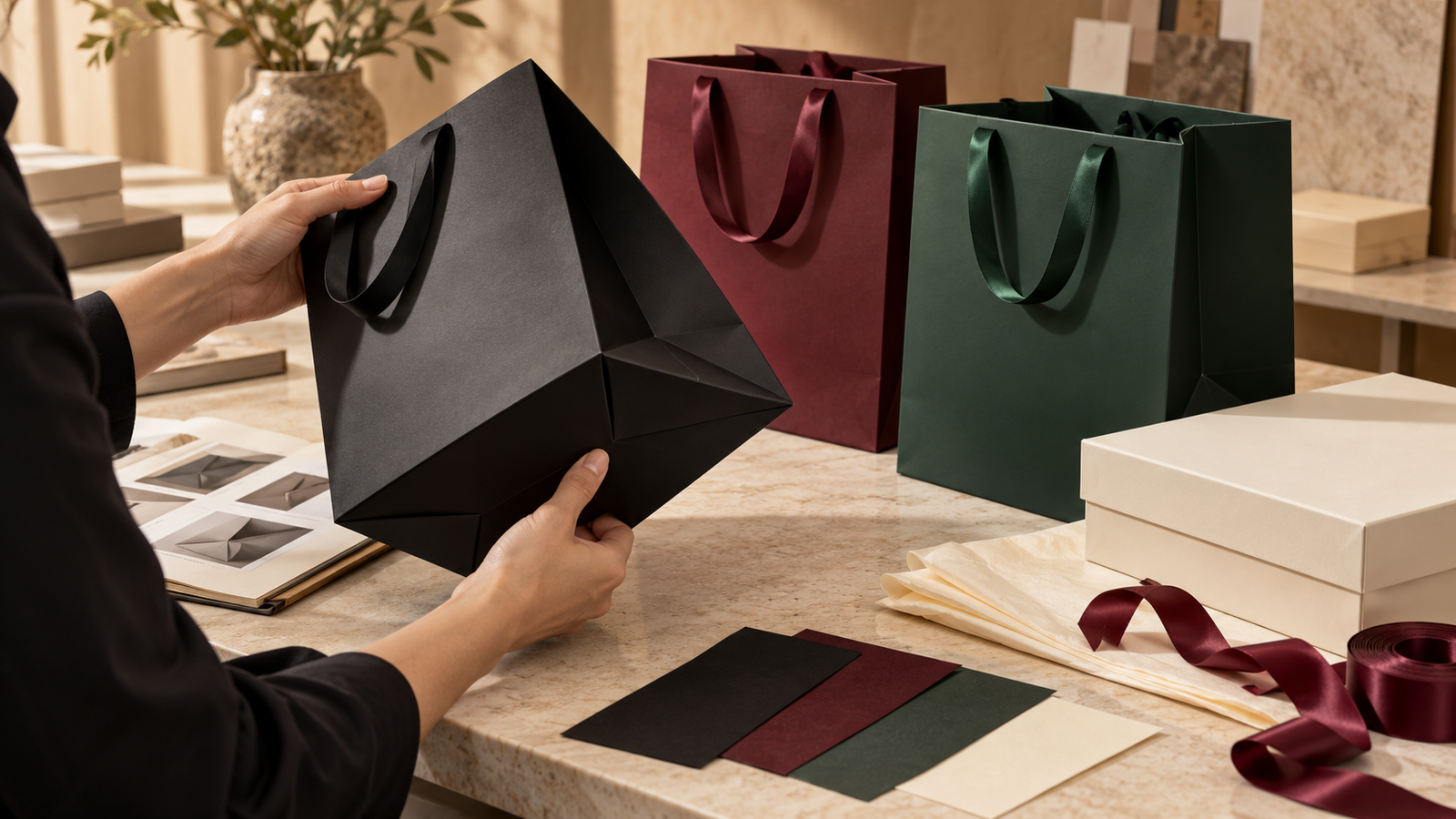
A luxury paper bag inspection should separate appearance limits from structural limits. A faint line visible only under close angled inspection is not the same failure as a fibre split that opens during packing. Agree the viewing condition, sample reference and rejection point before bulk production.
What should be included in the supplier brief?
- finished bag width, height and gusset, plus the approved dieline;
- product or gift-box dimensions, maximum packed weight and retail packing motion;
- paper grade, colour, surface, grammage and grain-direction requirement where relevant;
- print process, colour references, ink coverage and artwork layers;
- varnish, coating, laminate, foil or other finish in the exact process order;
- handle, turn-top, reinforcement, base board and seam construction;
- fold-crack acceptance criteria, inspection light and retained reference sample;
- sample stages, production checks, packing protection, quantity and delivery destination.
Can a dark paper bag avoid white fold lines completely?
A coloured-through paper can reduce the contrast created when a white base sheet becomes visible, but it does not remove every risk. The surface can still scuff, the fibre can still split and finishes can still fail. Printed white-base paper remains a valid route when it is compatible with the design and conversion process. The commercial choice is between controlled, tested systems—not between a “good” and “bad” material label.
How does fold control support the complete luxury pack?
The bag is the public-facing part of the purchase after it leaves the counter. Its colour and finish should coordinate with the rigid gift box, printed tissue paper and packaging ribbon, but it must also survive opening, packing, carrying and transport. Approving the complete set reveals whether the box catches the gusset, whether tissue changes the packing motion and whether the full load increases strain at vulnerable folds.
Frequently asked questions
Does higher paper GSM prevent fold cracking?
No. Grammage is only one property. A heavier or thicker sheet can create greater outer-fold strain and may need a different crease. Compare paper flexibility, coating, caliper, grain, print and crease setup on the finished construction.
Can lamination stop printed paper bags from cracking?
It can change the surface behaviour and improve some handling resistance, but it is not a guarantee. The film, adhesive, print, paper and fold still need to work together. Inspect for whitening, lifting and splitting on the converted sample.
Should artwork avoid every fold?
Not necessarily. Large colour fields often wrap around a bag by design. The important step is to identify high-strain areas, avoid placing critical details there when practical and physically test the actual printed fold before production.
Is a flat printed proof enough?
No. A flat proof can approve colour, content and registration, but it cannot prove how the sheet behaves after creasing, folding, gluing, opening and loading. Use a fully converted sample for final fold approval.
What photos should be included in a fold-cracking claim?
Include the full bag, the exact fold location, a close view under neutral light, the quantity affected, the production lot or carton reference and whether the line is only visual or opens when flexed. Keep affected samples for joint review.
Make the fold part of the specification
Send your bag dimensions, product or gift-box pack-out, artwork, paper direction, finish, quantity and destination. We can develop luxury paper bags, rigid boxes, tissue paper and ribbon as one coordinated, production-ready packaging set.