
CUSTOM CHOCOLATE PAPER BAG GUIDE
Custom Chocolate Paper Bags: A Practical Buyer’s Guide
Plan a premium paper shopping bag around the real chocolate box, retail handoff, seasonal range and food-contact boundary.
A custom chocolate paper bag should be designed around the finished chocolate box or gift set that customers actually carry. The box footprint, packed weight, lid style, ribbon and store-packing routine determine the useful bag size and construction. The best result feels generous and gift-ready without letting delicate boxes slide, tilt or disappear inside an oversized carrier.
For most premium confectionery projects, the shopping bag is an outer retail carrier rather than the material touching the chocolate. That distinction matters. The box, tray, cups or wrapper protect the food; the bag supports the complete packaged purchase and delivers the final visible brand moment. If any paper, tissue, ink, coating or adhesive will contact unwrapped food, it needs a separate food-contact assessment for the intended market and use.
This guide focuses on the buyer decisions that are specific to boxed chocolates, truffles, bars and seasonal gift assortments. Use our luxury paper bag size guide for general dimension terminology and the custom gift box range when the primary pack also needs development.
What makes a good paper bag for chocolate boxes?
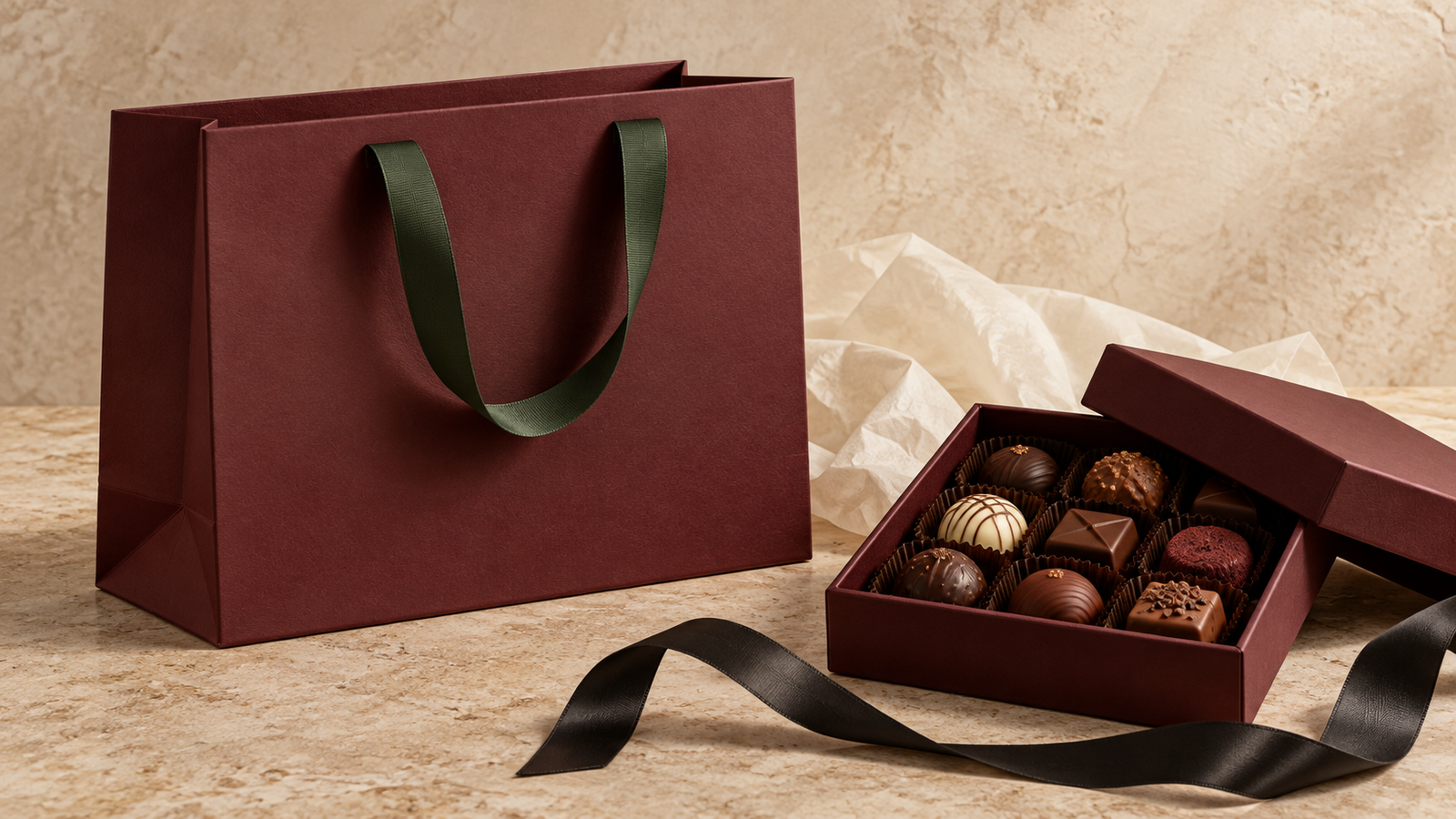
A good chocolate paper bag accepts the assigned box formats quickly, supports their combined packed weight, remains balanced in the customer’s hand and protects the presentation from avoidable knocks. Its paper, handles and finish should fit the brand, but structure and store usability come first.
| Chocolate purchase | Bag priority | What to test |
|---|---|---|
| Single small box of truffles | Compact proportion and controlled opening | The box is easy to load and does not vanish below excessive tissue |
| Long bar or praline box | Bag footprint that supports the full box length | The box stays level instead of pressing into one gusset |
| Medium seasonal assortment | Stable base and enough height for tissue or a card | The lid and decoration remain unmarked during packing and carrying |
| Stacked gift boxes | Reinforced construction and a planned stacking order | The lower box carries the load without lid distortion |
| Mixed purchase | Space for bars, boxed pieces and a receipt without uncontrolled movement | Small items do not drop beside or beneath the main box |
These are design principles, not standard dimensions. Chocolate packaging varies widely by piece count, tray design, box board, lid overhang, closures, decorative bands and seasonal sleeves. Start with the actual sale-ready packs, not a catalogue label such as “24-piece box.”
How should chocolate gift boxes be measured for a shopping bag?
Measure every box in its closed, finished and fully packed condition. Record the maximum external length, width and height, including a lid overhang, belly band, bow, seal or attached card. Record the gross packed weight and photograph the preferred orientation inside the bag. If two boxes are normally stacked, measure and weigh the stack as the store will present it.
The GS1 Package and Product Measurement Standard provides a consistent method for determining package dimensions and states that maximum distances should include projections, lids and attached components. It also includes examples for candy and snack packaging. A shared measurement method helps the chocolatier, box supplier and bag manufacturer work from the same physical reference.
Build a box matrix before choosing bag sizes
List each active box format, its packed weight, annual or seasonal quantity, sales channel and likely purchase combinations. Include limited-edition sleeves and bows because they can change clearance. Mark which boxes may share a bag and which need a dedicated format. This exposes awkward outliers before the bag range is quoted.
Specify the carry orientation
A shallow chocolate box normally travels best on its broad base. Long praline boxes may need a landscape carrier, while a compact square assortment may suit a portrait format. Do not rotate a presentation box onto a narrow edge merely to fit an existing bag unless the product team has confirmed that the tray, lid and chocolates remain secure in that orientation.
How much clearance should the bag allow?
There is no single clearance allowance that works for every chocolate box and bag construction. The usable space changes with paper thickness, turn-tops, side folds, base board, manufacturing tolerance and how fully the gussets open. The right clearance lets staff lower the box into place without scraping the lid or forcing the opening, while keeping movement controlled during carrying.
- Open a converted bag sample exactly as staff would at the counter.
- Insert the largest assigned box without tilting or pressing its lid.
- Confirm that the base opens flat and supports the complete footprint.
- Add the approved tissue, card, receipt and any secondary item.
- Lift, carry, set down and unpack the bag several times.
- Repeat with the smallest assigned box and the heaviest normal purchase.
- Ask retail staff whether the action is quick and repeatable during a busy period.
Too little space creates scuffed corners and slow service. Too much space allows movement, consumes more paper and weakens the deliberate presentation. Approve the real loading action, not only the nominal dimensions on a drawing.
How many chocolate paper bag sizes does a brand need?
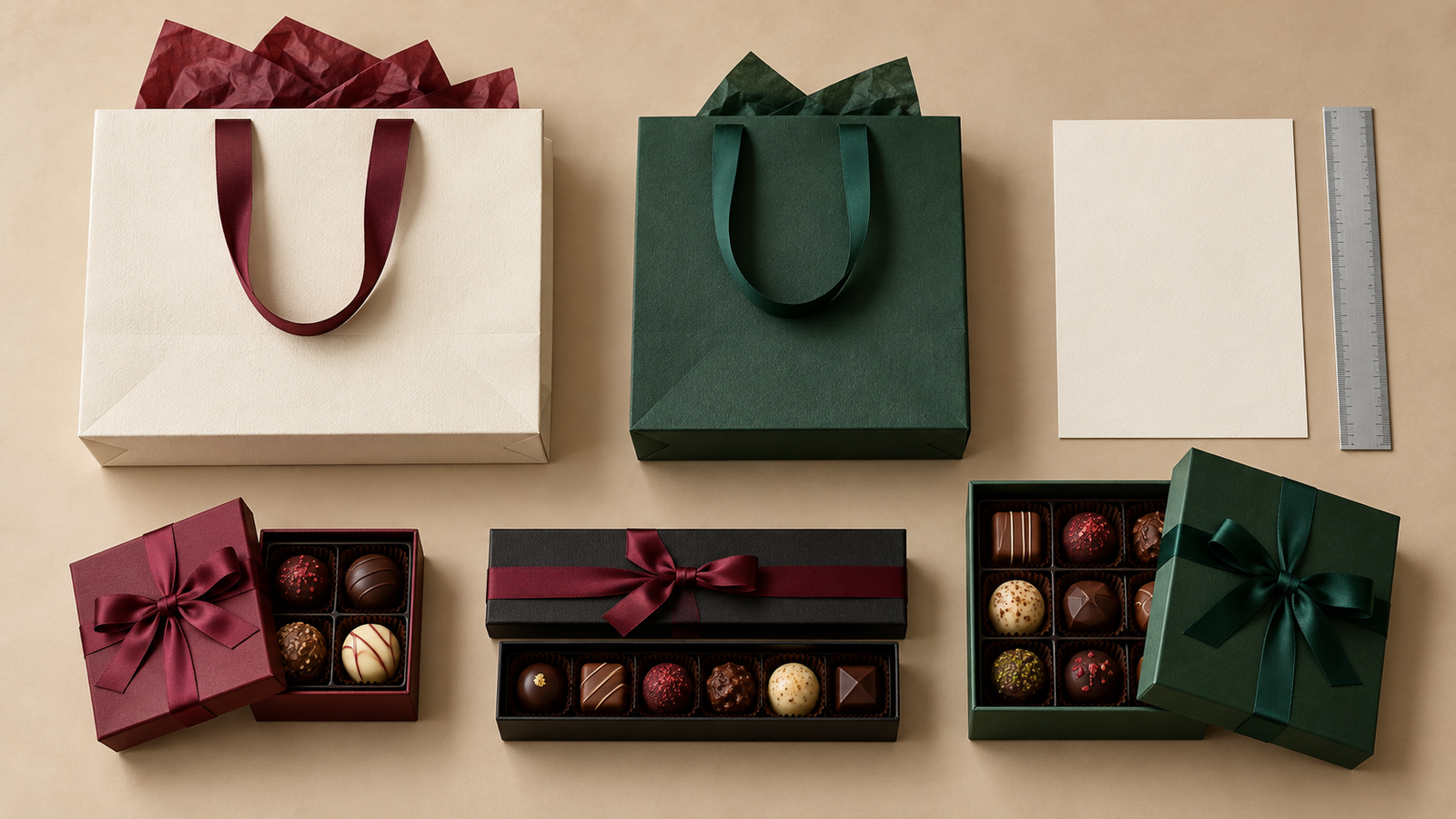
The smallest useful range is usually better than a visually even small-medium-large family. Group boxes by genuine fit and purchase behaviour. One compact bag may serve a small square box and several bars, while a second landscape bag may support medium gift assortments. A third format is justified only when large hampers, stacked boxes or seasonal collections create a different load.
Size consolidation can reduce artwork versions, inventory pressure and minimum-order exposure. Excessive consolidation produces oversized bags, extra tissue and unstable packs. Compare the unit economics with the operational cost of storing each bag SKU, then photograph every proposed box-to-bag combination for approval.
What construction supports boxed chocolates safely?
Chocolate boxes can be deceptively dense, especially when several assortments are stacked. The bag must transfer this load from the base through its walls and handle attachments without tearing, sagging or distorting the lower box. Paper grammage alone cannot predict that performance.
- Base board: spreads concentrated box weight and helps the bag stand square during packing.
- Turn-top reinforcement: supports rope or ribbon handle attachment areas.
- Controlled gussets: open around the box without sharp pressure points.
- Reliable seams: keep the load path intact through lifting and carrying.
- Matched adhesives: must suit the paper, coating, folds and expected storage conditions.
- Appropriate handles: should be comfortable with the heaviest normal purchase, not just an empty sample.
Define a practical loaded-bag check using the actual box combination and intended carry time. For broader requirements covering dimensions, handle attachment, seams, appearance and packing, use our luxury paper bag quality-control checklist.
Can a paper shopping bag protect chocolate from heat?
No ordinary paper shopping bag should be presented as temperature-control packaging. It can carry and visually protect closed boxes, but it is not a substitute for validated insulated packaging, cold-chain controls or product-specific storage instructions. Chocolate formulation, climate, journey time and retailer procedures all affect heat risk.
Keep the bag specification honest about its role. If the customer journey includes outdoor events, long transfers or hot delivery routes, the chocolate brand should define separate thermal controls. Any insulating insert or additional material also changes the fit, packed weight, disposal instructions and potential regulatory scope, so include it in sampling rather than adding it after bag approval.
Does the shopping bag need food-contact compliance?
It depends on the intended use. A bag carrying sealed or fully boxed chocolates is different from a bag intended to hold unwrapped confectionery. Write that boundary into the specification. If the bag, tissue or another component may touch food directly, ask the responsible supplier for market-specific compliance evidence covering the actual paper, ink, coating, adhesive and use conditions.
The European Commission’s food-contact materials guidance explains that materials intended to contact food, including paper, must comply with EU safety rules and good manufacturing practice. In the United States, the FDA identifies paper and paperboard, coatings and adhesives within its food-contact framework. These sources do not make every paper bag food-safe by default; compliance depends on the intended contact and the specific components used.
Do not infer compliance from a vague phrase such as “food grade.” State whether contact is direct or indirect, whether food is wrapped, the food type, expected contact time and temperature, destination market and documents required. Keep food-contact evidence separate from forest sourcing and recyclability claims.
Which paper, print and finishes suit premium confectionery?
Chocolate brands often rely on deep colour, fine linework and tactile materials. An uncoated or specialty paper can create a warm crafted feel; a coated stock can support crisp imagery and strong colour; a well-specified recycled paper can reinforce a material-led story. The paper still has to fold cleanly, carry the intended load and remain consistent across repeat orders.
Use foil, embossing, debossing, spot gloss or lamination selectively. A single controlled focal finish can feel more premium than several competing effects. Review artwork around gusset creases, the base fold and handle holes, and approve the finish on the actual production paper. Compare options in our luxury paper bag finishes guide and prepare files with the paper bag artwork checklist.
Which handles work for chocolate gift bags?
Ribbon handles can coordinate closely with gift boxes and create a soft hand feel. Cotton rope offers a rounded grip and suits a broad range of premium bags. Paper handles may support a fibre-focused direction when the design and load are validated. Choose the handle by packed weight, bag width, desired drop, assembly method, brand appearance and end-of-life plan.
Test handle drop with the filled bag. A very short drop can press the turn-top into the hand; an excessive drop can let a wide, shallow bag swing or tilt. The handle attachment must also remain clear of the box lid and tissue. See our detailed paper bag handle comparison for material and construction questions.
How should the retail packing workflow shape the bag?
Observe the real counter sequence. Staff may select chocolates, close or ribbon the box, add a product card, open the bag, place tissue, insert the box and finish the handoff. A bag that looks elegant in a photograph can still fail if it will not stand open, catches a delicate bow or takes too long to prepare during seasonal peaks.
- Can the flat bag be stored and opened quickly?
- Does it stand safely while the box is lowered inside?
- Can staff see the box orientation and avoid crushing the lid?
- Is tissue decorative, protective or both, and where is it placed?
- Do small bars or cards need a controlled position?
- Can the completed bag be handed over without touching unwrapped food?
- Will the bag remain comfortable through the customer’s likely journey?
How can the bag coordinate with boxes, tissue and ribbon?
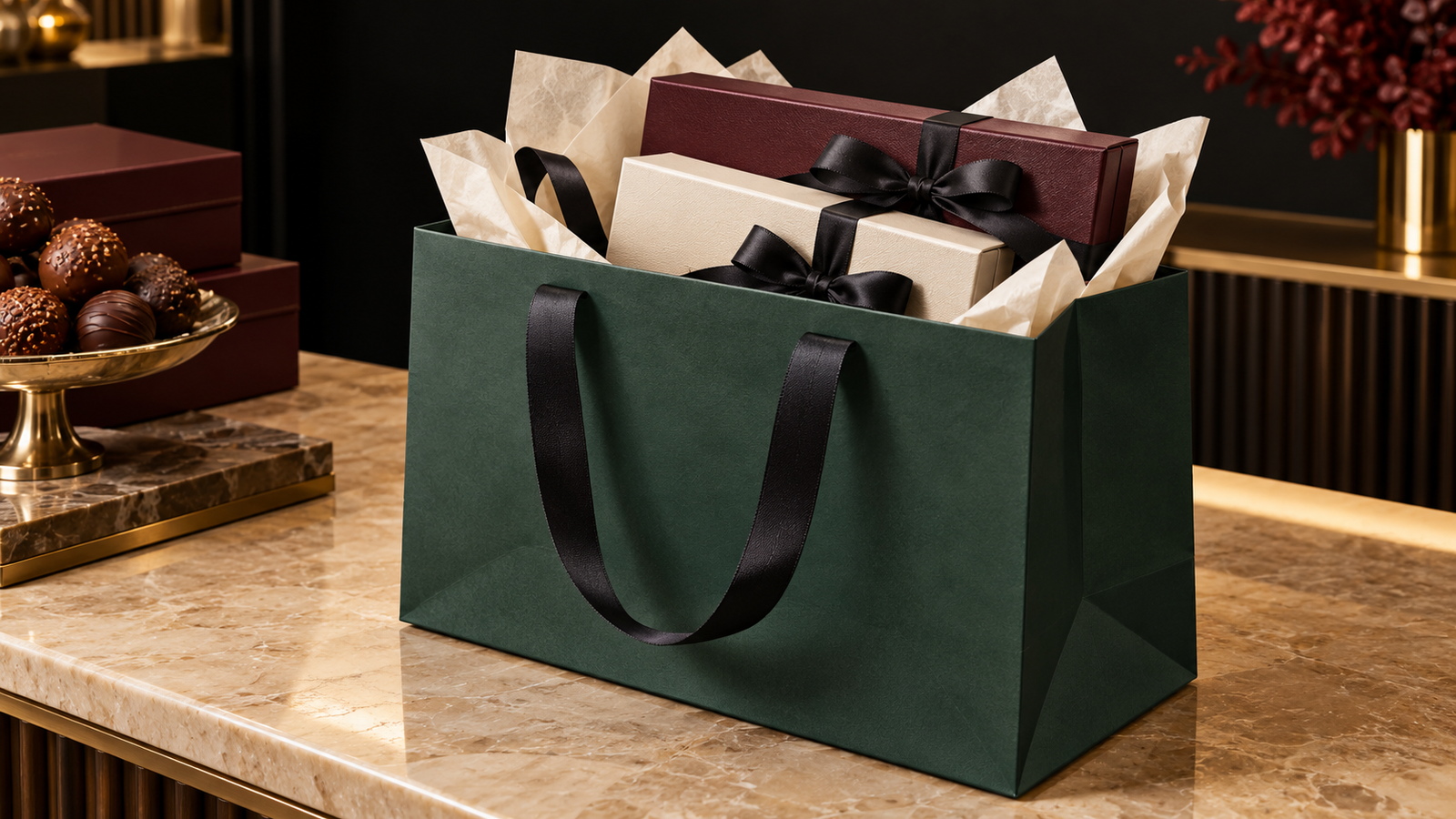
A coordinated set does not require every layer to match exactly. Let the rigid chocolate box carry the most detailed product story, use printed or coloured tissue for the reveal, introduce ribbon as a tactile accent and give the paper bag a strong, legible outward role. Repeating one colour, motif or finish is often enough to connect the system.
Review the full set under the lighting where it will be sold. Colour changes across coated paper, uncoated paper, tissue and satin ribbon. Confirm that the handles do not cover the main bag mark and that tissue supports rather than hides the gift box. Our custom printed tissue paper guide and luxury packaging set guide explain how to coordinate the layers without overdesigning them.
How should seasonal chocolate ranges be planned?
Chocolate sales often include permanent collections, gifting peaks and limited editions. Keep the bag range flexible enough to support seasonal sleeves or ribbon changes without creating unnecessary bag SKUs. An evergreen bag with a controlled seasonal tissue, tag or ribbon may reduce leftover stock, while a dedicated seasonal bag may be justified for a major campaign with a forecasted volume and reuse plan for surplus.
Work backwards from the in-store date. New sizes, specialty papers, complex finishes and fully printed samples add approval steps. Separate confirmed demand from optimistic volume, document replenishment lead time and avoid printing a year on a bag unless the stock is intentionally single-season.
What should a chocolate paper bag sample prove?
Begin with a blank converted prototype when the size or structure is new. Use it to confirm loading, balance, clearance, base support and handle comfort. Then approve a fully printed and finished sample when colour, texture, foil, embossing, tissue and ribbon coordination are important.
- Every approved box combination enters and leaves without damage.
- The base supports the full footprint and the bag remains upright.
- Small items do not move into hidden or crushing positions.
- Handles and attachment areas remain secure at the heaviest normal load.
- Print and finishes are clear of folds, seams and hardware.
- Tissue and ribbon can be placed consistently by retail staff.
- The bag survives realistic carrying, setting down and repacking.
- Flat-packed bags arrive at stores without marking visible panels.
Keep a signed approved master with the specification, colour references, packed box samples and test conditions. Our custom paper bag sampling guide explains what structural prototypes, print proofs, finish strike-offs and pre-production samples can and cannot prove.
How should sourcing and recyclability claims be verified?
Certified fibre sourcing, recycled content and recyclability are separate attributes. If an FSC label or order claim is required, verify the supplier’s current chain-of-custody scope, the exact claim on the sales documents and the approved artwork. FSC explains that chain-of-custody certification tracks certified forest-based material through manufacturing and distribution. Its revised trademark standard took effect in July 2026, so use current approved label files rather than copying an old mark.
Assess recyclability across the complete bag: body paper, inks, coatings, metallic decoration, handles, reinforcement and adhesives. The 4evergreen Circularity by Design Guideline, Version 4 explains how different constituents affect paper recycling processes and uses a decision tree to identify the relevant mill route. Avoid claiming that a bag is universally recyclable merely because its largest component is paper.
What should be included in a chocolate paper bag quote request?
- Finished external dimensions and gross packed weight for every chocolate box
- Box-to-bag orientation, normal purchase combinations and required clearance
- Quantities by bag size, seasonal split, delivery schedule and destination
- Confirmation that chocolates are fully wrapped or boxed, plus any direct food-contact use
- Paper colour, texture, sourcing and recycled-content requirements
- Print colours, artwork files and separate finish layers
- Handle material, colour, width or diameter and target drop
- Turn-top, handle and base reinforcement requirements
- Gift boxes, tissue paper, ribbon, cards or tags to coordinate
- Structural, colour, finish and pre-production sample expectations
- Inspection, load-check, flat-packing, carton and shipping requirements
Include photographs of the intended pack-out and send physical box samples when possible. A complete brief allows suppliers to quote comparable constructions and reduces assumptions about food contact, box orientation, seasonal artwork and accessory placement.
Frequently asked questions about custom chocolate paper bags
Can one paper bag fit all chocolate box sizes?
Only when the assigned boxes share a compatible footprint, height and packed weight. Test the smallest, largest and heaviest normal combinations. Many brands can cover most purchases with two well-planned sizes instead of forcing every pack into one oversized bag.
Should tissue paper touch unwrapped chocolates?
Not unless that exact tissue, ink and intended use have appropriate food-contact evidence for the destination market. Decorative tissue is normally kept outside the primary food pack, around a closed chocolate box or within the shopping bag.
Does heavier paper always make a stronger chocolate bag?
No. Strength depends on paper properties, grain direction, folds, seams, adhesives, gussets, base support, handles, reinforcement and manufacturing control. Approve the complete converted bag with the actual packed load.
Are ribbon handles suitable for heavy chocolate gift boxes?
They can be, provided the ribbon, attachment method, turn-top reinforcement and complete bag construction are validated for the packed weight. Test comfort and security with the heaviest normal purchase rather than relying on appearance alone.
What sample should be approved before production?
Approve at least a converted structural sample with the real chocolate boxes. When print, foil, embossing, tissue or ribbon are important, also approve a fully printed and finished pre-production sample against written colour and construction references.
Build the bag around the finished chocolate gift
A premium chocolate paper bag works because its decisions are connected. Measure the finished boxes, define the purchase combinations, prove clearance and carrying performance, keep food-contact responsibilities clear, and approve the bag with tissue, ribbon and store workflow in place. The result is a refined outer carrier that protects the presentation and makes the complete gift feel intentional.
Plan a chocolate paper bag around your real gift boxes
Share your chocolate box dimensions, packed weights, bag quantities, delivery market and visual direction. Bespoke Packaging can help develop a coordinated paper bag, rigid gift box, tissue and ribbon specification for quotation and sampling.