
CUSTOM PACKAGING RIBBON GUIDE
Custom Packaging Ribbon: A Practical Buyer’s Guide
Choose ribbon by weave, fibre, width, colour, branding and real packing use—then approve it on the finished bag or box.
Custom packaging ribbon is a woven or otherwise formed textile trim specified for a particular gift box, paper bag, wrap or retail packing routine. The best choice is not simply the ribbon that looks most luxurious on a swatch. It is the ribbon whose surface, fibre, width, colour, print, cut edge and tying behaviour work together on the real package.
Satin offers a smooth, light-catching face; grosgrain adds visible ribs and a firmer hand; cotton ribbon gives a softer, matte textile character. Those descriptions refer to different aspects of the ribbon, so a useful buying brief must separate surface or weave from fibre content. A polyester satin and a silk satin can share a visual family but differ greatly in price, availability, care and consistency. The same principle applies to printed, woven and plain-colour branding.

Which ribbon is best for luxury packaging?
There is no universal best packaging ribbon. Start with the job the ribbon must perform, then compare samples on the actual pack. Satin is a strong first option for a polished bow or smooth branded surface. Grosgrain suits a more structured, tactile tie. Cotton ribbon works when a matte, natural-looking hand supports the design. Velvet, organza and speciality constructions can create a specific effect, but they should earn their place through the brand brief and packing process rather than novelty alone.
| Ribbon direction | What it contributes | What to prove on a sample |
|---|---|---|
| Satin | Smooth face, controlled sheen and fluid drape | Bow shape, slipping, surface marking, print or foil adhesion and the appearance of both faces |
| Grosgrain | Ribbed texture, firmer hand and visible structure | Logo clarity across the ribs, bend around corners, knot bulk and cut-edge finish |
| Cotton ribbon | Matte texture and a soft, textile-led expression | Shade consistency, lint, fraying, print sharpness and handling marks |
| Velvet or speciality ribbon | Pronounced texture, depth or transparency | Crushing, direction of pile, colour transfer, tying speed and repeat availability |
If the ribbon will become a handle rather than a removable box tie, treat it as a load-bearing component. Width, attachment, reinforcement and carry testing matter more than decorative drape. Our luxury paper bag handles guide covers that separate structural decision.
What does “satin”, “grosgrain” or “cotton ribbon” actually describe?
Satin and grosgrain mainly describe how a ribbon surface is constructed and appears; cotton and polyester identify fibre content. A buyer should therefore avoid a specification that says only “burgundy satin ribbon”. It leaves unanswered whether the ribbon is single-faced or double-faced, what fibre it uses, how wide and heavy it is, whether its edges are woven or cut, and what colour reference and finish the supplier must match.
When should you choose satin ribbon?
Choose satin when a clean sheen, smooth hand and elegant drape lead the visual brief. Double-faced satin is useful when both sides remain visible as the ribbon crosses a lid or forms a bow. Single-faced satin may work when the reverse can be controlled, but a flipped loop can expose a visibly different side. Smooth satin also gives fine artwork a more even visual ground than a strongly ribbed construction, although every print or foil treatment still needs a production-relevant proof.
When should you choose grosgrain ribbon?
Choose grosgrain when the brand needs a tactile rib, a firmer tie or more visual structure. Its crosswise ribs can help a bow feel crisp, but they also interrupt very fine printed detail. Test the smallest type, line and reversed area at actual size. A bold symbol may reproduce well where a delicate serif or thin foil rule becomes uneven across the ridges.
When does cotton ribbon make sense?
Cotton ribbon can support a quiet, crafted or material-led presentation. Its matte surface pairs naturally with uncoated papers and restrained print. “Cotton” is not a guarantee of a particular environmental outcome, however, and it does not describe weave, dyeing, finishing or certification. Ask for the precise composition, construction and evidence required by the brand rather than converting a fibre name into a broad sustainability claim.
How should you choose ribbon width and cut length?
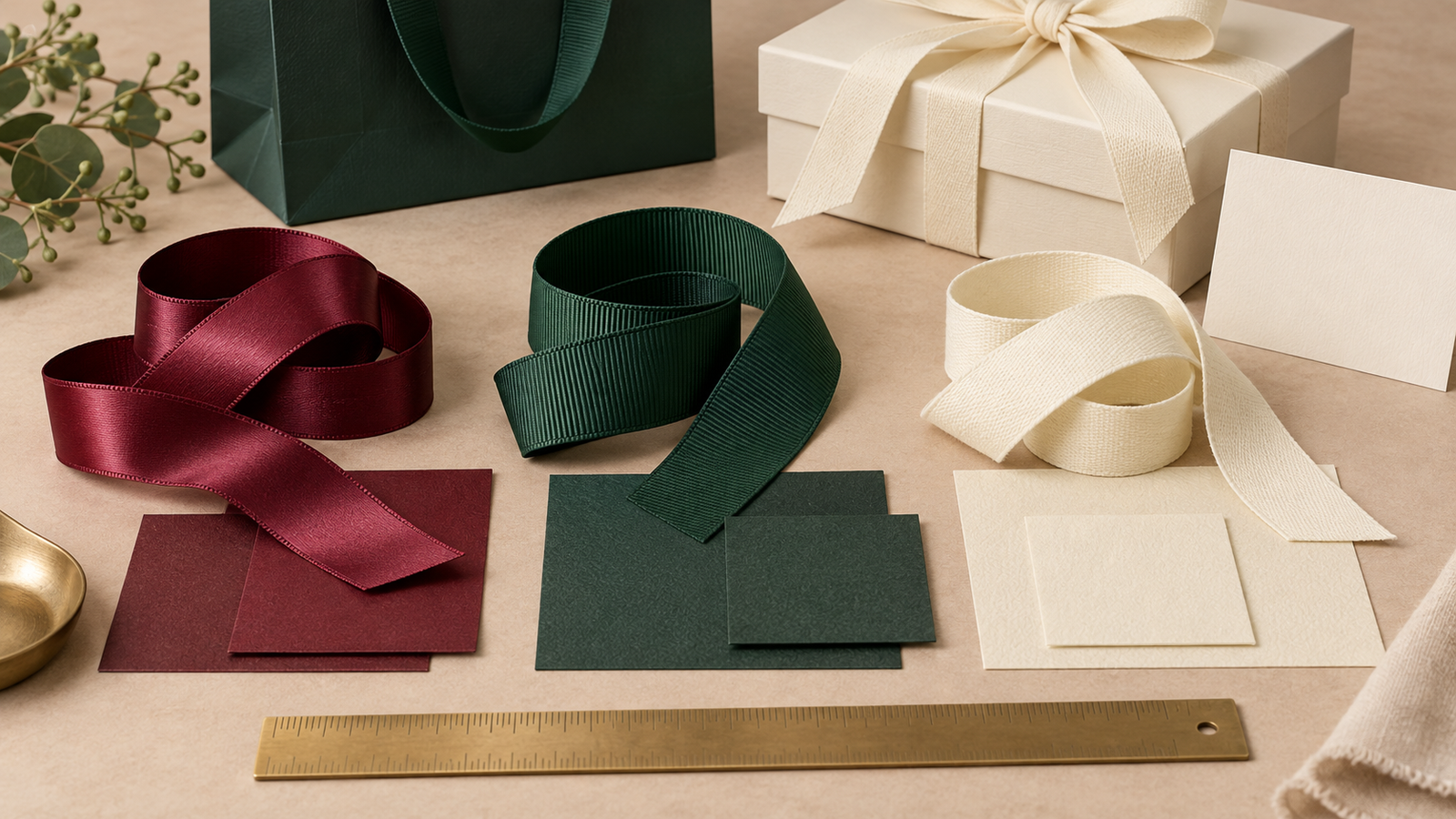
Ribbon width is a proportion decision and an operating decision. A narrow ribbon can look refined on a compact jewellery box yet disappear on a large presentation box. A wide ribbon creates more colour and a fuller bow but uses more material, covers more artwork and can slow hand tying. The right width is the option that creates the intended hierarchy without obstructing the opening experience.
- Mock up at least two widths on the actual box, not on an isolated card.
- Check whether the ribbon crosses a lid, passes through a slot, wraps a sleeve or forms a separate bow.
- Define the finished bow style and number of loops before calculating cut length.
- Include the allowance consumed by knots, folds, tails and any trimming method.
- Test the longest practical packing shift; a beautiful tie that is slow or inconsistent can become an operating problem.
- For pre-cut pieces, specify length tolerance, edge treatment, packing orientation and count.
Do not copy a universal width or cut length from an online guide. Box dimensions, ribbon hand, bow style and packer technique all change the result. A physical tying trial is a faster route to a dependable specification.
Should packaging ribbon be plain, printed or woven?
Plain custom-dyed ribbon makes colour and texture the brand cue. Printed ribbon adds a logo, message or repeat pattern to an existing surface. Woven branding builds the motif into the textile construction. None is inherently more premium; each creates a different edge definition, hand feel, cost structure and sampling route.
- Start from viewing distance. A ribbon tied on a small box is read close up, but a branded paper-bag handle or large hamper bow may be seen farther away.
- Simplify the artwork. Tiny text, very thin rules and crowded repeats are vulnerable to weave texture, ribbon movement and small registration shifts.
- Set the repeat around the application. Place a full logo where it will remain visible after the ribbon wraps a lid or forms loops and tails.
- Choose a process with the supplier. Ink printing, transfer processes, foil transfer and woven motifs need different artwork and ribbon surfaces. Ask which route is proven on the selected construction.
- Approve the converted result. Judge the ribbon after cutting, tying, folding and packing—not only as a flat length from a roll.
The artwork file should state the ribbon width, motif size, repeat direction, colour references, one- or two-sided requirement and acceptable orientation at joins. The paper bag artwork guide explains the same production principle for dielines: artwork becomes reliable only when it is mapped to the actual object and process.
How do you match ribbon colour to bags, boxes and tissue?
A screen value is not a production standard. Ribbon fibres, weave, dye, sheen and viewing angle change perceived colour, while coated paper, uncoated paper, foil and tissue reflect light differently. Pantone explains that its PMS graphics system and Fashion, Home + Interiors system serve different materials and uses; its FHI guidance identifies TCX for soft textile surfaces. That is why a printed packaging reference and a textile reference may need to be translated rather than treated as identical instructions.
Give the supplier the reference system, code, physical standard and viewing conditions you intend to use. Then approve the ribbon beside the production paper, box wrap and tissue. Exact sameness across dissimilar materials may be neither possible nor desirable. A controlled relationship—matching hue with deliberately different sheen, for example—often looks more considered. Our packaging colour guide explains how to keep digital, print and physical references separate.
What performance checks matter for packaging ribbon?
Decoration still has to survive production, retail and customer handling. Inspect the characteristic that creates risk for the chosen application rather than applying an unrelated generic test list.
- Colour transfer: rub dark ribbon against the light paper, tissue or product surface it will touch. ISO 105-X12:2016 describes dry and wet rubbing tests for textile colour fastness; a project can reference a relevant method and define its own acceptance requirement with the supplier.
- Fraying and edge quality: check every specified cutting method after handling and tying.
- Slip and knot security: confirm whether the approved bow loosens during packing, transport or display.
- Creasing and surface marking: wrap the ribbon around the real corner radius and leave it packed for the intended time.
- Print or foil resistance: flex and tie the decorated area, then inspect cracking, loss, offset and staining.
- Width and thickness consistency: verify that ribbon passes through slots, channels or automated guides without binding.
- Packing compatibility: check that rolls, pre-cut lengths or pre-tied bows arrive protected, untangled and ready for the packing line.
A removable gift-box ribbon is not a structural paper-bag handle. If one ribbon is proposed for both roles, approve each application separately and test the bag as a complete load-bearing construction.
How should sustainability and safety claims be specified?
Begin with a precise bill of materials: fibre content, recycled-content claim if any, dye or finish, print layer, attachments and how the ribbon is used. “Eco ribbon”, “natural” and “recyclable” are not complete specifications. A ribbon made with recycled polyester remains a textile component; the evidence for its recycled content is separate from the recyclability claim for the paper box or bag it decorates.
Textile Exchange states that the Recycled Claim Standard and Global Recycled Standard establish third-party criteria for recycled materials and chain of custody. Its current Materials Matter transition information says the new standard becomes effective on 31 December 2026 and mandatory for relevant Tier 4 audits from 31 December 2027. Buyers using these claims should verify the supplier, product scope, transaction evidence and claim rules that apply when the order is produced; a recycled yarn statement alone does not prove an approved final-product claim.
OEKO-TEX STANDARD 100 applies to textiles and accessory materials and bases testing on intended use; its 2026 standard also makes clear that certificate scope defines which items are covered. If a brand requires this certification, verify the certificate number, validity and exact ribbon scope rather than accepting a logo image. For the paper-based pack, the February 2026 4evergreen Circularity by Design Guideline advises assessing how components affect the relevant sorting and recycling route. Keep decorative ribbon removable where practical, avoid unnecessary material, and confirm disposal guidance in the destination market.
Which ribbon samples should you approve?
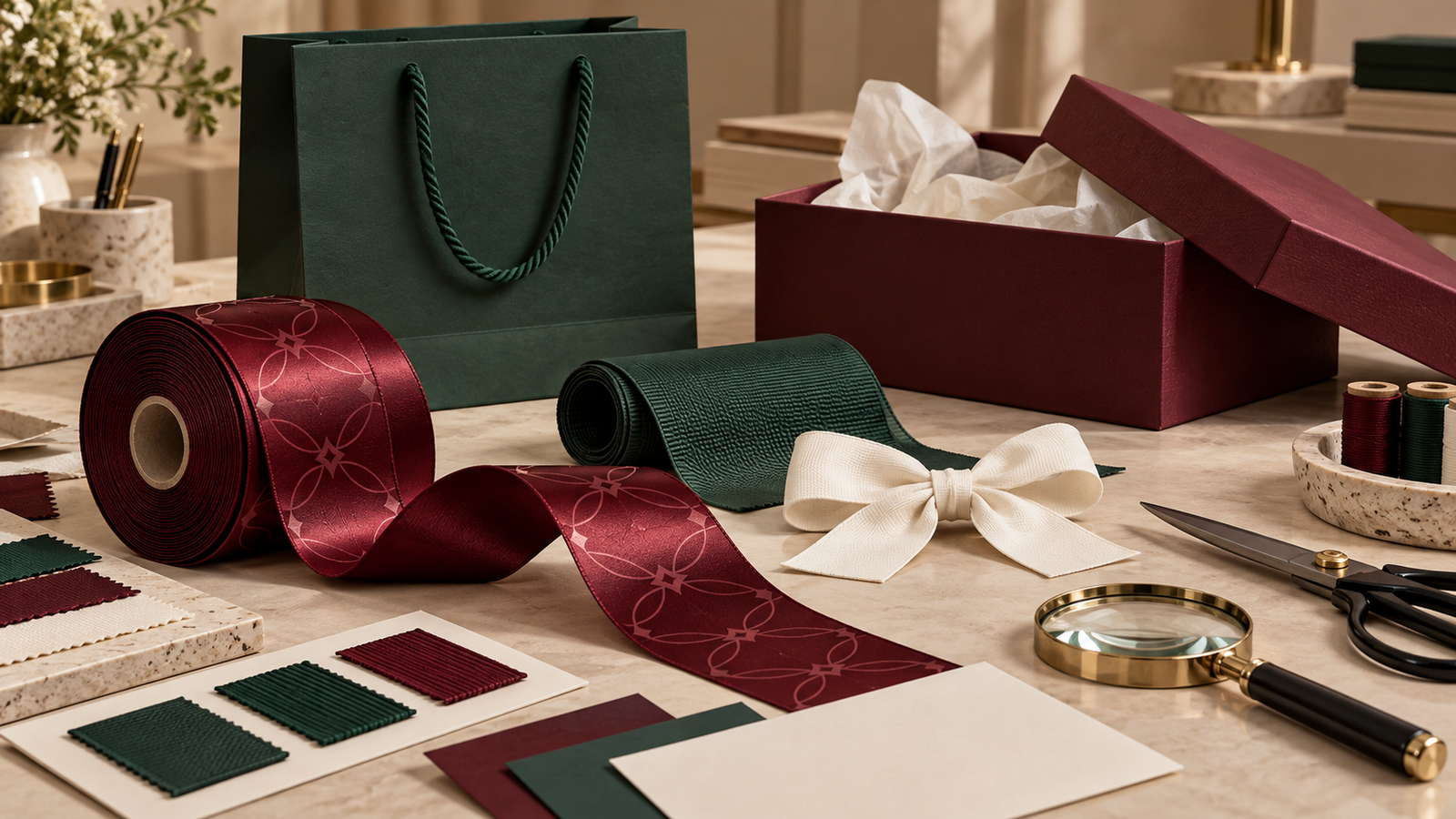
Use samples to answer separate questions in sequence. A stock swatch shows approximate weave, hand and sheen. A lab dip or custom colour trial addresses shade. A printed or foil strike-off addresses artwork, repeat and adhesion. A cut-and-tied application sample shows the customer-facing result. For a coordinated programme, approve the ribbon on the actual rigid gift box and beside the luxury paper bag and tissue.
- Shortlist construction, fibre and width with stock samples.
- Approve a physical colour reference under agreed lighting.
- Proof the smallest and most demanding artwork at production size.
- Cut, wrap and tie the ribbon using the real package and method.
- Check rub, fray, slip, fold and visible repeat placement.
- Sign and retain an approved reference with date, version and supplier identification.
- Use the approved reference for bulk inspection and repeat orders.
Our custom packaging sampling guide uses the same evidence-led approach: approve only what a sample is capable of proving, and label each reference clearly.
What should be checked during bulk production?
Turn the approved sample into a short inspection specification. Record fibre and construction, finished width, roll or cut length, colour reference, artwork and repeat, printed side, edge treatment, joins, bow style, packing method and quantity. Then identify appearance defects and functional defects separately.
- Compare shade and sheen across rolls and against the approved master.
- Measure width and cut length using the agreed method and tolerance.
- Inspect weave defects, contamination, pulls, crushing and inconsistent edges.
- Check logo size, repeat spacing, orientation, registration and missing print.
- Flex and rub decorated areas in the way the packing operation will handle them.
- Tie representative pieces on production boxes and review the finished bow.
- Confirm roll lengths, cores, splice policy, pre-cut counts and carton identification.
- Photograph and retain representative accepted and rejected examples.
Inspection frequency and acceptance criteria should match order risk, application and supplier agreement; there is no responsible universal tolerance for every ribbon. When ribbon ships with bags, boxes and tissue, reconcile the complete set so one missing accessory does not stop the packing line. The luxury packaging quality-control checklist shows how to connect approved references, measurements and real-use checks.
How should ribbon work across a complete luxury packaging set?
Give every layer one clear role. The paper bag is the public-facing carrier. The rigid box protects and stages the closer reveal. Tissue softens and controls that reveal. Ribbon adds movement, tactility and a deliberate moment of opening. Repeating the same large logo on all four components usually creates noise; coordinating colour, scale and finish creates a more confident system.
- Use a bold bag mark and a quieter plain ribbon when the carrier already leads.
- Use branded ribbon to introduce identity when the box itself is deliberately minimal.
- Echo one secondary colour across ribbon and printed tissue paper rather than forcing an exact paper match.
- Keep the ribbon clear of fragile foil, embossed details and frequently handled box edges.
- Pack the complete set exactly as a store or fulfilment team will use it before approval.
The luxury packaging sets guide explains how to coordinate paper bags, gift boxes, tissue and ribbon without making every surface identical.
What should a custom packaging ribbon RFQ include?
A comparable ribbon quotation needs more than colour and total metres. Send the application, package dimensions, expected quantity and packing location together with the specification.
- Application: box tie, bow, sleeve, tissue bundle, tag, bag decoration or load-bearing handle
- Ribbon construction and fibre composition
- Single- or double-faced requirement
- Finished width, thickness or weight reference where relevant
- Colour system, code and physical master
- Plain, printed, foil-transferred or woven branding
- Artwork size, colours, repeat, orientation and printed side
- Roll length, core and splice rules, or pre-cut length and edge treatment
- Required samples, tests, certificates and approved references
- Packing format, quantities, delivery destination and target date
- Whether ribbon must be coordinated with paper bags, gift boxes or tissue paper
Ask suppliers to separate tooling, colour development, sampling, ribbon, printing, pre-cutting, pre-tying and delivery costs where they materially change the quote. This makes alternatives easier to compare and prevents a low per-metre price from hiding an unsuitable packing format.
Frequently asked questions about custom packaging ribbon
Is satin or grosgrain better for gift boxes?
Satin is usually the better starting point for smooth sheen and soft drape. Grosgrain is useful when visible texture and a firmer bow are more important. Tie both options on the actual box because width, corner radius, bow style and handling can reverse a decision made from loose swatches.
Can a logo be printed on any ribbon?
Not with equal results. Surface texture, fibre, finish, colour, ribbon width and the selected print or transfer process affect detail and adhesion. Ask the supplier to recommend a proven route, then approve the real artwork on the intended ribbon.
How wide should packaging ribbon be?
There is no universal width. Choose it in proportion to the box or bag, the logo size, the bow volume and the packing method. Compare two or three physical widths on the finished pack before ordering.
Can ribbon colour exactly match printed paper?
It can be coordinated closely, but exact visual sameness is not assured because textile and paper surfaces absorb and reflect light differently. Use appropriate physical standards and approve the materials together under agreed lighting.
Is recycled polyester ribbon automatically sustainable?
No single material name proves an overall environmental claim. Verify composition, recycled-content evidence, chain of custody and applicable claim rules. Also consider how much ribbon is used, whether it is removable or reusable, and how it affects the complete packaging system.
What information is needed for a ribbon quote?
Provide application, construction, fibre, width, colour reference, branding method, artwork, repeat, quantity, roll or cut format, packing requirement, delivery destination, deadline and any required samples, tests or certifications.
Choose ribbon as part of the package, not as an afterthought
Successful custom packaging ribbon connects the visual brief with a repeatable packing operation. Define the weave and fibre, prove width and cut length on the package, simplify branding for the surface, approve colour physically, test the handling risks and document the bulk reference. The result should make the luxury paper bag or gift box feel complete without creating avoidable material, labour or quality problems.
Bespoke Packaging develops branded ribbon alongside custom luxury paper bags, rigid gift boxes and tissue paper. Share your package dimensions, ribbon application, preferred colour and texture, quantity, delivery market and target date so the complete set can be sampled and quoted together.