
CUSTOM CAKE PAPER BAGS GUIDE
Custom Cake Paper Bags: A Practical Buyer’s Guide
Specify a wide-base premium paper bag around the closed cake box, packed weight and bakery handoff—then prove level carrying on a physical sample.
Custom cake paper bags are wide-base carriers sized to hold a closed cake box flat and stable during a bakery handoff. The bag should be designed from the actual box footprint, packed weight and carrying routine—not selected from a generic shopping-bag chart. A successful specification combines usable loading clearance, deep gussets, a supported base, balanced handles and a physical test with the real packed box.
The paper bag is normally secondary carrying packaging: the cake remains protected inside its primary cake box. That distinction shapes material and food-contact requirements, but it does not remove the need to manage moisture, handling and contamination risks in the real bakery environment. This guide explains what a buyer should measure, sample and put into a comparable quote request.
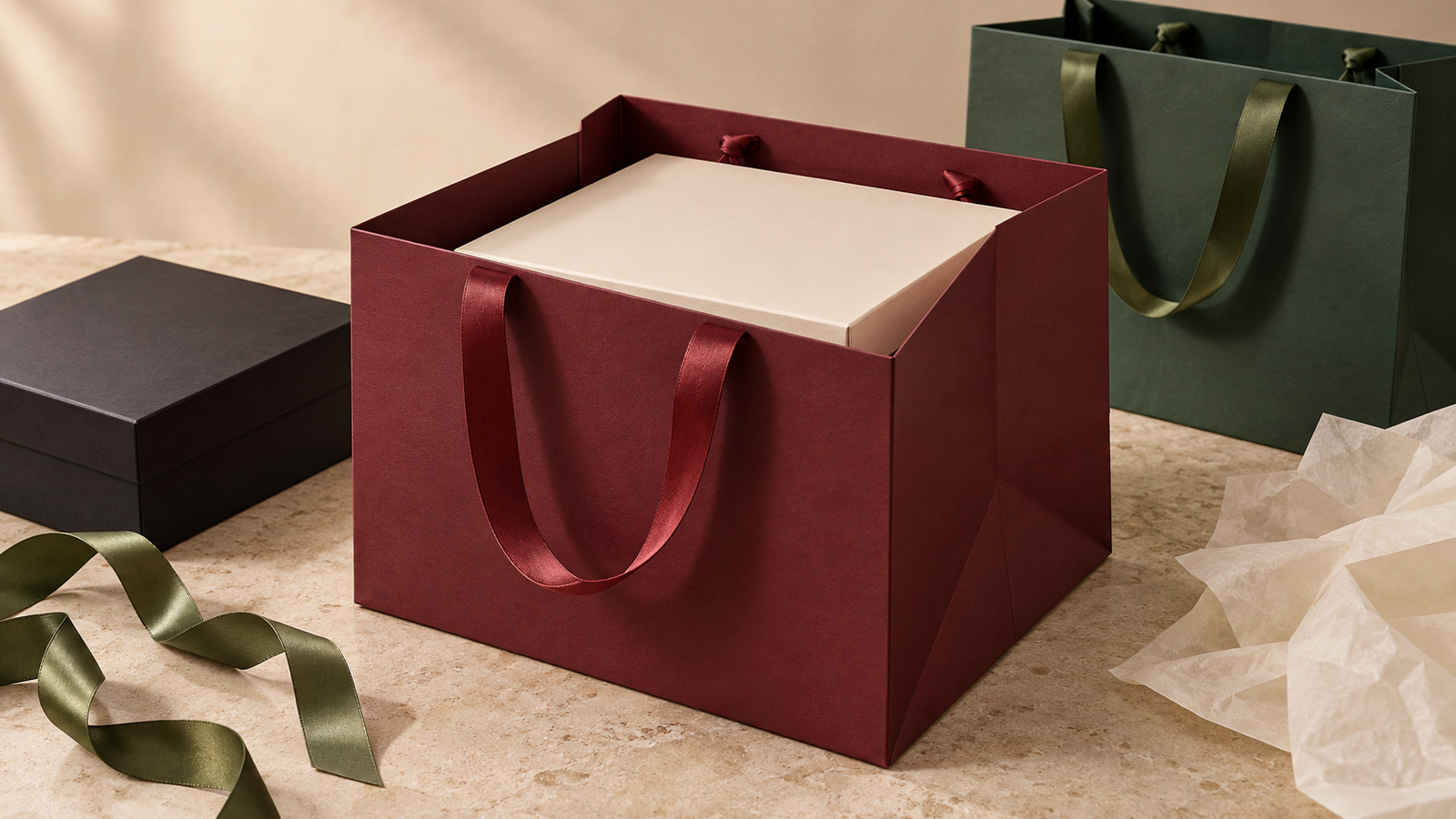
What makes a cake paper bag different from a standard shopping bag?
A typical cake box is wide and relatively low. It must stay close to horizontal, and its footprint may be much larger than its height suggests. A standard portrait shopping bag can be tall enough but still have too little gusset depth, forcing the box to tilt during loading. An oversized general-purpose bag can create the opposite problem: the box moves across the base and becomes harder to control.
A cake carrier therefore needs a base that supports the closed box in its intended orientation. Bag width, gusset and height must work together. The handles must lift symmetrically, and the top opening must give staff enough access to lower and remove the box without catching corners. The finished pack should feel premium at the counter while remaining practical for the journey to the customer’s destination.
| Design question | Cake-box requirement | Risk if ignored |
|---|---|---|
| Base footprint | Supports the closed box flat | Box tilts, bows the bag or sits on folded gussets |
| Loading clearance | Allows hands and box corners to pass | Staff must force or angle the box |
| Side support | Limits unnecessary movement without crushing the box | Pack slides or arrives with damaged edges |
| Handle balance | Lifts the packed bag evenly | Bag leans and cake presentation is disturbed |
| Base and seams | Carry the stated packed weight | Bottom deflects or adhesive joints fail |
How do you measure a cake box for a paper bag?
Measure the box that will actually enter the bag: closed, assembled and containing any board, insert, pad or protective component used in production. Record the external dimensions at the widest points. Use one consistent order—width, depth and height—and include units on every drawing and quotation. Do not rely only on the nominal cake diameter because the finished box, not the food, controls bag fit.
The GS1 Package and Product Measurement Standard provides a common framework for assigning package dimensions. Your bag project may use its own agreed orientation, but the principle is valuable: define what is being measured, how it is presented and which dimension each number means. Photographs and a physical box sample help prevent a supplier from rotating the footprint or interpreting depth as height.
- Measure every closed cake-box size in the range, not one “representative” box.
- Record the maximum packed weight for each box, including boards, inserts and decorations inside the primary pack.
- Note protruding tabs, lids, windows, handles or closure features that change the widest point.
- Identify whether boxes are loaded from above, staged on a counter or handed directly to a customer.
- State whether one bag should carry one box, stacked boxes or an assortment with other items.
- Send a physical production box when possible, especially if board flex or lid geometry affects fit.
Our broader luxury paper bag size guide explains width, gusset and height in more detail. For cake packaging, keep the footprint orientation explicit on both the box drawing and the bag dieline.
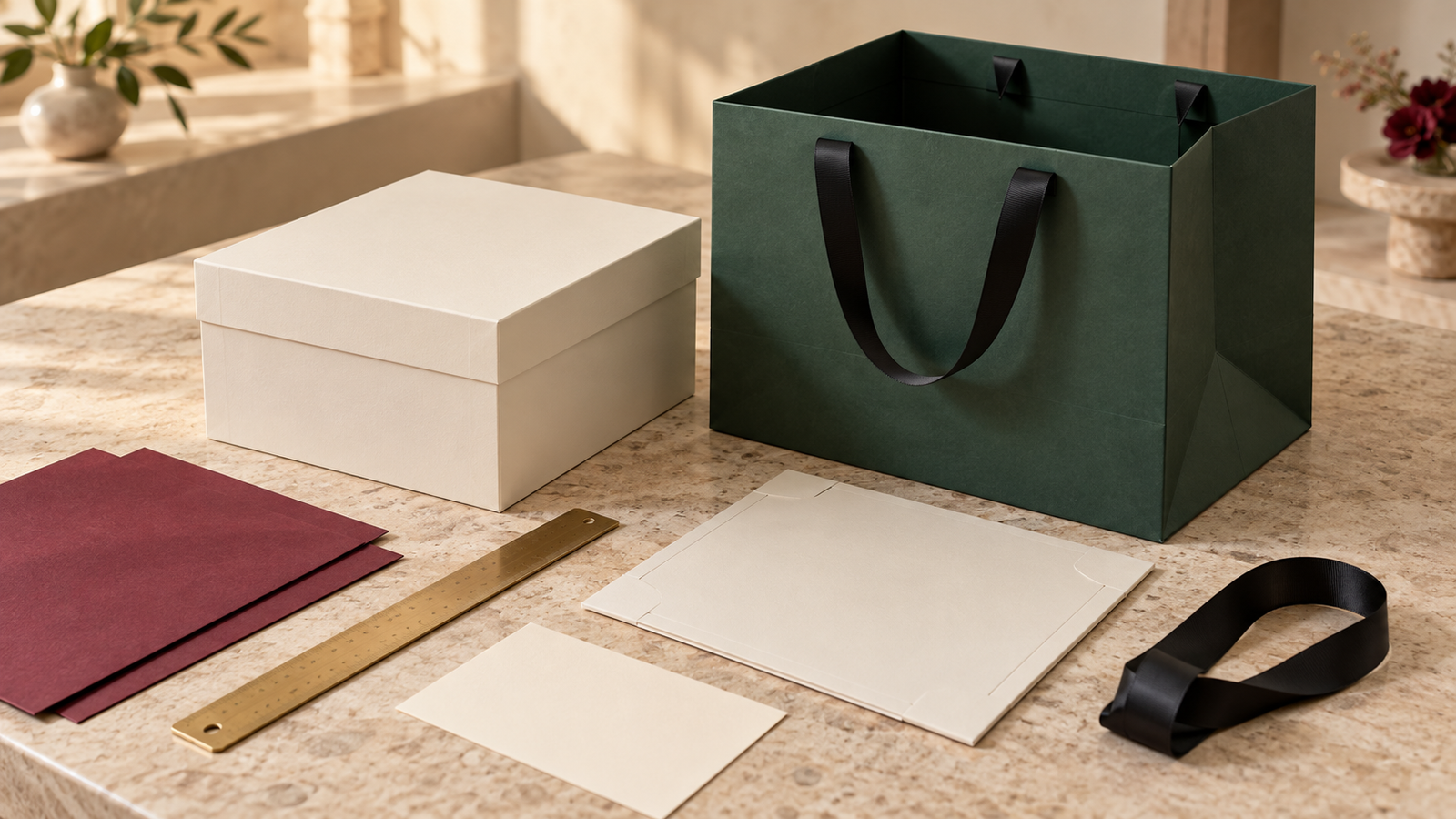
How much clearance should a cake box have inside the bag?
There is no universal clearance that fits every cake box, paper and retail workflow. The space must be large enough for staff to load and remove the box without tilting it, yet controlled enough that the box does not travel across the base. Lid overhang, box stiffness, handle position, bag opening and the thickness of folded gussets all affect usable space.
Test clearance physically. Ask a staff member to load the packed box, bring the handles together, carry the bag through the expected handoff and remove the box on a table. Repeat the process with the largest allowed box and realistic tolerances. If the box catches, do not solve the problem only by adding excessive bag size; review opening geometry, gusset folds and hand access first.
Which construction features keep a cake box level?
A flat, correctly sized base
The base should open fully and support the box without leaving it perched on partly folded gussets. A base board can spread load and help maintain a flat platform, but its material, thickness and dimensions must be specified. It cannot compensate for a bag whose footprint is wrong.
Deep gussets with controlled folds
Wide cake boxes usually require a generous gusset. The paper must crease and open cleanly without fighting the box corners. Check the gusset in both flat-packed storage and fully opened use; bakery staff should not need to reshape every bag before loading.
Balanced handles and reinforcement
Handle holes or attachments should be placed symmetrically and reinforced for the stated load. Ribbon can create a softer luxury presentation; cotton rope can feel substantial; paper handles may simplify a fibre-focused material strategy. Handle material alone does not prove performance. Review attachment, folded top, patches and the complete load path described in our paper bag handles guide.
Paper, seams and adhesive matched to the pack
Paper grammage is only one input. Sheet stiffness, grain direction, moisture response, side seams, base folds and adhesive bonds work together. A heavier sheet does not repair an undersized reinforcement patch or poorly formed base. Compare the complete construction using the paper bag construction guide and the paper bag GSM guide.
Does a cake paper bag need food-contact compliant materials?
First define the contact boundary. If the cake remains fully enclosed in a suitable primary cake box, the outer carrier is normally not intended to touch food directly. If unwrapped food, open windows, exposed boards or foreseeable transfer can create contact, the relevant paper, inks, coatings, adhesives and other components must be assessed for that intended use and target market.
The European Commission’s 2026 food-contact materials information states that materials intended to contact food—including paper—must not release substances at levels that endanger health, unacceptably change food composition or affect taste and smell. Requirements vary by market and intended contact conditions, so ask for evidence that matches the exact construction and use rather than accepting a generic “food grade” statement.
Operational hygiene still matters when the outer bag is secondary packaging. Store bags dry and protected from dust and odours. Keep them away from wet counters and uncontrolled chemicals. Train staff to load only closed boxes and to replace bags that are visibly contaminated or damaged. Do not claim the carrier preserves freshness, controls temperature or prevents leakage unless the complete system has been designed and validated for that function.
How should premium cake bags be printed and finished?
Large square panels create useful brand space, but the design must respect folds, handles and the wide base. Keep essential marks on the main faces and away from gusset creases unless folded artwork is intentional. Check dark solid colours for rub and fold behaviour. If foil, embossing or spot coating is used, approve it on the selected paper and locate it where loading and handling will not damage the effect.
A restrained colour family often coordinates better across the bag, closed cake box, ribbon and printed tissue paper than repeating every finish on every item. Remember that tissue used decoratively around a boxed order has a different contact role from a liner that could touch exposed food. Specify each component by its real use.
How many cake bag sizes should a bakery order?
Start with the box range and order history. Group boxes only when one bag can hold them level without excessive movement or waste. A single universal bag may simplify inventory but look oversized around small orders and perform poorly with the largest. Too many near-identical sizes increase artwork versions, minimum quantities, stockholding and picking errors.
- List annual or seasonal volume by closed cake-box size.
- Identify the few formats that cover most orders.
- Test whether neighbouring sizes can share one bag without tilting or loose movement.
- Separate tall specialty cakes or multi-box orders if their handling differs materially.
- Use clear size codes on cartons and warehouse records without adding visible consumer clutter.
- Plan launch, wedding and holiday peaks before confirming quantity breaks.
What samples and tests should buyers approve?
A flat artwork proof confirms layout but cannot prove box fit, base opening, handle balance or loaded performance. Approve a structurally representative blank first, then a printed and finished converted sample using the intended paper, reinforcements, base board and handles. Place the real closed cake box and the maximum defined load inside.
- Open the bag from its flat-packed state using the normal bakery routine.
- Load and remove every approved box without forcing or tilting.
- Lift by both handles and check whether the base stays acceptably level.
- Walk, stop, turn and set the bag down using an agreed handling sequence.
- Inspect handle attachments, folded top, seams, gussets and base after the test.
- Check print, finish and paper surfaces for rub, cracking or visible stress.
- Retain a signed physical master and record the packed configuration it represents.
Testing should model the intended handoff, not promise protection through parcel networks or uncontrolled delivery conditions. If the pack will enter a longer distribution route, define that route separately and work with the supplier on appropriate packaging tests. The paper bag samples guide explains what each sample stage can and cannot prove.
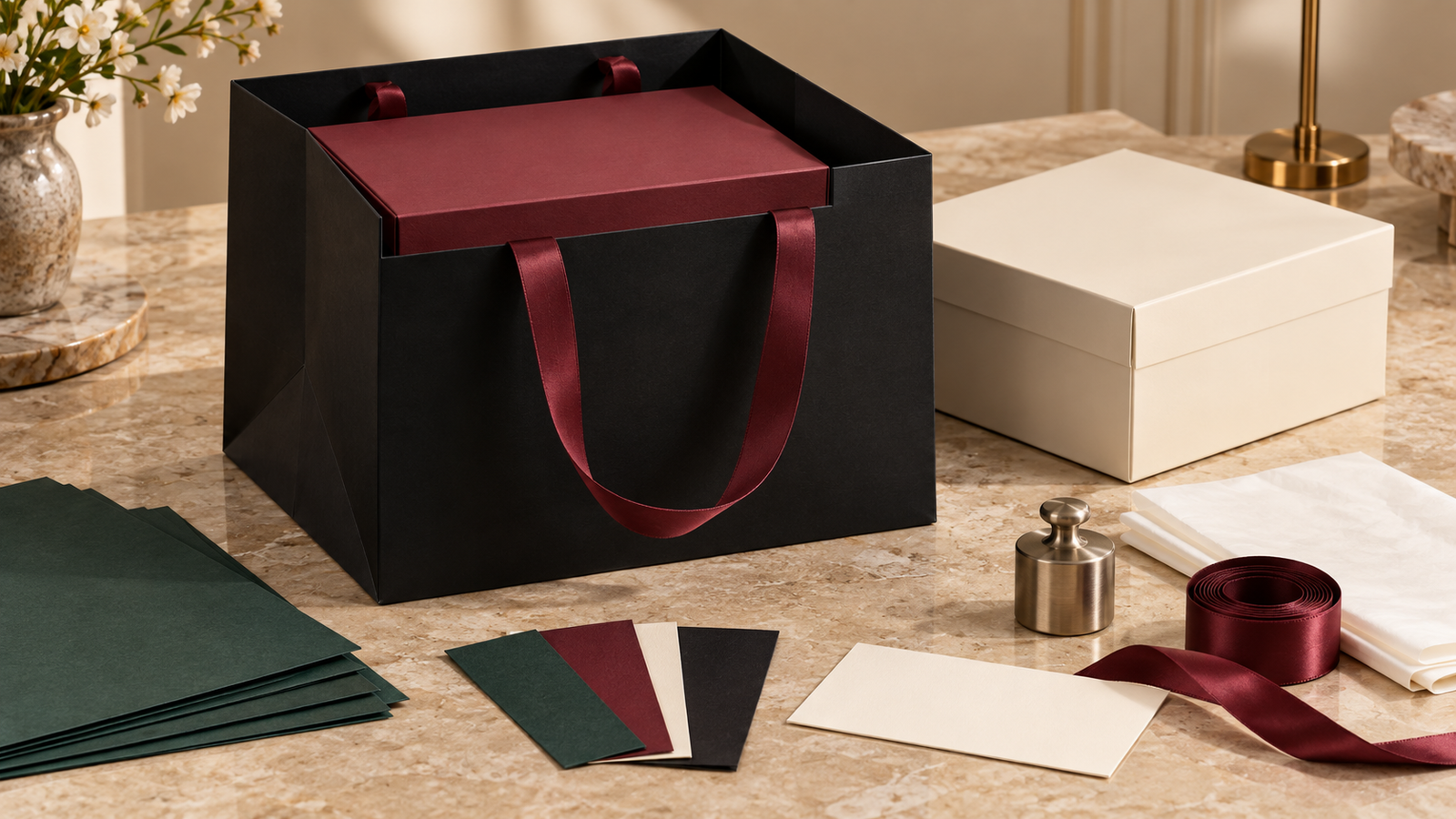
How should production cake bags be inspected?
Inspection criteria should refer to the approved bag and packed use. Measure dimensions in the agreed opened condition. Confirm that the base board and reinforcement are present, handles are paired and secure, seams are bonded, gussets open correctly and the closed cake box loads as approved. Cosmetic checks should cover colour, print registration, finish, scuffs, creases and contamination.
Define critical, major and minor defects before shipment, and state the sampling plan if the order uses acceptance sampling. Functional checks may require a separate sample from cosmetic inspection. Our paper bag quality-control checklist provides a broader framework; the buyer still needs product-specific limits for the cake-box fit and carry routine.
What should a custom cake paper bag RFQ include?
| RFQ section | Information to provide | Why it matters |
|---|---|---|
| Closed cake boxes | External width, depth, height, sample and maximum packed weight | Defines the real footprint and load |
| Bag format | Finished width, gusset, height and loading orientation | Prevents rotation and dimension-order errors |
| Construction | Paper, folded top, reinforcement, base board, seams and handles | Creates a comparable load path |
| Contact boundary | Closed primary box, any foreseeable food contact and target markets | Directs relevant material evidence |
| Artwork and finish | Colour references, print files, coatings, foil or emboss layers | Aligns decoration with paper and folds |
| Samples and tests | Blank, printed sample, packed-box fit and carrying sequence | Defines approval evidence before bulk production |
| Quantity and delivery | Units by size, launch date, packing, incoterm and destination | Supports pricing, production and freight planning |
Ask every supplier to quote the same specification and identify exclusions. Unit price is not comparable when one offer omits base boards, handle reinforcement, samples, export cartons or delivery responsibilities. The custom paper bag cost guide explains these commercial differences.
Frequently asked questions about cake paper bags
What is a wide-base cake bag?
It is a paper carrier with enough width and gusset depth to support a closed cake box in its intended flat orientation. The exact dimensions must come from the real box and loading clearance.
Can one bag fit several cake-box sizes?
Sometimes. Group sizes only after testing that each box loads easily, remains acceptably controlled on the base and can be carried level. Do not assume shared outer dimensions from cake diameter alone.
Should tissue paper go inside a cake bag?
Tissue can decorate a fully closed boxed order if it does not interfere with level carrying. If it may contact exposed food, its material, print and intended use require separate food-contact assessment.
Are ribbon handles strong enough for a cake box?
Handle material alone does not answer the question. Ribbon width, attachment, knots or fittings, reinforcement, folded top and the whole bag must be tested with the maximum packed configuration.
Can a cake paper bag replace delivery packaging?
Not by assumption. A retail carrier is designed for a defined handoff and carrying routine. Vehicle delivery, stacking, vibration, temperature and long distances create different risks that may require additional transport packaging and route-specific validation.
Design the bag around the bakery handoff
A premium cake paper bag succeeds when the closed box loads without tilting, sits flat, lifts evenly and arrives with the brand presentation intact. Start with measured box samples and real packed weight. Then specify the base, gussets, paper, handles, reinforcement, printing and food-contact boundary as one system.
For a quote, send box dimensions and samples, quantity by size, artwork, target colours, handle preference, maximum load, retail workflow, delivery market and launch date. If you also need coordinated paper cake boxes, ribbon or tissue, include them in the same brief so colour, fit and sampling can be reviewed together.
Build a Cake Bag Around the Real Box
Share your closed box sizes, packed weights, quantities and artwork. We can coordinate the wide-base paper bag, cake box, handles, ribbon and tissue before sampling.