
CORPORATE GIFT PACKAGING
Custom Corporate Gift Bags: A Buyer’s Planning Guide
How to plan a premium paper carrier around the real gift set, recipient groups, brand hierarchy, assembly workflow and delivery route.
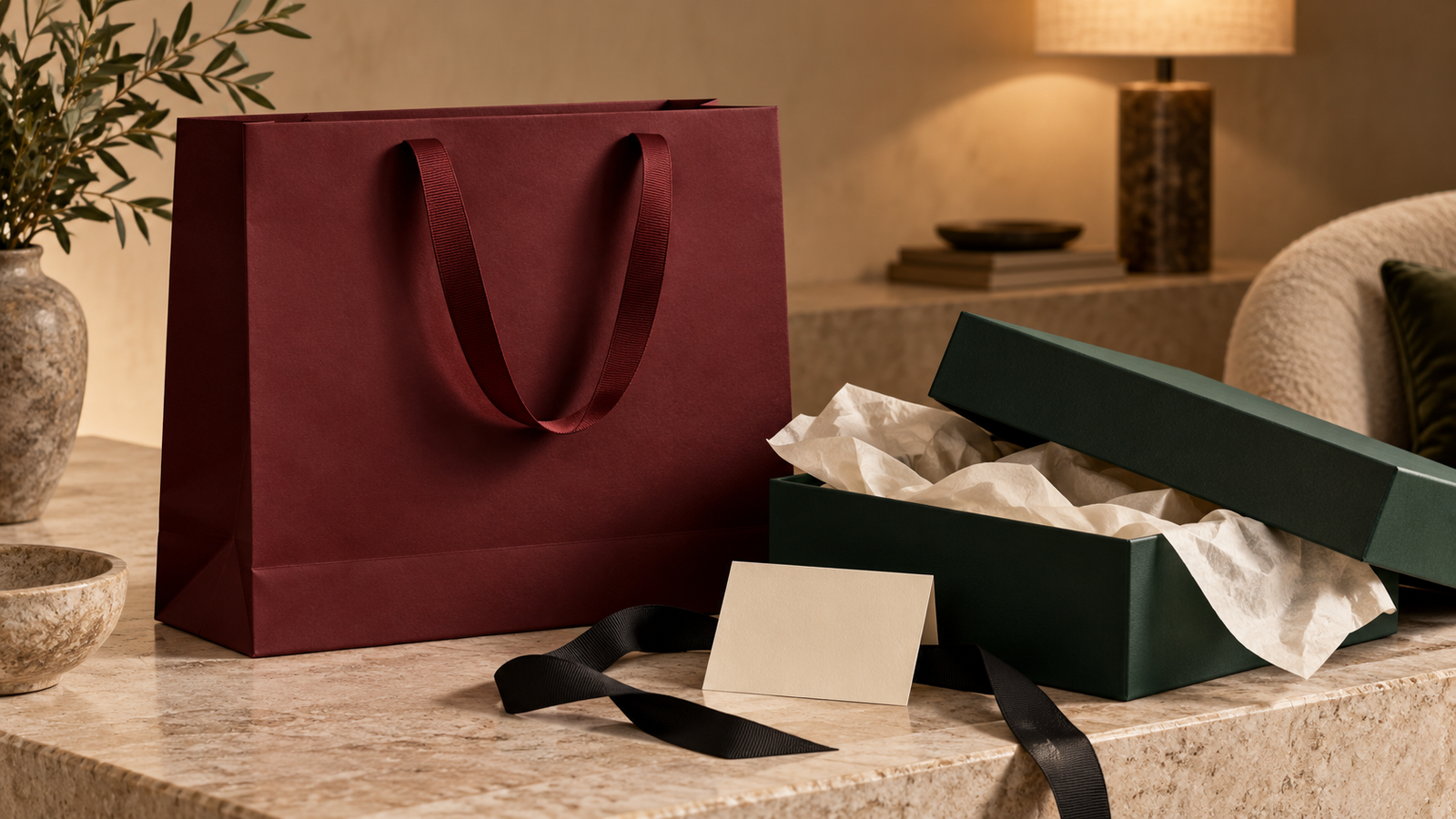
Custom corporate gift bags are premium paper carriers developed around a complete business gift programme, not simply stock bags with a company logo. The useful brief begins with the actual gift set, recipient groups, presentation moment, quantities, delivery locations and deadline. The bag can then be sized and engineered to carry the finished box, tissue, ribbon, card and any accompanying item as one controlled handoff.
What should a corporate gift bag specification achieve?
- Fit the complete presentation set in its approved orientation, with workable loading and removal clearance.
- Carry the packed weight through the paper, turned top, reinforcement, handles, gussets and base as one structure.
- Express the correct company, campaign or co-brand hierarchy without making the bag visually temporary.
- Support the real assembly, storage, handoff and distribution workflow.
- Keep sourcing, recyclability and regulatory claims tied to the final documented construction.
Why must planning start with the gift programme?
A client thank-you, an employee welcome pack and an executive presentation may all be called corporate gifts, but they create different packaging demands. Contents, timing, recipients, personalisation, presentation and delivery can change. A single visual concept should not be approved until the buyer knows which of those conditions the packaging must serve.
Client appreciation
Presentation may happen in person or through an account team. The bag should feel considered, protect the gift-box surface during the handoff and leave room for an approved card without becoming oversized.
Employee programmes
Welcome, recognition or milestone packs often repeat across dates and locations. The specification needs stable components, clear packing instructions and a practical way to control versions or recipient groups.
VIP and executive gifts
A smaller recipient list can justify more tactile paper, restrained finishing or a special presentation box, but every extra component still needs a defined role and an approval reference.
This intent is different from an event paper bag planned around registration desks, sponsor materials and venue flow. Some programmes overlap, but the gift brief should say whether the bag is a one-day guest kit, a relationship gift, an employee pack or a repeatable year-round format.

How should bags, boxes, tissue and ribbon divide the work?
A coordinated package is strongest when every layer has a clear job. The product’s primary pack contains it. A rigid gift box can protect and stage the reveal. Tissue cushions surfaces and controls the first view. Ribbon can close the box or add a deliberate brand accent. The luxury paper bag brings the set together for carrying and presentation.
Presentation system
- gift item and primary pack;
- box and insert where needed;
- tissue, ribbon and card;
- paper bag sized around the closed set;
- brand and recipient-facing information.
Distribution system
- protective wrap or separators;
- master cartons and count control;
- route-appropriate transport protection;
- location or recipient version control;
- receiving, storage and assembly instructions.
Do not ask the decorative shopping bag to perform the work of a parcel mailer or export carton. If gifts travel individually, place the finished presentation set inside transport packaging developed for that route. Our luxury packaging sets guide explains how to coordinate the visual system without duplicating material unnecessarily.
How do you size a corporate gift bag?
Measure the finished pack-out, not the loose products or an early box drawing. The current GS1 Package and Product Measurement Standard provides a repeatable framework for communicating package dimensions across product and packaging levels. That discipline is useful even when the gift set is not a retail trade item.
- Build each real gift set. Include the closed box, insert, tissue, ribbon, card and every item that will cross the handoff point.
- Choose the carry orientation. Decide which face sits on the base and whether the set loads from above without scraping decorated surfaces.
- Record external dimensions and packed weight. Use a consistent dimension order and identify the heaviest approved combination.
- Group genuine pack-out families. Avoid a new bag for every minor variation, but do not force a large set into a small carrier or place a compact gift in excessive empty space.
- Approve practical clearance. There is no universal allowance; box texture, tissue bulk, bag structure and packing speed all affect it.
- Run a physical pack-and-carry trial. Load, lift, walk, set down and remove the gift from a fully converted sample.
For a deeper measurement workflow, use the luxury paper bag size guide. Ask the supplier to state both the finished bag dimensions and the usable opening because turned tops, gussets and handle attachments can influence how the set enters the bag.
Which construction details matter for gift sets?
Corporate gifts often combine several compact items inside a rigid box, creating a concentrated load. Paper grammage alone does not prove that the finished bag will carry it. The body paper, grain direction, turned top, reinforcement patches, handle attachment, side seam, gussets, base closure and base board share the load.
Approve the complete load path
Request a converted sample built to the proposed production specification and test it with the representative gift set. A paper swatch, handle sample or generic weight claim cannot prove the performance of the assembled bag.
Select cotton rope, ribbon or paper handles for comfort, attachment method, brand expression and material strategy—not appearance alone. The paper bag handles guide compares those routes, while the construction guide explains the reinforcement and base details that support them.
How should brand, campaign and recipient details be organised?
Start with a visual hierarchy. The main company mark may belong on the bag, while a campaign message, partner logo or recipient name may be better placed on a card, belly band, tag or removable sleeve. That separation can preserve a reusable core bag across programmes and limit the number of printed bag versions.
For co-branded projects, agree logo order, relative scale, clear space, colour route and approval responsibility before artwork begins. If names or messages vary by recipient, keep the variable-data item operationally separate from the fixed bag artwork unless the chosen print process and quantity genuinely support variable production. Every version needs an owner, an approved file and a count.
What should samples and approvals prove?
| Approval stage | Decision it can support | What it cannot prove alone |
|---|---|---|
| Material and colour references | Paper texture, approximate colour direction, ribbon feel and finish options | Finished dimensions, carrying performance or converted appearance |
| Plain structural sample | Bag size, box fit, loading sequence, handle drop and basic carry trial | Final ink, foil, embossing or surface durability |
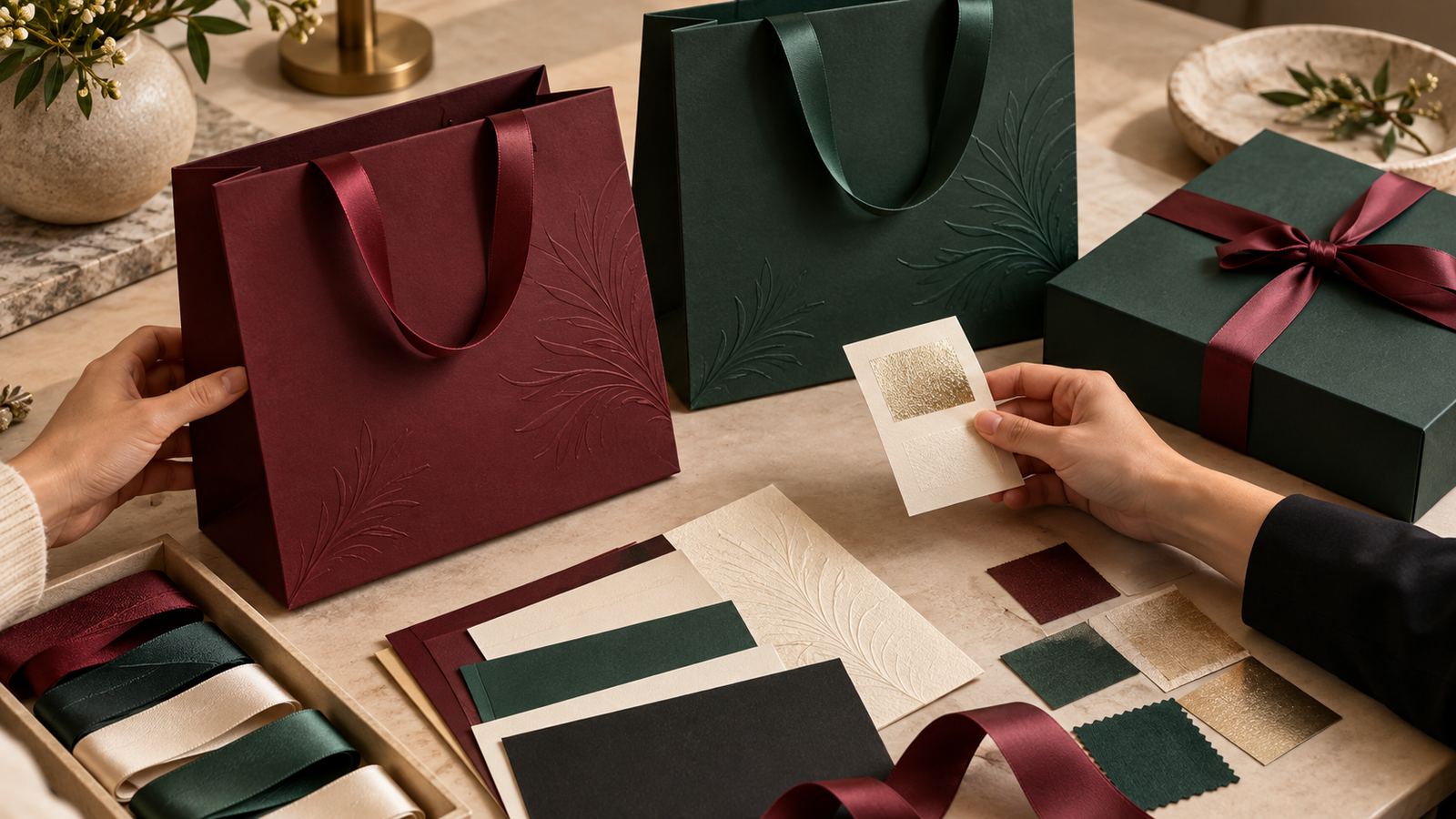
| Printed converted sample | Artwork, colour, finish, construction and the complete presentation together | Consistency across the production run unless acceptance criteria are defined |
| Pilot pack-out | Assembly instructions, component counts, version control and real operator workflow | Every distribution hazard without a route-based test plan |
Keep one signed or digitally controlled approval record for the final specification. Record size, paper, print references, finishing, handles, reinforcement, box and tissue details, packing sequence and accepted tolerances. The paper bag sampling guide helps match each sample type to the decision it can responsibly support.
How should assembly and multi-location delivery be planned?
Decide where the gift becomes a finished set: at the packaging supplier, a fulfilment partner, a regional office, an event venue or the recipient’s location. That choice determines whether bags ship flat, whether boxes arrive assembled, how tissue is protected, who inserts cards and how recipient or location versions are controlled.
- Create a bill of materials and a visual packing sequence for each approved gift version.
- Separate recipient data from general packaging files and give only the necessary fulfilment party access.
- Set carton quantities that support receiving and distribution without excessive repacking.
- Use location codes or removable outer labels on transport cartons rather than adding temporary logistics information to the luxury bag.
- Protect finished bag faces, handles and tissue from scuffing, crushing and moisture before handoff.
- Reconcile packed, dispatched, received and surplus quantities after each wave.
Test the shipping configuration that will actually travel. ISTA distinguishes screening, partial-simulation, general-simulation and route-specific approaches; the right method depends on the distribution hazards and decision required. A successful carry trial proves the retail bag, not the parcel or master-carton system.

When should the packaging schedule begin?
Work backwards from the required arrival date, not the announcement date. Allow time to freeze gift contents, confirm recipient groups, measure the set, approve structure and artwork, make any required printed sample, complete production, inspect, pack and deliver. Personalised cards, partner approvals and multiple destinations create their own dependencies.
Do not publish a universal lead time in the brief. Material availability, print and finishing, quantity, sample route, peak periods and shipping method can all change it. Build one joined schedule using the principles in the custom paper bag lead-time guide, and identify the buyer approvals that stop or release the next stage.
How should sourcing and environmental claims be handled?
Use the least complex packaging system that still protects, contains, handles, informs and presents the gift as required. ISO 18602:2013, confirmed current in 2024, addresses optimisation of packaging weight or volume while maintaining its required functions. Removing a useful protective layer can create damage; adding a layer without a defined function creates avoidable material.
For paper-based recovery decisions, the February 2026 4evergreen Circularity by Design Guideline Version 4 considers the final converted packaging and different recycling pathways. Test unfamiliar combinations rather than assuming that a paper appearance proves recyclability. If an FSC on-product label is requested, FSC instructs buyers to verify the final supplier’s certification and have the certified supplier manage the approved label.
For gifts placed on the EU market, the Packaging and Packaging Waste Regulation applies from 12 August 2026, with requirements phasing in over time. Confirm the role of each economic operator, the destination market and the final pack before making compliance, recycling or reuse claims. A supplier certificate for one paper grade does not automatically substantiate every statement about the finished gift system.
What belongs in a quote-ready corporate gift bag brief?
Gift and programme
- programme purpose and handoff moment;
- recipient groups and approved versions;
- complete gift contents and pack-out photos;
- closed dimensions, orientation and packed weight;
- quantity by version and required arrival date.
Packaging and delivery
- bag size family and construction preferences;
- paper, print, handles, reinforcement and finish;
- box, insert, tissue, ribbon, card or tag;
- artwork hierarchy and personalisation method;
- assembly location, destinations and transport route;
- sampling, inspection, claims and required evidence.
Frequently asked questions
Should the corporate gift bag and box match exactly?
No. They should feel coordinated, but exact colour matching across coated paper, uncoated paper, ribbon, tissue and box wrap may not be realistic. Define a colour hierarchy, approve physical samples together and allow materials to contribute their own texture.
Can one bag size cover every corporate gift?
Only if physical pack-out trials prove that the grouped gift sets load, carry and present well. A small, disciplined size family is often more practical than either one universal bag or many nearly identical sizes.
Where should recipient personalisation appear?
Often on a card, tag, sleeve or other controlled variable item rather than the main paper bag. This keeps fixed packaging reusable across programme waves and makes version checking easier, but the right route depends on quantity, print process and presentation.
Can the luxury paper bag be shipped directly to the recipient?
It should not be treated as parcel protection. Put the finished bag and gift set inside transport packaging designed and tested for the delivery route, then confirm how the recipient will remove it without damaging the presentation.
Plan the full corporate gift handoff
Share the gift-set dimensions, packed weight, quantities, recipient groups, artwork direction, destinations and required date. Bespoke Packaging can develop the luxury paper bags, rigid gift boxes, tissue paper and ribbon as one production-ready system.