
CUSTOM EURO TOTE BAGS
Custom Euro Tote Bags: A Buyer’s Guide to Luxury Paper Bags
Learn what makes a Euro tote a premium paper shopping bag, when the format is worth specifying, and how to turn the idea into a quote-ready construction.
Custom Euro tote bags are structured paper shopping bags developed for premium retail presentation. They commonly combine crisp panels and gussets with a turned top, separate handles, reinforcement and a firm base. The useful buying question is not whether a supplier uses the label “Euro tote,” but whether the proposed construction fits your product, carried weight, store workflow and brand standard.
This guide explains how Euro totes differ from simpler machine-made paper carriers, which details belong in the specification, and what a physical sample should prove before production. The focus is a practical luxury bag—not decoration added to an unsuitable structure.
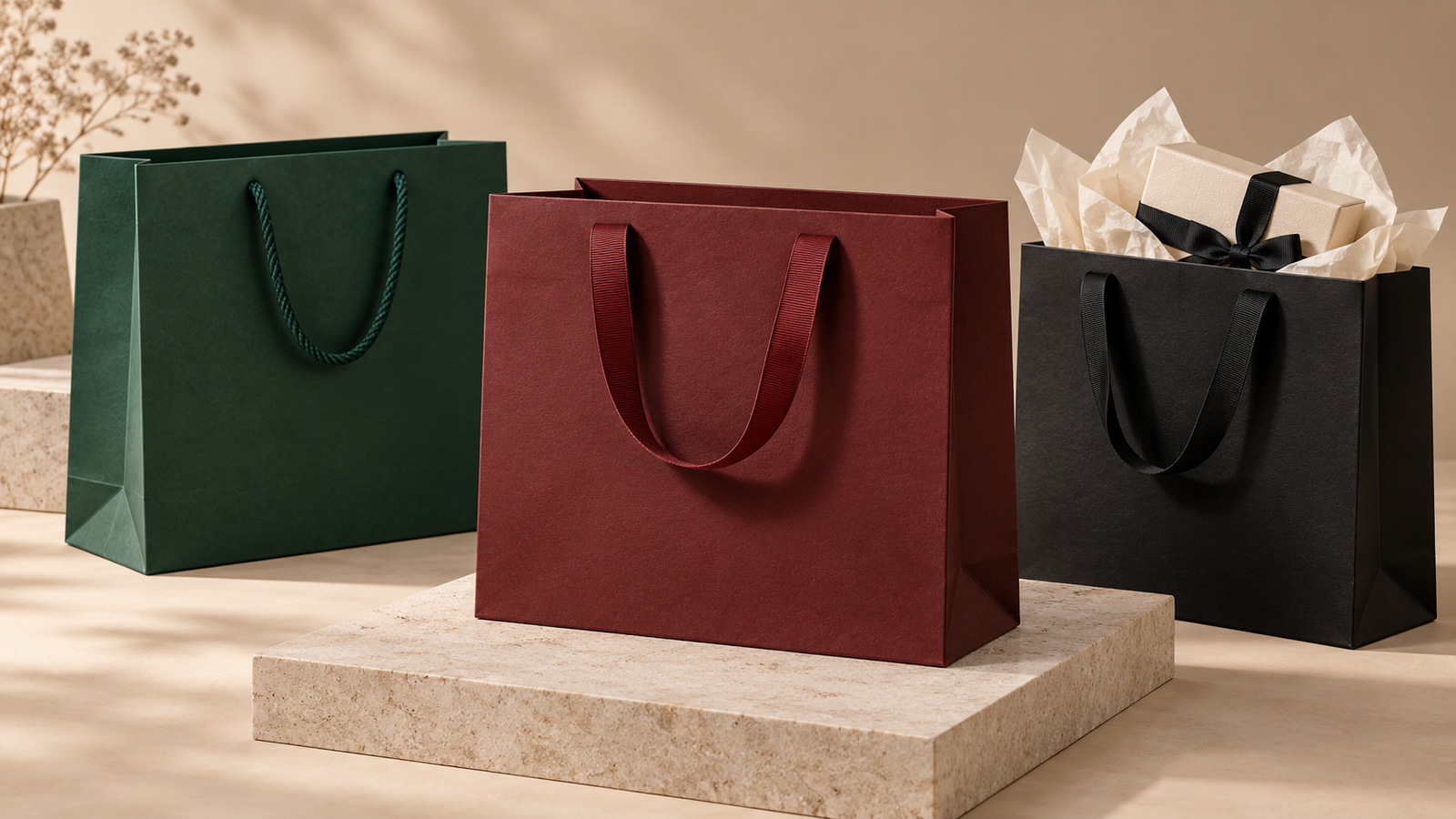
What is a Euro tote bag?
A Euro tote is a premium paper carrier with a more tailored, presentation-led build than a basic folded shopping bag. Typical features include sheet-fed printed panels, defined gussets, a turned or reinforced top edge, rope or ribbon handles and a reinforcing board in the base. Exact terminology varies between suppliers, so buyers should confirm every component rather than treating “Euro tote” as a complete technical specification.
It is still a retail carrier. A Euro tote can carry a rigid gift box, apparel, cosmetics or another finished product pack from the counter, but it should not automatically be treated as parcel packaging or as proof of a particular load rating.
How does a Euro tote compare with a standard paper shopping bag?
Both formats can be well made. The difference is usually the design objective and converting route, not a simple good-versus-bad ranking. A machine-made kraft carrier can be efficient for everyday volume and straightforward branding. A Euro tote gives buyers more control over silhouette, paper, print, handles and finishing when the handoff itself is part of the brand experience.
| Decision point | Custom Euro tote | Standard machine-made carrier |
|---|---|---|
| Primary role | Premium retail or gifting presentation | Efficient everyday carrying |
| Visual structure | Crisp, tailored panels with a defined top and base | Lighter, more utilitarian folded form |
| Handles | Often ribbon, cotton rope or another separately fitted handle | Often twisted or flat paper handles applied during converting |
| Customization | Broad control over paper, print, finish, proportions and details | Often optimized around standard materials, sizes and efficient production |
| Best choice when | The bag is a visible part of a luxury packaging system | Speed, simplicity, volume or an all-paper everyday format leads |
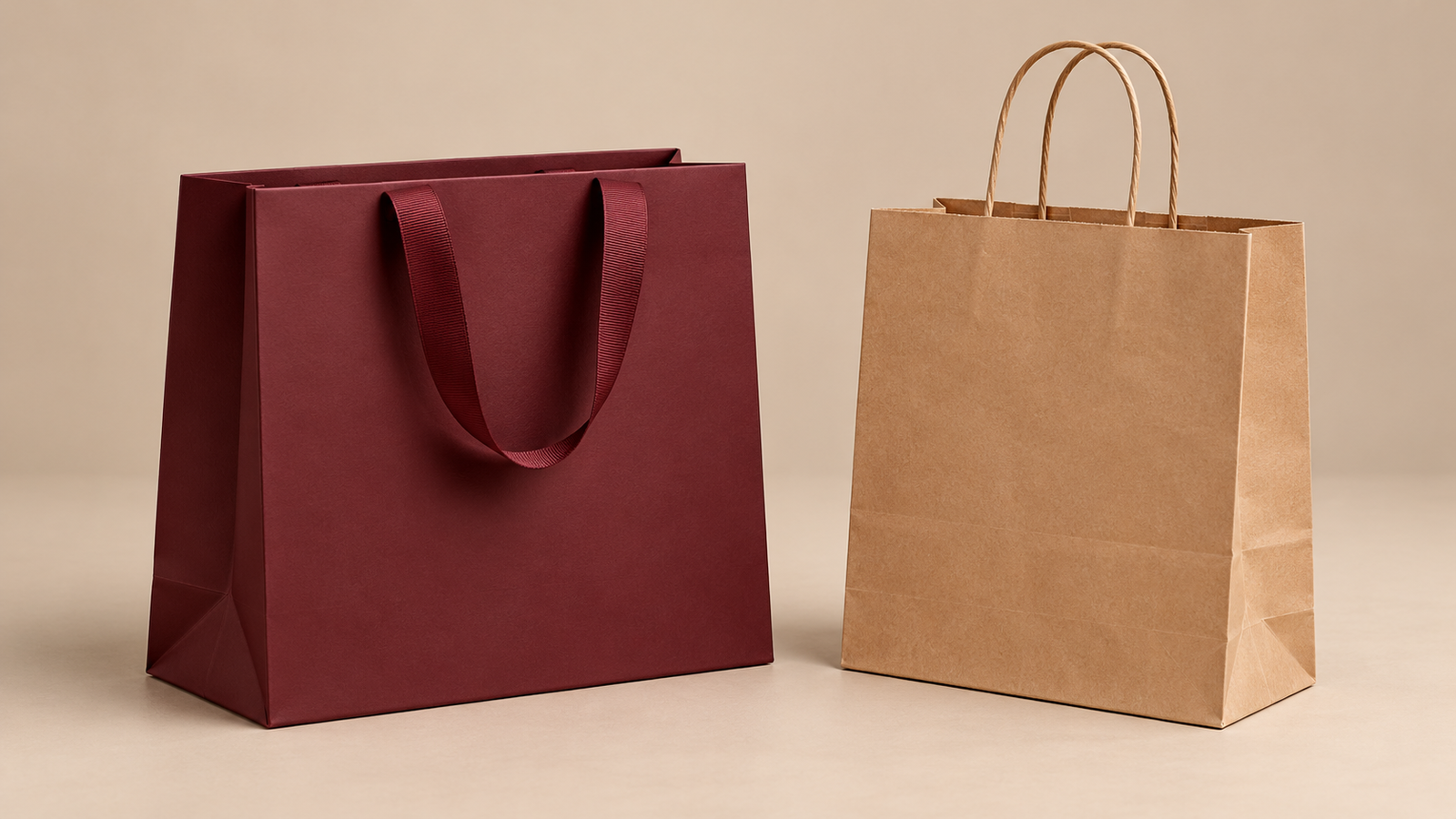
When is a Euro tote the right commercial choice?
Choose the format when its structure and presentation solve a real requirement. It is commonly relevant for boutiques, launches, gifting, department-store counters and premium products already protected by a folding carton or rigid box. It can also be a strong outer carrier for a coordinated set of gift boxes, tissue paper and ribbon.
- The bag remains visible after purchase. Proportion, hand-feel and handle comfort contribute to the customer handoff.
- The product needs a stable footprint. A defined gusset and base can hold a boxed product more intentionally than a loose carrier.
- Artwork needs controlled reproduction. Sheet-fed printing and flat-panel decoration may suit detailed colour and finish requirements.
- The packaging set must coordinate. Paper, handles, tissue and ribbon can be approved beside the product box.
- The order can support the development route. Custom construction, proofs, hand finishing and inspection add decisions, time and cost.
A Euro tote may be unnecessary when a simple stock carrier meets the product, budget and brand need. Premium does not mean adding every possible feature. It means choosing a controlled solution whose value is visible and repeatable.
Build the specification around the complete load path
The body paper, side seam, gussets, base folds, base board, top reinforcement, handle holes and handle attachments work as one system. A thick-looking paper does not compensate for an underbuilt attachment, and a strong handle does not rescue a weak base. Our luxury paper bag construction guide explains this connection in more detail.
Top and handles
Define the turned top, reinforcement strip, hole position, eyelets if used, handle material, width, drop length and internal knot or tab. Check comfort and whether the handles mark the printed panels in transit.
Body and gussets
Specify the paper, grain and panel stiffness needed for the desired silhouette. Confirm how the side seam and gusset folds behave when the actual product is loaded and removed.
Base and reinforcement
Match the base construction and any board to the product footprint and carried weight. The board should lie flat, distribute the load and stay located during packing and use.
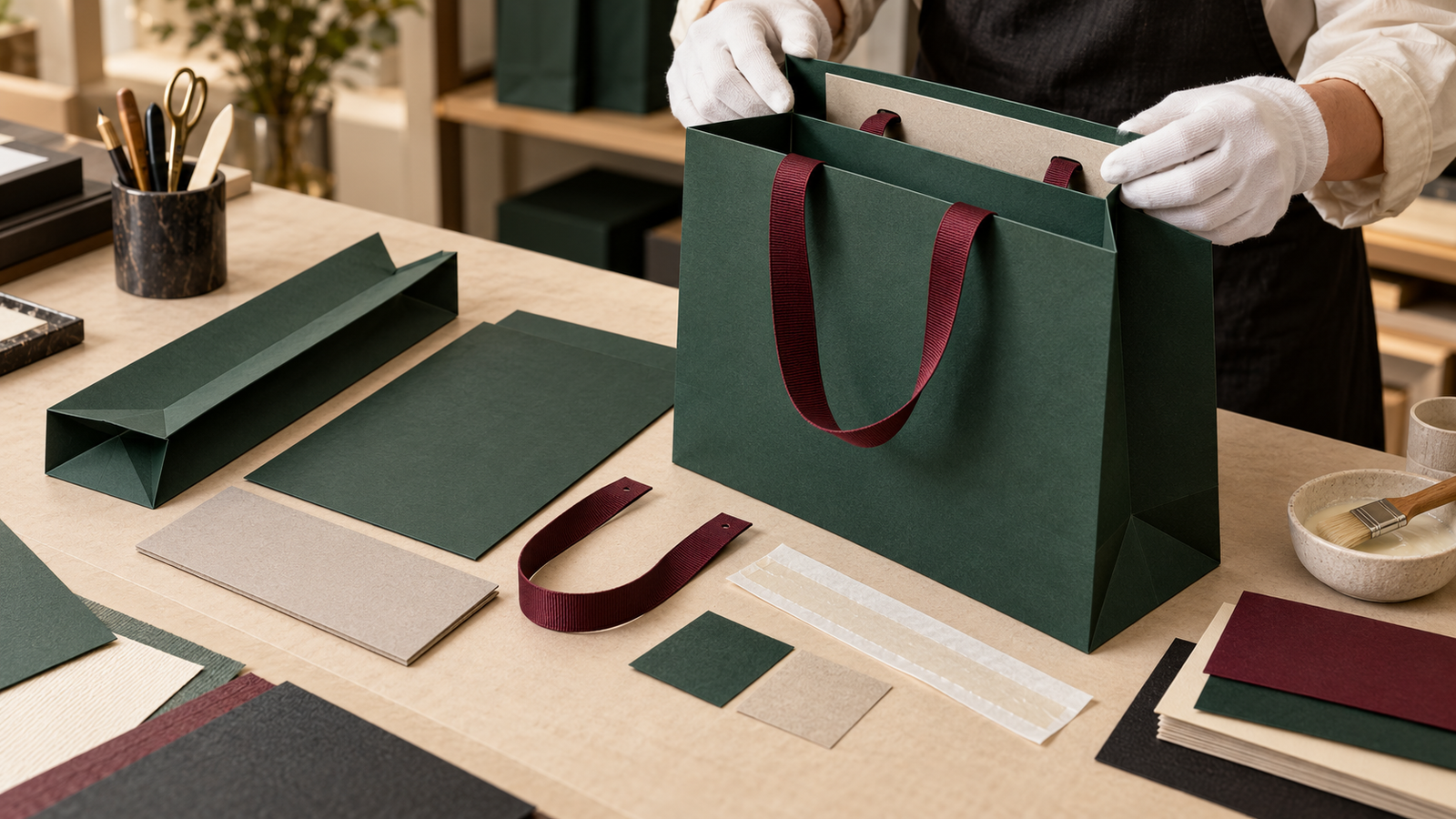
The Paper Bag platform’s industry guidelines for high-quality paper carrier bags emphasize fitness for purpose: the transport route, contents, volume and intended load all affect the material and construction choice. The document also identifies handles as a critical point and recommends matching paper strength, attachment and reinforcement to the intended use. Its example performance goal is not a universal promise for every luxury bag; set and validate the requirement for your own size and packed product.
How should you size a custom Euro tote?
Start with the finished product pack that will enter the bag. Measure its maximum width, depth and height in the carry orientation, record the packed weight, and include tissue, ribbon, cards or multiple items that staff add at the counter. The current GS1 Package and Product Measurement Standard provides a consistent method for communicating package dimensions; use that measurement discipline and then add the practical clearances required for packing.
- Measure the completed pack, not the unboxed product.
- Choose the intended orientation and keep fragile finishes away from pressure points.
- Add only enough clearance for repeatable loading, tissue and removal.
- Check that the base supports the product footprint without excessive movement.
- Review the bag proportion with the smallest and largest SKU intended for that size.
- Confirm the dimensions with a physical structural sample.
The convention is normally width × gusset × height, but confirm it on the supplier dieline. The paper bag size guide includes a fuller brief for developing a small, useful size family instead of accumulating unnecessary formats.
Which paper, print and finish choices belong in the brief?
Define the result you need before naming a material. Coated paper can support controlled graphics and certain laminations; uncoated, coloured or textured stocks can create a quieter tactile impression; kraft or recycled-content options may support a different visual and sourcing direction. Ask for production-relevant samples because colour, cracking, rub resistance and fold quality can change with the paper and converting route.
Record grammage, but do not use GSM as a stand-in for thickness, stiffness or finished-bag strength. The paper bag GSM guide explains why those properties must be considered separately. Choose offset, screen, digital or another print route from the artwork, substrate, colour control and order plan. Add foil, embossing, spot effects or lamination only where the paper, fold lines, handling and recycling objective support them.
How do you specify Euro tote handles?
Ribbon and cotton rope are familiar premium choices, but appearance is only one part of the decision. Include the material, weave or construction, colour reference, width or diameter, usable drop length, hole spacing, attachment method and top reinforcement. Then test the complete bag with the real load.
- Can staff open and fill the bag without the handles falling into the product area?
- Is the drop comfortable for the intended hand or forearm carry?
- Do knots, tabs or eyelets stay secure and avoid damaging the contents?
- Does the handle colour transfer, fray or mark the bag surface?
- Can handle and ribbon components be coordinated without forcing an exact match across different materials?
Compare the alternatives in our luxury paper bag handles guide, and specify decorative packaging ribbon separately from a load-bearing ribbon handle.
What should the sample and production approval prove?
Approve risk in stages. A blank structural prototype can resolve fit and handle position before expensive print or finishing is added. A colour proof or finish strike-off can establish appearance, but only a fully converted sample shows how print, folds, handles and reinforcements work together.
Load and workflow checks
- Pack the exact product set at realistic counter speed.
- Lift, walk, turn, set down and reopen the bag.
- Watch the base, side seam, gussets and handle attachments.
- Repeat the handling sequence for the required use case.
Appearance and control checks
- Inspect colour, print, rub, foil or embossing on the converted bag.
- Check fold cracking, glue marks, scuffs and panel alignment.
- Record the approved sample, dieline and artwork revision.
- Translate important observations into measurable acceptance criteria.
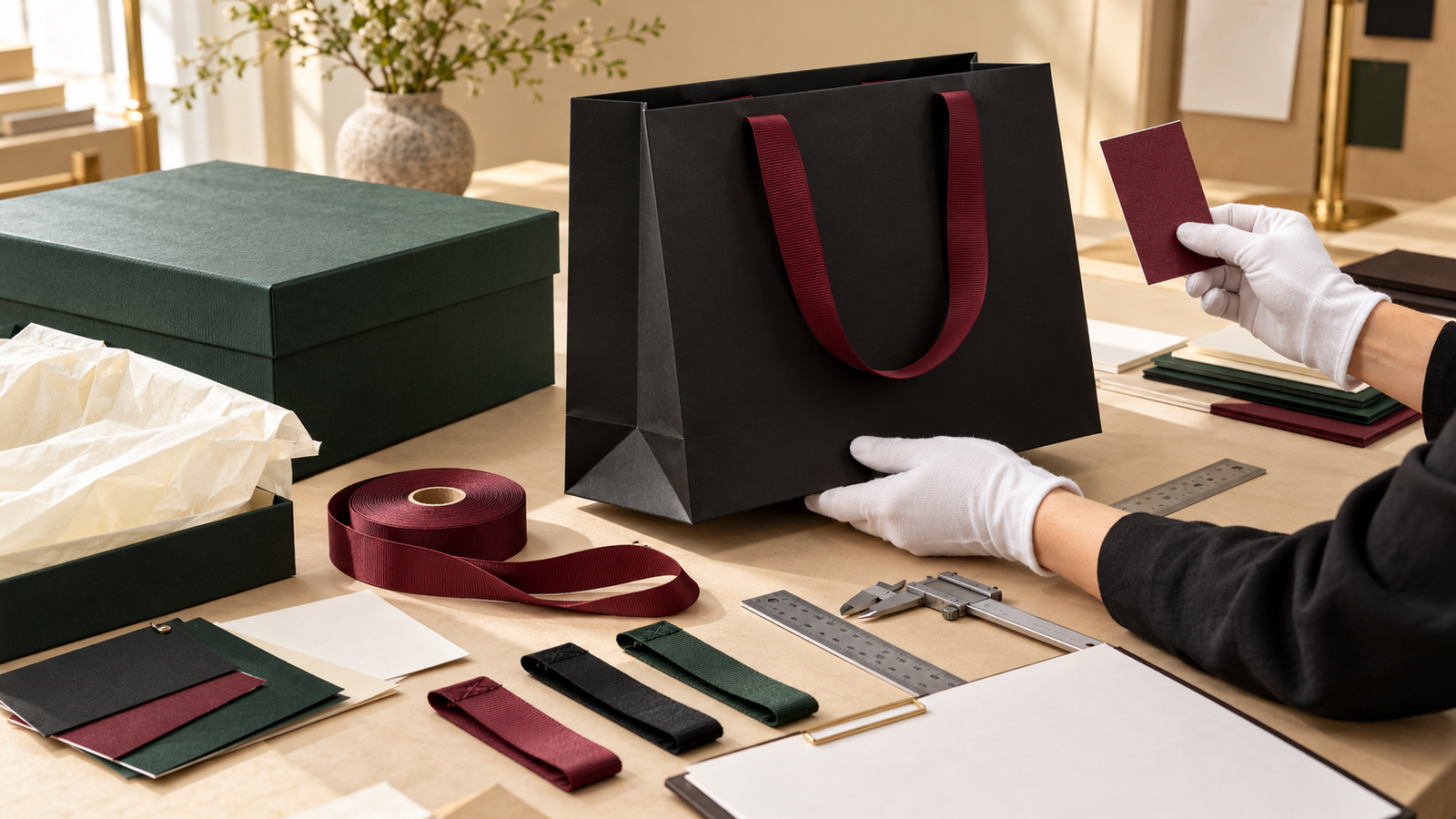
For further planning, see the custom paper bag samples guide and the paper bag quality-control checklist. The approved reference should connect the buyer’s specification, supplier production file and inspection plan.
How should sourcing and recycling claims be handled?
Review the complete construction: body paper, coating or lamination, inks, metallic decoration, handles, eyelets, reinforcement boards, adhesives and labels. The 2026 4evergreen Circularity by Design Guideline Version 4 shows why component choices and combinations matter to collection, sorting and recycling routes for fibre-based packaging. Do not infer recyclability from the paper body alone.
If an FSC label or claim is required, request it before artwork approval. FSC chain-of-custody certification tracks eligible forest-based material through manufacturing and distribution and enables qualified organizations to pass claims and use labels on finished products. Keep that sourcing statement separate from recycled-content, reusability or recyclability claims.
For EU programs, the European Commission states that Regulation (EU) 2025/40 on packaging and packaging waste has applied since 12 August 2026, with provisions and later milestones that depend on the topic. Identify destination markets and required evidence early, and obtain market-specific advice before printing environmental or compliance statements.
What belongs in a quote-ready Euro tote RFQ?
- Finished product-pack dimensions, packed weight and carry orientation.
- Proposed bag width, gusset and height, or physical products for size development.
- Quantity by size, artwork, colourway, delivery and destination market.
- Paper type, colour, grammage and any required strength, stiffness or sourcing evidence.
- Printing method, colour references, artwork files and decoration layers.
- Top construction, handle material, drop, attachment and reinforcement details.
- Base construction, board specification, seam and gusset expectations.
- Coordinated gift boxes, printed tissue paper and ribbon requirements.
- Sample stages, performance checks, cosmetic tolerances and approval owners.
- Packing method, carton limits, shipping route, delivery deadline and Incoterm.
- Required material, certification, recyclability or market-compliance documentation.
Frequently asked questions about custom Euro tote bags
Are Euro tote bags always made from very heavy paper?
No single paper weight defines the format. The correct paper depends on bag dimensions, desired stiffness, print and finish, carried load, reinforcement and converting. Approve the complete loaded construction instead of choosing from GSM alone.
Do Euro totes need rope or ribbon handles?
Those handles are common, but they are not the only possible choices. Paper, textile and die-cut approaches can suit different brand, performance and end-of-life goals. Define the handle and attachment explicitly.
Are Euro tote bags reusable?
A well-made bag may be used again, but “reusable” should be tied to a defined use case and evidence rather than appearance. State the intended number and type of uses, then select materials, construction and testing accordingly.
Can Euro tote bags be recycled?
That depends on the complete construction and the relevant local collection and recycling route. Review coatings, lamination, handles, eyelets, boards, adhesives and decoration with the paper body; request evidence for the market where the bag will become waste.
What should I send for an accurate Euro tote quote?
Send the finished pack dimensions and weight, quantity by size and design, target delivery, destination, artwork direction, paper and handle preferences, required finishes, coordinated packaging components and the sample or testing level needed. Physical product packs are especially useful when fit is critical.
Turn your Euro tote idea into a production-ready bag specification.
Share the finished product dimensions, packed weight, quantity, destination and visual direction. We will help develop custom luxury paper bags with coordinated gift boxes, tissue paper and ribbon for sampling and production.