
LUXURY PAPER BAG PRODUCTION GUIDE
How Luxury Paper Bags Are Made: A Buyer’s Production Guide
Follow a premium paper shopping bag from approved specification to printing, converting, handle fitting, inspection and protected delivery.
The paper bag manufacturing process turns an approved flat design into a load-bearing retail package through material control, printing, optional finishing, cutting and creasing, bag forming, handle assembly, inspection and packing. For luxury paper bags, the exact route varies with the paper, print method, surface treatment, handle and quantity. The useful buyer question is therefore not only “How are paper bags made?” but “What must be approved before each stage begins?”
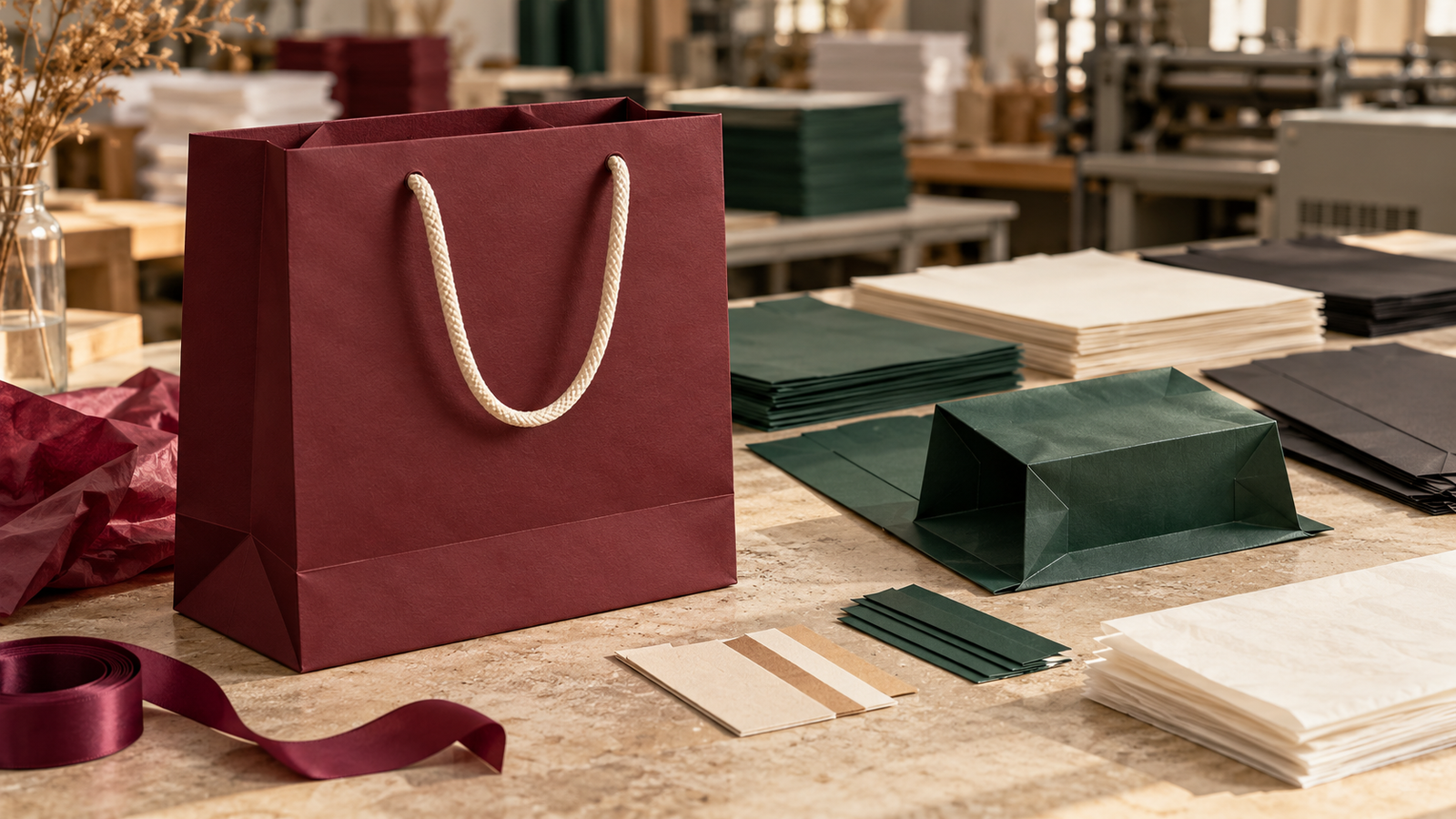
The process in one sentence
Freeze the product fit and bag specification, approve materials and artwork, prove the print and finishes, convert the flat sheet or web into the bag body, fit the reinforced handles, inspect the complete loaded bag, then pack it so the approved result survives transport.
What is the paper bag manufacturing process?
Paper bag manufacturing is a converting process: paper is printed and transformed from a flat material into a three-dimensional carrier with faces, side gussets, a bottom, a top edge and handles. Some bags are made on integrated reel-fed lines; many premium custom paper bags use sheet-fed printing and a sequence of machine and hand-finishing operations. A factory may combine both approaches. The specification—not the word “luxury”—determines the practical route.
The CEPI Eurokraft and EUROSAC industry guidelines for high-quality paper carrier bags describe paper, glue, converting and handles as connected quality factors. That is the right purchasing model: a visually perfect panel is not enough if a seam, base or handle attachment is unsuitable for the packed product.
What must be settled before production starts?
Production should begin from one controlled specification. Dimensions, intended contents, packed weight, paper, print, finishes, top treatment, handle construction, reinforcement, quantity, packing and delivery market need named references. If these inputs live across conflicting emails and artwork versions, the factory can execute each instruction correctly and still make the wrong bag.

Product and structure
- finished width, gusset and height;
- real product or gift-box dimensions;
- packed weight and carry orientation;
- top fold, base board and handle reinforcement;
- retail use, storage and distribution route.
Appearance and evidence
- final dieline and artwork version;
- colour references and viewing conditions;
- print, coating and decoration layers;
- paper and handle samples;
- required sourcing, recycled-content or recyclability claims.
Commercial controls
- approved quantity by size and artwork;
- sample and proof responsibilities;
- tolerances and defect criteria;
- packing count and carton marks;
- delivery terms and approval deadlines.
Use production-representative dimensions. The current GS1 Package and Product Measurement Standard provides a repeatable approach to package measurements; keep the product, retail box, finished bag and export carton as separate measured levels. Our paper bag artwork guide explains how to release artwork on the supplier’s dieline.
Do all paper bags follow the same production route?
No. Route choice depends on the construction and the supplier’s equipment. The comparison below is a planning guide, not a rule that every factory follows.
| Production route | Typical strengths | Common specification fit | Buyer focus |
|---|---|---|---|
| Integrated reel-fed conversion | Continuous forming and repeatable high-volume output | Kraft shopping bags and standardised constructions, often with inline printing and paper handles | Machine capability, print route, size range, paper and handle options |
| Sheet-fed premium conversion | Broad print, paper and decorative-finish choice | Luxury paper bags with separate handles, turn-tops, reinforcement and detailed surfaces | Flat-sheet proofing, finish registration, crease behaviour and assembly control |
| Hybrid route | Combines machine conversion with separate finishing or assembly | Projects that need efficient forming plus special handles or decoration | Which operation happens where, handoff references and in-process checks |
Ask suppliers to describe the proposed route for your exact bag. A different machine, paper direction, finishing sequence or outsourced operation can change what the sample proves and where quality must be checked.
How are luxury paper bags made step by step?
1. Materials are purchased and checked
The factory receives the specified paper, inks, coatings or film, foil, adhesives, handles, reinforcement pieces and base boards. Incoming checks should confirm identity and relevant properties against the approved bill of materials. A paper name or GSM alone does not define stiffness, tear behaviour, surface, shade or print response; the luxury paper bag materials guide explains why those properties must be considered together.
2. Artwork is prepared and printed
Prepress checks map panels, folds, bleed, safe areas, colour separations and finish layers to the approved dieline. Printing then follows the chosen offset, screen, flexographic or digital route. For four-colour offset work, ISO 12647-2:2013 defines process-control parameters across colour separation, proofing, printing forme, OK sheet and production printing. A buyer does not need to prescribe that standard for every job, but should agree the colour reference, substrate, acceptable variation and approval record.
3. Surface treatments and decoration are applied
Lamination, varnish, foil, embossing, debossing or spot effects are applied in a sequence compatible with the paper and print. The converted fold and crease matter as much as the flat effect: a beautiful finish that cracks at the gusset or lifts at an edge is not production-ready. Approve a strike-off or converted sample for high-risk combinations, and use the paper bag finishes guide to compare the main options.
4. The printed material is cut, creased and formed
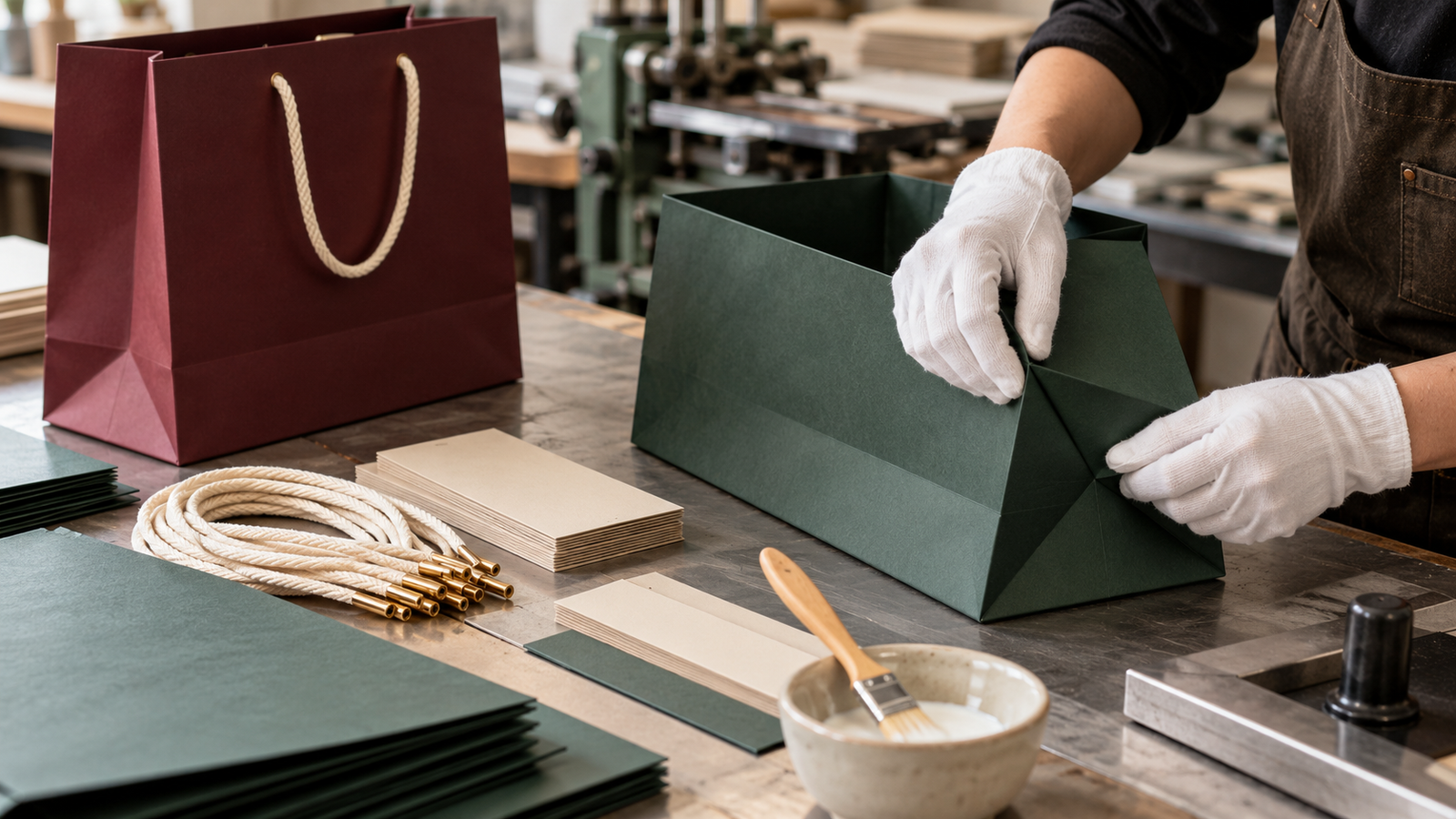
Panels are cut and creased, then folded to create the front, back, side gussets and bottom. Depending on the route, a web may be formed into a tube and cut before the bottom is opened, folded and glued; premium sheet-fed bags may be assembled from prepared sheets through a sequence of machine and hand operations. Control of paper direction, crease position, glue placement and squareness affects how the bag stands and carries.
5. Turn-tops, reinforcements and handles are fitted
Luxury bags often use a folded top edge with reinforcement cards inside. Handle holes are positioned, then rope or ribbon handles are threaded, knotted or otherwise anchored according to the approved construction. Paper handles may be attached with reinforcing patches. The handle, top reinforcement and bag body form one load path, so approve their relationship on the complete bag rather than evaluating the cord or ribbon alone.
6. In-process and final inspections confirm the result
Useful checks happen while correction is still possible: print and colour during printing, registration during finishing, dimensions and crease position after cutting, bond and squareness during forming, and handle security during assembly. Final inspection compares production with the approved master for appearance, dimensions, construction, quantity and packing. It should also include a realistic loaded-bag evaluation where the intended contents and carry conditions justify it.
7. Bags are protected, counted and packed
Finished bags are commonly flattened and nested for efficient shipping, with handles and decorated surfaces arranged to avoid pressure and rubbing. The approved pack-out should define orientation, interleaving or protective tissue where needed, units per inner bundle and carton, carton strength, labels and moisture protection appropriate to the route. Packing is part of production quality: it must preserve the bag shape and finish already approved.
Which approval gates protect a production order?
- Specification freeze: one signed record identifies size, materials, construction, artwork, quantity, acceptance and packing.
- Colour and finish approval: the correct substrate and process are represented, and any limitation is written down.
- Fully converted sample: the bag is checked with the real product or production-representative load for fit, balance, appearance and handling.
- Production reference: the factory and buyer retain the same signed master, artwork revision and change record.
- Pre-shipment release: inspection results, quantities, pack-out and shipping marks are confirmed before dispatch.
Not every project needs every physical proof, but skipping a gate should be a conscious risk decision. See our paper bag sampling guide for what a swatch, digital proof, strike-off and converted sample can—and cannot—prove.
How should material strength and finished-bag quality be checked?
Match the test to the risk. Paper-level results can help compare specified materials: ISO 1924-3:2005 covers tensile properties and tensile energy absorption, ISO 2758:2014 covers paper bursting strength, and ISO 1974:2012 covers Elmendorf tearing resistance. All three remain current on ISO’s catalogue at the time of writing. These tests describe paper properties; they do not replace evaluation of seams, gussets, bottom, handles and the complete loaded bag.
The Paper Bag guidelines also point to EN 13590 for measuring the volume and carrying capacity of carrier bags for retail goods. Whether that standard, a buyer method or a route-specific test is appropriate depends on the bag and claim. Define sample conditioning, load, lift cycle or duration, failure criteria and reporting before production. Our luxury paper bag quality-control checklist provides a broader inspection plan.
Where do sourcing and recyclability claims enter production?
They enter before purchasing, not after the bags are made. If an FSC claim or label is required, eligible material, supplier scope, transaction documentation, product group and label artwork must follow the certified chain. FSC explains that chain-of-custody certification tracks certified material through manufacturing and distribution; buying an FSC-certified paper grade does not by itself authorise any finished-product claim.
Recyclability is also a complete-construction question. The 4evergreen Circularity by Design Guideline Version 4 addresses inks, varnishes, adhesives, barrier layers, metallic decoration and integrated components across paper-mill routes. Record the actual material and process stack, then assess it for the intended market; do not turn a paper-only statement into a claim about the entire bag.
Why do late changes affect cost and lead time?
Changes that can restart work
- bag size or dieline after artwork release;
- paper after colour or finish approval;
- print process or colour target after plates or proofs;
- lamination, foil or embossing after process planning;
- handle construction after hole and reinforcement setup;
- quantity or pack-out after materials and cartons are ordered.
Questions to ask before approval
- Which inputs are still provisional?
- What purchase or tooling starts after this approval?
- Which sample represents the bulk route?
- What change requires a new proof or sample?
- Who can approve each stage, and by when?
- How will revisions be recorded across factory and buyer teams?
A production schedule is a chain of dependent decisions. Build approval time into the plan and ask the supplier to show the critical path. The custom paper bag lead-time guide maps specification, artwork, materials, sampling, production, inspection and freight as one launch schedule.
How does bag production coordinate with boxes, tissue and ribbon?

The bag is the retail carrier, but its size and load come from the finished product pack. Approve the rigid gift box first enough to establish its external dimensions; account for tissue and ribbon in the presentation; then test the complete set inside the bag. Coordinate colours with process-appropriate references rather than expecting identical readings from coated paper, uncoated tissue, wrapped board and textile ribbon.
Final pack-out should keep these components in separate protective systems until store or fulfilment assembly. A coordinated luxury packaging set succeeds when each layer performs its own job and the handoff between them has been measured and tested.
Frequently asked questions
How long does the paper bag manufacturing process take?
There is no responsible universal duration. Material availability, sample route, print method, surface finishing, handle construction, quantity, factory loading, inspection and freight all matter. Ask for a dated schedule that separates buyer approvals from supplier production.
Are luxury paper bags handmade?
They are usually made through a mix of industrial and manual operations. Printing, lamination, die-cutting or creasing may be machine processes, while folding, reinforcement and handle fitting may be partly automated or hand-finished. The important point is controlled repeatability, not a romantic label.
When should a buyer approve a physical sample?
Approve one when product fit, handle comfort, loaded balance, fold behaviour, surface finish or assembly cannot be judged reliably from a screen or flat proof. Use production-intent materials and record any handmade difference from the planned bulk route.
What information should be sent for a paper bag quote?
Send the finished bag size or the product/box dimensions, packed weight, quantity by size, paper direction, print colours, finish locations, handle style, reinforcement, reference images, delivery country and required date. State any sourcing or recyclability claim that must be supported.
Turn your approved concept into a controlled production order
Share your product or gift-box dimensions, expected load, artwork, handle direction, quantity and delivery market. Bespoke Packaging can develop luxury paper bags and coordinate the finished set with rigid boxes, tissue paper and ribbon.