
LUXURY PAPER BAG SIZE GUIDE
Luxury Paper Bag Sizes: How to Measure and Choose the Right Fit
Learn how to read width, gusset and height, size a luxury paper bag around the finished product, allow practical packing room and approve the fit before production.
The right luxury paper bag size is the smallest practical finished size that accepts the complete packed product comfortably, carries it securely and presents it in the intended proportion. Start with the finished box or retail pack—not the bare product—then define the bag’s width, gusset and height, the maximum packed weight, the handle clearance and any tissue, cards or accessories that will travel inside.
There is no universal “small”, “medium” or “large” that works across every supplier. A medium bag in one range may be a different shape from a medium bag elsewhere, and two bags with similar outer dimensions may provide different usable space because of folded tops, handle knots, base boards and gusset construction. This guide gives buyers a repeatable way to specify and test size without relying on names alone.
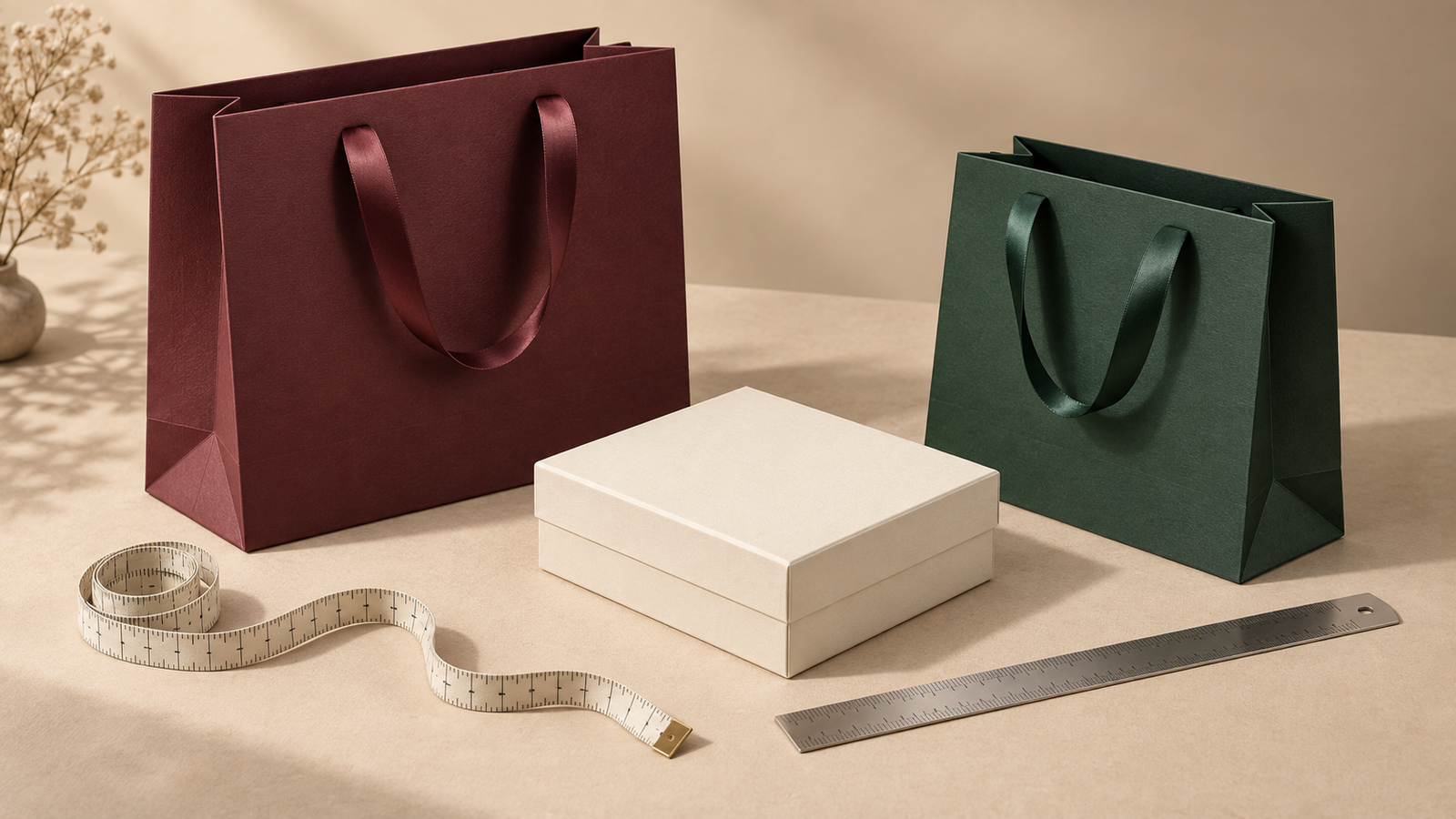
How are luxury paper bag dimensions written?
Custom shopping bag dimensions are commonly discussed as width × gusset × height, often abbreviated W × G × H. Width is the left-to-right measurement across the main face. The gusset is the side depth that opens when the bag is formed. Height runs from the finished base to the top edge of the bag body.
| Dimension | What it controls | What buyers should check |
|---|---|---|
| Width | Front-panel space and the maximum product width that can enter the bag | Finished pack width, loading angle, artwork scale and side clearance |
| Gusset | Usable depth and the footprint when the bag is opened | Finished pack depth, tissue bulk, base-board fit and whether the sides open cleanly |
| Height | Vertical coverage, proportion and distance between the product and handles | Finished pack height, top clearance, folded top and the way the bag is carried |
Some suppliers list dimensions in another order, especially when a catalogue or local market convention is involved. Write the labels in words on the quotation, dieline and approval sample rather than sending three numbers without context. The current GS1 Package and Product Measurement Standard also illustrates why consistent orientation matters: it defines height, width and depth from an agreed front and asks data owners to record maximum measurements. GS1 is not a custom paper-bag specification, but its measurement discipline is useful when several teams exchange product and packaging data.
Are there standard luxury paper bag sizes?
There are familiar retail proportions and many suppliers maintain existing size ranges, but there is no single international chart that makes “small” or “large” interchangeable. The U.S. International Trade Commission’s paper shopping bag industry report describes a market containing varied bag types, paper weights and dimensions. That breadth is a useful warning against treating one vendor’s stock chart as a universal standard.
The examples below are discussion starters, not guaranteed fits or Bespoke Packaging stock promises. They show how different proportions can serve different presentation problems. Final dimensions must be confirmed against the actual packed product and the proposed construction.
| Planning format | Illustrative W × G × H | Typical fitting question |
|---|---|---|
| Small portrait | 160 × 80 × 200 mm | Will a compact presentation box enter without catching the handles or folded top? |
| Medium portrait | 240 × 100 × 300 mm | Does the finished cosmetics, accessory or folded-item pack sit upright with controlled space? |
| Large portrait | 320 × 120 × 380 mm | Can a larger box or grouped purchase be carried without the side panels bowing? |
| Wide landscape | 360 × 130 × 280 mm | Does a horizontal rigid box sit flat instead of turning diagonally? |
| Tall narrow | 120 × 100 × 350 mm | Is the base stable and is there enough top clearance for a bottle-style pack? |
A familiar size can reduce tooling or simplify replenishment, but it should not force a poor fit. Oversizing wastes paper and shipping volume, allows the contents to move and can make a premium item look lost. Undersizing makes loading awkward, rubs finishes and pushes rigid corners into the bag panels.
How do you calculate the right paper bag size?
- Build the finished product pack. Include the rigid gift box, sleeve, insert, tissue, card, ribbon and any protective layer used at retail.
- Measure the maximum external dimensions. Record the widest, deepest and tallest points in a consistent orientation. Do not rely only on a CAD nominal if production components already exist.
- Record the packed weight. Dimensions determine space; weight affects paper, reinforcement, handle choice and the way the filled bag behaves.
- Choose the intended orientation. Decide whether the pack should stand portrait, lie landscape or sit as part of a grouped purchase.
- Add functional allowance. Provide room for natural loading, tissue and manufacturing variation without creating an obviously loose fit.
- Check internal intrusions. Handle knots, eyelets, folded tops, reinforcement cards and base boards can reduce usable space even when the external size looks correct.
- Review the proposed dieline. Confirm that the printed front, gusset and fold positions match the physical orientation described in the quote.
- Approve a physical mock-up. Pack the real contents, lift the bag, carry it, remove the product and inspect the panels and finishes before authorising production.
Planning rule: required internal bag space must exceed the maximum finished pack dimensions by an agreed functional allowance.
The allowance is project-specific. Confirm it with a physical sample instead of applying a universal number.
If several items may be carried together, mock up the realistic combination rather than adding catalogue dimensions in a spreadsheet. Soft apparel compresses; rigid boxes do not. Tissue and ribbon occupy irregular space. A box that fits alone may become difficult to remove once a receipt envelope, product literature and a second item are added.
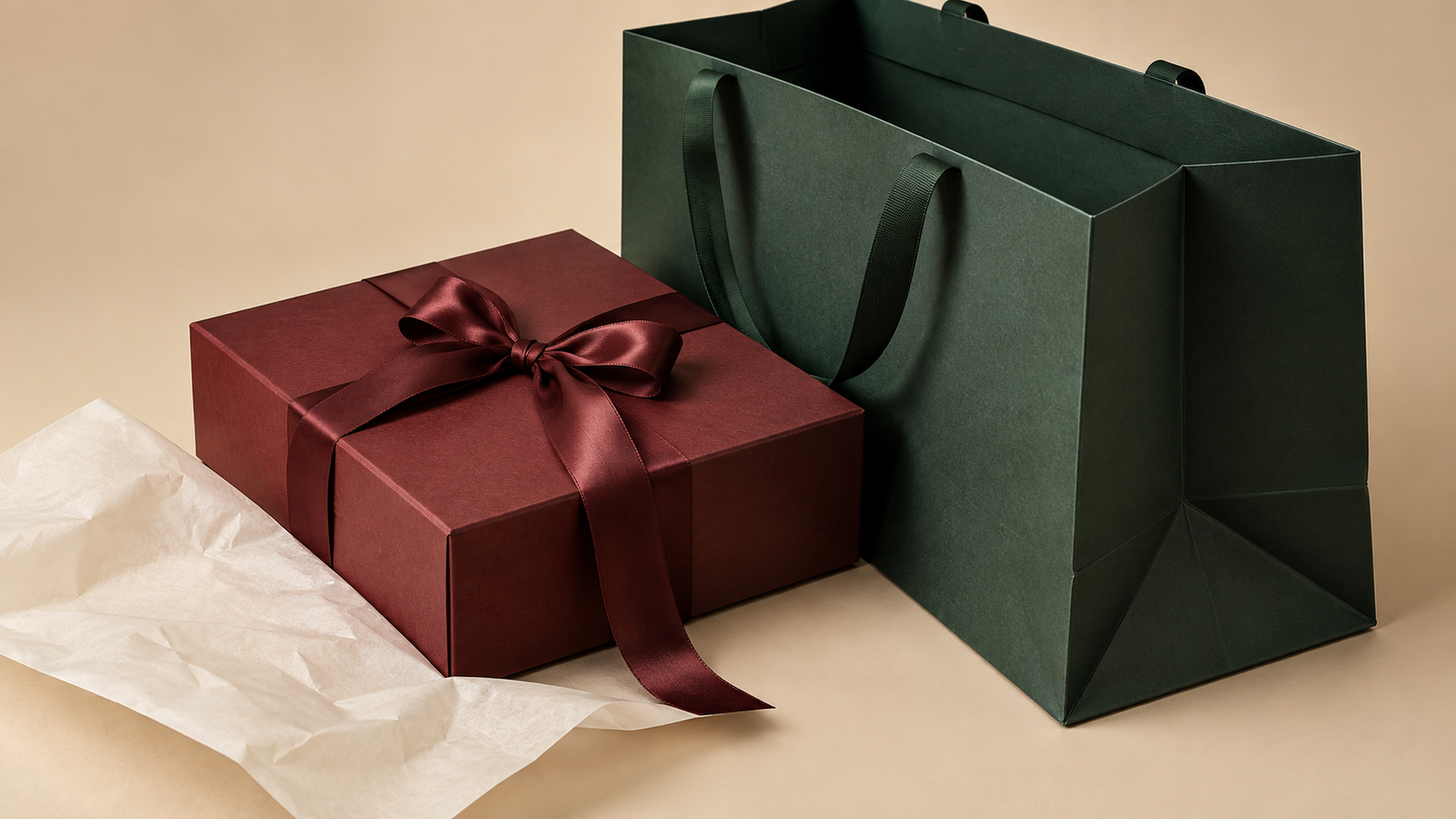
How much clearance should a luxury paper bag have?
There is no safe fixed clearance for every bag. The correct allowance depends on product rigidity, loading direction, tissue volume, surface sensitivity, bag construction, dimensional tolerance and how quickly retail staff must pack the purchase. A few millimetres may be meaningful for a compact jewellery box, while a large apparel or gift set may need a different proportionate allowance.
Ask the supplier to distinguish external finished dimensions from usable internal space. Then test four moments: insertion, the product resting at the base, carrying by the handles and removal. The fit should not require forcing the gussets open, scraping the box corners down the sidewalls or pulling the handles apart to reach inside.
- Too tight: bowed panels, stressed corners, damaged tissue, scuffed finishes and slow packing.
- Too loose: shifting contents, weak presentation, more material and unnecessary carton volume.
- Balanced: easy loading, controlled movement, clean bag shape and a product that can be removed naturally.
How does product shape change the best bag proportion?
Portrait bags for upright retail packs
A portrait bag has more height than width. It often suits compact fashion accessories, cosmetics, books or stacked small boxes, provided the base remains stable. Very tall, narrow formats need particular attention to handle position, packed centre of gravity and tipping.
Landscape bags for wide presentation boxes
A wide luxury bag can allow a horizontal rigid box to stay in its presentation orientation. It may also give the main artwork more visual width. Check that the gusset opens fully, the base does not sag and the handle spacing keeps the filled bag balanced.
Square bags for compact sets
Square or near-square bags create a composed, gift-like silhouette and can work well for candles, accessories and grouped boxes. They can be inefficient if the real product is much narrower than the footprint, so confirm the packed arrangement rather than choosing the shape for symmetry alone.
Tall narrow bags for bottles and vertical products
Bottle-style proportions need a stable base and controlled depth. Measure any presentation carton rather than the bottle itself, and consider whether a divider or insert is required when more than one item will be carried. The bag is a carrier, not a substitute for protective primary packaging.
Does bag size determine paper and handle strength?
Size influences the structure, but it does not determine strength on its own. A larger panel can flex more, a deeper gusset changes the base footprint, and a heavier filled pack increases the load transferred through the handles, top reinforcement, side panels, seams and base. Paper type, fibre direction, moisture, fold geometry, adhesive and workmanship all matter alongside nominal grammage.
ISO 536:2019 specifies how paper and board grammage is determined. Grammage is therefore a defined material measurement, but it is not a complete bag-performance rating. Use our luxury paper bag materials guide and handle guide to develop the construction, then test the assembled bag with representative contents.
The handle drop also changes the user experience. A large apparel bag may need room for hand or forearm carrying, while a compact jewellery bag can use a shorter, more controlled handle. Specify handle material, length, attachment and carrying method together; do not resize the body and assume the previous handle specification will remain suitable.
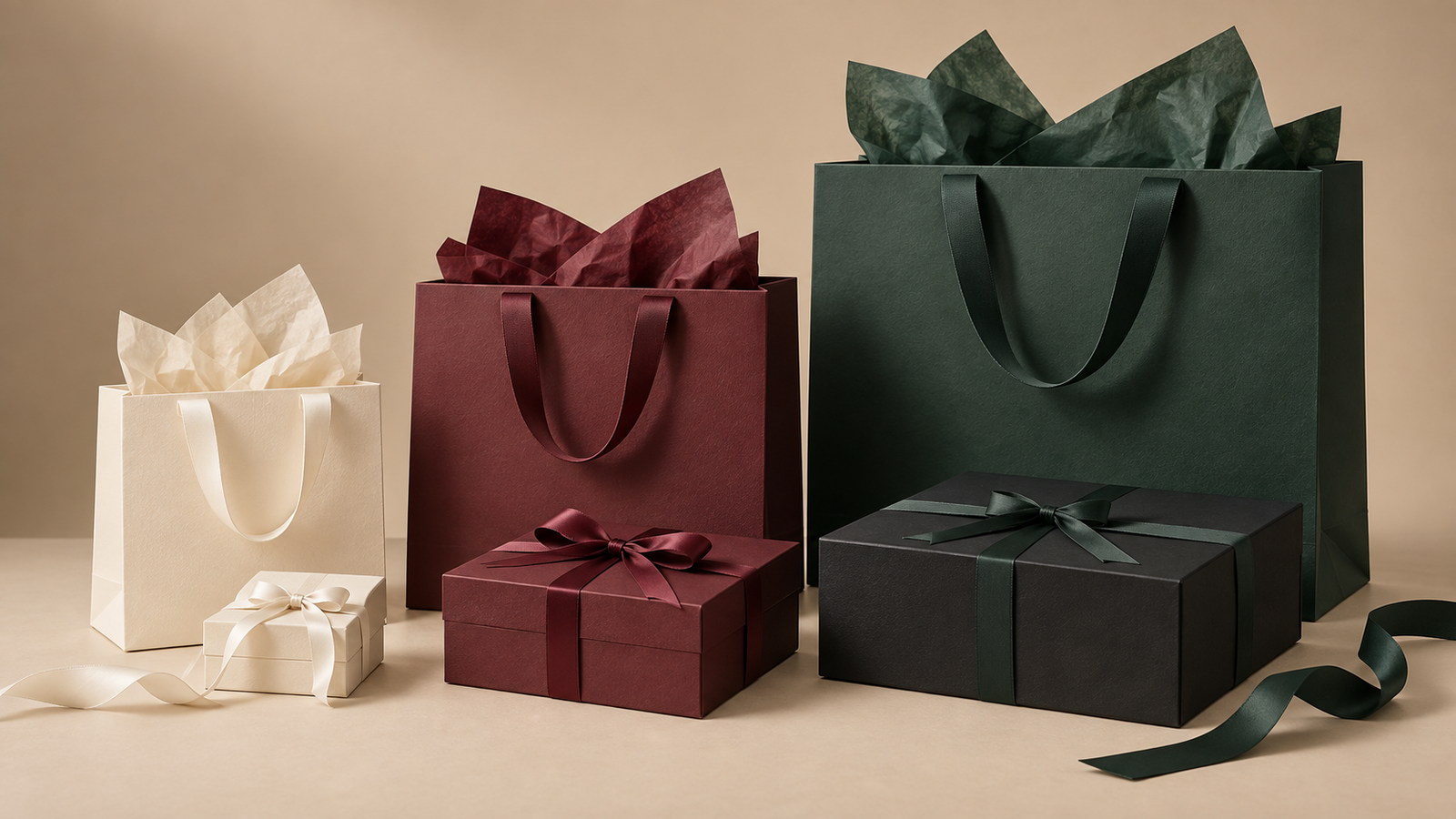
Can one paper bag size cover several products?
Yes, if the products share a workable footprint, weight range and presentation standard. Consolidating sizes can reduce SKU complexity, make stock easier to manage and support the quantity planning discussed in our luxury paper bag MOQ guide. It can also help stores avoid choosing among many nearly identical bags at the point of packing.
However, a universal bag can become too large for small items and too tight for larger ones. Test the smallest, largest and most awkward product in the proposed family. Consider whether tissue, a removable paper insert or two carefully chosen bag sizes creates a better experience than one compromised format.
- group products by finished pack footprint, not only by retail category;
- compare the lightest and heaviest packed configurations;
- check whether the same handle drop works across all uses;
- keep artwork and logo scale visually balanced on each proposed size;
- model bag consumption against matching boxes, ribbon and tissue paper;
- confirm that consolidating sizes does not increase shipping and storage volume disproportionately.
When should you request a paper bag prototype?
Request a physical size mock-up before final artwork approval whenever the product fit, proportion or carrying performance is new. A plain paper dummy can answer dimensional questions early. A later printed and finished sample can confirm colour, material, handle, reinforcement and decoration. These stages solve different risks and should not be treated as interchangeable.
Pack the approved production components whenever possible. Photograph the test arrangement, record the finished dimensions and weight, and keep the signed sample or approved specification as a quality reference. Our paper bag quality-control checklist explains how approval references connect to incoming materials, complete-bag tests and pre-shipment inspection.
Transport testing applies to the complete packaged-product system, not just an empty shopping bag. The International Safe Transit Association’s design and testing guidance recommends documenting how an evaluation was made and comparing laboratory outcomes with actual distribution information where possible. If luxury bags ship inside export cartons, test the carton, protection, packing count and distribution route as a system. A retail carrier that arrives crushed cannot deliver the intended brand experience.
How do bag dimensions affect printing and finishing?
Changing size changes more than the outline. It changes the front-panel artwork area, the relationship between logo and handles, the position of gusset folds and the amount of paper consumed. A finish that looked balanced on a small sample may feel undersized on a wide bag, while a large foil area can cross folds or become vulnerable to handling.
Review artwork on the supplier’s final dieline and inspect a formed sample, not only a flat PDF. Keep important marks away from creases, glue areas, handle holes and edges according to the converter’s tolerances. Our printing guide and finishes guide cover process selection, proofing and decoration compatibility in more detail.
What size information belongs in a paper bag RFQ?
- finished bag width, gusset and height, with the measurement order written in words;
- whether dimensions are intended as external finished size or required usable internal space;
- the finished product or gift-box dimensions, orientation and maximum packed weight;
- photos, drawings or physical samples of the complete item that will enter the bag;
- tissue, cards, ribbon, sleeves and secondary items included during retail packing;
- quantity for every bag size, artwork and colourway;
- paper, handle, top fold, reinforcement, base board, print and finish requirements;
- desired carrying method and approximate handle drop;
- required prototype, printed sample and production approval stages;
- units per inner pack and export carton, destination and storage constraints;
- acceptable size consolidation options or existing formats the supplier may propose;
- the latest date for approved samples and final delivery.
Ask the supplier to return a dimensioned dieline and assumption sheet with the quotation. If two quotes use different measurement orders, usable spaces, papers, reinforcements or packing counts, their prices are not directly comparable. For broader freight planning, see how packaging size affects shipping costs.
Frequently asked questions about luxury paper bag sizes
What does the gusset mean on a paper bag?
The gusset is the folded side depth that opens to create usable space. It works with the base to determine the bag’s footprint. Confirm whether a quoted depth refers to the finished external gusset and test how fully it opens around the actual product.
Should the bag be measured inside or outside?
Suppliers usually quote a finished convention for their product, but the buyer also needs usable internal space. State both the external finished dimensions being ordered and the dimensions of the packed item that must fit. Let the dieline and physical sample resolve any difference.
How much bigger should a paper bag be than the box?
There is no universal allowance. The answer depends on the box size, loading direction, tissue, handle construction, bag tolerance and desired presentation. Ask the manufacturer to propose a functional allowance and approve it with the real packed box.
Can handle knots reduce the usable bag width?
They can intrude near the top of the bag, especially with rope or ribbon threaded through holes. Reinforcement cards and folded tops also occupy space. Test insertion and removal at the handle zone rather than checking only the base footprint.
Is a larger bag always stronger?
No. Strength comes from the complete design: paper, grain direction, folds, adhesive, reinforcement, handle attachment, base and workmanship. A larger body can increase leverage and panel flex. Test the final construction with the intended load.
Should matching tissue paper use the same size as the bag?
No. Tissue is sized for wrapping, cushioning or presentation and may be folded or layered. Specify the sheet size, number of sheets and packing method separately, then test them inside the approved bag and box combination.
Approve the fit before you approve the artwork
A well-sized luxury paper bag begins with the finished product, not a generic size name. Define width, gusset and height clearly, include every packed component, add a project-specific functional allowance and approve the physical fit. Then align paper, handles, printing, finishing and export packing around the tested size.
Bespoke Packaging develops custom luxury paper bags together with rigid gift boxes, ribbon and tissue paper. Share the finished product dimensions, maximum packed weight, preferred orientation, quantity and destination, and we can help turn them into a quote-ready bag specification and coordinated packaging set.
Does your current bag fit the finished product—or only the product dimensions on a spreadsheet?