
SEASONAL PAPER BAG BUYER GUIDE
Custom Christmas Paper Bags: A Buyer’s Planning Guide
Plan a premium holiday bag range that feels festive, fits the product and still controls artwork, quantities, approvals, leftover stock and the complete gift presentation.
Custom Christmas paper bags are branded paper shopping bags developed for a defined holiday selling period. A strong programme does more than place snowflakes on an existing carrier. It decides which bag structures can remain useful after the season, where festive artwork creates real value, how many sizes and designs the forecast can support, and when every approval must be complete for bags to reach stores on time.
For premium retailers, the paper bag is often the most visible part of the Christmas handoff. It may need to carry a rigid gift box, protect tissue and ribbon, move through a busy counter, and still look considered in a customer’s hand. This guide explains how procurement, design and operations teams can turn that requirement into a quote-ready seasonal specification without inventing a universal quantity, price or production schedule.
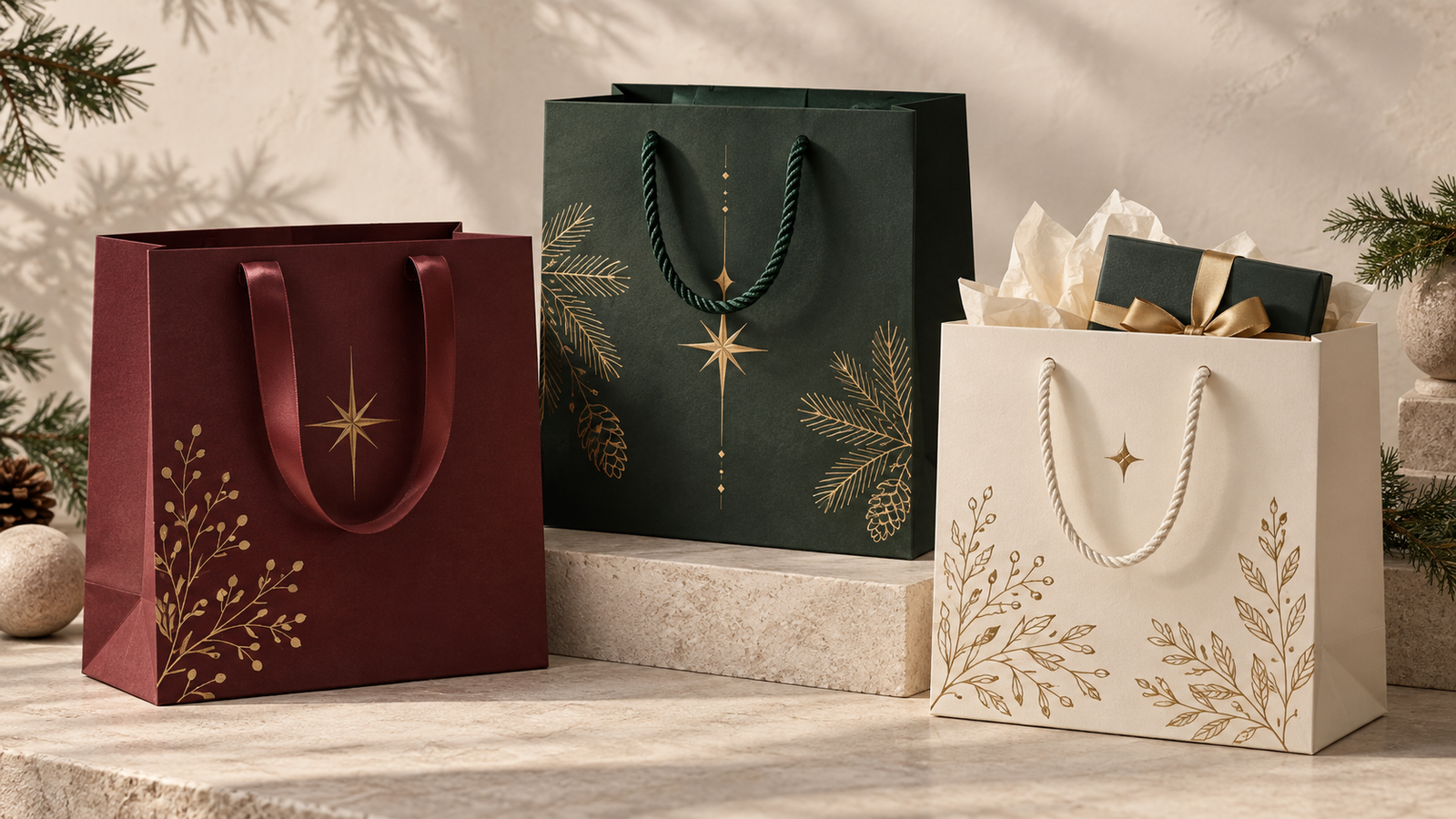
What are custom Christmas paper bags?
A custom Christmas paper bag is a retail or gift carrier whose size, paper, handles, printing or finishing is selected for a Christmas campaign. The degree of customisation can range from one seasonal colour or foil motif on an established bag to a fully bespoke bag with new dimensions, paper, handle colour and coordinated gift packaging.
The word “Christmas” describes the campaign, not a technical construction. A festive bag can be made from kraft, coated, uncoated or specialty paper; it can use rope, ribbon or paper handles; and it can be printed, foil stamped, embossed or left deliberately quiet. The correct combination depends on the completed product pack, brand position, destination market, quantity and time available.
Should the bag be fully seasonal or partly evergreen?
The first strategic decision is how much of the packaging should expire with the campaign. A fully seasonal design can create a distinctive store moment, but every unsold bag becomes difficult to use after the holiday. An evergreen bag with a removable or replaceable seasonal layer is more flexible, although the Christmas expression may be quieter.
| Approach | What changes for Christmas | Best when | Main control point |
|---|---|---|---|
| Fully seasonal bag | Bag colour, artwork and finish | The campaign is large, planned and visually important | Forecast by size and design |
| Evergreen bag with seasonal print | One panel, band or restrained motif | The base bag already fits the brand and products | Confirm the print route and usable area |
| Evergreen bag with accessories | Tissue, ribbon, tag or sticker | Demand is uncertain or the bag must remain usable later | Make accessories easy to apply at the counter |
| Hybrid range | Hero size is seasonal; supporting sizes stay evergreen | One gift set drives most seasonal volume | Keep colours and materials coordinated |
Do not assume that more decoration makes a bag more premium. A deep green or burgundy paper bag with a small metallic mark and excellent proportions may feel more luxurious than a crowded all-over pattern. Decide what must signal Christmas and what should continue to signal the brand.
What should stay consistent with the core brand?
A seasonal bag should still be recognisable as part of the brand’s packaging system. Keep the core logo, typographic rules and one or two established colours stable. Add Christmas through a controlled secondary palette, a motif, a foil detail, ribbon, tissue or a gift tag rather than rebuilding every visual cue at once.
- Brand anchor: decide which logo version, signature colour or material character cannot change.
- Seasonal cue: choose one clear device such as a winter botanical line, star geometry, ribbon colour or limited pattern.
- Hierarchy: decide whether the brand or the seasonal message should be seen first.
- Cross-material colour: judge ink, paper, foil, tissue and ribbon together; identical colour references do not guarantee identical appearance on different materials.
- After-season use: check whether the remaining bag would still be acceptable if a removable tag or ribbon were taken away.
Pantone describes its graphics system as a shared colour language for print and packaging, but a reference number is only the start of colour control. Approve the colour on the actual paper and finish because substrate shade, surface texture, coating and metallic decoration change perception. Our packaging colour guide explains when CMYK, spot colour and physical proofs are useful.
How many bag sizes and designs should a holiday range use?
Start with the real seasonal pack-out, not a list of imagined small, medium and large bags. Measure the finished rigid gift boxes, boxed product combinations and tissue volume. Group packs that can share a bag without excessive empty space, unstable carrying or a poor visual proportion.
The current GS1 Package and Product Measurement Standard provides a consistent way for trading partners to communicate package measurements and calls for measurements to be retaken when a change can affect dimensions or weight. For a seasonal project, record the state in which each gift set is measured and give the supplier the maximum packed dimensions and weight.
- List the top seasonal product or gift-set combinations by expected units.
- Measure each completed pack, including the box, sleeve, tissue or bow that must enter the bag.
- Test which packs can share a bag while remaining stable and easy to remove.
- Separate a high-volume hero size from low-volume exceptions.
- Count every size, artwork and colourway as a potential inventory line.
- Use the fewest formats that serve the product experience without forcing damaging compromises.
The luxury paper bag size guide shows how width, gusset and height relate to a finished product pack. Final dimensions should be confirmed by a physical fit test rather than by an online size label alone.
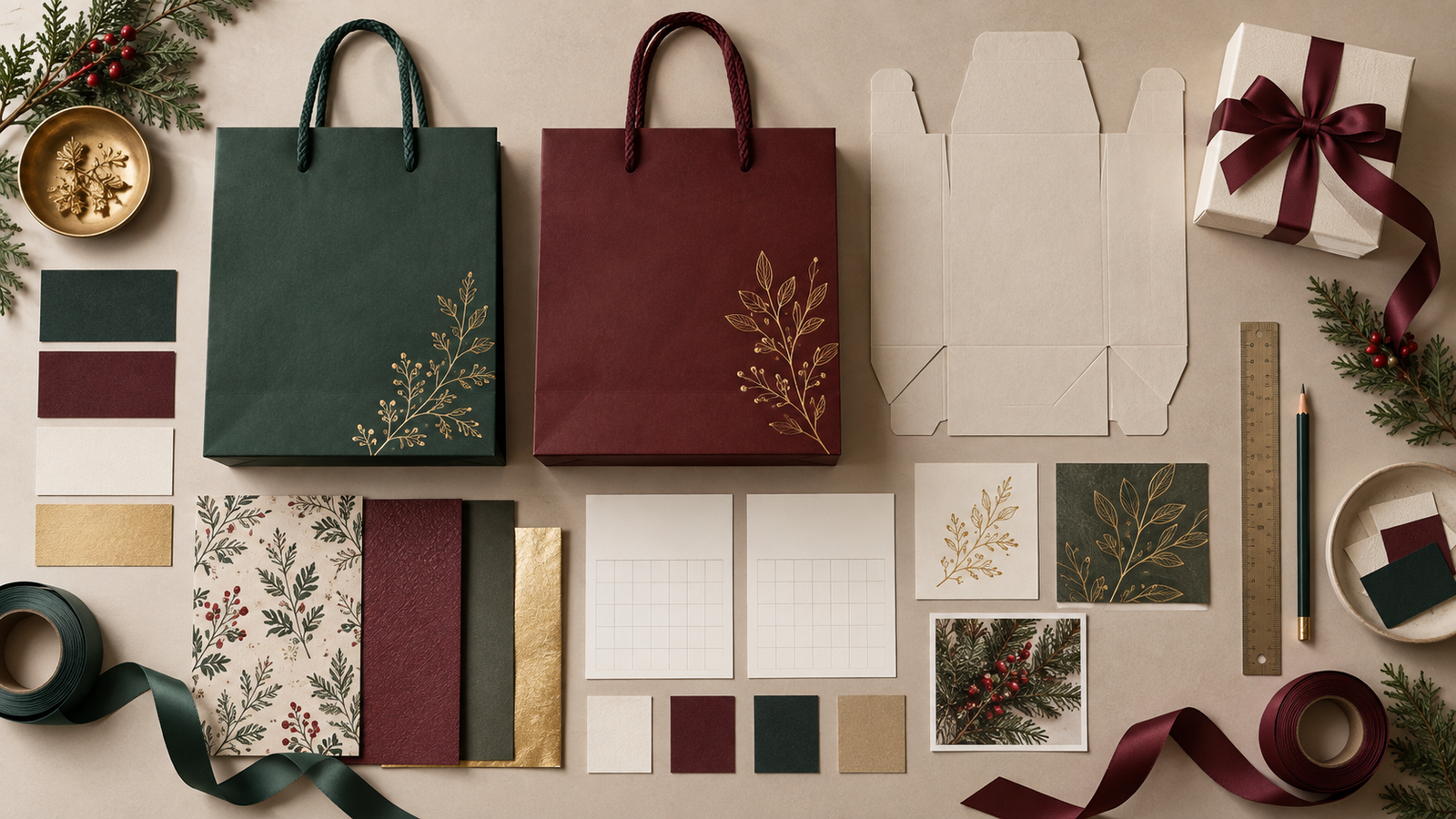
When should custom Christmas paper bags be ordered?
There is no responsible universal order date. The correct deadline depends on whether the bag is stock overprint or fully custom, how many components need approval, material availability, production capacity, inspection, freight, customs and distribution to stores. Work backward from the date the bags must be physically received and usable, not from Christmas Day or the campaign launch alone.
- Set the need-on-site date. Include receiving, inventory checks and store allocation.
- Reserve delivery and contingency time. Confirm the delivery basis, destination and seasonal freight risk.
- Add production and packing. Ask the supplier for the current schedule against the exact specification and quantity.
- Add approval time. Allow buyer time for dielines, digital proofs, colour or finish tests and physical samples.
- Add specification and artwork development. Do not start this clock until product packs and decision owners are known.
- Set freeze dates. Name who can approve size, artwork, colour, sample and production release.
A “production lead time” rarely includes every step above. The custom paper bag lead-time guide helps buyers map the complete critical path and identify which decisions can run in parallel.
How should seasonal artwork be built on the bag dieline?
Build artwork on the supplier-approved flat dieline for the chosen construction. Mark the visible front and back panels, gussets, base, turn-top, seams, handle holes and safe areas. A repeated winter pattern can look continuous on a screen yet break awkwardly at a gusset fold or disappear under a top turn when the bag is formed.
- Use vector source artwork for logos, line motifs and finish masks where requested.
- Keep critical marks away from folds, creases, seams and handle attachments.
- Name spot colours, white-ink layers, foil, embossing and varnish layers unambiguously.
- Check the design on a full-size assembled mock-up, not only a reduced flat PDF.
- Approve front, back and gusset orientation with handles visible.
- Create a version code and date so obsolete seasonal artwork cannot be released by mistake.
For a complete file handoff, use the luxury paper bag artwork guide. It explains bleed, safe areas, colour separations and finish layers without treating the supplier’s specific dieline as optional.
Which paper bag construction suits holiday retail?
Christmas selling can change the load. Customers may combine several products, choose a heavier candle or ceramic item, or carry a finished rigid gift box rather than one unboxed product. Specify the bag around that real use. Paper weight alone does not prove carrying performance; the top turn, handle reinforcement, handle attachment, side seam, gussets and base board work as a load path.
For premium presentation, ribbon handles can coordinate directly with a gift-box bow, while cotton rope offers a rounded hand feel and paper handles can support a more fibre-led brief. The right handle must be long enough for the intended hand or arm carry, secure at the attachment and compatible with the packed weight. Review the paper bag handle guide and test a filled sample before release.
Which printing and finishing choices work for Christmas bags?
Choose the process from the artwork, paper, quantity and approval standard. Offset, screen, flexographic and digital printing solve different problems; hot foil, embossing and spot effects add separate material and process controls. A metallic-looking ink is not the same result as transferred foil, and an image on a monitor is not an approval of either.
- Restrained foil: useful for a star, line motif or logo when a true reflective accent is required.
- Embossing or debossing: adds a tactile cue but needs suitable paper, artwork and pressure control.
- Full-colour print: supports illustration and pattern, but colour must be evaluated on the selected paper.
- Printed solid colour: may reveal rub, fold or shade variation; decide whether coloured paper is a better route.
- Surface coating or laminate: can change protection and feel, but it must be assessed as part of the whole construction and end-of-life claim.
Compare the main processes in the printing guide and use the foil-stamped paper bags guide when metallic decoration is central to the seasonal concept.
How should the bag coordinate with boxes, tissue and ribbon?
The bag is the public-facing carrier; the rigid box protects and stages the product; tissue softens the reveal; ribbon closes or celebrates the pack. A premium Christmas set works when these layers have distinct jobs and a controlled visual relationship. It does not need the same motif repeated at full strength on every surface.
- Size the bag around the finished gift box and bow, including removal clearance.
- Use one leading surface for the seasonal motif and let other components support it.
- Approve bag paper, box wrap, tissue and ribbon under the same lighting.
- Check whether tissue volume pushes the bag open or hides the gift presentation.
- Choose ribbon widths and knots that packing staff can apply consistently at peak volume.
- Assemble one complete approval set and retain it as the visual reference.
See the luxury packaging sets guide for a component-by-component method covering colour, fit, hierarchy and approvals.
How can buyers reduce leftover seasonal inventory?
Seasonal inventory risk is created before production when too many sizes, colourways or dated messages are approved. Forecast at the SKU level, identify the assumptions with the greatest uncertainty and protect flexibility where it matters. A supplier’s minimum may apply per size, paper, artwork or print setup rather than to the combined headline quantity.
- Use evergreen core bag sizes where product fit already works.
- Concentrate fully seasonal decoration on the highest-volume hero size.
- Avoid printing a year unless the campaign requires it.
- Use tags, tissue or ribbon for volatile or market-specific messages.
- Separate committed store demand from forecast upside.
- Agree how production tolerances, overrun and shortfall will be reported.
- Plan where unopened excess stock can be stored and whether it remains usable next season.
Ask for quantity breaks against one controlled specification and compare landed usable cost, not only the lowest unit price. The paper bag cost guide explains how SKU count, setup, packing and delivery assumptions change a quotation.
What sustainability and regulatory checks matter?
Do not treat “paper,” “recycled,” “FSC-certified,” “recyclable” and “reusable” as interchangeable. Each refers to a different question. Define the exact claim, the destination market, the complete construction and the evidence required before adding environmental language or a certification mark to seasonal artwork.
The February 2026 4evergreen Circularity by Design Guideline treats printing inks, overprint varnish, adhesives, barrier layers and integrated components as parts of paper-based packaging design, and states that final constructions should still be tested for actual recyclability. Review the bag body, coating, decoration, handles, reinforcement and adhesive together rather than assuming the base sheet proves the whole bag claim.
For bags placed on the EU market, Regulation (EU) 2025/40 includes packaging-minimisation requirements under Article 10, with the 2030 obligation framed around reducing weight and volume to the minimum necessary for functionality. Seasonal appearance by itself should not become a reason for unnecessary layers or false volume. Legal applicability and evidence should be reviewed for the actual product, market and date.
If an FSC label is requested, FSC’s official on-product guidance says the company supplying the final product should be verified as FSC-certified and the label specified for the product. Confirm chain-of-custody scope, invoice claim and authorised artwork rather than adding a tree logo or informal “FSC paper” statement. Our FSC-certified paper bags guide provides a practical verification sequence.

What should the sample and inspection process confirm?
A screen visual can confirm content and approximate placement. It cannot prove bag fit, paper feel, handle comfort, foil release, emboss depth, colour on the chosen stock, rub resistance or finished carrying performance. Match the approval evidence to the decisions that could cause a seasonal failure.
- Fit mock-up: proves the completed gift set can enter, sit and be removed as intended.
- Paper and handle samples: prove material character and colour direction before full conversion.
- Print or finish test: proves the seasonal artwork on the real or agreed comparable surface.
- Fully converted pre-production bag: proves construction, appearance and use together.
- Approved master: becomes the identified physical reference for production and inspection.
- Packed transit sample: shows how bags and delicate finishes are protected in cartons before they reach the store.
Before shipment, inspect against named criteria: dimensions and tolerances, artwork version, colour or approved reference, print registration, foil or emboss position, surface damage, handle security, seams, reinforcement, base board, count and export packing. The sample guide explains what each approval stage can and cannot demonstrate.
What belongs in a quote-ready Christmas paper bag brief?
- Campaign name, sales markets and need-on-site date.
- Finished product or gift-box dimensions, maximum packed weight and reference photos.
- Bag dimensions or a request for supplier recommendations from the pack-out.
- Quantity by size, artwork, colourway and delivery lot.
- Evergreen elements and seasonal elements clearly separated.
- Paper type, colour and tactile direction.
- Handle material, colour, dimensions, drop and intended carry method.
- Print and finish positions with vector artwork or a development brief.
- Required dieline, proof, finish test, sample and approved-master stages.
- Destination, delivery basis, receiving constraints and carton-mark requirements.
- Sourcing, recycled-content, recyclability or certification claims that need evidence.
- Matching rigid gift box, tissue paper, ribbon and tag requirements.
- Decision owners and freeze dates for size, artwork, colour and production release.
If a specification remains open, state the required outcome: fit this gift box, carry this packed weight, look recognisably premium and seasonal, remain usable after the campaign where possible, and arrive at this location by this date. A useful quotation should expose assumptions rather than hide them.
Frequently asked questions about custom Christmas paper bags
Can a luxury Christmas bag use an existing bag size?
Yes, if the existing size, paper, handles and construction fit the completed seasonal product pack. Add restrained print, tissue, ribbon or a tag only after testing the bag with the real contents. An existing format is not a shortcut when product fit is poor.
Should Christmas paper bags include a date or year?
Only when the dated campaign value outweighs leftover-stock risk. A year makes unused bags difficult to carry forward. Many brands can create a clear seasonal identity through colour, pattern, foil, ribbon or a removable tag without dating the bag.
Are ribbon handles suitable for heavy gift boxes?
They can be, but suitability depends on ribbon material and width, attachment, top reinforcement, bag construction and the actual packed load. Test a fully converted filled bag and define the acceptance method rather than relying on appearance or paper weight alone.
How many Christmas bag designs should a brand order?
Use the fewest designs that serve distinct products, markets or brand moments. Every size and artwork can create a separate forecast, setup and inventory line. A hero seasonal design plus evergreen supporting sizes is often worth comparing with a fully seasonal range.
Can Christmas paper bags be called recyclable?
Not from the word “paper” alone. Assess the complete construction, including coatings, laminate, inks, foil, handles, reinforcement and adhesives, against the intended collection and recycling route. Support the final claim with applicable evidence for the destination market.
Build the seasonal moment on a controlled bag programme
The best custom Christmas paper bags balance a short selling season with long-term brand discipline. Start with the completed gift pack, limit the size and artwork family, separate evergreen and seasonal decisions, work backward from the need-on-site date, approve physical evidence and control the full construction. The result can feel unmistakably festive without creating avoidable complexity or surplus.
Bespoke Packaging develops custom luxury paper shopping bags with rigid gift boxes, tissue paper and ribbon. Share your product packs, campaign quantity, artwork direction, destination and required date, and we can build a coordinated Christmas packaging specification for quotation and sampling.