
BEAUTY BRAND PACKAGING GUIDE
Custom Cosmetic Paper Bags: A Buyer’s Guide for Beauty Brands
Plan a premium paper shopping bag around the beauty products, gift boxes and tissue your customer actually carries home.
Custom cosmetic paper bags are branded retail carriers designed around a beauty brand’s finished products and handoff experience. The useful specification is not simply “a luxury bag with a logo.” A skincare set in a rigid box, a single boxed fragrance and several small makeup cartons create different requirements for bag width, base, handle comfort and presentation.
For beauty retailers, the paper bag is often the most visible part of a coordinated package after purchase. It needs to carry the complete pack comfortably, protect its presentation through normal handling and look consistent with the box, ribbon and tissue inside. This guide turns those needs into decisions a buyer can put in a quotation brief and test in a physical sample.
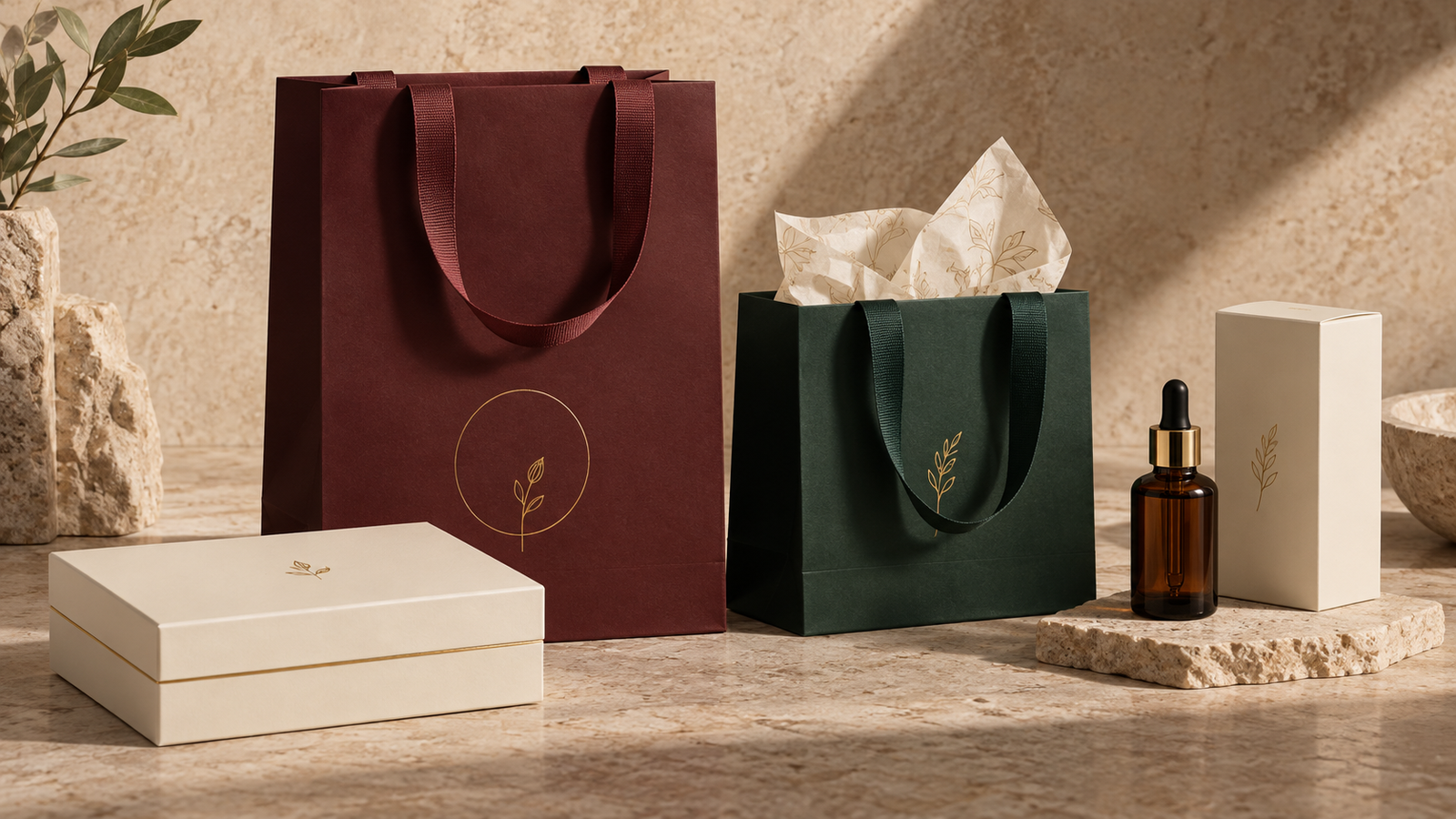
What should a cosmetic paper bag do?
Start with the handoff, not a paper swatch. A beauty-store carrier may hold one small carton, a mixed basket of boxed items, or a substantial seasonal gift set. In each case it should allow staff to pack the purchase quickly, keep the intended presentation visible, stand or travel as required and give the customer a comfortable grip. A shopping bag is still a carrier: fragile glass, liquids and delicate components need their own suitable primary and protective packaging inside it.
Define the use case in a single sentence before discussing decoration. For example: “This bag carries one boxed serum and two makeup cartons from the boutique counter,” or “This larger bag carries a finished rigid gift box, tissue and card at a holiday event.” Those statements lead to different structures even when both bags share the same artwork.
Which beauty purchases need different bag formats?
| Beauty retail use | Start the bag brief with | Check in a sample |
|---|---|---|
| One compact boxed item | A small footprint that avoids a loose, oversized presentation | Easy insertion, upright appearance and comfortable handle reach |
| Mixed cosmetics basket | The actual combination of cartons, any divider or tissue, and total packed weight | Base stability, access at the opening and movement during carrying |
| Boxed fragrance or skincare set | The finished protective box rather than the bare bottle or jar | Clearance at the gusset, level base and handle-to-top distance |
| Premium gifting or launch event | Rigid gift box, tissue, ribbon, card and intended presentation order | Whether the complete set fits without crushing the tissue or bow |
The table is a planning aid, not a set of universal sizes. Two products with the same volume can behave differently if one arrives in a tall carton and the other in a broad rigid box. When a brand wants fewer bag sizes, test the most common order combinations before consolidating them. An overly large “one bag for everything” format may save a stock-keeping unit yet weaken the small-purchase experience.
How do you size a paper bag for cosmetics and gift sets?
Measure the finished pack: product box or rigid gift box, its orientation, tissue, inserts and anything attached to it. Then specify the bag’s usable internal width, gusset and height, not only the external face dimensions. Allow practical clearance for packing and removal without letting a compact product fall into a deep, empty-looking bag. Our luxury paper bag size guide explains the three dimensions and the fit checks in detail.
Test the opening and the base as well as the volume
A box may fit mathematically but catch on the bag’s top folds, handles or opening. Staff should be able to lower the pack in without forcing it, then lift it out without scraping a decorative lid. The base should remain level when the bag is set on a counter. If a glass fragrance is inside a gift box, check that its protective insert—not the shopping bag—controls its movement.
Use a small family of purposeful sizes
A compact bag for single items and a wider bag for boxed sets often create a clearer retail system than many barely different sizes. Keep a shared colour and handle language while adjusting the footprint to the actual purchases. Record which product combinations each approved size serves, so store teams do not have to guess.
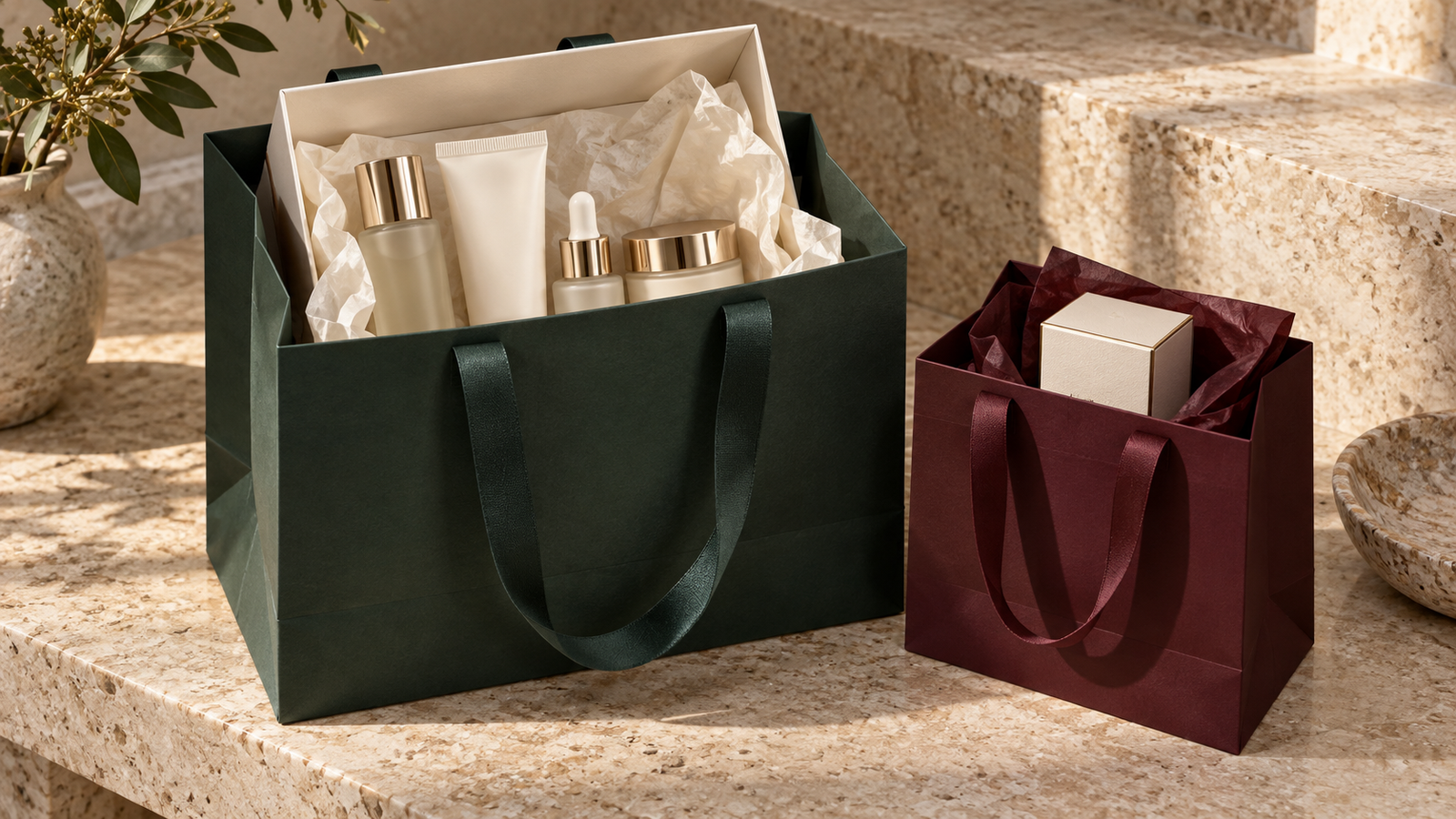
What construction works for a premium beauty bag?
Choose the paper, top fold, handle attachment, side seams and base as a system. A tactile paper can suit a restrained boutique design; a different surface may suit detailed, full-colour artwork. The right choice depends on print, feel, packed weight and how the bag will be handled. Compare physical paper samples against the desired finish rather than choosing by grammage alone. The paper materials guide outlines the main stock families, while the construction guide explains how the load moves through the complete bag.
Specify handles from the carrying experience
Ribbon can connect the carrier to a gift-box bow; soft rope may feel comfortable for a heavier boxed set; paper handles can support a more paper-led visual language. The attachment and reinforcement matter as much as the visible handle material. Ask to test the finished bag with the heaviest intended pack and the handle length a customer will actually use. The handle comparison provides a fuller decision framework.
Keep the interior presentation deliberate
An ivory or branded tissue wrap can conceal a mixed purchase and make opening feel considered. For a fitted rigid box, a little tissue may soften the presentation without crowding the opening. Treat tissue as part of the pack-out sample: too much can force the bag outward or hide a carefully designed box. If the bag needs internal printing, include it in the artwork, cost and sample plan rather than assuming it is standard.
How should the bag, box, ribbon and tissue work together?
A coordinated beauty packaging set does not require the same decoration on every surface. Decide which component carries the strongest brand signal. A deep-colour paper bag can frame an ivory rigid gift box; a restrained logo can let a satin ribbon or printed tissue provide the moment of detail. Repeat a limited palette and a clear hierarchy so the full set reads as one brand when laid out on a retail counter.
Compare real components together under the same light. A burgundy printed on coated bag paper, an uncoated box wrap and a dyed ribbon may not appear identical even when the artwork calls them the same colour. Pantone explains why a colour’s appearance changes between coated and uncoated paper; the practical response is to agree on acceptable visual relationships across actual materials. Use a physical reference or production-relevant sample for colour-critical decisions, as described in our packaging colour guide.
Which print and finish choices support a beauty brand?
Begin with brand artwork and handling, then choose only the decoration that strengthens the concept. Fine typography and complex colour may need a different print route from a single bold mark. Foil, embossing or a selective gloss can add a focal point, but test the actual design on the chosen paper. A finish that looks compelling on a flat swatch may behave differently near a fold or handle. Our guides to paper bag printing and luxury finishes compare the main routes.
For a multi-item beauty line, decide how much artwork should be shared across sizes and how seasonal editions will change. Keeping the core bag structure and brand colours consistent can make variant planning easier; changing paper, print coverage, finish or handle can alter sampling and unit cost. Ask the supplier to quote those changes explicitly rather than assuming a graphic swap has no production effect.
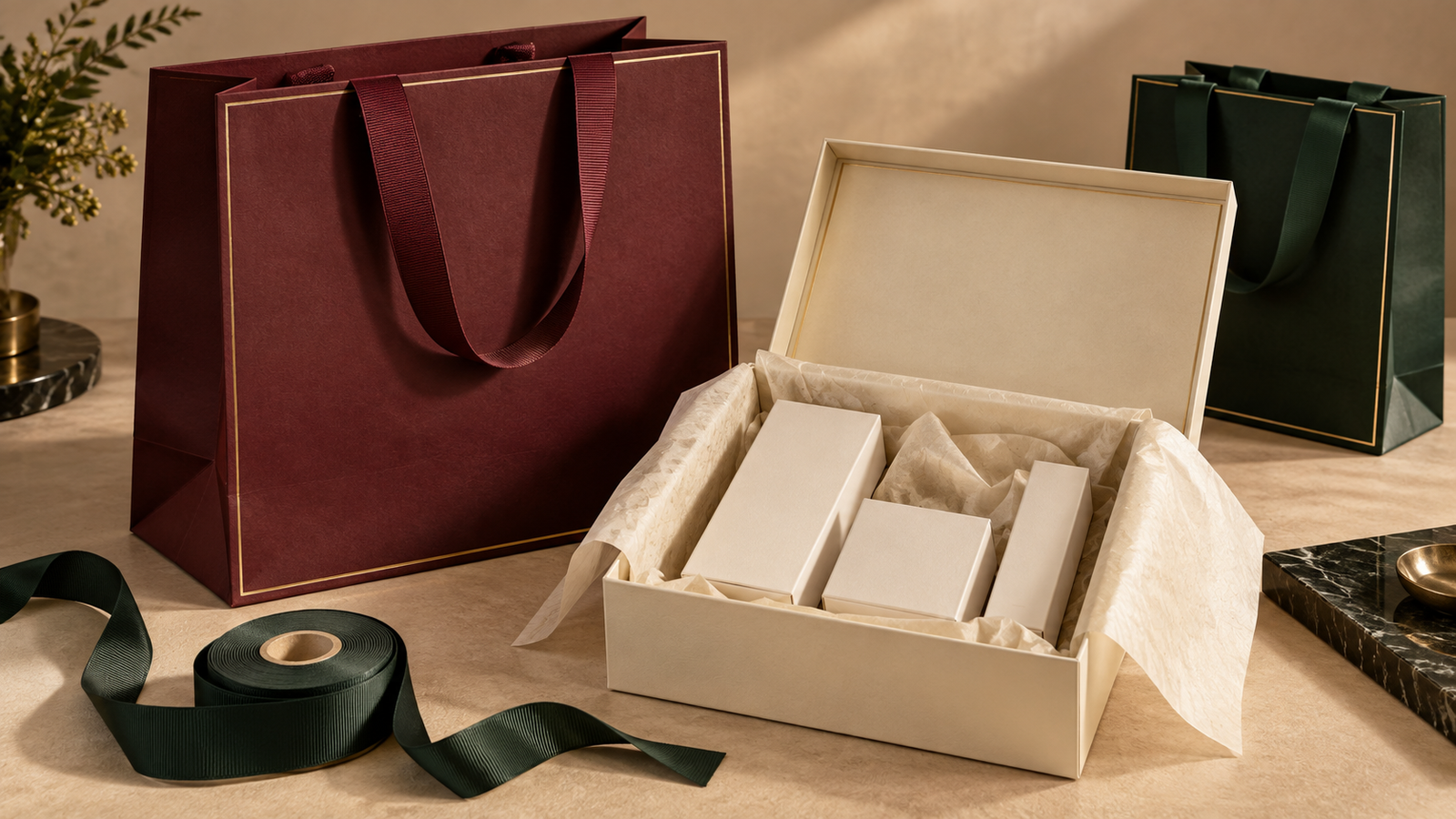
How do you make sourcing claims responsibly?
If responsibly sourced paper is part of the brief, state the exact claim and evidence you need. An FSC label on a finished bag is not created by choosing an FSC paper swatch alone: FSC says its chain-of-custody requirements track certified material through the supply chain and govern use of its label. Ask the supplier which components and production route can support the proposed claim, and approve label artwork before printing.
Likewise, avoid calling every decorated paper bag recyclable by default. Handles, coatings, adhesives and mixed materials can affect the appropriate route, and local collection differs by market. If recyclability is a brand requirement, review the complete proposed construction against the destination market’s collection guidance. The paper-industry 4evergreen Circularity by Design Guideline is a useful design reference for paper-based packaging, but it is not a substitute for checking the exact bag and local system.
What belongs in a quote-ready cosmetic paper bag brief?
A useful inquiry lets the supplier evaluate the whole retail system, not just quote a nominal bag size. Include these decisions, marking open points honestly:
- Finished product or gift-box dimensions, orientation and the heaviest packed combination.
- Each intended bag size, approximate quantity per size, reorder expectations and delivery destination.
- Reference images or artwork, brand colour targets and preferred paper or tactile direction.
- Handle material, colour, length and any reinforced top or base requirement.
- Logo print, foil, embossing, coating or other finish priorities.
- Related rigid boxes, tissue paper and ribbon to be developed or matched.
- Any specific sourcing claim, artwork approval process, sample needs and required in-store date.
If the size is undecided, send the actual packed products or detailed measurements and request a structural mock-up. If the brand colour is critical, request a printed sample on the proposed stock. For custom orders, our MOQ guide and lead-time guide help turn size and quantity choices into a workable buying plan.
What should you check before approving production?
Pack the physical sample exactly as store staff will: the real finished box or product carton, intended tissue, ribbon and insert. Carry it, set it down, lift the product out and photograph the result from the customer-facing angles. Check that the opening stays neat, the base stands square, the handles feel secure, artwork sits where expected and the full set reads consistently. Record the approved sample version and any accepted variation. The sample approval guide explains which proof or prototype can resolve each risk; the quality-control checklist then connects that reference to bulk inspection.
Frequently asked questions
Can one cosmetic paper bag size serve every product?
Sometimes one size works for a narrow product range. Test the smallest common purchase and the largest intended gift set before committing. If the small purchase looks lost or the large set needs force to fit, use two purposeful sizes instead.
Should a perfume bottle go directly into a paper bag?
A shopping bag should not replace suitable product packaging. Use a carton, fitted box or other appropriate protective pack for a fragile bottle, then size and test the bag around that finished pack.
Can the bag and gift box use the same colour specification?
They can share a target, but different papers and processes may produce different appearances. Approve physical samples side by side and define the acceptable visual match for each component.
Is a ribbon handle always the most luxurious option?
No single handle is right for every beauty order. Ribbon can connect well to gifting, but comfort, attachment strength, brand style and the complete bag’s packed weight should decide. Compare finished, loaded samples.
Build the bag around the beauty experience
The strongest cosmetic paper bag brief starts with what customers take home. Define the finished pack, choose a small set of appropriate sizes, build the bag’s structure around the real carrying load and approve the carrier beside its box, tissue and ribbon. Then the premium visual design and the practical retail handoff support each other.
Bespoke Packaging can develop custom luxury paper bags as part of a coordinated beauty packaging set with rigid gift boxes, tissue paper and ribbon. Share your products, packed dimensions, order mix, artwork direction, quantities and delivery market, and we can help turn the brief into sample and quotation options.
Does your current bag sample hold the complete beauty set the customer will actually carry?