
PAPER BAG PRICING GUIDE
Custom Paper Bag Cost: What Changes Your Quote?
Learn which specifications change a custom paper bag quote, how to compare suppliers like for like, and how to budget for the complete landed cost rather than one headline unit price.
Custom paper bag cost is determined by one complete specification: finished size, paper, construction, handles, printing, finishes, quantity, packing and delivery terms. There is no responsible universal price for a luxury paper shopping bag because changing any of those variables can change material use, setup, production time, handwork and freight.
The useful question is not “What does a paper bag cost?” but “What does this approved bag cost at these quantities, packed this way and delivered to this place?” This guide gives brand and procurement teams a practical method for obtaining comparable quotations without weakening the bag or hiding costs outside the unit price.
Why can custom paper bag quotes vary so much?
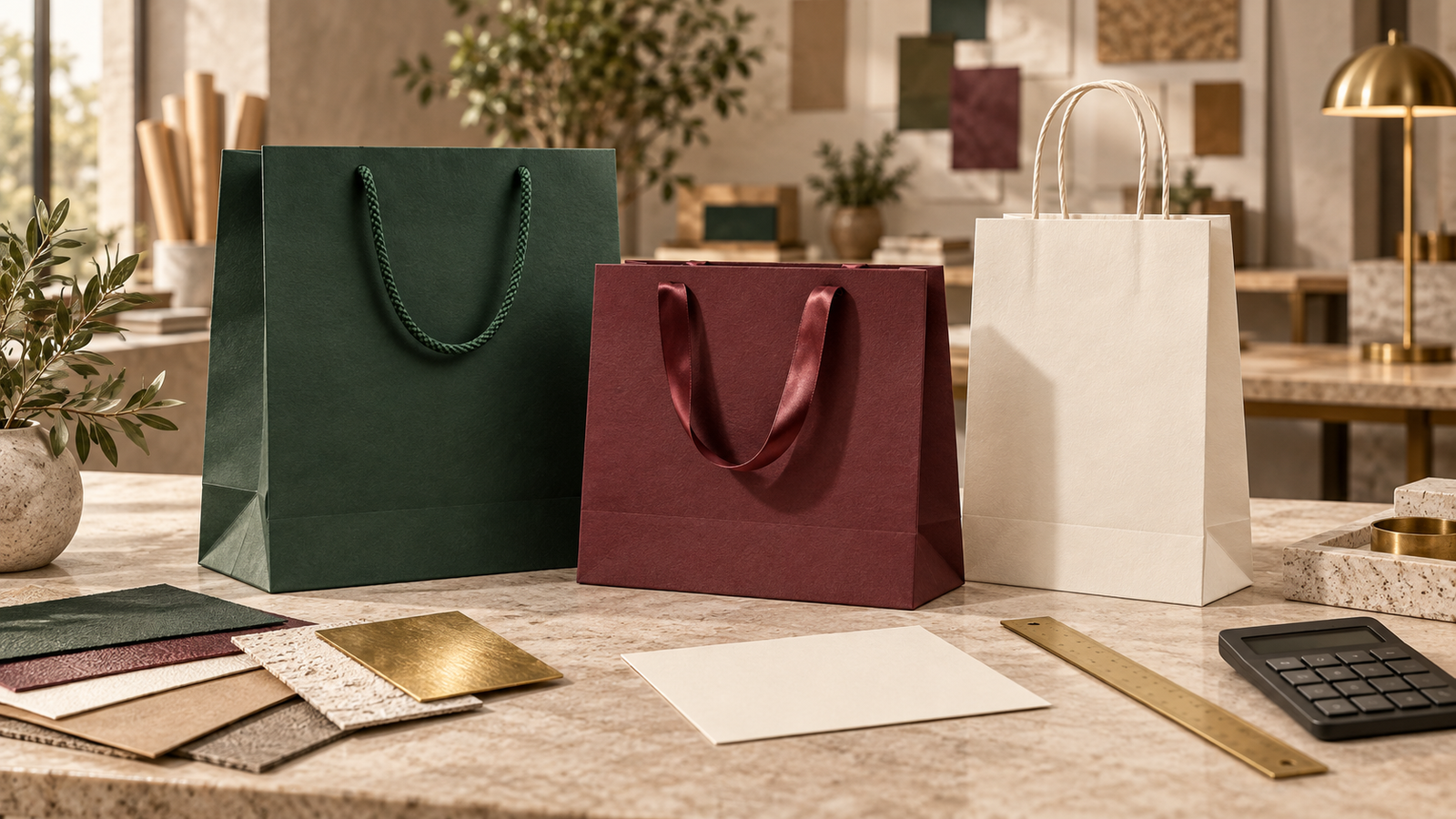
Two quotations can use the same finished dimensions and still describe different products. One may include a coated sheet, folded top, reinforcement boards, cotton rope handles, offset printing and matte lamination. Another may assume uncoated kraft, twisted paper handles, simpler printing and lighter packing. Unless every assumption is visible, the lower price may be a different bag rather than a better offer.
Independent market evidence supports that broader view. The U.S. International Trade Commission’s paper shopping bags industry report identifies paper as the major raw material and also lists handles, adhesives and printing among production inputs. In its purchaser evidence, price, availability and quality all appeared as important buying factors. That is a useful procurement reminder: a quotation must be judged with supply reliability and the approved quality level, not price alone.
Which factors change custom paper bag cost?
| Cost driver | What changes in production | What the buyer should specify |
|---|---|---|
| Finished size | Paper area, sheet yield, cutting format, folding and carton count | Width × gusset × height and the packed product |
| Paper | Material price, grammage, surface, stiffness, print response and sourcing | Paper family, shade, feel, performance and required claims |
| Construction | Turn-top, reinforcement, base board, seams, adhesives and conversion steps | Maximum packed weight and approved structural sample |
| Handles | Material, colour, length, attachment, reinforcement and handwork | Handle type, drop, colour and load expectation |
| Printing | Prepress, plates or screens, ink, coverage, passes and colour control | Artwork, colour references and print route assumptions |
| Finishes | Film, foil, dies, embossing, varnish, setup sheets and extra passes | Exact area, effect and approved finish reference |
| Quantity and SKUs | Setup allocation, material batches, changeovers and unit economics | Quantity for every size, design and colourway |
| Packing and freight | Carton volume, protection, pallets, transport and delivery responsibilities | Carton requirements, destination and named Incoterms rule |
How do size and paper affect the quote?
A larger bag normally uses more paper, but area is only the beginning. Proportions affect how a layout nests on a press sheet, how the bag is cut and folded, how many units fit in a carton and whether the supplier can use an established construction. The USITC report records industry evidence that custom sizes can require additional expense, which is why a small dimensional adjustment can sometimes change production efficiency without changing the customer experience.
Measure the real packed product before reducing or enlarging the bag. Use our luxury paper bag size guide to define width, gusset and height around product clearance, tissue and any rigid gift box. An oversized bag can add paper and freight volume; an undersized bag can slow packing, crush the contents or fail at the side and base folds.
Paper price is influenced by grade, availability, colour, texture, coating, recycled content, certification and ordered quantity. Grammage is useful but it is not a complete strength specification. ISO 536:2019, confirmed as current in 2025, defines the method for determining paper and board grammage. It does not tell a buyer which grammage will carry a particular product. Stiffness, tensile behaviour, folds, reinforcement, adhesives and bag geometry must be considered together. Compare physical samples and a converted prototype, not GSM in isolation.
How much do handles and construction matter?
A premium bag is a load-bearing system. The top turn-over, handle holes, reinforcement patches, side seam, gussets, bottom fold, base board and adhesive distribute force through the paper. Removing a structural component can lower a quote while increasing the risk of distortion or failure. The right comparison keeps the tested construction constant.
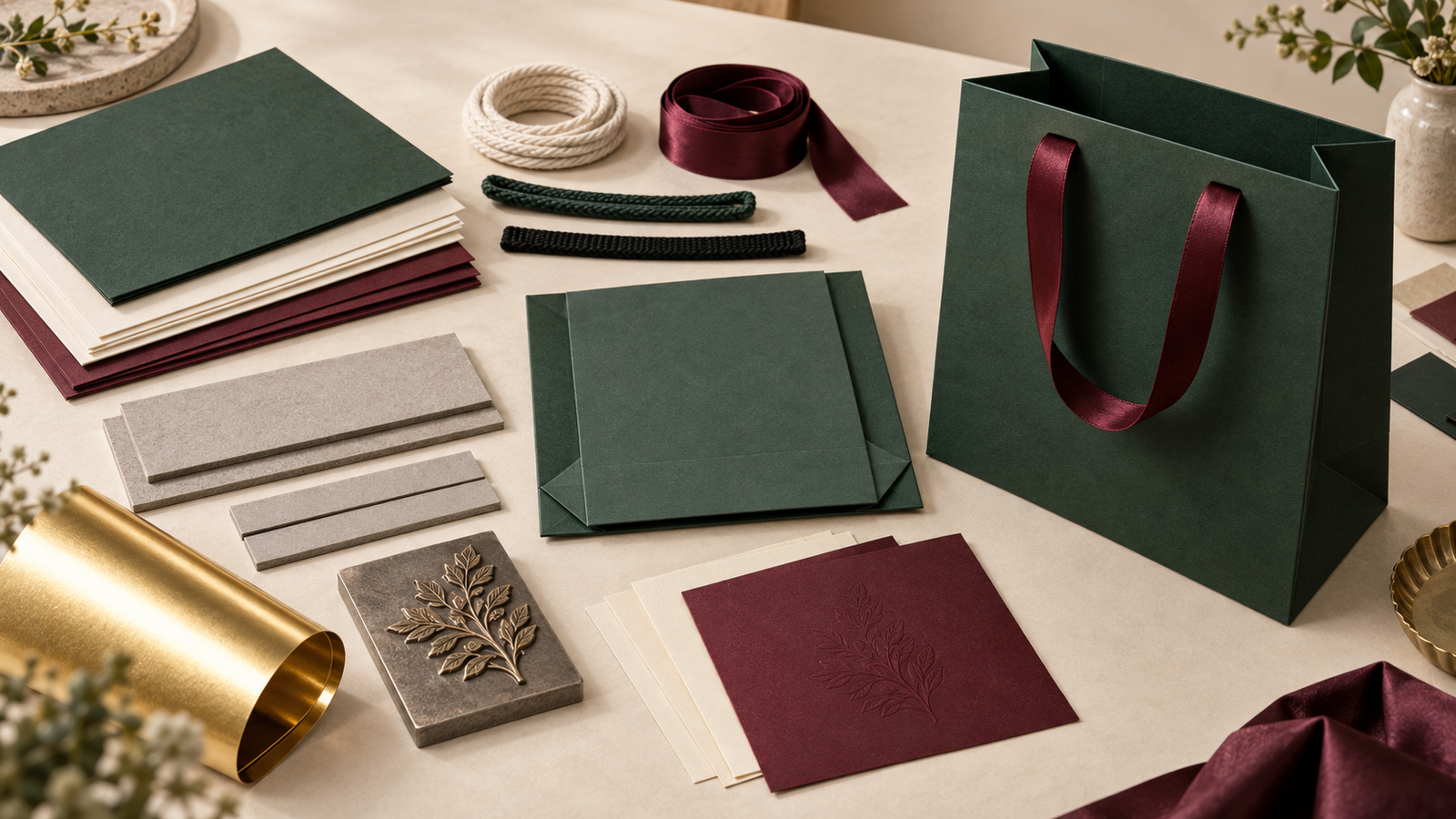
Handles can create both material and assembly costs. Twisted or flat paper handles, cotton rope and satin ribbon each use different components and attachment methods. Custom-dyed rope or ribbon may carry its own sourcing quantity; hand threading and knotting adds work to every bag. Choose the handle for comfort, load, appearance and recycling route, then record its material, diameter or width, drop length, colour, attachment and reinforcement. Our paper bag handle guide explains those trade-offs.
How do printing and finishes change paper bag price?
Printing cost depends on the chosen route, number of colours, ink coverage, colour changes, paper surface, proofing method and acceptable tolerance. Offset, flexographic, screen and digital production have different setup and run economics. A logo in one spot colour is not automatically equivalent to a full-coverage brand colour, interior print or photographic image. Ask the supplier to name the proposed route and colour system in the quotation.
Foil stamping, embossing, debossing, spot varnish, edge treatment and lamination each add a material, tool, setup or production pass. Effects may also interact: a foil and emboss combination needs registration; a soft-touch film changes the surface under print and finishing; a deep emboss must suit the paper and converted bag. Use the printing guide, finishes guide and artwork checklist to define the effect before asking factories to price it.
One well-controlled premium detail can be more effective than stacking processes. If the budget is under pressure, preserve the paper, colour, structure and handle experience that customers touch first, then test whether a smaller foil area or a blind emboss creates the intended focus with fewer operations.
Why do quantity and SKU count change unit cost?
Custom production includes work that happens before the first acceptable bag is packed: preflight, material allocation, colour preparation, tooling, machine setup, first-piece checks and finishing setup. A longer run spreads that work across more saleable units, but price does not fall in one smooth line. Material purchase levels, printing routes, carton quantities and production batches can create distinct breaks.
Request the same specification at several realistic quantities. Then confirm whether the route, paper, tolerances or packing change at each level. A lower unit price is not a saving if the extra bags become obsolete, consume unsuitable storage space or commit cash needed elsewhere. The luxury paper bag MOQ guide shows how to compare quantity ladders, inventory risk and minimums per SKU.
SKU count matters because every change in size, artwork, language, colour, handle or finish can create another setup. Ask explicitly whether the quoted minimum and unit price apply per design, per size, per colourway or across the total order. Consolidating demand into a small, proven size family can improve economics more safely than making each bag thinner.
What costs sit outside the factory unit price?
- structural mock-ups, printed samples, colour proofs and finish trials;
- printing plates, screens, cutting forms, foil dies or embossing tools;
- inspection, testing, replacement allowance and approved master samples;
- inner packs, export cartons, moisture protection and pallets;
- collection, freight, insurance, customs clearance, duties and taxes;
- warehouse receiving, storage, handling and stock finance;
- damage, colour drift, surplus stock, design changes and emergency reorders;
- coordination costs when bags, gift boxes, ribbon and tissue come from different suppliers.
Samples are not wasted cost when they answer the right question. A structural mock-up can expose a fit problem before decorated production; a finish trial can prevent a large batch with weak contrast; a fully converted pre-production sample can confirm how paper, print, reinforcement and handles work together. See the sample approval guide for a staged approach.
How should freight and Incoterms affect the comparison?
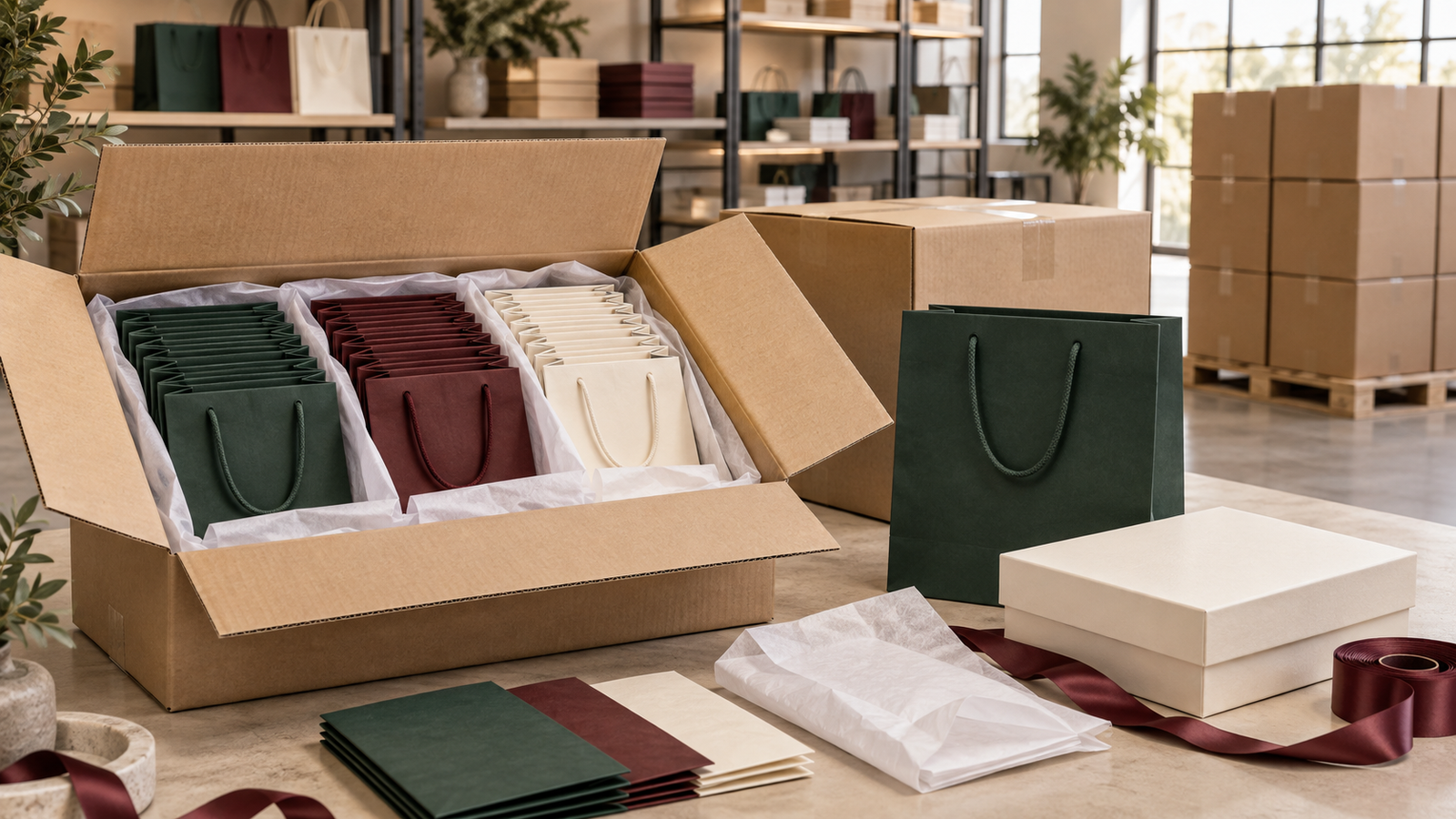
Paper bags often weigh less than the space occupied by their export cartons. Carton dimensions, units per carton, handle protection and pallet pattern can therefore affect transport cost as much as the net bag weight. DHL’s guidance on weight and dimensions explains that its express chargeable weight is the greater of actual and volumetric weight. Freight rules vary by carrier and mode, so ask for the completed carton list and a current transport quotation for the real shipment.
Also compare the same delivery basis. ICC’s Incoterms® 2020 guidance describes the rules as allocating cost, risk and obligations between seller and buyer. An ex-works factory price, a port-delivered offer and a delivered-duty arrangement are not directly comparable. Write the named rule, named place and version into the commercial comparison, then identify freight, insurance, clearance, duties and final delivery that remain outside the seller’s figure.
How do you compare paper bag quotations like for like?
- Freeze one RFQ specification. Give every supplier the same dimensions, product load, paper direction, handle, artwork, finishes, quantity by SKU, packing and destination.
- Request an assumption sheet. Ask the supplier to restate material, construction, printing route, finishing, tolerance, packing count and delivery term.
- Separate recurring and one-time charges. Tooling, proofing and samples should not be hidden inside an unexplained unit rate.
- Compare realistic quantity breaks. Confirm whether any technical assumption changes as volume changes.
- Check what is excluded. Record taxes, freight, duties, inspection, storage and local delivery that are still payable.
- Approve evidence. Review paper and handle swatches, structural samples, colour references and finish trials before releasing bulk production.
- Calculate landed usable cost. Divide the complete expected spend by acceptable bags available for use, not simply by the ordered quantity.
- Evaluate reliability. Include lead time, capacity, communication, quality controls and the corrective-action process in the sourcing decision.
Certification claims also need definition. FSC chain-of-custody guidance says FSC-certified material is identified and tracked during manufacturing and distribution, with related production, purchase and sales records retained. If an FSC claim or label is required, state it in the RFQ and verify that the proposed supply chain can support the claim before treating two paper options as equivalent.
Where can you reduce cost without making the bag feel cheap?
- Fit the bag to the product. Remove unnecessary volume while preserving fast packing and a considered reveal.
- Use fewer proven sizes. Consolidate compatible products into a disciplined family rather than fragmenting demand.
- Choose available premium materials. A stock paper or handle colour may deliver the right feel without a custom mill or dye batch.
- Prioritise one finish. Give the logo or texture a clear role instead of adding several competing processes.
- Reduce hidden print coverage. Decide whether full interior printing materially improves the customer experience.
- Coordinate the complete set. Let a strong bag lead while the rigid gift box, tissue and ribbon support it with simpler treatments.
- Improve artwork readiness. Correct dielines, colour separations and finish layers reduce avoidable prepress rounds.
- Plan orders earlier. A realistic paper bag lead time protects sampling and freight choices from emergency premiums.
Do not save by guessing at paper strength, deleting reinforcement or skipping the sample that proves the complete bag. A failure at the handle or base damages the product and brand experience while creating replacement, waste and rush-shipping costs. Use the construction guide and quality-control checklist to keep performance visible.
What belongs in a quote-ready paper bag brief?
- finished width, gusset and height;
- product dimensions, packing method and maximum packed weight;
- quantity required for every size, design, colourway and delivery batch;
- paper family, surface, colour, grammage direction and required certification;
- turn-top, reinforcement, base board and other construction details;
- handle material, colour, dimensions, drop, attachment and reinforcement;
- print artwork, colour references, coverage and proposed printing route;
- foil, embossing, varnish, lamination or other finish, with exact artwork areas;
- sample stages, approval references, testing and inspection requirements;
- units per inner pack and carton, carton protection and pallet needs;
- delivery deadline, destination and named Incoterms rule;
- matching box, ribbon and tissue specifications where they form one packaging set.
Frequently asked questions about custom paper bag cost
How much does a custom paper bag cost?
There is no universal price. Cost depends on the exact size, paper, structure, handle, printing, finish, quantity, packing, delivery term and destination. A useful supplier quote states those assumptions and separates one-time charges from recurring unit cost.
Why is a luxury paper bag more expensive than a standard bag?
A luxury bag may use premium paper, a folded top, reinforcement boards, rope or ribbon handles, controlled colour, specialist finishing and more hand assembly. These choices should create a better visual, tactile or carrying result; they are not valuable simply because they add processes.
Does a higher GSM always mean a higher price and better bag?
Heavier paper can increase material use and cost, but GSM alone does not establish stiffness, strength or finished-bag performance. Compare the exact paper and test the converted bag with the real product and complete handle-reinforcement system.
What is the best way to compare two paper bag quotes?
Send one controlled RFQ, have each supplier restate every technical and commercial assumption, separate tooling and samples, align delivery terms, and calculate the complete landed cost. If the specifications differ, resolve them before comparing price.
Can a supplier reduce cost without changing the design?
Sometimes. Better sheet yield, an available paper, a different production route, consolidated SKUs, simpler packing or a more suitable quantity can improve economics. Ask the supplier to identify every proposed change and approve a new sample when the change can affect appearance or performance.
Build the quote around the bag your customer will carry
A useful custom paper bag quote is transparent enough to explain why the price changes. Define the real product load, freeze the specification, compare quantity breaks on the same basis and add packing, freight and buyer-side costs. Then reduce complexity where it does not serve the product, rather than weakening the parts that create strength and premium feel.
Bespoke Packaging develops custom luxury paper bags together with rigid gift boxes, ribbon and tissue paper. Send us your product dimensions, bag size, quantity by SKU, artwork, destination and target experience, and we can help turn them into a clear, comparable quotation.
Are the quotations on your desk pricing the same bag—or only the same dimensions?