
FASHION RETAIL PACKAGING GUIDE
Custom Boutique Paper Bags: A Buyer’s Guide for Fashion Retail
A practical buyer’s guide to sizing, specifying and approving premium paper shopping bags for clothing stores and fashion boutiques.
Custom boutique paper bags are branded shopping bags planned around a fashion retailer’s actual products, store workflow and presentation standard. The best bag is not simply the thickest or most decorated option. It fits the folded garment or boxed accessory, carries the load securely, opens quickly at the counter and makes the complete purchase feel considered.
For a fashion brand, the paper bag is also the most public part of the pack. It moves from till to street, often holds several product types and may need to work across permanent collections, seasonal launches, gifts and returns. A useful buying brief therefore starts with the merchandise and store operation before choosing paper, handles or finishes.
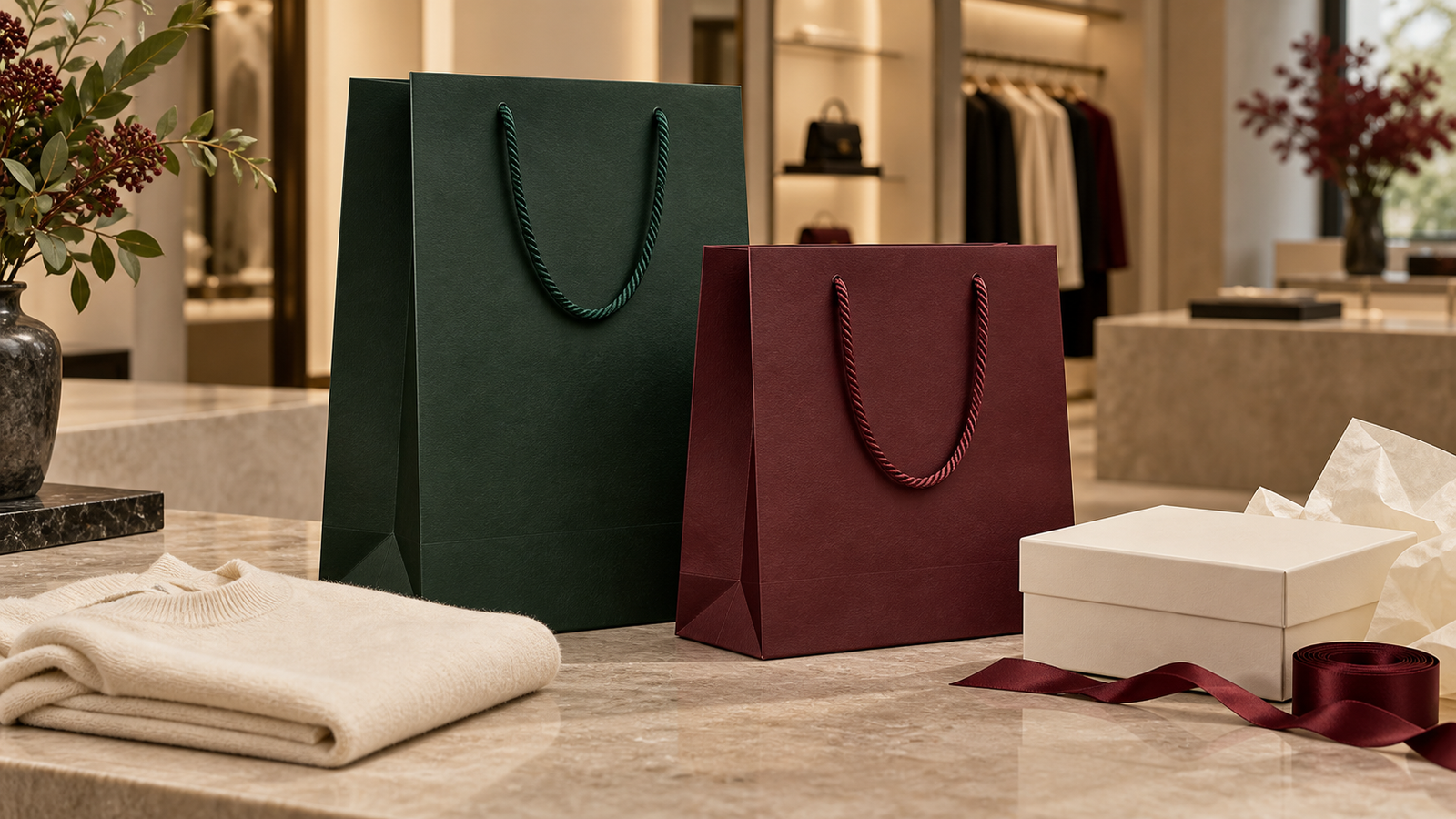
What should a fashion boutique decide first?
Begin with a short list of real packing scenarios. Record what a customer is likely to buy together, how each item is folded or boxed, the heaviest expected combination and whether staff add tissue, ribbon, cards or hangers. Include exceptional purchases such as a coat, multiple knitwear pieces or a gift-boxed accessory instead of sizing only for the easiest sale.
Then decide where the bag will be used. A compact accessory bag for a jewellery counter, a medium carrier for one folded garment and a larger fashion shopping bag for outerwear solve different problems. A store with a small stockroom may prefer a disciplined size family, while a flagship with distinct departments may need more formats. The aim is the fewest sizes that cover the real product mix without making most orders look lost or overpacked.
How many boutique paper bag sizes do you need?
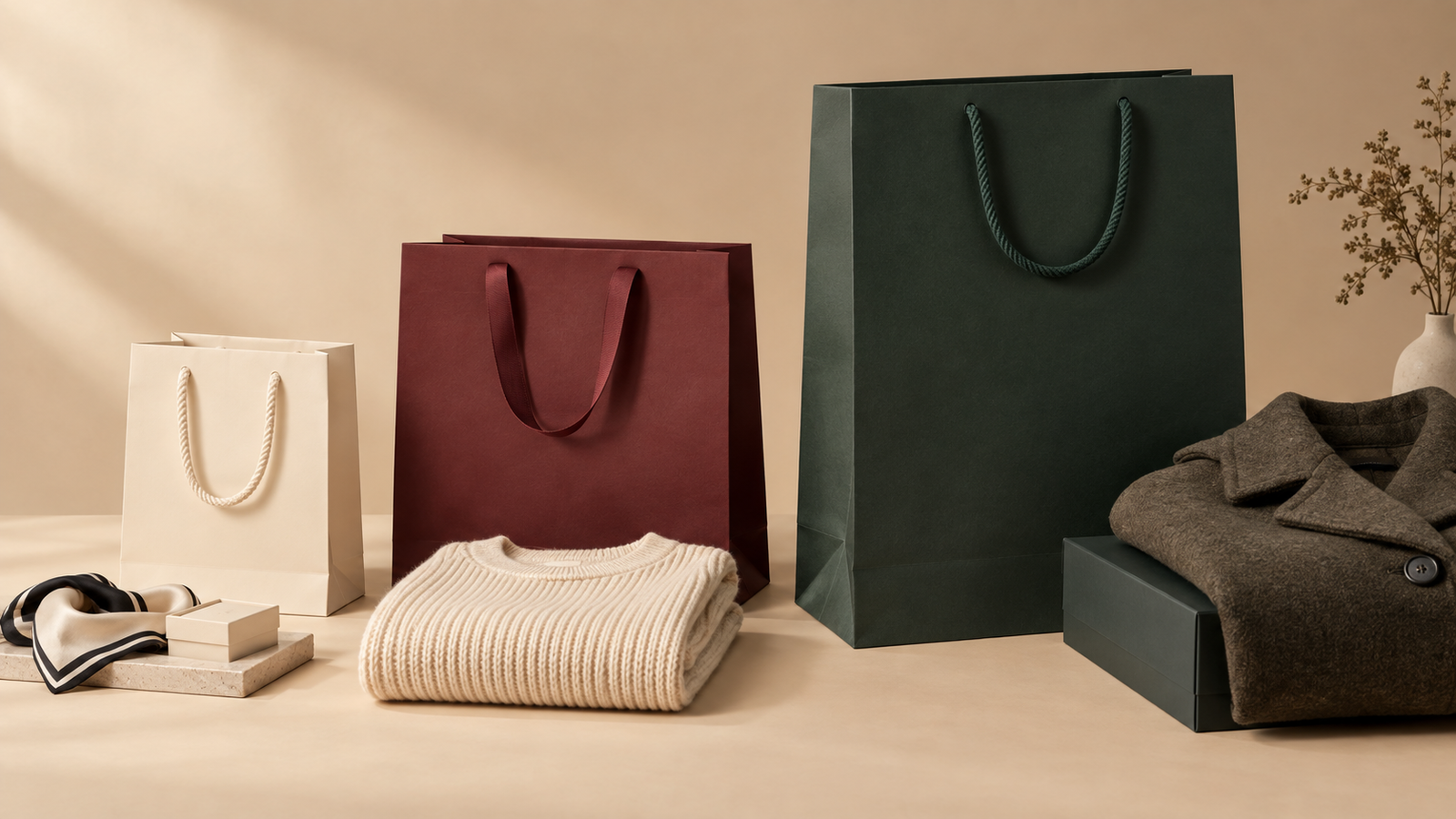
Many fashion retailers can start by testing three roles rather than ordering a separate bag for every product. These are roles, not universal dimensions: the finished measurements must come from your packed merchandise. Our luxury paper bag size guide explains width, gusset and height in detail.
Small: accessories and compact gifts
Use a small format for scarves, belts, wallets, small boxes or other accessories. Measure the finished box or wrapped item, not the bare product. Check that staff can lower it into the bag without forcing the opening and that handles do not crush tissue or a presentation box.
Medium: the everyday garment purchase
This is often the working format for a folded shirt, knitwear, dress or several light items. Test the store’s preferred fold and any tissue wrap. A bag that is too narrow makes packing slow; one that is too deep hides the product and uses unnecessary material. Check both the packed appearance and the way it stands on the counter.
Large: outerwear and multi-item purchases
A large format may be needed for coats, jackets, structured garments or a combined purchase. Do not enlarge the face alone: the gusset, base, top opening, handle drop and reinforcement must work together. Pack the heaviest realistic order, carry it for a meaningful period and check that the base stays level and the sides do not distort.
Which construction works for fashion retail?
Specify the bag as one load-bearing system. Paper panels, side and bottom folds, the top turn-over, handle holes, reinforcement boards, adhesive and base board all contribute. A heavyweight paper alone does not guarantee a strong bag, and a light garment can still create awkward leverage if it shifts inside a wide carrier. Our paper bag construction guide maps the complete load path.
Ask the supplier to recommend paper and reinforcement after seeing the packed weight and dimensions. Compare coated, uncoated, specialty and recycled papers as physical samples, because surface, stiffness, print response and fold behaviour all matter. The materials guide provides a fuller comparison.
Rope, ribbon or paper handles?
Soft rope handles can be comfortable for a heavier boxed or multi-garment purchase. Ribbon handles create a strong connection to gift wrapping and are suited to a deliberate luxury presentation. Paper handles support a more paper-led material story and can work well for suitable loads and constructions. Select the handle together with its attachment method and test the drop length with the actual bag; our handle guide compares the main options.
How should colour, print and finishes be specified?
Fashion packaging often depends on a restrained palette, precise typography and tactile contrast. Decide whether colour comes from the paper itself, process printing, a spot colour, foil or a combination. Screen appearance is not an approval reference. Pantone explains that coated and uncoated references are printed on different paper surfaces; a named colour can therefore look different when the paper, ink film or finish changes.
Choose decoration after the paper and artwork are defined. A small foil mark, blind emboss or selective gloss can give a focal point, but every process adds its own artwork, setup and approval need. Review a project-specific sample on the proposed stock instead of relying on an unrelated supplier swatch. Our printing guide, finishes guide and artwork checklist show how these decisions connect.
How do bags, boxes, ribbon and tissue become one system?
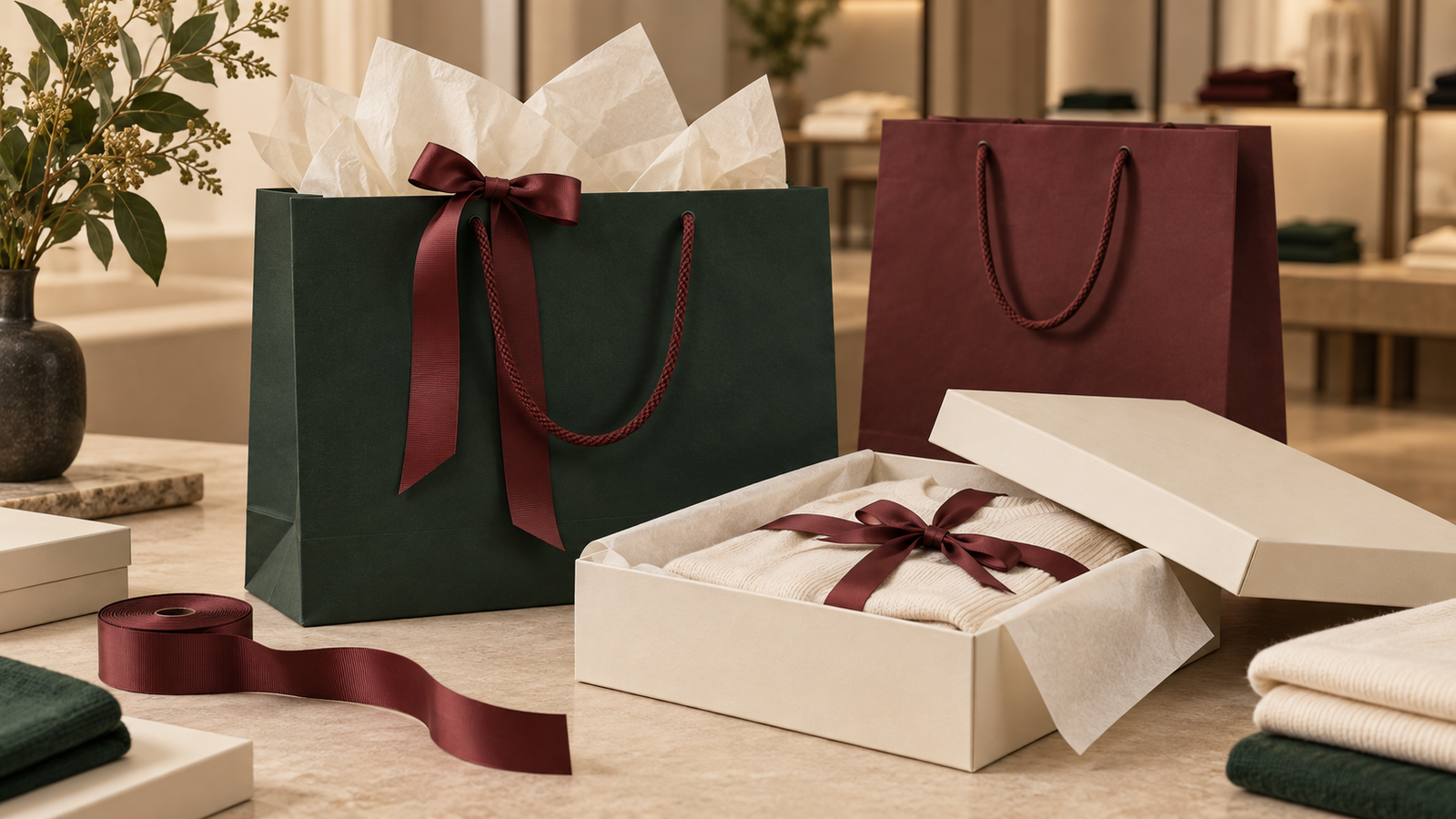
A coherent retail pack does not require every component to repeat the same treatment. Choose one lead expression and support it. A forest-green paper bag may carry a restrained mark while an ivory rigid gift box provides the reveal; tissue can soften the opening, and a burgundy ribbon can repeat a collection colour at a smaller scale.
Approve the components together under the same light. Paper shade, coating, box wrap, printed tissue and dyed ribbon absorb and reflect colour differently. Define which component is the master reference and whether the others must match exactly or sit in an intentional tonal relationship. Photograph the approved set so store teams and inspectors can see the intended packing sequence.
What store operations should the bag support?
- Fast opening: staff should be able to separate and open a flat-packed bag without damaging the top or handles.
- Predictable selection: a simple size name or stock code helps staff choose the right format at a busy till.
- Neat packing: the opening and gusset should accept the approved garment fold, box and tissue sequence.
- Efficient storage: confirm how many flat bags fit in a carton and how cartons will be stored away from moisture, dirt and crushing.
- Reliable replenishment: record usage by size, seasonal peaks, lead time and reorder point instead of ordering all formats in equal quantities.
- Consistent handoff: show staff where tissue, ribbon, receipt and care card belong so the finished pack matches the approved presentation.
Size and SKU discipline also affect order quantity. Combining similar product groups into one proven bag can simplify stock and support better production economics, but consolidation should never compromise fit or load performance. Use the MOQ guide and lead-time guide to plan each format around realistic consumption.
What should a sustainability brief include?
Start with evidence, not a visual assumption. Ask for the paper specification, recycled or certified content claim where relevant, coating or lamination, handle material, reinforcement, adhesives, inks and decorative processes. FSC explains that chain-of-custody certification tracks certified forest-based material through production and distribution; an FSC label or promotional claim must follow the applicable certification and trademark rules.
Review the complete bag rather than judging the main sheet alone. The 4evergreen Circularity by Design Guideline provides industry guidance for paper-based packaging designers across materials, components and recycling routes. Ask your supplier how the selected handles, films, coatings and finishes affect the target collection and recycling system.
Legal requirements depend on the market and the business placing the packaging there. For EU sales, the European Commission states that Regulation (EU) 2025/40 began applying from 12 August 2026 on a phased basis. Confirm current obligations, labelling, producer-responsibility and evidence requirements for each destination rather than asking a factory to make a universal compliance promise.
Which samples should a boutique approve?
Use the least expensive sample that can answer the current question, then move toward a complete pre-production bag when multiple variables interact. A plain structural prototype can prove product fit and handle drop. A printed or finish sample can establish colour and decoration. A fully converted sample can prove the final combination of paper, reinforcement, handles, printing, finish and packing presentation.
Pack the final sample exactly as store staff will, then carry, set down, open and repack it. Review the front, back, side gussets, top, base and inside folds. Keep the approved sample, signed specification, colour reference and artwork version together. The sample approval guide explains what each proof can establish, while the quality-control checklist connects that reference to bulk inspection.
What belongs in a quote-ready fashion bag brief?
- Photographs and finished dimensions of representative folded garments, boxes and accessories.
- Expected purchase combinations, maximum packed weight and intended tissue or ribbon presentation.
- Required bag roles and estimated quantity for each size, including seasonal demand and reorder plan.
- Preferred paper appearance, surface, colour, structure, reinforcement and handle direction.
- Artwork files, print colours, foil or relief layers and the physical approval reference.
- Sustainability claims, documentation and market-specific compliance information needed by the brand.
- Sample stages, approval owners, inspection expectations and approved master requirements.
- Flat-packing, carton marking, shipping destination and required in-hand date.
Frequently asked questions
What is the best paper bag size for a clothing boutique?
There is no universal best size. Measure the shop’s approved garment fold, common multi-item order, tissue and any product box. Test a small family of formats against those real packs and select the fewest sizes that give secure carrying and a balanced presentation.
Are luxury paper bags only for high-value purchases?
No. A premium bag can be the standard carrier when its specification, quantity and store use are planned economically. Some brands reserve a more elaborate ribbon-handle or gift format for selected purchases while using a coordinated everyday bag for routine sales.
Should every fashion collection have a new bag design?
Not necessarily. An evergreen bag can protect brand consistency, simplify inventory and reduce obsolete stock. Seasonal change can appear through tissue, ribbon, a card or a controlled artwork version when the underlying bag size and construction remain suitable.
Can the same bag carry clothing and a gift box?
Yes, if the usable dimensions, base, reinforcement and handles are tested with both packing scenarios. A box concentrates load differently from a soft folded garment, so approve the complete bag with the heaviest and most awkward intended pack.
Build the bag around the retail experience
A successful boutique paper bag connects the product, the counter routine and the brand. Start with real merchandise, establish a disciplined size family, engineer the complete structure, approve colour and finishes on the chosen paper, and document how the bag works with boxes, tissue and ribbon.
Bespoke Packaging develops custom luxury paper bags for fashion boutiques together with rigid gift boxes, ribbon and tissue paper. Share your product mix, packed dimensions, quantity, artwork direction, delivery market and launch date, and we can help turn them into a sample and quotation plan.
Would your current paper bag still feel right for the busiest real purchase at your till?